
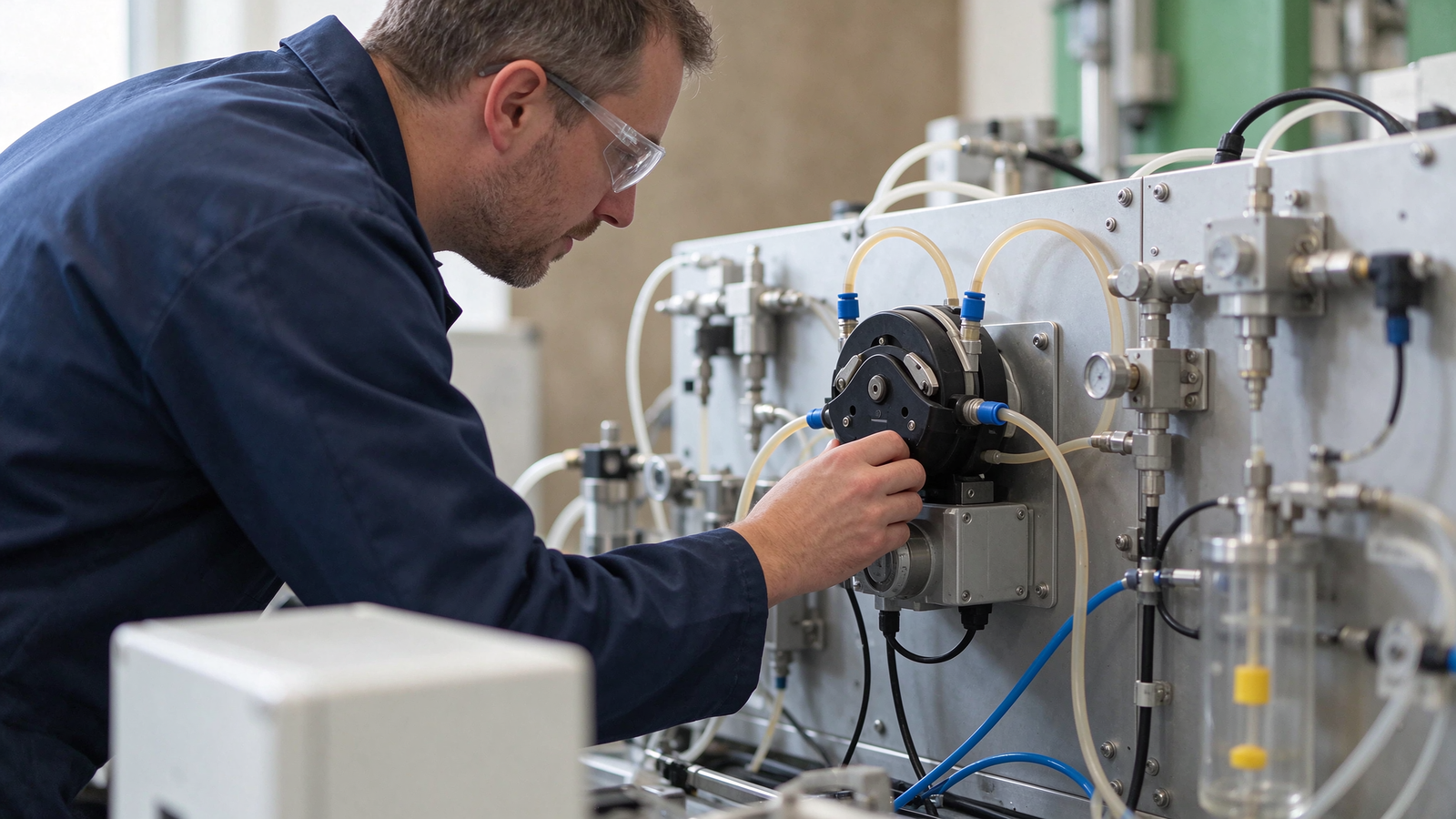
A peristaltic pump that starts making a new noise, vibrating on its mount, humming but not turning, or stalling under load usually tells you where the problem lives before any measurement does. The hard part is separating a normal occlusion rhythm from a fault: every peristaltic pumps in cycles as rollers compress the tube, so a low regular rhythm is expected, while a sudden clatter, a rattling bearing, a wobbling body, or a drive that trips off is not. This guide walks through the mechanical, tube, head, drive, and installation sources of noise and vibration on a peristaltic, how to locate the root cause without pulling the pump apart first, and what to repair or replace when the fault is found.
What a Healthy Peristaltic Sounds and Feels Like
Before troubleshooting, it helps to know the baseline. In normal operation the rollers pass over the tube in a steady repetition, producing a regular compression-and-release sound that matches the drive speed. The housing and motor carry a gentle vibration proportional to that rhythm, and the mounting feet stay seated on the panel. Delivered flow follows the same steady pattern. A reference recording or a note taken when the pump was new makes later diagnosis faster: compare the current noise against that baseline rather than against a vague idea of what any pump “should” sound like.
Deviations worth investigating include a noise that rises in pitch or volume over a run, a rattling that tracks a loose part, vibration that shakes fittings or loosens screws, a rubbing or scraping sound in the head, a motor that buzzes without turning, a speed that wanders under load, or a unit that trips off and will not restart until it cools or is reset.
Where Noise and Vibration Come From
Peristaltic faults divide into five groups, and the symptom usually points to one group first. The tube itself changes character as it wears; the head carries rollers and bearings that can loosen or wear; the driver and motor produce electrical or rotational faults; the mounting and plumbing transmit or amplify vibration; and the fluid side can load the head beyond what the drive carries.
| Fault group | Typical signs | First place to inspect |
|---|---|---|
| Tube condition | Groaning or stiff compression, pulsing that worsens with run time, visible cracks or flattening | Tube interior and outer wall for wear, hardness, kinking |
| Head and rollers | Clatter, click on each roller pass, side-to-side play in the rotor | Roller contact, rotor play, fasteners, wear plates |
| Driver and motor | Buzz without rotation, stall under load, tripped supply, speed drift | Supply voltage, wiring, motor current, drive fault indicator |
| Mounting and plumbing | Vibration travels to panel, loose feet, rattling pipes or fittings | Mounting bolts, isolation, line restraint, pipe strain |
| Fluid loading | Head strains as back-pressure or viscosity rises, slow flow loss | Discharge restriction, line blockage, fluid temperature and viscosity |
Tube-Related Noise and Wear
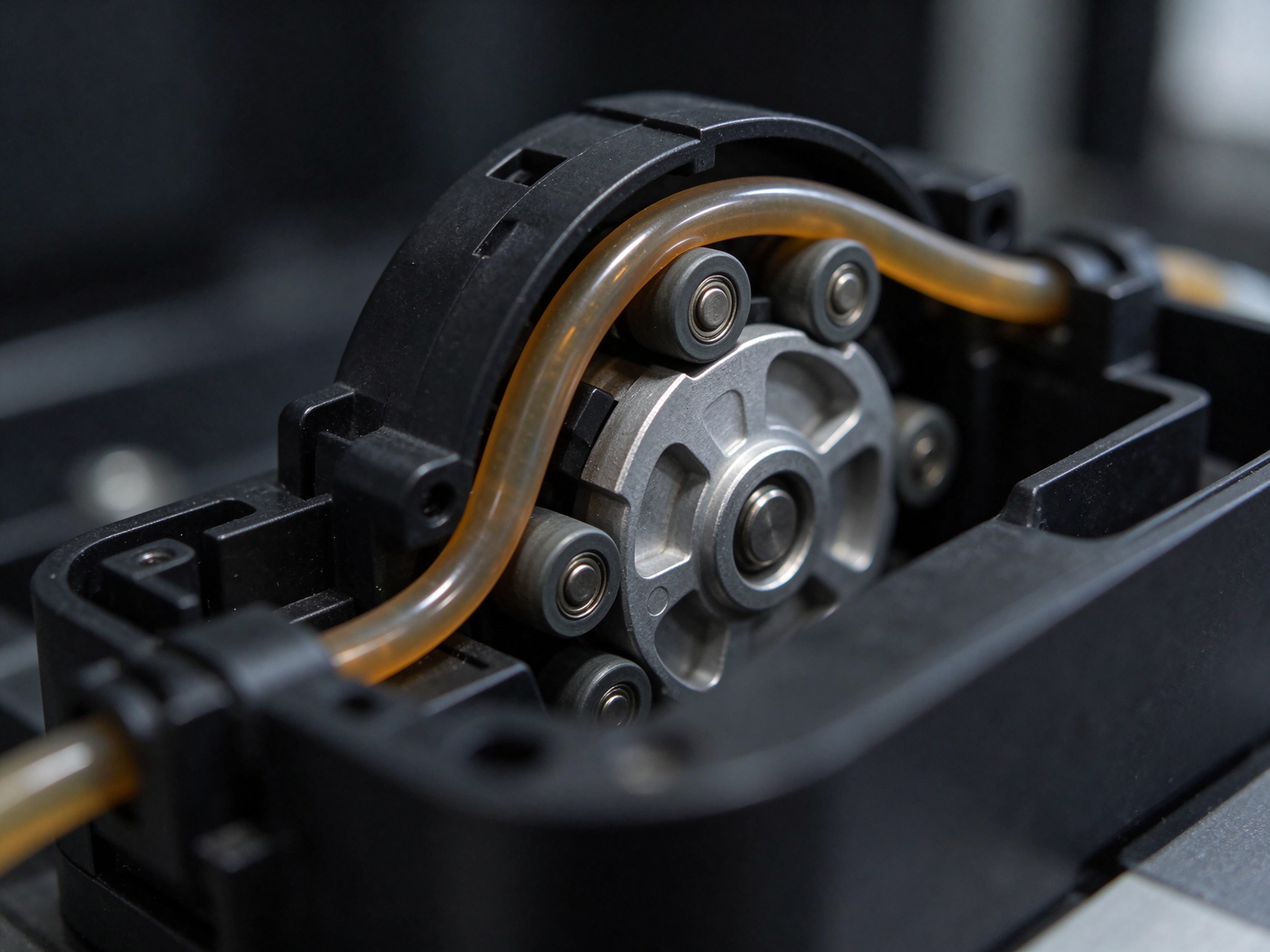
The tube is the part that moves most in a peristaltic, so it is often the first source of an audible change. A tube that has become hard or swollen from chemical attack compresses less smoothly, which raises the force the roller has to apply and produces a stiffer, louder pass. A tube worn thin along the occlusion track may flatten, rub unevenly, or develop fine cracks that show as a repeating scraped sound. A tube kinked, twisted, or pinched off-center in the head adds an irregular rhythm. Over-tight occlusion can also make the pump run loudly and load the drive, while a tube that is too loose slips and pulses.
Inspect the tube with the pump stopped and isolated from the supply. Look along the full contact track for whitening, cracks, pinching, or a flattened band; feel whether the wall has gone soft or brittle; and check that the tube seats centrally between the rollers and the housing. Compare the current tube against a known-good spare if the material and bore are recorded. The peristaltic pump tube wear track is the clearest record of how hard the head has been working.
Head, Rollers, and Bearing Wear
If the noise is mechanical rather than a stiff tube, the head rotor and its bearings are the next group. A worn roller surface or a roller with play in its axle does not contact the tube evenly, so each pass clicks or rattles instead of rolling smoothly. A loose rotor lets the shaft move sideways, which shows up as play when you turn the head by hand. Wearing bearings add a high-frequency rumble that follows the rotation, and a loose wear plate or head fastener lets parts chatter under the compression load.
With power locked out, turn the rotor by hand and listen and feel for roughness, sticking, or side play. Check that head bolts and any roller fasteners are seated to the correct tightness, and look for scoring or flat spots on roller surfaces. Where a bearing is the suspect, there is usually no adjustment that restores it; the head or bearing assembly has to be replaced. Regular visual checks of roller condition keep a head fault from reaching the tube and forcing an unplanned tube change.
Driver and Motor Faults
Drive faults sound and behave differently from head noise. A motor that buzzes or hums but does not turn may not be receiving enough supply, may have a wiring or connection problem, or may be stalled against a load the drive cannot overcome. A drive that cuts out after running for a while often points to an overcurrent or thermal condition, while speed that wanders under load can reflect slip in the transmission or an overloaded motor. Erratic triggering, missed pulses, or a channel that starts and stops can trace to the control signal or its connection rather than the pump itself.
Check the supply matches the driver rating, verify wiring and connectors are tight and dry, and read any fault indicator on the drive or controller before opening the head. Confirm the line is not blocked or overloaded, because a stalled discharge can make a healthy motor stop under load. The peristaltic pump driver should be matched to the head load and duty cycle; a drive undersized for the number of channels or the tube wall thickness will strain and trip even when the head and tube are sound. The motor-driver operating manual lists the supply, control, and duty limits to check against.
Mounting, Plumbing, and Resonance
Not every vibration starts at the pump. A unit bolted to a thin panel can turn a normal rhythm into a rattling sheet-metal resonance, and pipe strain held against the pump port transmits force back into the head. Flexible lines that are too rigidly tied off, loose fittings, or a reservoir mounted on the same panel can amplify and redistribute vibration. The result is a pump that looks noisy when the real issue is isolation and restraint around it.
Check mounting feet and bolts, confirm the panel is rigid enough, and look at whether any line or fitting bears on the pump port rather than on its own supports. Where vibration reaches adjacent instruments, consider isolating the pump from the panel and keeping flexible discharge and suction lines free of hard bends. Record the drive speed when the resonance appears; some structures amplify only at certain speeds, which points to a mounting or panel issue rather than a worn part.
A Root-Cause Diagnostic Sequence
Work from the outside in so you do not disassemble a healthy head. Stop and isolate the pump, note the exact symptom and when it appears, then check the easiest external items first before opening the head.
| Step | Action | What it confirms |
|---|---|---|
| 1. Baseline | Compare current noise and vibration against the new-pump recording or note | Whether the condition is new or within normal range |
| 2. Fluid side | Check discharge for blockage, restriction, rising viscosity or temperature | Whether head load is forcing the fault |
| 3. Supply and signal | Verify voltage, wiring, connectors, control signal and drive indicator | Whether it is an electrical or control fault |
| 4. Tube | Stop and inspect the full tube track, seating and condition | Tube wear, attack, kink or occlusion setting |
| 5. Head by hand | Lock out power, turn rotor, check play, rollers, bearings and fasteners | Mechanical wear or looseness in the head |
| 6. Mounting | Check feet, panel rigidity, pipe strain and line restraint | Resonance or transmitted vibration |
| 7. Run test | Re-run briefly after each correction and watch flow, sound and current | Which fix cleared the symptom |
Symptom-to-Cause Reference
| Observed symptom | Likely root cause | Action |
|---|---|---|
| Steady clatter on each roller pass | Loose rotor, worn roller, or loose head fastener | Check play and fasteners; inspect rollers; replace worn parts |
| High-frequency rumble rising with speed | Worn bearing in rotor or motor | Replace bearing or head assembly; do not run to failure |
| Stiff groan that worsens after warm-up | Hardened or swollen tube, over-tight occlusion | Inspect tube compatibility and seating; reset occlusion |
| Buzz, no rotation | Low supply, loose connection, or stalled against load | Check supply and wiring; clear discharge restriction |
| Trips after a run, restarts after cooling | Overcurrent or thermal overload from load or undersized drive | Reduce head load; confirm drive matches duty and tube |
| Speed wanders or flow pulses under load | Transmission slip, tube slip, or overloaded motor | Check tube seating and drive margin; recalibrate after service |
| Panel rattles, pump body feels normal | Panel resonance or line strain | Isolate mount, support lines, remove pipe strain |
| New vibration after a tube change | Tube off-center, wrong bore, or loose head reassembly | Re-seat tube to center; verify bore; retighten head |
Prevention and Maintenance
Most mechanical and drive faults are predictable if the pump is inspected on a schedule. Keep a log of run hours, tube changes, observed noise, and any trip events. Inspect the tube at the interval your duty and chemical demand, before it reaches a cracked state, and record the material and bore so a replacement matches. Check head fasteners and mounting torque on the same cycle, and watch for any change in delivered flow that would point to tube slip or head wear. For unattended skids, alarms on low level, pressure, or drive fault give notice before a mechanical event damages the line.
Where the fluid is abrasive, viscous, or chemically aggressive, the wear rate on tube and head is higher, so inspection intervals should be shorter rather than copied from a clean-water duty. The driver reference and the NIST measurement guidance on checking rotational and flow conditions support a maintenance program based on observed readings rather than guesswork. Keep spare tubes and any common head wear parts on hand so a fault does not wait on consumables.
Repair Versus Replace
Some faults are field serviceable: a worn tube, a loose fastener, a kinked line, or a loose connection. Others are not: a scored roller, a worn bearing, or a damaged housing usually means replacing the head assembly, and a motor or drive that has failed electrically should be replaced rather than patched. When the pump has been running many hours and several parts show wear at once, weigh the cost of a partial repair against fitting a fresh head and drive, because leaving an old bearing next to a new tube often means a second shutdown soon after the first.
For small instrument feeds, a K15 micro peristaltic pump keeps the head compact and service simple; for general process dosing, a K25 small peristaltic pump head carries a wider range of duties; higher-flow lines use a large-flow peristaltic head, and controlled panels often run a 24V dosing pump drive.
Common Questions
Is a little noise normal on a peristaltic? A regular low rhythm that matches the roller speed is normal. A new clatter, rumble, scrape, or buzz that was not there at baseline is not, and should be traced to tube, head, drive, or mounting before it worsens.
Can a noisy tube damage the drive? A stiff, swollen, or over-tight tube raises the load the motor must drive, which can push the drive toward overcurrent or thermal trip over time. Replacing the tube and checking the occlusion setting removes that extra load.
Why does the pump run fine empty but stall on the fluid? That points to discharge restriction, high viscosity, or back-pressure the head and drive cannot carry, rather than a worn head. Check the line and fluid condition first, then confirm the drive margin.
How often should I inspect the head? Tie inspection to run hours and fluid aggressiveness. Clean-water intermittent duty can be checked less often; abrasive, viscous, or chemical duty needs shorter intervals and a written log.
Do I need to replace the whole pump after a bearing fault? Usually the head or bearing assembly is replaced, and the drive is kept if it tested healthy. Match the replacement head to the original bore and tube so the flow and load stay in range.
If a peristaltic on your line is showing new noise, vibration, or a drive fault, contact YOORAIN with the symptom, when it appears, the fluid and duty cycle, the supply voltage, and how the pump is mounted. We can help identify whether the fault sits in the tube, head, drive, or installation and recommend the service part or replacement head that matches your duty.