
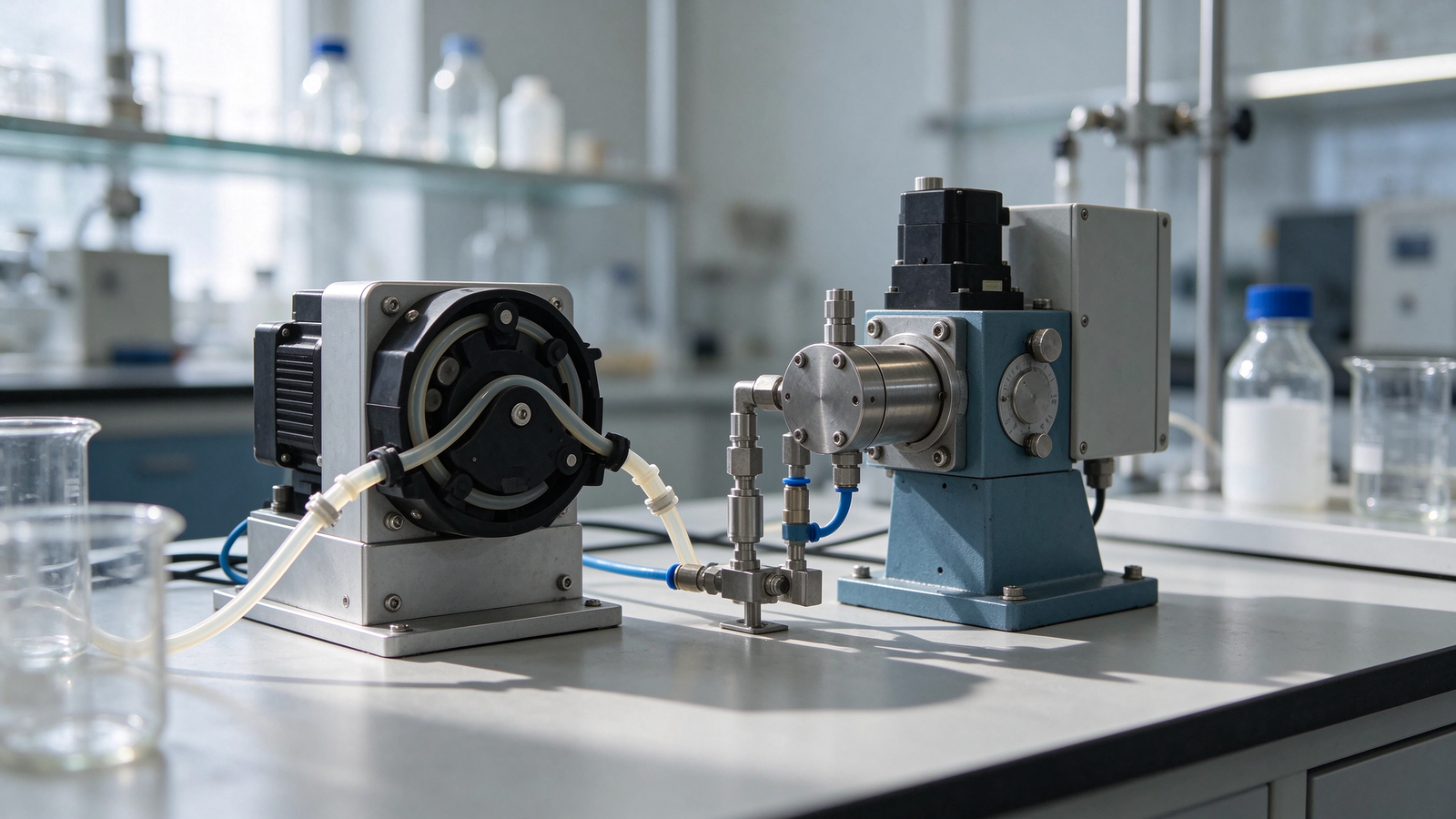
When a process has to feed a chemical or reagent at a controlled dose, buyers often compare two positive-displacement families: the peristaltic tube pump and the piston or plunger metering pump. Both move a fixed displacement per cycle, but they reach that displacement in different ways, and the wetted path looks very different. That difference decides which one tolerates a shear-sensitive fluid, which handles particles, which keeps a clean chemical isolated, and which suits a high-pressure injection point. This comparison lays out how each works, where each performs well, and what to match against your fluid, pressure, and maintenance expectations before you specify either one.
How Each Pump Moves Fluid
A peristaltic closes the tube against the head as the rotor turns, pushing the column of fluid ahead of the roller and letting the tube open behind it to draw in the next charge. The fluid never leaves the tube; it does not touch seals, valves, or a chamber wall. A piston or plunger metering pump drives a reciprocating plunger into a wetted chamber, displacing fluid through inlet and outlet check valves on each stroke. The chamber, seals, and check valves all contact the fluid, and the check valves open and close on every cycle.
That split — fluid trapped in a sealed tube versus fluid working through a valved chamber — drives most of the differences that follow.
| Point | Peristaltic tube pump | Piston / plunger metering pump |
|---|---|---|
| Wetted path | Tube only; no valves or chamber seals in the fluid | Chamber, plunger seal, inlet and outlet check valves |
| Fluid isolation | Closed tube, no contact with pump internals | Open wetted chamber exposed to internals |
| Shear on fluid | Gentle; fluid moves through a continuous tube | Plunger displacement and valve action add shear |
| Particles / slurry | Pass through the tube without seating on a valve | Check valves and seals can trap or wear on particles |
| Run dry | Can run dry without damaging the tube | Seals and chamber rely on the fluid for lubrication and seal |
| Service | Tube replacement as the main consumable | Valves, seals, and plunger parts may need service |
| Pressure handling | Limited by tube material and head design | Built for higher-pressure injection in many designs |
| Flow adjustment | Speed-based control over the tube | Stroke length and/or stroke rate control |
Where the Peristaltic Fits
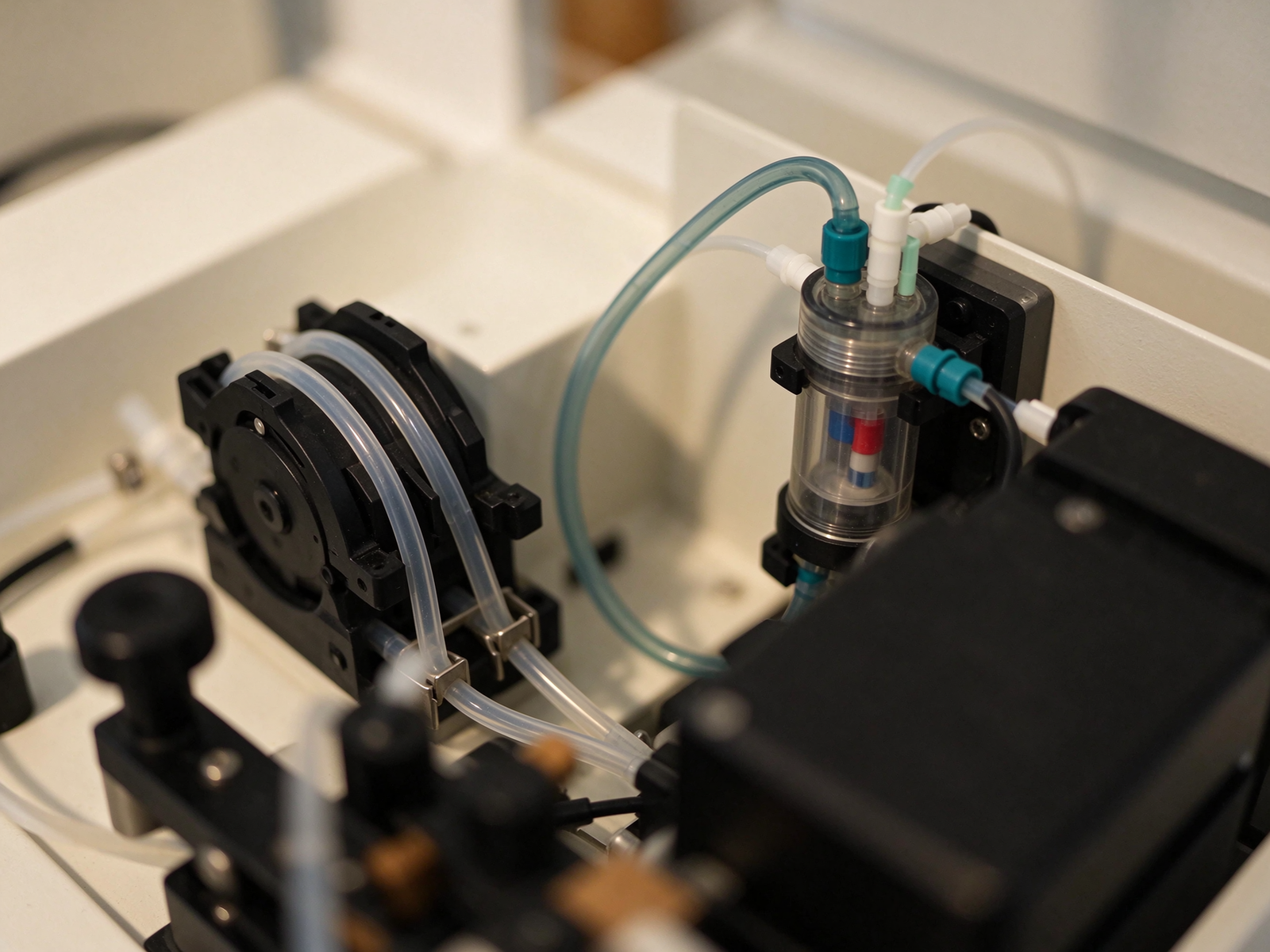
The peristaltic earns its place when the fluid cannot sit in a valved chamber or when the tube isolation matters. Shear-sensitive products such as certain reagents, biological or food-contact fluids, and delicate formulations move more gently through a continuous tube. Fluids with small particles or a light slurry pass through the bore without relying on a check valve to seat cleanly on every stroke, which reduces a common metering failure mode. A closed tube also keeps the chemical away from pump internals and keeps the reservoir and line isolated from the atmosphere, which suits sterile or odor-sensitive feeds. When the tube ages, replacing it is a short field job that restores the wetted path to new.
For low-flow instrument and dosing duties, a micro peristaltic pump gives a compact sealed path; general additive feed uses a small peristaltic pump head; controlled panels often pair the head with a 24V dosing pump drive. The peristaltic pump tube material is matched to the chemical, and the peristaltic pump driver sets the speed and control scheme.
Where the Piston / Plunger Pump Fits
The plunger design is built around a rigid displacement chamber and check valves, which tends to suit clean, low-particle chemicals delivered into a higher-pressure injection point where the tube’s pressure ceiling would be limiting. Stroke-length control can repeat a precise small dose on clean fluids, and the wetted materials can be selected for the chemical. The trade-off is that the check valves and plunger seal are wearing parts that contact the fluid, and fluids with particles, soft solids, or high viscosity can interfere with valve seating or accelerate seal wear. Because the chamber and seal rely on the process fluid, running dry or feeding an abrasive fluid changes the service picture.
Installation, Priming, and Control
Installation changes how either pump performs in service. A peristaltic draws its own charge through the tube and can lift fluid from a reservoir within its suction limit, but the suction line must stay airtight and free of kinks so the tube can hold its prime. A plunger pump relies on its check valves to prime, and air or particles in the chamber can delay that seating. On control, a peristaltic adjusts dose mainly by changing drive speed, while a plunger pump commonly adjusts stroke length and stroke rate; match the control signal and resolution to the dose events your process needs. On either design, keep the discharge line open and unrestricted, and re-check the dose after installation or consumable service.
Comparing Fluid Compatibility and Wear
Compatibility review should list the actual fluid, concentration, and temperature on both sides. On a peristaltic, the only material to match is the tube, plus any fitting contact; internal seals and valves are not in the path. On a plunger pump, the chamber material, plunger seal, and both check-valve seats must all resist the fluid, and the valve seat has to remain clean enough to seal each stroke. Abrasive or crystallizing fluids are the stress case for a valved design, because particles or crystals can hold a valve off its seat and a crystal can score a seal. The NSF fluid-handling guidance supports reviewing wetted materials and chemical segregation before either family is selected.
| Duty condition | Better fit | Reason |
|---|---|---|
| Shear-sensitive or delicate fluid | Peristaltic | Continuous gentle tube path, no valve action |
| Light slurry or small particles | Peristaltic | No check valve to trap or seat against solids |
| Closed isolation / odor or sterile concern | Peristaltic | Fluid stays inside the sealed tube |
| High-pressure clean chemical injection | Piston / plunger | Chamber and valves rated for higher discharge pressure |
| Clean reagent, precise stroke control | Piston / plunger | Stroke length and rate metering on clean fluid |
| Intermittent duty that may run empty | Peristaltic | Tube tolerates dry running; plunger seal does not |
Maintenance and Consumables
Peristaltic service concentrates on the tube, the main fluid-contact consumable, plus periodic checks of rollers and mounting. Plunger service spreads across valves, seals, and plunger parts, and any blocked or stuck check valve has to be cleaned or replaced. Calibration on either family should be checked by dispensing and measuring a known volume over a set number of cycles, rather than trusting the control setting; the NIST gravimetric measurement practice describes that volume check. After a tube change or a valve/seal service, re-calibrate the affected pump before returning it to duty.
The motor-driver operating manual and driver reference cover the drive side for peristaltic units; for a plunger pump, the metering head’s stroke and valve rating come from that manufacturer’s data. Match consumables to the duty so spares do not hold up a line restart.
Common Questions
Can a peristaltic replace a plunger pump on high-pressure injection? Only if the required pressure sits within the tube and head’s pressure range. For a discharge point beyond that range, the valved plunger design is usually the stronger fit; compare the actual back-pressure before switching.
Which handles a slurry better? A peristaltic generally passes light particles through the tube without a valve to trap them. A valved chamber can wear or bind where solids catch on a seat or seal.
Which is easier to keep clean between chemicals? A peristaltic wets only the tube, so flushing or swapping the tube separates one chemical from the next. A valved chamber may hold residue around valves and seals that has to be flushed thoroughly.
Which gives a steadier dose? Both can be calibrated to a repeatable dose on the right fluid. Peristaltic accuracy depends on tube condition and slip; plunger repeatability depends on clean valves and intact seals. Re-check calibration after consumable service.
What costs more to maintain? Peristaltic maintenance centers on tube replacement; plunger maintenance can involve valves, seals, and plunger parts. Compare consumable cost and downtime for your specific fluid before choosing on purchase price alone.
If you are deciding between a peristaltic and a piston metering pump for a chemical or reagent feed, contact YOORAIN with the fluid and concentration, discharge pressure, target flow or daily dose, any particles in the stream, temperature, and your control signal. We can advise which pump family matches the duty and, on the peristaltic side, suggest the head, tube material, and drive arrangement.