
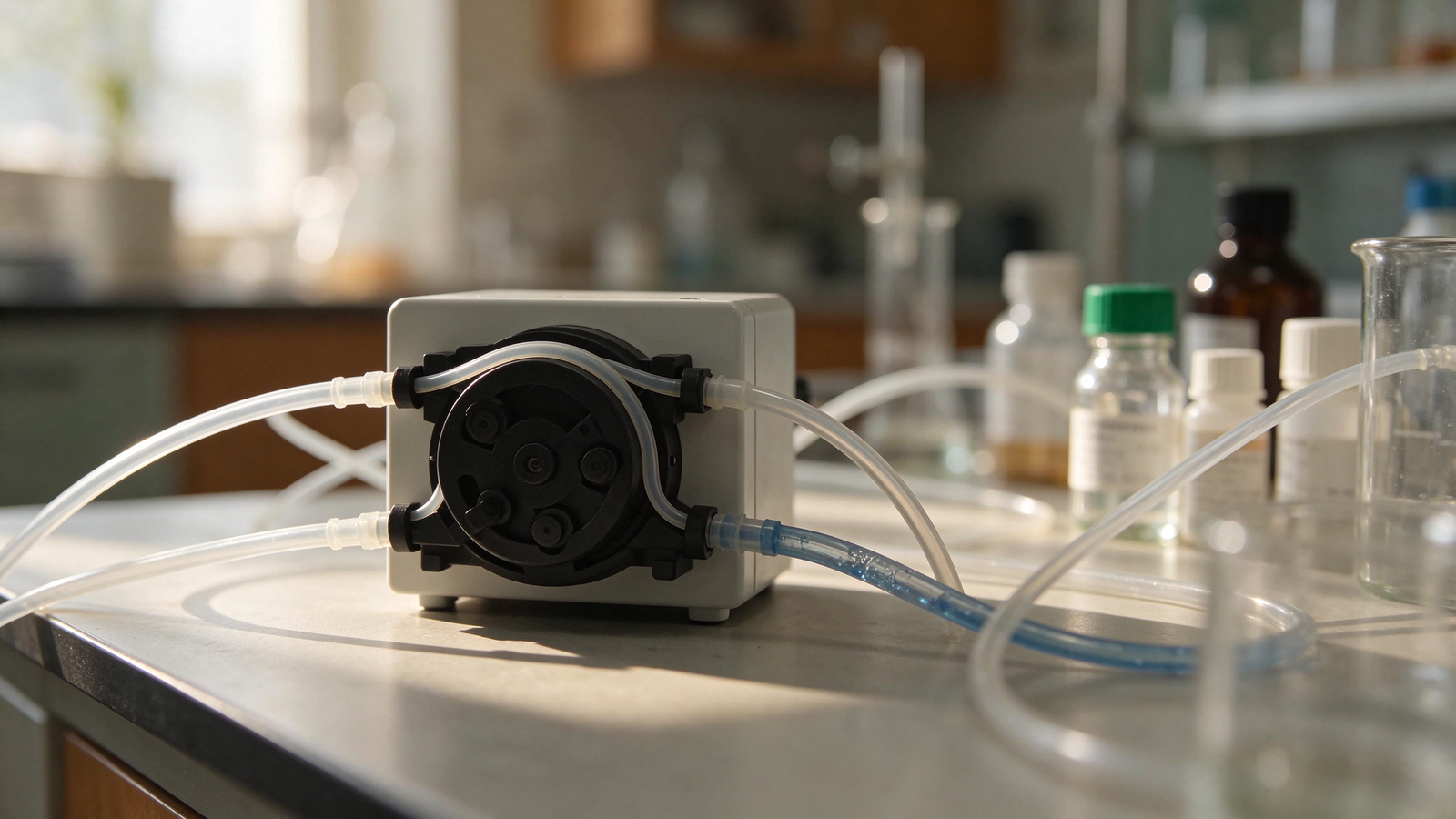
Outfitting a laboratory or R&D bench with a dosing pump means balancing small precise volumes, quick changes between reagents, cleanable fluid paths, and a control scheme that follows an experimental recipe. Production pump sizing often starts from high flow and continuous duty; a lab pump more often starts from low repeatable doses, compact mounting, easy tube changes, and the ability to switch fluids without a long cleanup. Peristaltic pumps are a common fit for this kind of work because the reagent stays in the tube, the wetted path is limited to the tube and fittings, and service usually means swapping a tube rather than stripping a chamber. This buyer’s guide covers what a lab or R&D duty actually needs, how to match head, tube, and drive to those needs, and the checklist to run before you place an order.
What a Lab or R&D Duty Asks For
Lab and pilot dosing covers reagent addition, media and buffer transfer, dye or additive metering, small-batch formulation, and instrument integration. The demands differ from a production line: volumes are often small, recipes change frequently, several reagents may run in parallel, and cross-contamination between experiments matters. A pump selected only on price may deliver the right nominal flow but be awkward to clean, hard to calibrate, or poorly matched to the reagent chemistry.
| Need | What it means for the pump |
|---|---|
| Small repeatable dose | Head and tube bore sized to low volumes; a drive that holds a steady speed |
| Frequent reagent changes | Tube-only wetted path, easy flush or tube swap, clear labeling |
| Parallel reagents | Multi-channel head where several feeds run together |
| Clean bench or instrument fit | Compact mounting, low noise, tidy tubing arrangement |
| Repeatable records | Calibration method that can be logged and repeated after service |
| Reagent compatibility | Tube material matched to each chemical, concentration, and temperature |
Matching Head, Tube, and Drive to the Duty
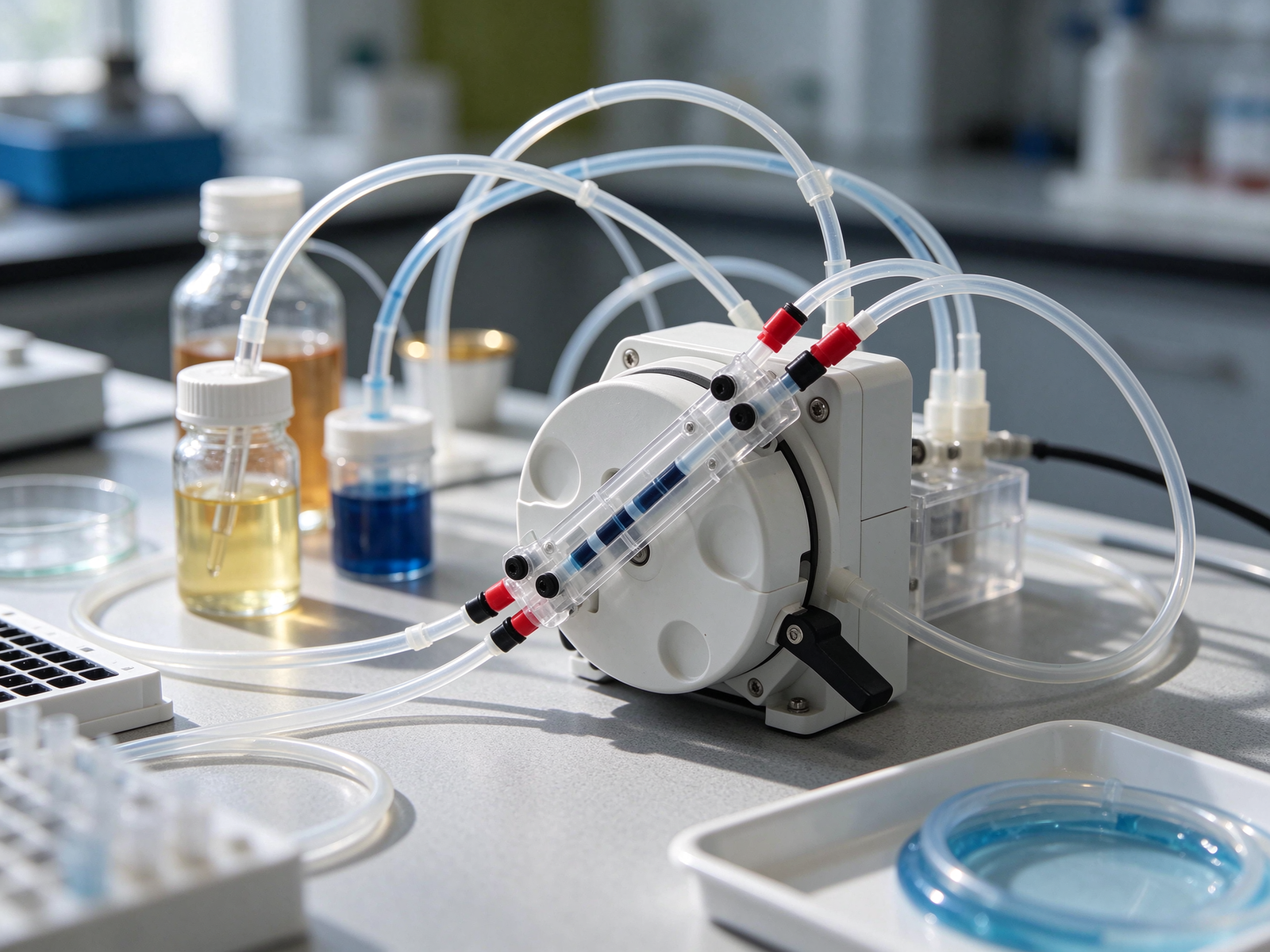
Start from the experimental range rather than the pump catalog: the smallest and largest dose per run, the addition time, how many reagents run at once, the fluid viscosity and chemistry, and whether the pump runs from a manual setting, an adjustable control, or an external instrument signal. From those facts the head size, tube bore and material, and drive are chosen together.
Very low-flow reagent additions commonly use a micro peristaltic pump; compact instrument and bench setups use a mini peristaltic pump arrangement; slightly larger transfers move to a small peristaltic pump head. The peristaltic pump tube sets the wetted material and bore, and the peristaltic pump driver chooses between fixed speed, adjustable speed, or a signaled control. Match the tube material to the most demanding reagent in the planned work, and check compatibility at the working temperature.
Tube bore matters as much as material on a bench pump. A narrow bore moves a small charge per cycle and suits low reagent volumes, while a wider bore carries more fluid per revolution but can make very small doses harder to control. If the work spans both trace additions and larger media transfers, check whether one head covers the range cleanly or whether two smaller setups give steadier control at each end. Avoid sizing a head for the largest single batch if most runs are low volume, since a pump working far below its comfortable range can deliver an uneven dose.
| Selection point | Questions to answer before ordering |
|---|---|
| Flow and dose | Volume per run, addition window, and any largest expected batch |
| Control | Manual adjustment, fixed recipe, or external signal from an instrument |
| Channels | How many reagents feed at once and whether one multi-channel head fits |
| Tubing and chemistry | Reagent names, concentrations, temperature, and any mixture or solvent |
| Mounting | Bench stand, panel mount, or integration inside an analyzer or pilot rig |
| Cleanability | How often reagents switch and whether a spare tube is kept ready |
| Spare support | Availability of replacement tubes, fittings, and lead time |
Calibration and Repeatable Records
On a bench pump, the delivered volume should be checked by dispensing and measuring a known quantity over a set number of cycles rather than trusting the speed dial. That check gives a baseline to compare against after a tube change, a reagent switch, or a period of storage. Record the dispensed volume, cycle count, date, and the tube material so the experiment trail stays consistent. The NIST measurement practice describes weighing and volume checks that support that kind of repeatable record. Where the lab follows internal quality procedures, keep the calibration log and the tube change record together with the experiment notes.
Cleanability and Cross-Contamination
A peristaltic limits the wetted path to the tube and end fittings, which helps when switching between reagents: the pump internals do not sit in the fluid, and residue concentrates in the bore that can be flushed or replaced. Between reagents, flush with a compatible rinse, run it through the head, and inspect the tube for discoloration or swelling. Where a reagent leaves a film or two chemistries must not meet, keeping a spare tube for the second reagent is a simple safeguard. Label each line clearly so reagents are not connected to the wrong channel.
Bench Use Versus Instrument Integration
A bench setup leaves the pump visible and accessible for manual adjustment and tube changes, which suits exploratory work where recipes change often. An integrated pump inside an analyzer or pilot rig tends to favor a fixed mounting, a defined control signal, and a tube that can be serviced without opening the whole assembly. Decide which arrangement the pump will live in before ordering, because mounting, wiring, and control options differ between the two. The motor-driver operating manual and driver reference describe drive-side options; confirm the signal and mounting details with the supplier for an integrated build.
Common Buying Mistakes
| Mistake | Result | Better practice |
|---|---|---|
| Choosing on nominal flow only | Pump cannot hold the low end or handles reagents poorly | Cover the full dose range and chemistry before sizing |
| Mismatched tube material | Tube swells or hardens, contaminates the reagent | Match bore and material to each planned chemical |
| Ignoring control signal | Drive does not match the instrument or recipe controller | State manual, adjustable, or signaled control up front |
| No spare tube planned | Reagent changeover or a failure stops the experiment | Keep the bore-matched tube in stock |
| Assuming cleanability | Residue crosses between reagents | Plan flush or dedicated tube per chemistry |
| Overlooking mounting | Pump does not fit bench panel or rig | Confirm stand, panel, or integrated mounting before order |
Frequently Asked Questions
What size peristaltic do I need for lab reagent dosing? Match the head and tube bore to the target dose and addition window, leaving room for the largest expected batch. A micro or mini head usually covers low-flow bench work; move to a small head only when flow demands it.
Can one pump handle several reagents? A multi-channel head can run parallel feeds, but keep each chemistry on its own tube path and flush or swap tubes between incompatible reagents. Do not assume one bore can carry every chemical without a flush plan.
How do I know the tube suits my reagent? Give the supplier the reagent name, concentration, solvent, and working temperature, and review the recommended tube material. Inspect early service for swelling, softening, or discoloration.
How often should I calibrate a bench pump? Check the delivered volume when the pump is set up, after any tube change or service, and periodically over regular use. Keep the readings in a log so drift is visible.
Does a lab pump need a special control setup? It depends on the work. Manual adjustment suits exploratory batches; an adjustable or signaled drive suits a fixed recipe or an instrument that controls the feed.
If you are choosing a peristaltic for a lab or R&D dosing setup, contact YOORAIN with the reagents and concentrations, target dose and addition time, number of channels, control signal, and whether the pump sits on a bench or inside an instrument. We can suggest the head, tube material, and drive arrangement, and note the spare tubes to keep on hand.