
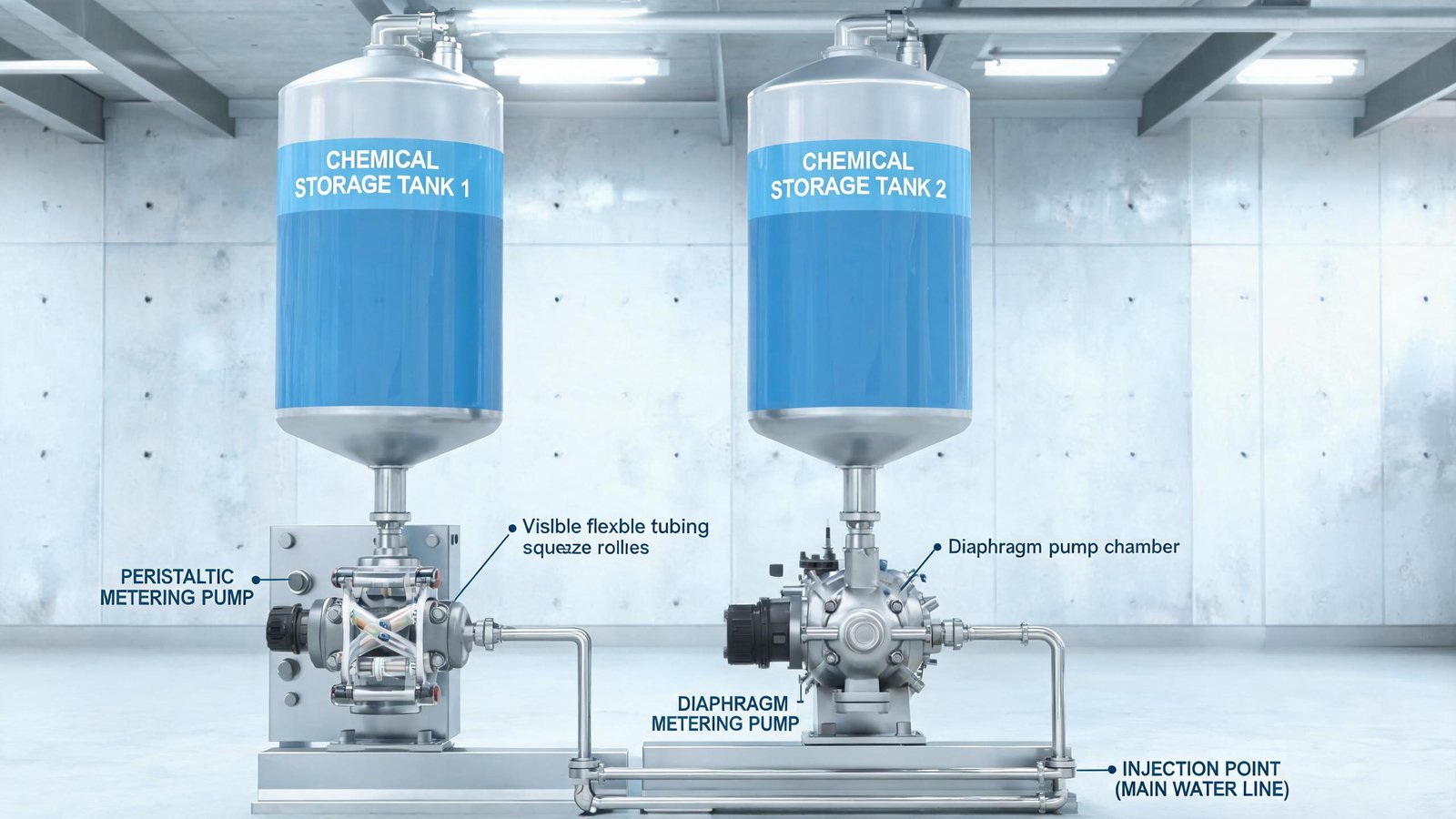
Water treatment plants dosing sodium hypochlorite, polymer coagulants, and lime slurry face a recurring question: should the metering pump be peristaltic or diaphragm? The choice affects dosing accuracy, maintenance frequency, chemical compatibility, and total cost of ownership. Engineers and procurement teams at municipal facilities and industrial plants in Germany and across Europe increasingly weigh these two technologies against each other, especially when off-gassing chemicals cause vapor lock in diaphragm pumps or when abrasive slurries wear out check valves.
This comparison examines peristaltic and diaphragm metering pumps across the factors that matter most in water treatment: flow control precision, pressure handling, chemical compatibility, maintenance requirements, and total operating cost. The goal is to help specifiers make an informed decision based on actual application conditions rather than generalizations.
What Makes the Options Different
The fundamental difference lies in how each pump moves fluid. A peristaltic pump compresses flexible tubing with rotating rollers, pushing fluid forward without any contact between the pump mechanism and the chemical. A diaphragm pump uses a flexible membrane that flexes back and forth, drawing fluid in through an inlet check valve and pushing it out through a discharge check valve.
This structural difference has practical consequences. Peristaltic pumps have no valves to clog, no seals to leak, and no diaphragm to rupture. The only wearing component is the tubing itself. Diaphragm pumps, on the other hand, rely on inlet and outlet check valves that can stick, clog, or fail—particularly when handling chemicals that off-gas or contain particulates.
| Design Factor | Peristaltic Pump | Diaphragm Pump |
|---|---|---|
| Fluid contact | Tubing only; pump mechanism isolated | Diaphragm, valves, pump head |
| Valves required | No | Yes (inlet and outlet check valves) |
| Seal type | None (tube is the seal) | Diaphragm seal |
| Priming | Self-priming, can run dry | May require priming; vapor lock risk |
| Shear on fluid | Low | Moderate |
Flow Control
Both pump types can achieve metering accuracy suitable for water treatment, but they differ in how they maintain that accuracy over time. Peristaltic pumps deliver pulsed flow proportional to roller speed. As long as the tubing maintains its elasticity and the rollers achieve full occlusion, the volume per revolution stays consistent. Flow rate is adjusted by changing motor speed, which makes control straightforward for automated dosing systems.
Diaphragm pumps also deliver pulsed flow, with each stroke displacing a fixed volume. Stroke length and stroke frequency adjustments allow turndown ratios of 10:1 or better on some models. However, valve wear and gas accumulation can cause the actual displaced volume to drift from the commanded value, requiring periodic calibration to maintain accuracy.
For sodium hypochlorite dosing—a common water treatment application—the off-gassing behavior of the chemical directly affects flow consistency. EPA drinking water regulations require precise disinfectant residual levels, which means dosing accuracy is not optional. Peristaltic pumps handle off-gassing chemicals without vapor lock because there are no valves to block. Diaphragm pumps may require degassing valves or baffles to manage gas accumulation.
YOORAIN’s K25 small peristaltic pump offers the compact form factor and speed-controlled dosing suitable for small-scale disinfectant feed, while the K45 large flow peristaltic pump handles higher-flow applications such as polymer dosing at municipal plants.
Pressure Requirements
Discharge pressure is where diaphragm pumps often have an advantage. Typical diaphragm metering pumps can operate against pressures of 10 bar or higher, making them suitable for injecting chemicals into pressurized water mains. Peristaltic pumps are generally limited by tubing burst pressure and fitting integrity, with typical operating pressures ranging from 2 to 4 bar for standard configurations.
| Pressure Scenario | Peristaltic Suitability | Diaphragm Suitability |
|---|---|---|
| Low-pressure dosing (tank to tank) | Good fit | Good fit |
| Injection into pressurized main (2-4 bar) | Possible with appropriate tubing | Good fit |
| High-pressure injection (above 4 bar) | Limited; requires reinforced hose | Preferred |
| Vacuum suction lift | Good; strong vacuum from tube restitution | Limited by valve design |
For applications requiring higher pressures, YOORAIN’s YD25 peristaltic hose pump uses a reinforced hose design that can handle more demanding pressure conditions than standard laboratory-grade pumps.
Tubing Considerations
Tubing selection is the single most important factor in peristaltic pump performance for water treatment. The tubing material must be chemically compatible with the dosed fluid, resilient enough to maintain occlusion after repeated compression, and rated for the system pressure. Common materials include Tygon for general chemicals, Viton for aggressive solvents, and EPDM for sodium hypochlorite.
For diaphragm pumps, the diaphragm material and valve elastomers determine chemical compatibility. PTFE diaphragms offer broad chemical resistance but come at a higher cost. Valve balls and seats also need to match the chemical being pumped.
The NSF/ANSI/CAN 61 standard governs materials in contact with drinking water. Any component—whether tubing in a peristaltic pump or diaphragm in a metering pump—that contacts treated water must meet this standard. YOORAIN offers a range of peristaltic pump tubing options, and specifiers should confirm NSF/ANSI 61 compliance for the specific tubing material and size used in drinking water applications.
Maintenance
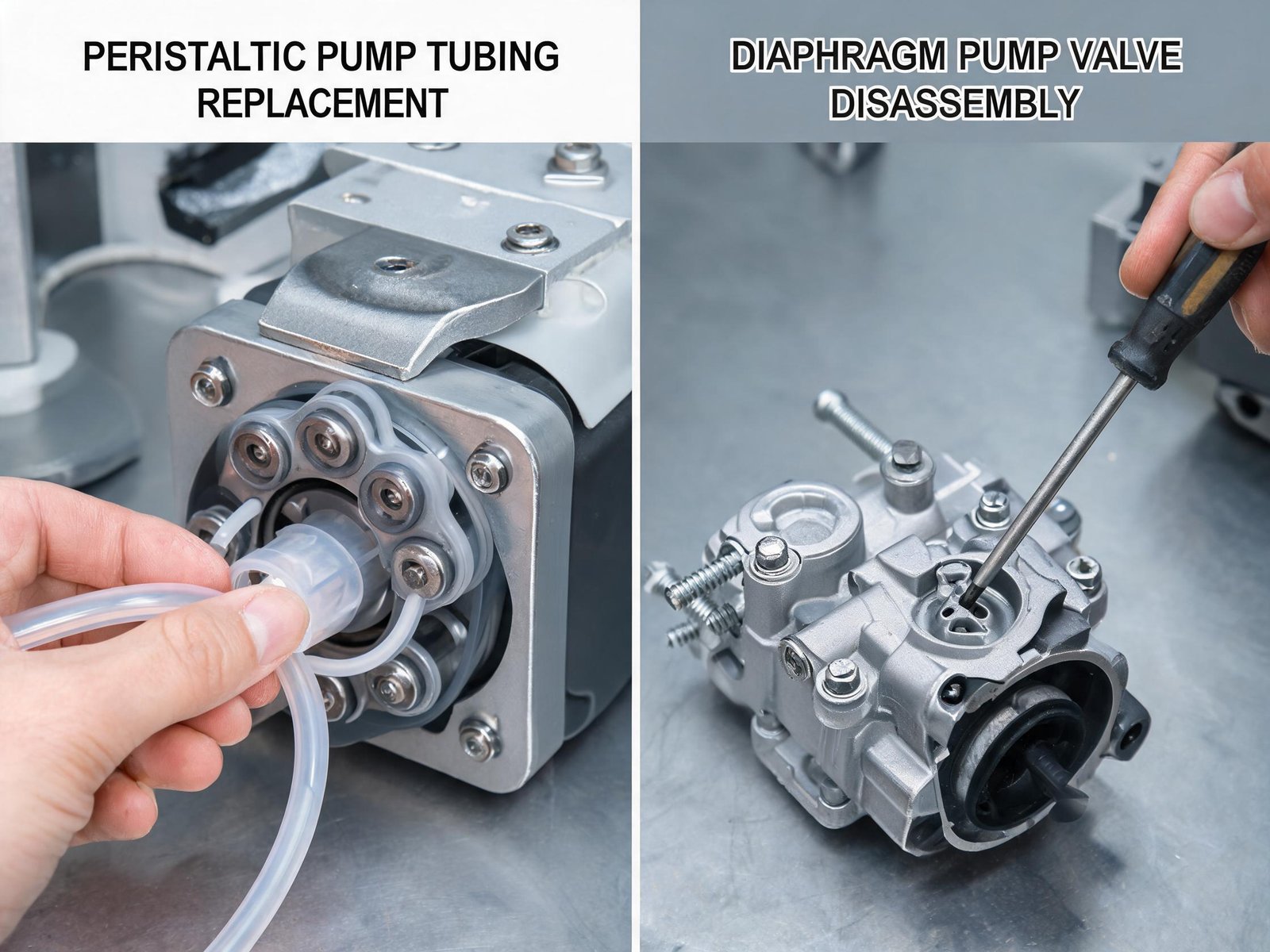
Maintenance requirements differ significantly between the two pump types. Peristaltic pumps require periodic tubing replacement—the only routine maintenance item. Tubing life depends on pump speed, chemical compatibility, duty cycle, and tubing material. In typical water treatment dosing applications, tubing may last from 500 to 2,000 operating hours. Replacement takes minutes and requires no special tools.
Diaphragm pumps require more complex maintenance. Check valves need cleaning or replacement when handling scaling or particulate-laden chemicals. Diaphragm replacement is needed periodically, and the process involves disassembling the pump head. Degassing valves, if equipped, add another maintenance point. The AWWA standards for chemical metering pumps provide guidance on maintenance intervals and performance verification.
| Maintenance Item | Peristaltic Pump | Diaphragm Pump |
|---|---|---|
| Routine wear part | Tubing only | Diaphragm, valves, seals |
| Replacement time | 5-15 minutes | 30-90 minutes |
| Special tools required | No | Often yes |
| Calibration frequency | Low; flow proportional to speed | Periodic; valve wear affects accuracy |
| Downtime for service | Minimal | Moderate |
Which Option Fits the Application?
The decision between peristaltic and diaphragm pumps depends on the specific chemicals, pressures, and operational priorities at the treatment plant. Peristaltic pumps are generally preferred for:
- Sodium hypochlorite and other off-gassing chemicals
- Polymer dosing where shear-sensitive fluids are handled
- Lime slurry and other abrasive or particulate-laden fluids
- Applications where minimal downtime and quick maintenance are priorities
- Low to moderate pressure systems (up to about 4 bar)
Diaphragm pumps are generally preferred for:
- High-pressure injection into water mains (above 4 bar)
- Applications requiring very high metering precision with stable conditions
- Facilities with established diaphragm pump maintenance protocols
- Continuous-duty applications where tubing replacement frequency is a concern
For facilities handling multiple chemicals at different injection points, a mix of both technologies may be optimal—peristaltic pumps for hypochlorite and slurry, diaphragm pumps for high-pressure acid feed.
Key Takeaways
- Peristaltic pumps eliminate valve clogging and vapor lock, making them well-suited for off-gassing chemicals like sodium hypochlorite.
- Diaphragm pumps handle higher discharge pressures, making them suitable for injection into pressurized mains.
- Tubing material selection is the critical factor for peristaltic pump reliability; chemical compatibility and NSF/ANSI 61 compliance must be verified.
- Peristaltic pump maintenance is simpler and faster—tubing replacement is the only routine task.
- For German water treatment facilities following EU and DIN standards, both pump types have valid roles depending on the specific application.
Need help selecting a pump for a water treatment dosing system? Contact YOORAIN with your target chemical, flow range, system pressure, and tubing requirements for a recommendation that fits your application.