
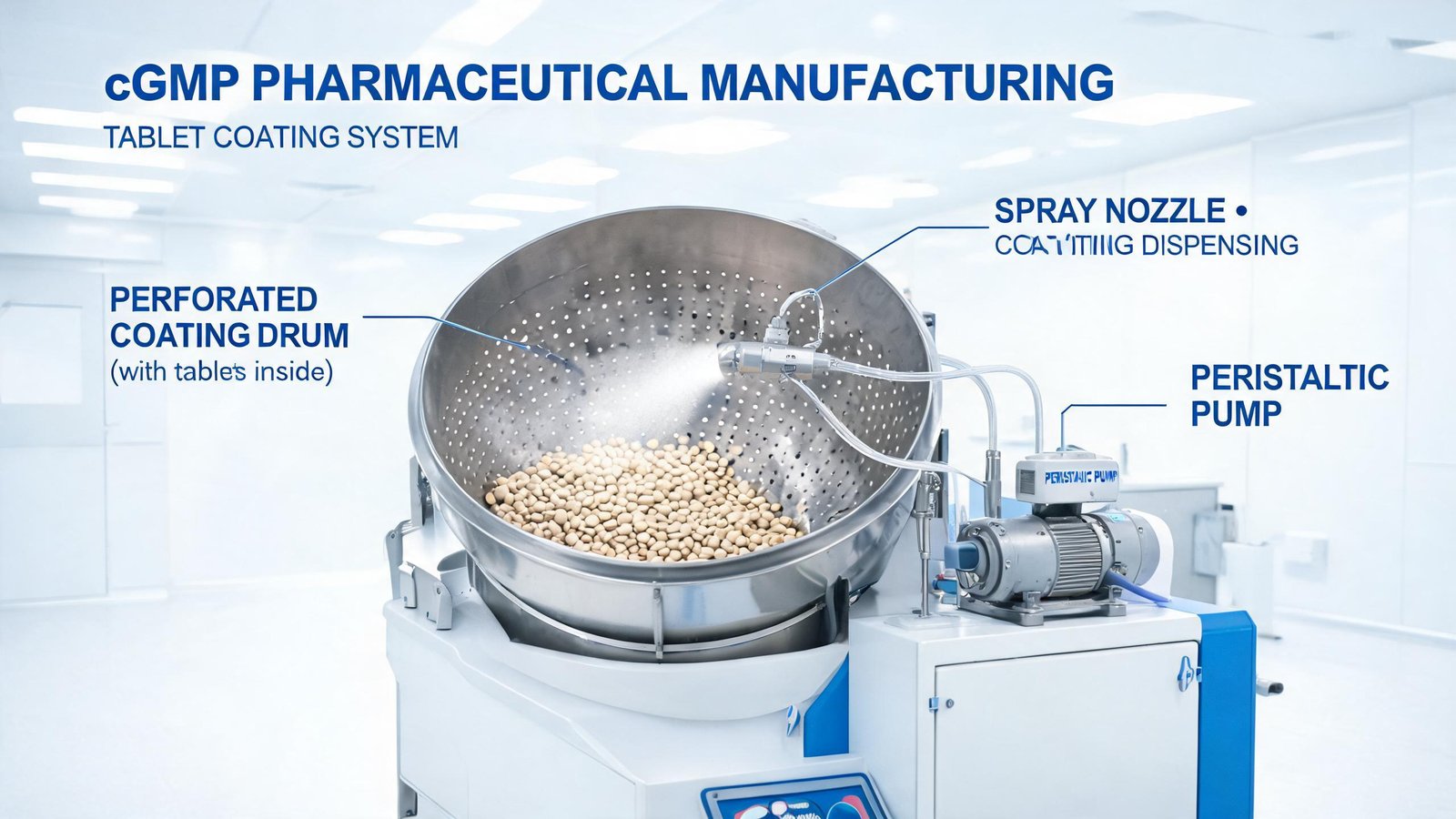
Pharmaceutical tablet coating relies on a peristaltic pump to deliver polymer-based coating solution from a mixing vessel to spray guns inside the coating pan. The FDA’s SUPAC Manufacturing Equipment Addendum classifies peristaltic pumps among the accepted liquid delivery systems for coating operations. When the pump delivers inconsistent flow, the coating develops visible defects — orange peel, sticking, picking, or uneven colour distribution — that can reject an entire batch under cGMP quality protocols. Diagnosing the root cause requires separating pump performance issues from process parameter issues, because the symptoms often overlap.
Coating solution delivery is not a passive transfer. The spray rate, atomising air pressure, pan speed, and inlet air temperature form an interdependent system. The peristaltic pump is the metering heart of that system, and any drift in its output propagates directly to the tablet surface. Understanding how pump-related variables cause specific coating defects enables faster batch rescue and prevents recurrence.
Common Problem
The most frequently reported coating defects traceable to peristaltic pump performance are:
| Defect | Visual Symptom | Likely Pump-Related Cause |
|---|---|---|
| Orange peel | Rough, non-glossy surface | Inconsistent spray rate causing droplet size variation |
| Sticking | Tablets adhere to pan wall or each other | Excess spray rate overloading drying capacity |
| Picking | Surface film removed in small patches | Flow surges causing localised over-wetting |
| Twinning | Two tablets stuck together | Pulsating flow creating wet spots on tablet edges |
| Edge chipping | Mechanical damage at tablet edges | Uneven coating reducing mechanical protection |
| Colour variation | Non-uniform colour across batch | Flow rate drift during coating cycle |
Each of these defects can also result from non-pump causes — formulation issues, pan speed, or drying air problems. The key diagnostic question is whether the defect appeared suddenly (suggesting a pump failure) or developed gradually over multiple batches (suggesting tubing wear or process drift).
What Causes It
Peristaltic pump-related coating defects originate from four primary sources: tubing wear, air entrainment, pump speed instability, and chemical incompatibility.
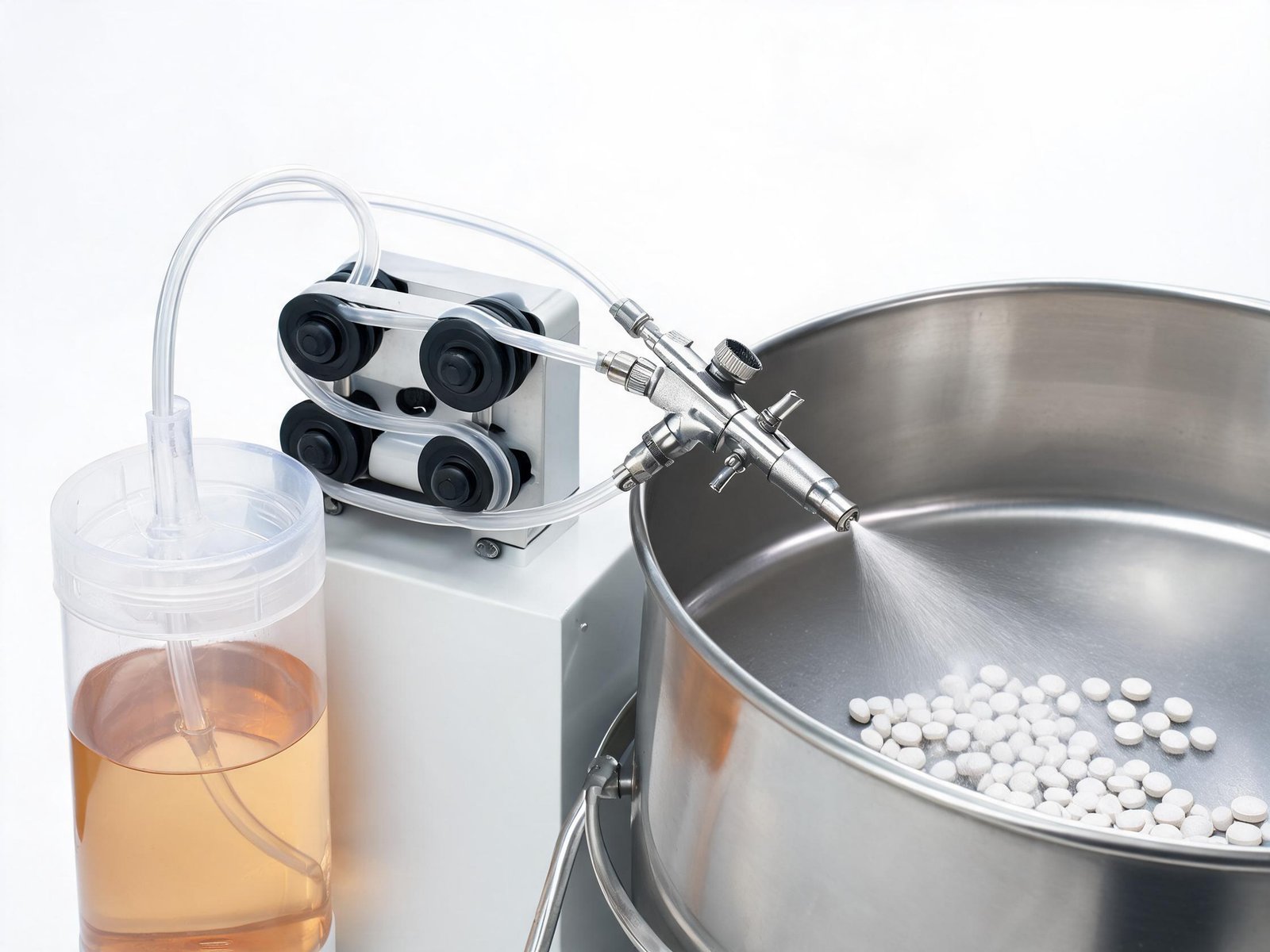
Tubing wear is the most common cause of gradual flow drift. As the tubing interior wears at the roller compression points, the effective inner diameter decreases, reducing volume per revolution. A pump that delivered 30 mL/min at 50 RPM during batch start-up may deliver only 27 mL/min after 200 hours of cumulative operation — a 10% reduction that progressively worsens if tubing is not replaced. This drift causes the spray rate to fall below the target, leading to under-coated tablets with thinner film that may not meet dissolution specifications.
Air entrainment occurs when the suction line from the coating solution vessel draws air instead of liquid. This can happen when the vessel runs low, when the suction tubing develops micro-cracks at fittings, or when the coating solution foams due to excessive agitation. Air in the peristaltic pump causes pulsating flow at the spray nozzle — the pump compresses air instead of liquid, delivering inconsistent droplet patterns. The result is localised over-wetting (picking) followed by dry spots, creating a mottled surface.
Pump speed instability arises when the motor controller receives unstable input voltage or when the drive electronics overheat during extended coating runs. Stepper-motor-driven peristaltic pumps are less susceptible because they maintain position with each step pulse, but DC-motor-driven pumps can exhibit speed fluctuation when the power supply is undersized. The peristaltic pump driver should be sized with at least 20% torque margin to prevent speed droop under load.
Chemical incompatibility between the coating solution and the tubing material causes tubing degradation — swelling, hardening, or cracking — that changes flow characteristics within a single batch. Aqueous film coating solutions containing high polymer concentrations can interact with silicone tubing over extended contact periods. If the tubing material absorbs solvent from the coating formulation, the wall thickness changes, altering the compression characteristics and flow rate.
How to Diagnose It
Diagnosing pump-related coating defects requires a systematic approach that isolates the pump variable from process variables.
Step 1: Verify actual spray rate. Disconnect the spray nozzle from the coating pan and dispense coating solution into a graduated cylinder for a measured time period. Compare the actual delivery rate to the set point. A deviation of more than 5% indicates a pump or tubing issue. This test should be performed at the beginning and end of each coating batch to establish a trend.
Step 2: Check for air in the fluid path. Observe the spray pattern at the nozzle. A steady, uniform fan pattern indicates consistent flow. A stuttering or sputtering pattern indicates air entrainment. Inspect the suction line for loose fittings, check that the solution vessel is adequately filled, and verify that the solution is properly degassed.
Step 3: Inspect tubing condition. Remove the tubing from the pump head and examine the interior at the compression points. Visible flattening, cracking, or discolouration indicates that the tubing has exceeded its service life. Measure the wall thickness at the compression zone and compare to the original specification. A wall thickness reduction of more than 10% warrants replacement.
Step 4: Verify motor stability. Monitor the pump motor current during operation. Fluctuating current draw indicates variable load, which can result from tubing hardening, bearing wear in the roller assembly, or electrical instability. For stepper-motor-driven units, verify that the step pulse train from the controller is clean and uninterrupted.
The FDA’s SUPAC Manufacturing Equipment Addendum establishes the equipment classification framework for coating operations, listing peristaltic pumps as a recognised pump subclass. Equipment changes that affect coating performance may require regulatory notification under SUPAC guidelines, making accurate diagnosis documentation part of the compliance record.
Engineering Fixes
Once the root cause is identified, the following fixes address the most common pump-related coating defects:
For orange peel caused by inconsistent spray rate: Replace tubing if it has accumulated more than 80% of its rated service life. Recalibrate the pump by measuring actual flow at the set point and adjusting the controller offset. Verify that the atomising air pressure is stable — the pump and the spray gun operate as a system, and air pressure fluctuation mimics pump flow instability.
For sticking caused by excess spray rate: Verify that the pump speed setting matches the validated coating recipe. If the pump has been recalibrated to compensate for tubing wear, the adjusted speed may overshoot after tubing replacement. Reset the pump to the original validated parameters after each tubing change. The 21 CFR Part 211 cGMP regulations for finished pharmaceuticals require that equipment operate within validated parameters, making post-maintenance verification a compliance step.
For picking caused by flow surges: Install a pulse dampener downstream of the peristaltic pump. The dampener absorbs the per-roller flow variation that is inherent to peristaltic operation, smoothing the delivery to the spray nozzle. This is particularly effective for pumps with fewer rollers, where the flow pulsation amplitude is larger. A K25 compact peristaltic pump with a multi-roller head design reduces inherent pulsation compared to two-roller configurations.
For twinning caused by pulsating flow: In addition to a pulse dampener, verify that the spray gun nozzle is not partially blocked. A restricted nozzle amplifies the effect of flow pulsation because the pressure spike from each roller compression forces more liquid through the reduced orifice, creating intermittent over-wetting on tablet edges.
For colour variation caused by flow rate drift: Implement in-line flow verification using a flow sensor downstream of the pump. The sensor provides real-time feedback to the coating controller, allowing automatic speed adjustment to maintain the target spray rate as tubing wears. This closed-loop approach is recommended for long coating cycles exceeding 4 hours, where tubing wear during a single batch can introduce measurable drift.
When to Change the Pump or Tubing
Replacement decisions should follow a data-driven approach rather than a fixed schedule. The following criteria indicate when action is needed:
Tubing replacement criteria:
- Cumulative run hours exceed 80% of the tubing manufacturer’s rated life for the specific coating formulation
- Flow rate at the set point deviates by more than 5% from the calibrated value and cannot be corrected by speed adjustment
- Visual inspection reveals cracking, discolouration, or deformation at compression points
- Coating defects traced to pump inconsistency recur after cleaning and recalibration
Pump replacement criteria:
- Motor current draw exceeds the manufacturer’s rated range, indicating bearing or drive wear
- Roller assembly exhibits visible play or uneven rotation when operated by hand
- The pump cannot maintain flow stability even with new tubing installed
- The pump design does not support the required flow rate range for current coating formulations
When upgrading pump capacity, consider the K15 micro peristaltic pump for low-flow precision coating applications or the housed peristaltic pump for integration into a cleanroom environment where the pump enclosure must withstand wipe-down sterilisation.
Maintenance Checklist
The following maintenance checklist supports consistent coating pump performance:
- Pre-batch: Verify tubing cumulative run hours against replacement threshold. Measure actual flow at set point and record in the batch record.
- Pre-batch: Inspect suction line for tightness at all fittings. Verify that the coating solution vessel is filled above the minimum level line.
- Pre-batch: Check spray nozzle for blockage. Run a priming cycle to fill the fluid path and expel air before connecting to the spray gun.
- During batch: Monitor spray pattern at 30-minute intervals. Note any change in pattern uniformity.
- During batch: For batches exceeding 4 hours, perform a mid-batch flow verification by collecting dispensed volume for 60 seconds at the nozzle.
- Post-batch: Flush the tubing with the validated cleaning solution. Record cumulative run hours.
- Post-batch: Inspect tubing interior for signs of chemical attack or mechanical wear. Document findings in the equipment log.
- Weekly: Verify motor current draw is within rated range. Inspect roller assembly for smooth rotation and bearing condition.
- Monthly: Verify that all pump control parameters match the validated coating recipe. Reconcile any adjustments made during the month.
- Quarterly: Perform a full flow calibration across the operating range. Compare results to the previous calibration to identify long-term drift trends.
For pharmaceutical coating operations requiring pump replacement or upgrade, providing the current coating formulation, validated spray rate range, batch sizes, and installation constraints helps suppliers recommend pump configurations that meet cGMP equipment requirements. You can discuss tablet coating fluid-handling specifications with YOORAIN to identify suitable pump options for your coating pan system.