
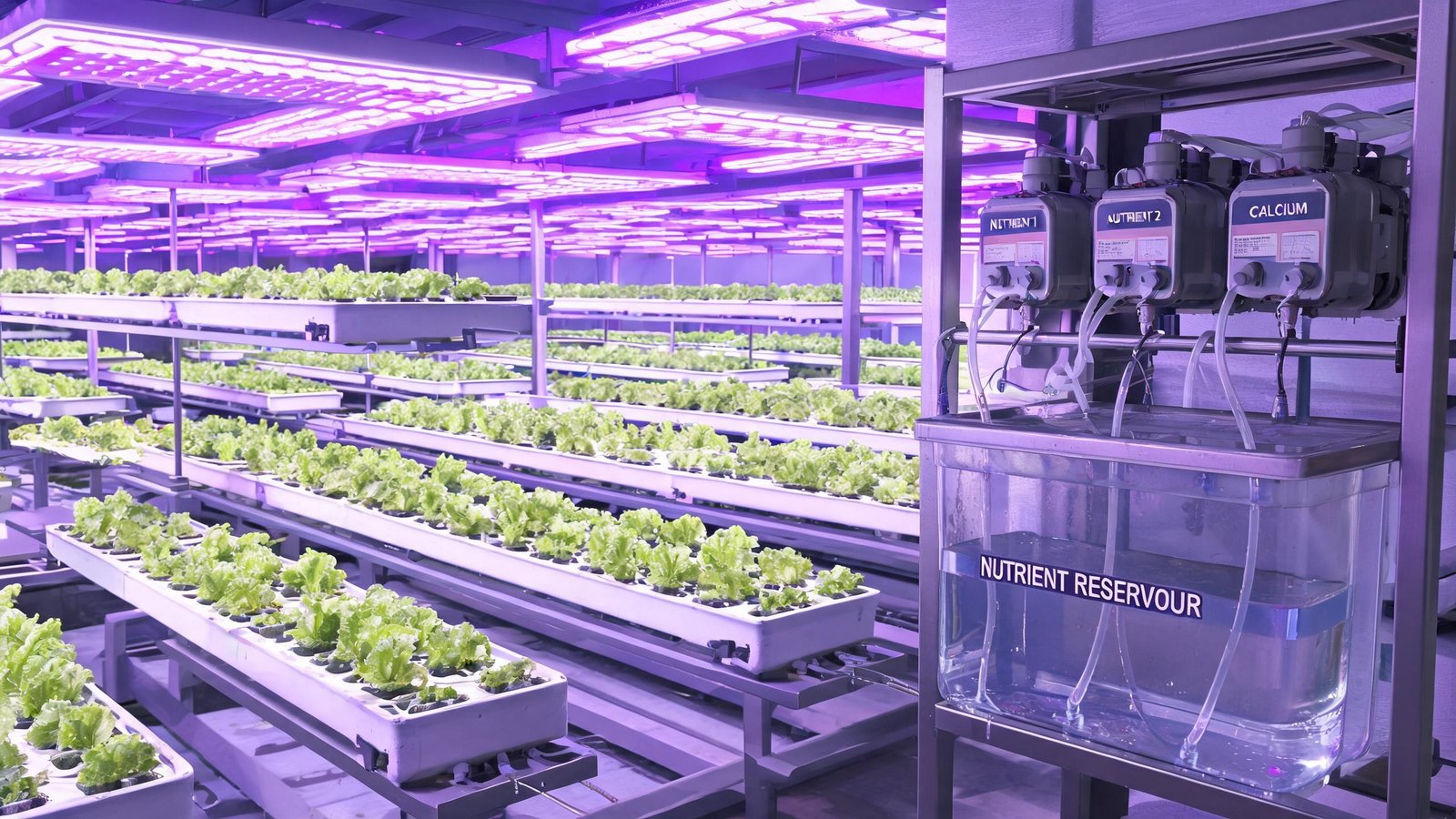
The global hydroponics market reached USD 17.2 billion in 2025 and is projected to grow to USD 19.47 billion in 2026 at a CAGR of 13.2%, driven by vertical farming expansion, water scarcity pressures, and controlled-environment agriculture investment. Vertical farming alone is forecast to grow from USD 8.52 billion to USD 10.61 billion at a 26.8% CAGR through the same period. Behind these figures is a supply chain of precision fluid-handling components — and the peristaltic pump is the dosing technology most commonly specified for nutrient delivery in commercial hydroponic systems.
For procurement teams at OEM equipment manufacturers, vertical farm operators, and fertigation system integrators, sourcing peristaltic pumps for nutrient dosing involves a matrix of technical, chemical, and commercial decisions that determine dosing accuracy, tubing longevity, and total cost of ownership. This procurement guide defines the specification framework, supplier evaluation criteria, and quality control checkpoints that separate reliable nutrient dosing pumps from marginal alternatives.
What Procurement Teams Should Define
Before approaching suppliers, the procurement team must document a complete dosing application profile. Incomplete specifications lead to mismatched pump selections that compromise nutrient ratio accuracy and require costly field replacement. The following parameters must be defined internally:
| Parameter | What to Specify | Why It Matters for Nutrient Dosing |
|---|---|---|
| Flow rate range | Minimum and maximum mL/min per channel | Determines whether the pump can cover both micro-dosing (iron chelate) and macro-dosing (calcium nitrate) |
| Dosing accuracy | ±% deviation from target volume | Commercial hydroponics requires ±2% or better to maintain EC stability; ±5% is acceptable only for hobbyist systems |
| Number of channels | Part A, Part B, pH-down, pH-up, micronutrients | Multi-channel systems prevent nutrient precipitation by keeping calcium and sulfate/phosphate stocks separate |
| Nutrient solution chemistry | Full list of chemicals, concentrations, and pH range | Determines tubing material compatibility; phosphoric/nitric acid for pH-down requires Viton or Santoprene, not standard silicone |
| Integration interface | Control signal (0-5V, 0-10V, 4-20mA, PWM, RS485) | Determines compatibility with EC/pH controllers and IoT fertigation platforms |
| Operating environment | Temperature, humidity, IP rating requirement | Greenhouse environments require IP54 or higher; vertical farm cleanrooms may require IP65 |
| Annual volume estimate | Units per year for OEM integration | Affects pricing tier, tooling amortization, and supplier qualification depth |
Procurement teams that skip the chemistry specification often discover tubing incompatibility during field operation. Calcium nitrate solutions, potassium sulfate, magnesium sulfate, and iron chelate (Fe-EDTA) are generally compatible with silicone tubing, but pH-adjustment acids — phosphoric acid and nitric acid — can degrade silicone within 200 operating hours. Specifying the full chemical list before supplier engagement prevents this failure mode.
Technical Requirements
Hydroponic nutrient dosing imposes technical requirements that differ from laboratory or industrial process pumping. The pump must deliver precise, repeatable volumes across multiple channels while withstanding intermittent exposure to corrosive pH-adjustment chemicals.
Flow rate and accuracy. Commercial hydroponic systems typically require per-channel flow rates between 10 and 200 mL/min, depending on reservoir volume and recirculation cycle frequency. Small-scale vertical farm modules may need as little as 10–50 mL/min for micronutrient channels, while macro-nutrient channels serving large reservoirs may require 100–500 mL/min. Dosing accuracy should meet ±2% at the target flow rate for commercial operations; stepper-motor-driven peristaltic pumps can achieve approximately ±1% accuracy, which is the preferred specification for EC-sensitive crops. For doses below 1 mL, accuracy degrades due to startup inertia, so the pump’s minimum reliable dose volume should be confirmed during specification.
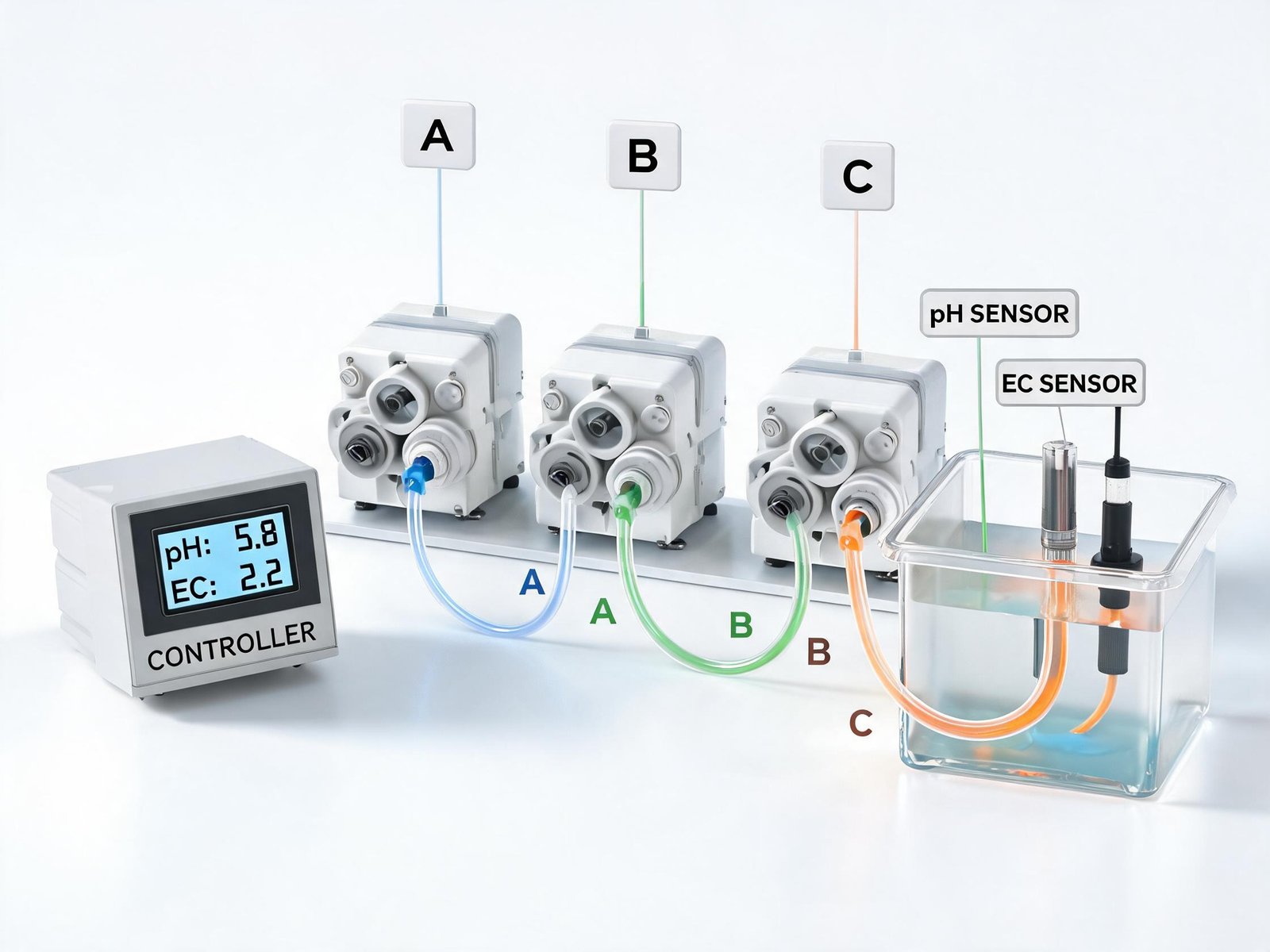
Multi-channel architecture. Modern hydroponic nutrient management separates dosing into at least four channels: Part A (calcium nitrate-based), Part B (sulfate/phosphate-based), pH-down (acid), and pH-up (alkali). Additional channels may be needed for micronutrient stock solutions. Procurement specifications should define the required channel count, whether channels share a common controller, and whether channels can be individually calibrated. A compact precision dosing pump for micronutrient channels may operate at different flow ranges than the macro-nutrient channels, requiring pump heads with different tubing sizes within the same controller architecture.
Tubing material and chemical compatibility. The tubing, not the pump internals, contacts the nutrient solution — this is a core advantage of peristaltic technology. However, tubing material selection is the most critical procurement decision for hydroponic dosing:
| Tubing Material | Chemical Resistance | Estimated Service Life | Best Application |
|---|---|---|---|
| Silicone | Moderate — suitable for mild nutrient solutions | 500–800 hours | Part A and Part B nutrient stocks |
| Santoprene | Higher — resists mild acids and bases | 1,000–2,000 hours | pH-up solutions, diluted nutrient concentrates |
| Viton (fluoroelastomer) | Very high — withstands concentrated acids | 2,000+ hours | Phosphoric acid, nitric acid pH-down |
Using a single tubing material across all channels is a common procurement mistake. While silicone is adequate for nutrient stocks, it degrades rapidly when exposed to concentrated pH-down acids. Procurement specifications should require different tubing materials per channel based on the dosed chemical, or specify a universal material like Viton at a higher cost but with significantly longer service life.
Control interface and IoT integration. The pump controller must interface with the facility’s EC/pH monitoring system. Current commercial hydroponic systems integrate EC sensors (typical range 0–5.0 mS/cm, ±0.1 accuracy) and pH sensors (range 2–12, ±0.1 accuracy) that trigger dosing based on threshold setpoints. Procurement should verify that the pump accepts the controller’s output signal — 0-10V analog, 4-20mA current loop, PWM, or digital RS485/Modbus — and that the controller supports closed-loop feedback to compensate for tubing wear over time. For IoT-enabled facilities, pumps that support MQTT or cloud-based remote management allow feed-chart adjustments and dosing-log retrieval from mobile or PC interfaces.
Supplier Evaluation
Supplier evaluation for hydroponic dosing pumps should assess technical capability, manufacturing quality, and commercial reliability. The following criteria distinguish qualified suppliers from commodity vendors:
Peristaltic pump design depth. The supplier should demonstrate application-specific pump configurations, not generic laboratory pumps repurposed for hydroponics. Request evidence of multi-channel dosing system deployments, tubing chemical compatibility testing data, and field service life documentation. A supplier that cannot provide tubing wear data for phosphoric acid exposure is not qualified for pH-down channel supply.
Manufacturing quality system. Verify ISO 9001 certification as a baseline. For pumps integrated into food-production equipment, NSF/ANSI compliance for food-contact components may be required, and CE marking is necessary for European market access. The supplier should provide dimensional inspection reports, motor performance test data, and flow calibration certificates for each pump shipment. The NSF/ANSI certification framework provides a reference for material safety in water-contact applications, though it is not a peristaltic-pump-specific standard.
OEM customization capability. For equipment manufacturers integrating pumps into fertigation skids or vertical farm control cabinets, the supplier should offer mounting bracket customization, multi-channel manifold integration, and controller firmware adaptation. Request samples of previous OEM integration projects with documentation of the mechanical interface, electrical connections, and software protocol. A pre-integrated housed pump unit reduces assembly time and simplifies enclosure design compared to bare pump-head components.
Tubing supply chain control. The supplier should either manufacture compatible tubing or maintain verified partnerships with tubing manufacturers. This ensures that replacement tubing meets the same chemical compatibility specifications as the original. Suppliers that leave tubing sourcing to the buyer introduce a compatibility risk that can cause field failures. The dosing pump tubing supply should be documented with material certifications and chemical resistance charts.
Commercial stability. Evaluate the supplier’s financial standing, production capacity relative to your annual volume, lead time consistency, and ability to support field issues. For OEM contracts, minimum two-year supply continuity with documented lead times and inventory buffer agreements is recommended.
Sample Testing
Sample testing is the procurement stage where specifications meet reality. No supplier claims should be accepted without independent verification. The following test protocol should be applied to at least three sample units per model:
Flow accuracy test. Set the pump to deliver a defined volume (e.g., 50 mL at 30 RPM) and measure actual delivery using a calibrated graduated cylinder or gravimetric scale. Repeat 10 times and calculate the coefficient of variation. For commercial hydroponic specifications, the CV should be below 2%. Test at minimum, mid-range, and maximum flow settings to identify accuracy degradation at the extremes of the operating range.
Tubing chemical immersion test. Cut tubing samples and immerse them in the actual nutrient solutions and pH-adjustment acids at field concentration for 168 hours (7 days) at the maximum operating temperature. Measure weight change, shore hardness change, and visual degradation. Tubing that exhibits more than 5% weight gain or visible cracking is unsuitable for that chemical. This test is especially critical for pH-down channels using phosphoric or nitric acid.
Endurance test. Run the pump continuously for 500 hours with the most aggressive chemical in the system (typically pH-down acid). Measure flow rate at the start, at 250 hours, and at 500 hours. Flow degradation exceeding 10% indicates insufficient tubing life for the application. This test also reveals bearing wear, roller assembly play, and motor thermal performance under continuous duty.
Integration test. Connect the pump to the actual EC/pH controller and verify signal response, dose triggering, and alarm handling. Test the full closed-loop sequence: sensor detects EC below setpoint, controller sends dose command, pump delivers nutrient, sensor confirms EC recovery. Document the response time and any communication errors. For multi-channel systems, verify that channels do not dose simultaneously when the controller specifies sequential dosing to prevent chemical precipitation.
Quality Control
Quality control for hydroponic dosing pump procurement extends beyond incoming inspection to ongoing supplier performance monitoring. The following QC framework should be contractually established:
Incoming inspection. For each shipment, verify pump model and configuration against the purchase order. Perform a 100% visual inspection for shipping damage. For critical applications, perform a sampling flow test on 5% of units (minimum 3 per shipment) using the protocol defined in sample testing. Record serial numbers, test results, and traceability data.
Batch documentation. Require the supplier to provide a certificate of conformance with each shipment, including: pump model and serial number range, flow calibration data, motor test results, tubing material and lot number, and chemical compatibility reference. This documentation supports field failure analysis and regulatory compliance for food-safety audits.
Field performance tracking. Establish a feedback loop with the equipment end-user or internal maintenance team to record: tubing replacement intervals, flow calibration drift between service intervals, and any pump failures. This data should be reviewed quarterly and shared with the supplier for corrective action. A pump head with quick-release tubing mechanism simplifies field maintenance and reduces downtime during tubing replacement.
Supplier performance scorecard. Track on-time delivery rate, defect rate (PPM), documentation completeness, and corrective action response time. Quarterly reviews with the supplier should address any scorecard items below target. For OEM contracts exceeding 500 units per year, consider a supplier quality engineer site audit annually.
Ordering Considerations
Final ordering decisions should balance technical specification, supplier capability, and total cost of ownership. The following considerations guide the purchase order:
Tubing lifecycle cost. The lowest-cost pump may use silicone tubing that requires replacement every 500–800 hours, while a mid-priced pump with Viton tubing may operate 2,000+ hours between changes. Over a one-year operating period with 12-hour daily dosing cycles, silicone tubing requires 5–6 replacements versus 1 for Viton. Calculate the total tubing cost per year, not just the pump unit price, when comparing suppliers.
Spare parts and service agreement. The purchase order should include initial spare tubing sets (minimum 3 sets per channel), a spare pump head, and a service manual. For OEM contracts, negotiate a service-level agreement for replacement part lead time (recommended: 15 business days maximum) and a field-failure response protocol.
Warranty terms. Standard industrial pump warranties cover 12 months from shipment. For hydroponic applications where continuous duty is common, negotiate 18 or 24-month coverage with a defined flow-accuracy guarantee (e.g., ±2% maintained for the warranty period with recommended tubing replacement intervals). The FTC warranty compliance framework provides reference guidance for commercial warranty terms.
Volume pricing and tooling. For annual volumes above 200 units, negotiate volume-based pricing tiers. If custom mounting brackets, controller firmware, or multi-channel manifolds are required, the tooling cost should be amortized over the expected contract volume and documented as a separate line item. For high-capacity dosing pump requirements serving large-scale commercial greenhouses, the tooling investment per unit decreases significantly above the 500-unit threshold.
Lead time and inventory buffer. Hydroponic equipment manufacturing schedules are often weather-dependent and seasonal. Establish a safety stock of 4–6 weeks of pump supply to prevent production line stoppages. For critical single-source components, maintain a dual-supplier qualification to mitigate supply disruption risk.
Specification Checklist
Use the following checklist to verify that all procurement specifications are complete before issuing the purchase order:
- Application profile: Flow rate range, dosing accuracy target, and number of channels defined
- Chemical compatibility: Full nutrient solution and pH-adjustment chemical list documented, with tubing material specified per channel
- Control interface: Signal type (analog/digital), communication protocol, and IoT integration requirements confirmed
- Environmental rating: IP rating, operating temperature range, and humidity tolerance specified
- Supplier qualification: ISO 9001 verified, NSF/ANSI or CE compliance confirmed where required, OEM customization capability demonstrated
- Sample testing: Flow accuracy, chemical immersion, endurance, and integration tests completed with documented results
- Quality control: Incoming inspection protocol, batch documentation requirements, and field performance tracking mechanism established
- Commercial terms: Volume pricing tiers, warranty period, spare parts package, lead time, and safety stock agreed
- Total cost analysis: Pump unit price, tubing lifecycle cost, maintenance labor, and downtime risk calculated for each supplier
For hydroponic nutrient dosing systems requiring peristaltic pump procurement, providing the nutrient solution chemistry, channel count, flow rate range, and controller interface specification enables suppliers to recommend pump configurations that meet commercial dosing accuracy requirements. You can discuss hydroponic nutrient dosing pump specifications with YOORAIN to identify suitable pump and tubing configurations for your fertigation system integration.