
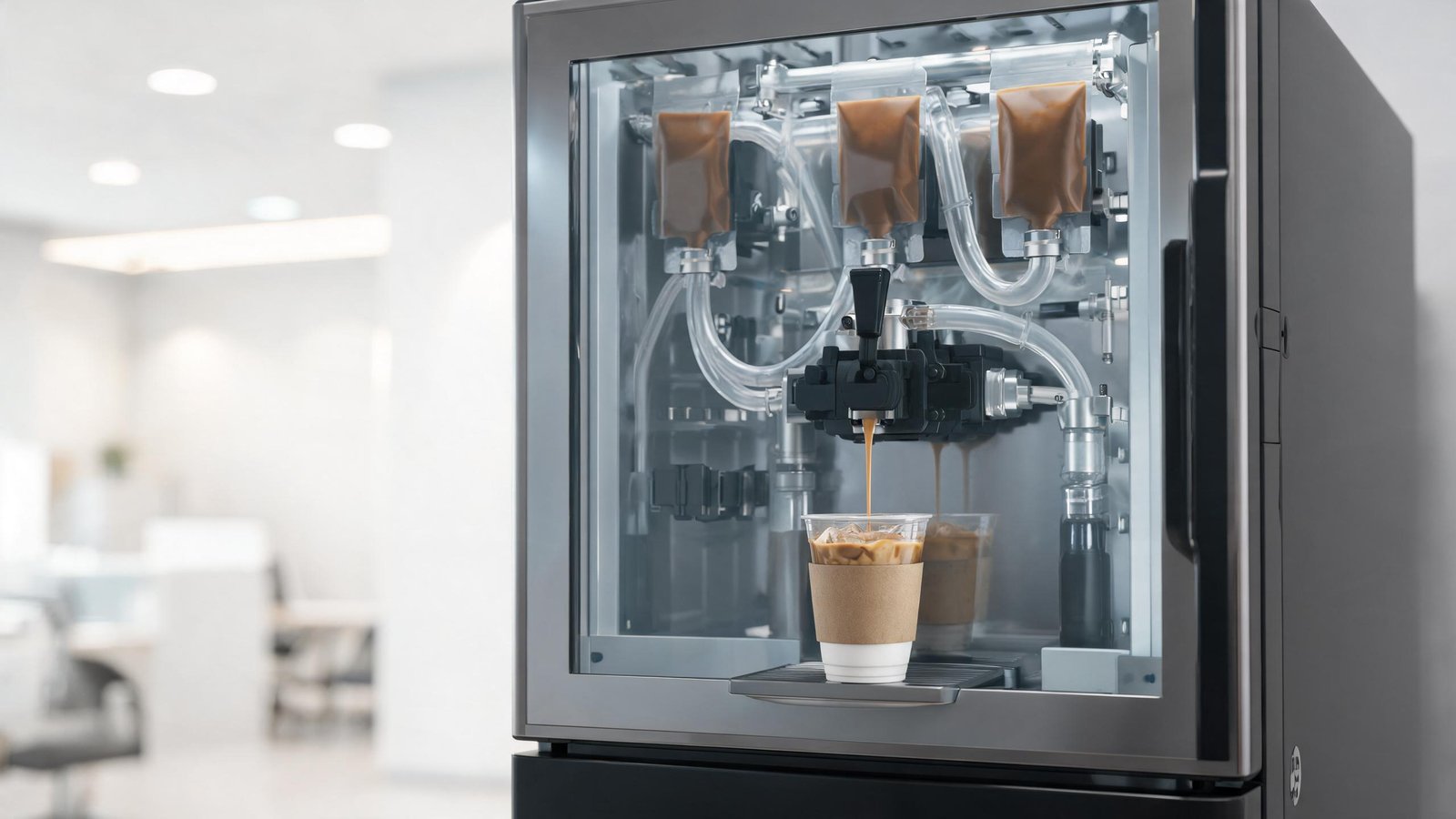
Japan operates several million beverage vending machines, and the same equipment class — concentrate-and-mix dispensers, coffee machines, smoothie and tea dispensers — is growing across Asia, Europe and North America. Inside each of these machines, a quiet engineering task repeats thousands of times a day: move a precise dose of syrup, concentrate, milk or water from a bag-in-box or reservoir into the mixing chamber, without the flavor degrading, the line clogging, or the pump adding noise to the customer experience. The peristaltic pump for vending machines has become the standard answer to that task, and for OEM equipment designers the selection details are worth understanding before committing a design.
This guide explains why the peristaltic principle suits beverage dispensing, what the fluid-handling requirements actually are, which pump characteristics matter, and where integration problems typically appear.
Why Peristaltic Pumps Fit Beverage Dispensing
Beverage equipment manufacturers choose peristaltic pumps for three practical reasons rather than by habit.
Product contact is confined to the tube. Everything the beverage touches is food-safe tubing; the motor, rollers and housing stay outside the fluid path. This simplifies food-safety qualification substantially, because the machine’s compliance case rests on one tube material rather than on an assembly of wetted metals, elastomers and lubricants. Well-specified peristaltic tubing carries recognized food-contact credentials — YOORAIN’s pump tubing is produced to meet USP Class VI and European Pharmacopoeia requirements as well as the FDA regulation for rubber articles intended for repeated food contact (21 CFR 177.2600), and equipment built around such tube aligns with the sanitation expectations of NSF/ANSI 18, the standard for manual food and beverage dispensing equipment.
The mechanism tolerates the fluids. Coffee syrups, fruit concentrates and sweetened tea bases are viscous and contain sugar particles; milk is delicate and spoilage-prone. A peristaltic pump moves all of these gently — there is no impeller shearing the product and no valve for particles to jam. When a line empties, the pump simply keeps displacing air, and when the line refills it recovers without re-priming procedures.
Cleaning is a tube change. The hygiene routine in beverage equipment ultimately comes down to replacing or flushing the fluid path. With a peristaltic design, swapping one tube resets the entire product-contact system in minutes — no disassembly of valve blocks, no CIP circuit for the pump itself. The FDA Food Code for retail food service emphasizes cleanable, replaceable product-contact surfaces, and a tube-based fluid path is about as cleanable as mechanical design gets.
Main Fluid-Handling Requirements
Beverage dosing duties share a requirement profile that differs from industrial pumping in useful ways:
| Fluid | Handling Characteristic | What the Pump Must Do |
|---|---|---|
| Coffee and flavor syrups | Viscous, sticky, sugar-laden | Positive displacement at low speed; tolerant tubing |
| Fruit concentrate | Viscous with pulp particles | Particle-friendly mechanism, no shear damage |
| Milk and creamers | Perishable, foam-sensitive | Gentle low-pulse transfer; fast tube swap for hygiene |
| Water and sparkling water | Thin, but carbonated lines foam | Steady low-pulsation delivery, no aeration |
Two numbers dominate the sizing conversation: dose volume per serving and service cycle rate. A coffee machine dispensing 30 ml of syrup per cup at busy-hour demand needs modest average flow but repeatable dose-to-dose consistency; a smoothie dispenser pulling continuous concentrate needs real flow rate. Sugar also raises the stakes on tubing selection — sticky media reward smooth-bore, low-adhesion tube with generous wall thickness.
Pump Selection Considerations
YOORAIN builds pumps specifically for this equipment class, and the product family illustrates the selection trade-offs well. The K335 vending machine peristaltic pump delivers up to 2000 ml/min with lower-pulse delivery, uses 24#/35#/36# tubing with 2.4 mm walls that handle viscous fluids, and arranges inlet and outlet in a vertical straight line — a layout that shortens the fluid route inside tall, narrow vending cabinets. The K25S vending machine peristaltic pump is the updated version of the K25 platform: an added roller smooths delivery while the flow ceiling rose from 1200 to 1300 ml/min, and a standard DC motor configuration makes it economical for mass production. For compact machines and low-volume dosing, the K4024 mini peristaltic pump covers 4.2–2500 ml/min depending on tube size and motor, with a snap-type pump head whose transparent cover lets a service technician check tube condition at a glance.
| Model | Max Flow | Tubing | Motor Options | Design Strength |
|---|---|---|---|---|
| K335 | 2000 ml/min | 24#/35#/36#, 2.4 mm wall | Stepper / DC / AC | Vertical straight-through fluid path |
| K25S | 1300 ml/min | 15#/24#/35# family | DC (standard), others optional | Mass-production economy, smoother delivery |
| K4024 | Up to 2500 ml/min | 24#/35#/36# | Stepper / DC / AC | Snap-assembly head, visible rotor |
Beyond flow rate, four characteristics separate a vending-duty pump from a generic one:
- Pulsation profile. Roller count and geometry determine how smoothly concentrate arrives at the mixing nozzle; smoother delivery means better portion consistency and less foam.
- Noise. Machines serve customers in offices and hotel corridors. Quiet gear geometry and balanced rotors keep pump noise below the ambient threshold of the machine.
- Tube-change access. Service happens in the field, often by a route technician. Snap-type heads and quick-release covers directly reduce service time.
- Motor economics. At vending production volumes, a few dollars of motor cost multiplies quickly. Platforms offering DC, stepper and AC variants on one pump head let the OEM match cost to duty.
Common Design Problems
Field experience in beverage equipment points to a handful of recurring issues, each with a design-level fix:
- Dose drift over service life. As the tube takes a compression set, output per revolution slowly falls and servings under-dose. Scheduled tube replacement and periodic flow verification prevent it; the principles are the same as those behind peristaltic pump flow rate calculation and calibration.
- Sugar crystallization at fittings. Concentrate that sits in fittings between cycles dries and builds restriction. Straight-through fluid paths with minimal dead volume — the K335’s vertical layout, for example — and warm-environment ratings for the tube reduce the problem.
- Foaming at the nozzle. Pulsation and aeration are the usual suspects. Lower-pulse pump heads, shorter downstream tubing and avoiding suction leaks on the inlet side all help.
- Tube failure disguised as an electronics fault. A worn tube lets air into the line, which looks like an intermittent dispensing error. Transparent pump covers and service reminders tied to cup counts make the real cause visible.
Integration Into Equipment
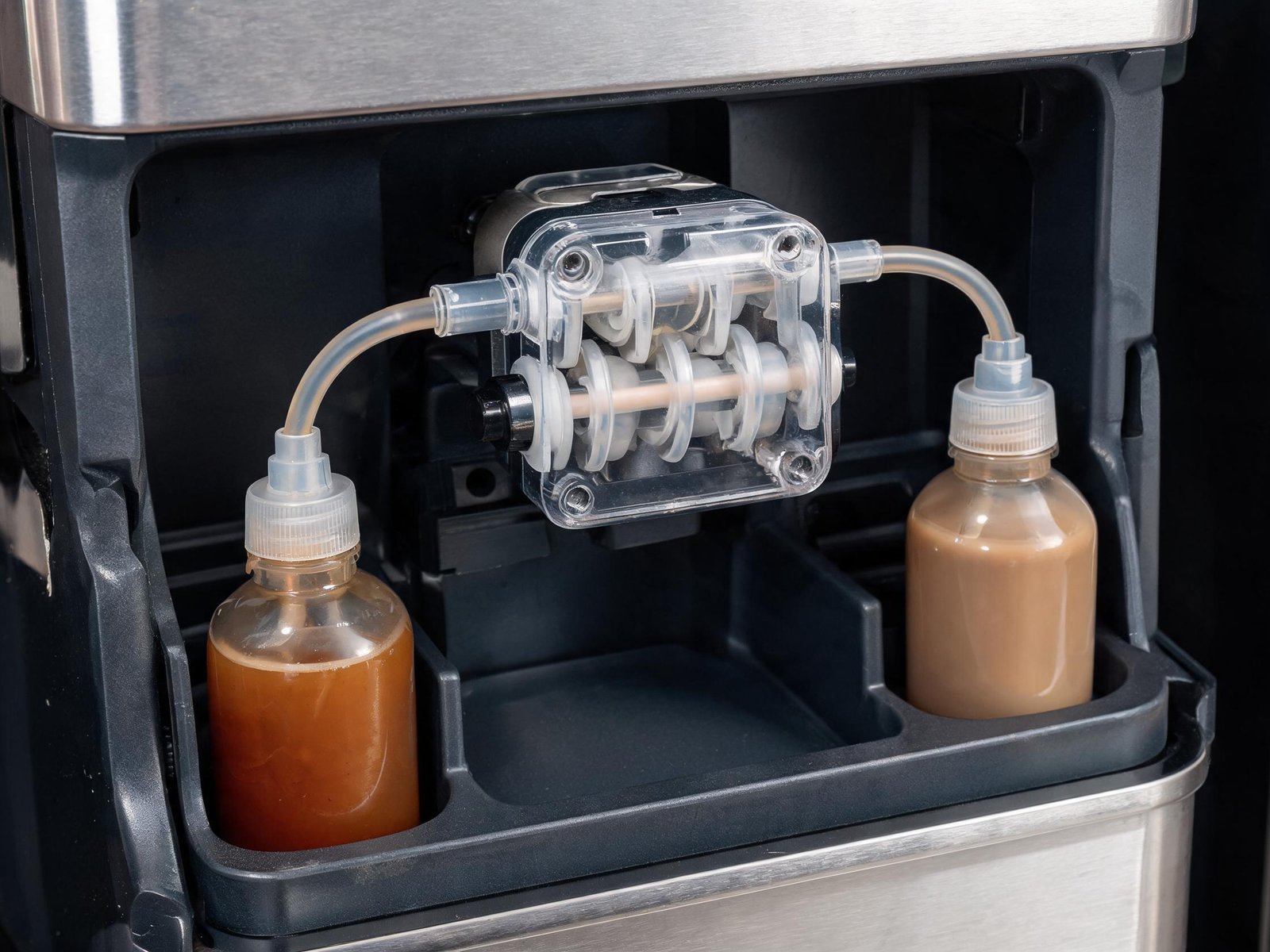
Mechanical integration determines how much the pump’s strengths survive into the finished machine. Mount the pump close to the reservoir to keep suction lines short, orient it so the tube can be replaced without removing adjacent modules, and route tubing away from compressor heat. Electrically, the machine controller drives the pump through a relay or driver — stepper-driven variants accept direction and speed control for dose shaping, while simple DC variants suit fixed-speed duties on a relay output.
| Integration Aspect | Recommendation | Rationale |
|---|---|---|
| Mounting position | Low in the cabinet, near reservoir | Short suction line, reliable fill |
| Tube routing | Wide bends, away from heat | Prevents kinks and accelerated wear |
| Service access | Head faces the service door | Fast tube replacement in the field |
| Control wiring | Match motor type to controller output | Avoids added converter hardware |
| Compliance evidence | Keep tube food-contact declarations on file | Supports NSF/ANSI 18 and market-specific reviews |
Sourcing from the same supplier family across models also pays off at integration stage: shared tube sizes and mounting conventions between the K335, K25S and K4024 mean one service kit can cover a multi-product machine lineup. For a broader view of how these pumps behave with food products, see our guide to peristaltic pumps in food and beverage processing.
Conclusion
Beverage dispensing rewards a pump principle that is boring in the best way: one tube, gentle displacement, nothing between the product and the outside world except tubing that can be swapped in minutes. For vending machine and coffee equipment OEMs, the practical work lies in matching flow range to serving volume, choosing roller geometry for pulse and noise, and designing the cabinet around tube replacement. Pumps built for the duty — like the K335, K25S and K4024 in YOORAIN’s vending lineup — exist precisely so those decisions stay straightforward.
If you manufacture vending, coffee or beverage dispensing equipment, ask YOORAIN for pump samples and test them with your own syrup and concentrate formulations before locking the design.