
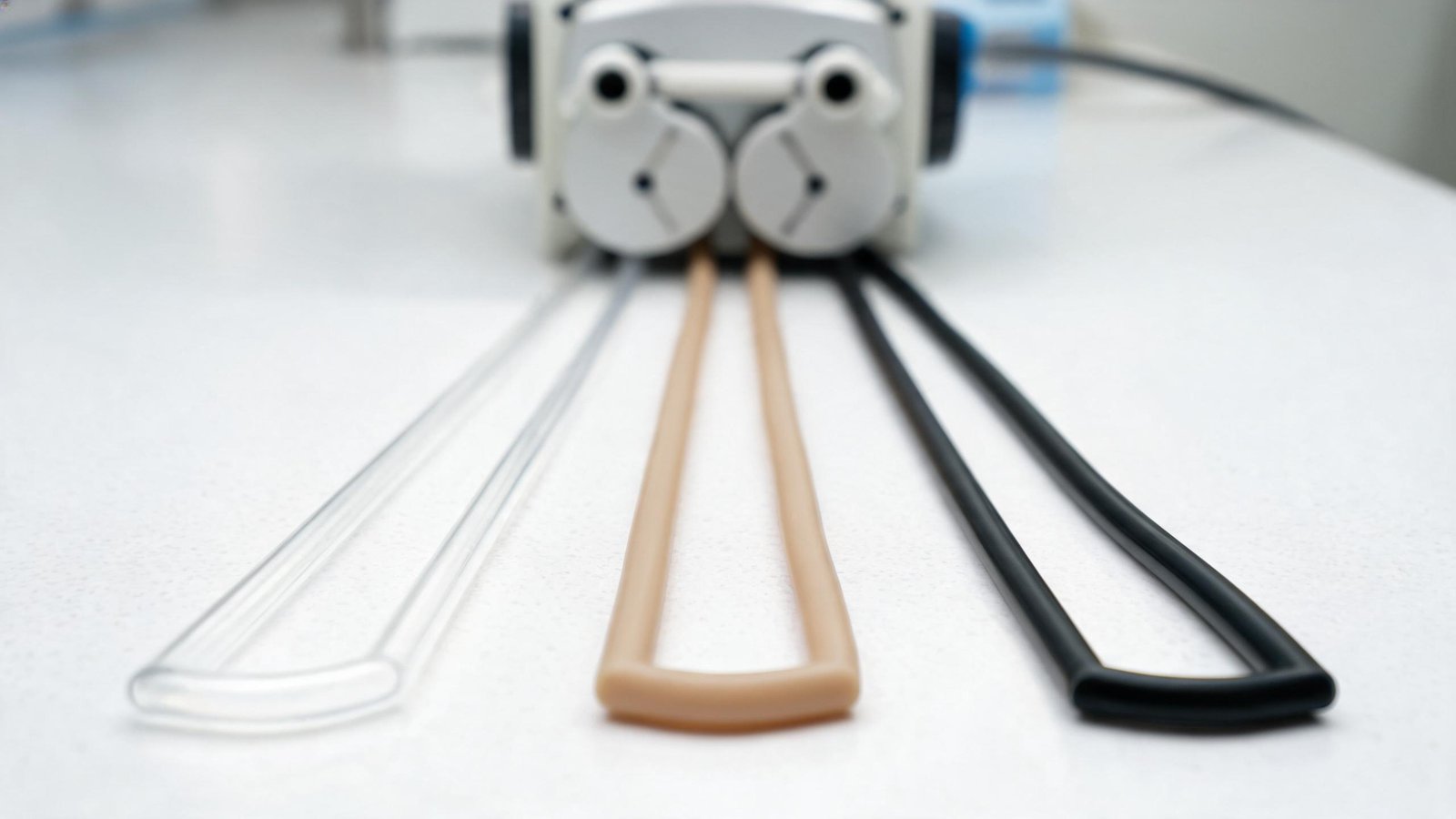
An OEM engineer specifies a peristaltic pump for a new dosing system and the pump head, motor and driver are settled within a week. Then the project stalls for a month — on the tube. The silicone tube swells in a solvent-based ink. The replacement tubing cannot be autoclaved. The third option costs four times more than the pump itself. Tubing material selection is where many peristaltic pump projects are actually won or lost, because the tube is the only wetted part and it defines chemical compatibility, service life and regulatory status in one decision.
The three materials that dominate small and mid-size peristaltic pumps are platinum-cured silicone, PharMed BPT and Viton (FKM). Each is the right answer for a different set of fluids and operating conditions. This guide compares them on the properties that matter in purchasing and engineering decisions, with confirmed specification data from YOORAIN’s peristaltic pump tube range and pump models that ship with multiple tubing options.
What Makes the Three Materials Different
Silicone tubing used in peristaltic pumps is typically platinum-cured: the curing chemistry leaves almost no extractable residues, the wall is highly transparent and the material stays flexible across a wide temperature range. It is the default choice for food, beverage, laboratory and general transfer work because it is economical, easy to inspect visually and gentle on delicate fluids such as cell cultures.
PharMed BPT is a thermoplastic elastomer developed specifically for peristaltic pump duty. Compared with silicone it is less permeable to gases, more resistant to repeated flexing fatigue and far more resistant to acids, alkalis and many cleaning agents. Industry references describe it as autoclavable and compliant with the same food-contact criteria as platinum silicone, and it has become the standard long-life option in pharmaceutical and bioprocess work.
Viton (FKM) tubing trades flexibility for chemical resistance. It handles aggressive media — concentrated acids, fuels, oils and many solvents — that would destroy silicone in hours. The trade-offs are a much stiffer wall, higher cost per metre and, because of the stiffness, higher motor torque demand and shorter flex life at a given speed. Viton is a specialist material: correct when the chemistry demands it, wasteful when it does not.
| Property | Platinum Silicone | PharMed BPT | Viton (FKM) |
|---|---|---|---|
| Wall flexibility | Very high | Medium | Low (stiff) |
| Transparency | High — fluid visible | Opaque beige | Opaque, usually black |
| Chemical profile | Water-based fluids, weak acids/alkalis | Acids, alkalis, alcohols, many cleaning agents | Concentrated acids, oils, fuels, many solvents |
| Gas permeability | Relatively high | Low | Very low |
| Autoclavable | Yes | Yes | Limited — check grade |
| Flex fatigue life in pump duty | Good | Longest of the three | Shortest — stiffness works against it |
| Relative cost | Lowest | Medium | Highest |
Chemical Compatibility Comes First
The first filter is always the fluid. A material that is perfect in every other respect fails immediately if the chemistry is wrong. Silicone swells in many organic solvents and is degraded by strong oxidising acids; PharMed BPT covers a much broader band of aqueous chemistry including dilute acids and alkalis; Viton is the fallback for the aggressive end of the chart.
Compatibility must be checked against the exact fluid — name, concentration and temperature — not a generic family name. A 5% sodium hypochlorite solution and a 15% solution at 50°C are different engineering problems. The most reliable working tools are the manufacturers’ compatibility databases: the Cole-Parmer Masterflex tubing application guide published by Thermo Fisher Scientific rates each formulation against hundreds of chemicals, and the comparison data in this overview of peristaltic tubing types gives a useful first-pass screening. Where the chart says “limited” or “not rated”, a 48-hour immersion test with the actual fluid settles the question before any pump is ordered.
Pressure, Temperature and Flex Life
After chemistry, the mechanical environment decides. Three questions cover most of it:
- What is the discharge pressure? Soft silicone walls expand visibly under pressure, which shows up as dose overshoot and pulsation. Stiffer formulations hold their bore better, so PharMed BPT or thick-wall silicone is preferred once discharge pressure rises beyond a modest back-pressure.
- What is the fluid and ambient temperature? Silicone tolerates the widest band and keeps its flexibility in cold rooms and near warm process lines. PharMed BPT covers normal process temperatures and autoclaving. Viton handles heat well but stiffens further in the cold.
- How many hours per day will the pump run? Flex fatigue is the normal end-of-life mechanism for peristaltic tubing. For continuous or near-continuous duty, the longer flex life of PharMed BPT usually outweighs its higher price; for intermittent dosing a few times per hour, silicone’s lower cost wins on total ownership cost.
Speed interacts with all three. Running a stiff tube at high rpm multiplies fatigue cycles and heat build-up in the compressed zone, which is why Viton sections are normally run slowly and in larger bores.
Food-Contact and Regulatory Compliance
For food, beverage and pharmaceutical equipment, the compliance claim on the tube matters as much as the chemistry. The relevant US reference is 21 CFR 177.2600 for rubber articles intended for repeated food contact, with USP Class VI and European Pharmacopoeia requirements covering biocompatibility-sensitive work.
YOORAIN’s pump tubing is manufactured against exactly these criteria: the tube range meets USP Class VI, FDA 21 CFR 177.2600 and European Pharmacopoeia requirements, with an ultra-smooth inner wall to limit particle adhesion and low leaching characteristics confirmed for batch consistency. That compliance set is available on the standard tubing used across the pump range, so a single tubing specification can cover a machine family sold into food and laboratory markets.
| Requirement | What it covers | Typical requesting industry |
|---|---|---|
| FDA 21 CFR 177.2600 | Rubber articles for repeated food contact | Food and beverage OEM, vending, dairy |
| USP Class VI | Biological reactivity testing of plastics and elastomers | Pharmaceutical, bioprocess, medical devices |
| European Pharmacopoeia (EP) | Material requirements for pharma-contact polymers | EU pharmaceutical and laboratory equipment |
| Low leaching / low protein adhesion | Protects sensitive fluids from contamination | Cell culture, diagnostics, reagent handling |
Matching Material to Pump and Application
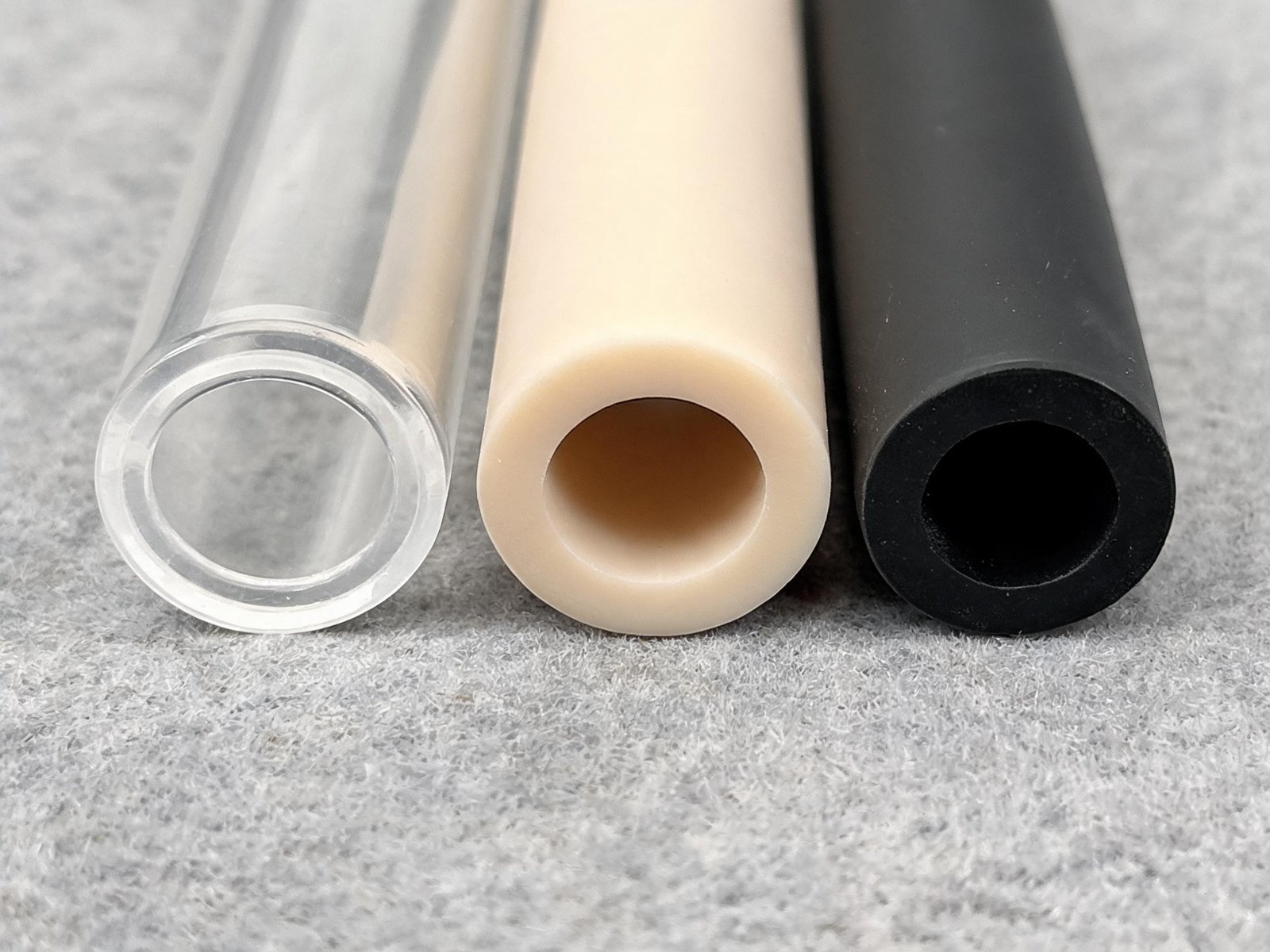
Material choice also interacts with the pump model. Smaller pumps with low-torque motors pair naturally with soft silicone; models designed for chemical duty offer factory tubing options so the pump arrives ready for the fluid. YOORAIN’s KFS DC brush motor peristaltic pump is a clear example: it can be configured with PharMed BPT, Viton or silicone tube depending on the fluid, so the same 6V/12V/24V platform covers laboratory reagents, nutrient dosing and more aggressive chemistry without a redesign. The K25 small peristaltic pump, rated up to 1200 ml/min, accepts 15#, 24# and 35# tube in silicone or BPT — useful when one machine frame must serve both a food-grade and a chemical-grade SKU.
| Application | Fluid examples | Recommended starting material |
|---|---|---|
| Food and beverage dosing | Syrups, flavours, dairy, sauces | Platinum silicone (FDA 177.2600) |
| Biopharma and cell culture | Media, buffers, harvest transfer | PharMed BPT (USP Class VI, low leaching) |
| Water treatment dosing | Hypochlorite, pH adjusters, coagulants | PharMed BPT or verified-compatible grade |
| Aggressive chemical transfer | Concentrated acids, oils, solvent-based fluids | Viton, after immersion test |
| General laboratory transfer | Water-based reagents, samples | Platinum silicone |
Flow planning closes the loop. Once the material and bore size are chosen, the delivered flow at the intended speed and back-pressure should be checked against a calculation rather than a catalogue maximum — the method in our guide to peristaltic pump flow rate calculation and calibration applies to any of these materials and flags where wall expansion or suction conditions will pull real output below the theoretical figure.
Which Option Fits the Application?
The decision usually collapses into three cases. If the fluid is food-grade or a mild water-based reagent and the run cycle is intermittent, platinum silicone is the economical, compliant default. If the pump runs continuously, sees regular acid or alkali exposure, or sits inside a pharmaceutical machine with documented biocompatibility requirements, PharMed BPT earns its price through service life. If the fluid is chemically aggressive enough to attack the first two, Viton is the correct specialist choice — accepted with its stiffness and cost, and validated by an immersion test before committing to production volumes.
If you are weighing two materials against a specific fluid, send YOORAIN the fluid name, concentration, temperature and target hours per day. We will return a tubing material recommendation with the matching pump model and can supply sample tube lengths for your own immersion and flex testing before you freeze the bill of materials.