
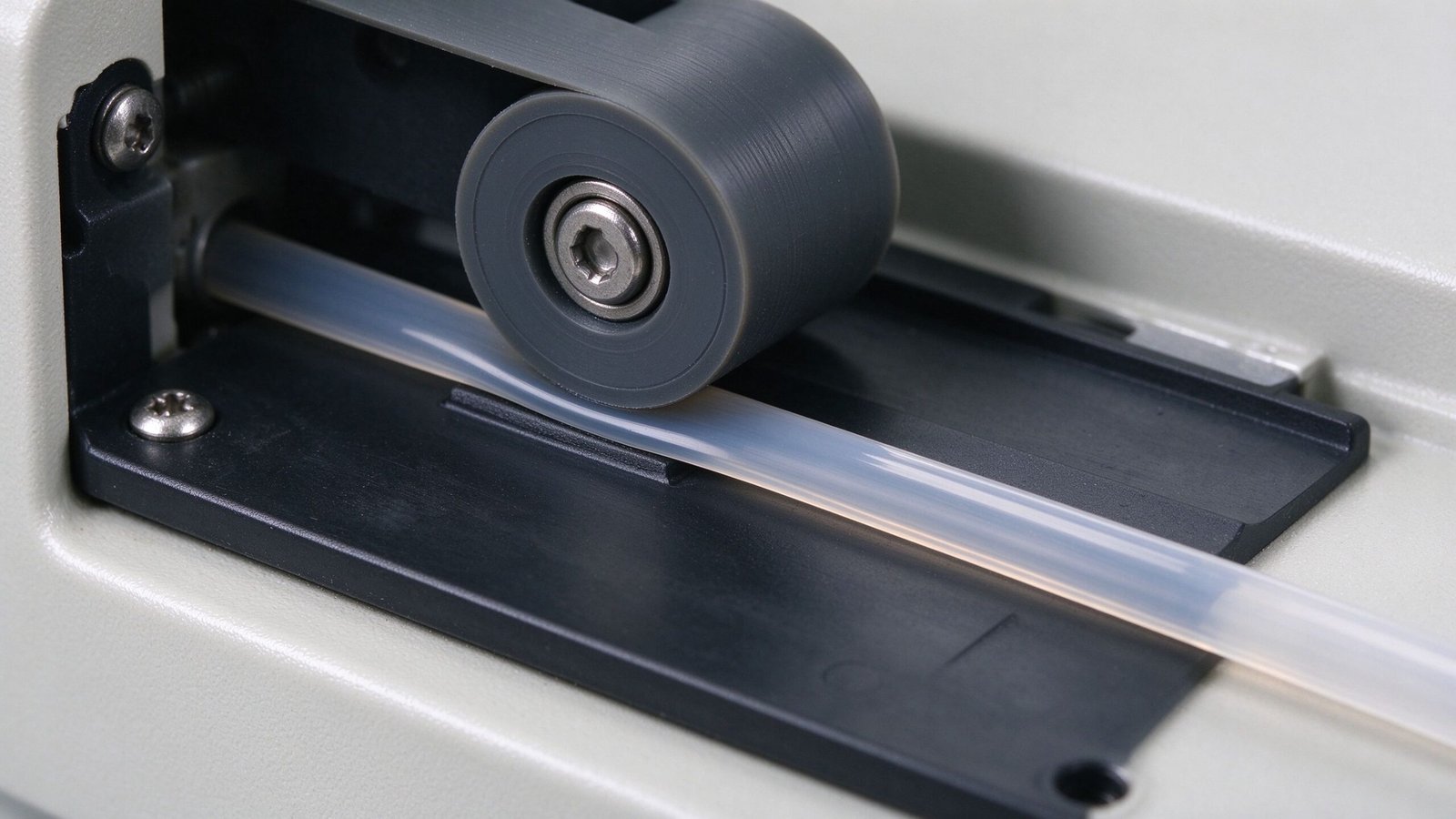
Occlusion is the single most important mechanical setting on a peristaltic pump, and it is the one most often ignored. It is the amount by which the roller squeezes the tube flat against the pump bed. Too little and the pump leaks back, loses prime, and delivers less than the rated flow. Too much and the tube fatigues in days, overheats, and wears the motor. Get it right and the pump is accurate, quiet, and long-lived. This reference explains what occlusion is, how it is set, how it changes with tube material and diameter, and how to judge it on the bench.
What Occlusion Actually Means
A peristaltic pump moves fluid by pinching a flexible tube between a roller and a fixed bed. The roller must fully close the tube at the pinch point so that the fluid ahead is pushed forward and the fluid behind is drawn in. Occlusion is the small distance between the fully closed tube and the bed: how much extra squeeze the roller applies beyond just flattening the tube.
A tube that is just touched, not closed, allows fluid to slip backward around the roller. The pump still turns, but the net flow drops and it cannot hold suction, especially with a long intake or viscous fluid. A tube that is squeezed flat with a little extra compression seals positively, and that is the working point. The challenge is that “a little” is measured in fractions of a millimeter, and it changes as the tube material, diameter, and wall thickness change.
| Occlusion state | What you see | Consequence |
|---|---|---|
| Too little (under-compressed) | Low flow, poor suction, slip at low speed | Leak-back, inaccurate dosing, loses prime |
| Correct | Smooth flow, quiet, starts reliably | Predictable tube life, accurate volume |
| Too much (over-compressed) | Hard turning, warm head, fast tube wear | Cracked tube, motor overload, short life |
Why It Is a Trade-Off, Not a Maximum
It is tempting to think more squeeze is better, because it guarantees a seal. But occlusion is a balance between sealing and tube life. Every compression cycle flexes the tube wall, and over-compression bends it past its designed fatigue limit. The tube does not fail immediately; it wears out faster, often after only a fraction of its expected hours. The symptom is a tube that develops a small pinhole or splits at the pinch point long before the pump motor shows any problem.
The correct occlusion is the minimum compression that still gives a positive seal under the real load. That means it is tested on the actual fluid, at the actual back-pressure, and at the coldest expected temperature. A setting that seals with water at room temperature may leak with a viscous fluid on a cold morning, and a setting that seals with the viscous fluid may over-compress a thin-wall tube. Sizing the right head and drive, as covered in peristaltic pump drive selection, is what leaves room for the correct occlusion instead of forcing it.
How Tube Material and Wall Thickness Change It
Occlusion is not a fixed number on the head; it is a function of the tube. A soft silicone tube compresses easily and needs less extra squeeze. A harder or reinforced tube needs more. Wall thickness matters as much as diameter: a thick-wall tube needs more bed clearance to fully close, and the same roller setting on a thin-wall tube will over-compress it. This is why a pump head is matched to a specific tube range, not to any tube that fits.
Changing tube material without re-setting occlusion is a common source of trouble. A user swaps from one tubing grade to another for chemical compatibility and the pump either loses flow or the new tube wears out quickly. The fix is to re-check the occlusion when the tubing changes. The compatible peristaltic pump tube range lists the sizes a given head accepts, and the head should be set for that size rather than adjusted by feel.
How Roller Count Interacts With Occlusion
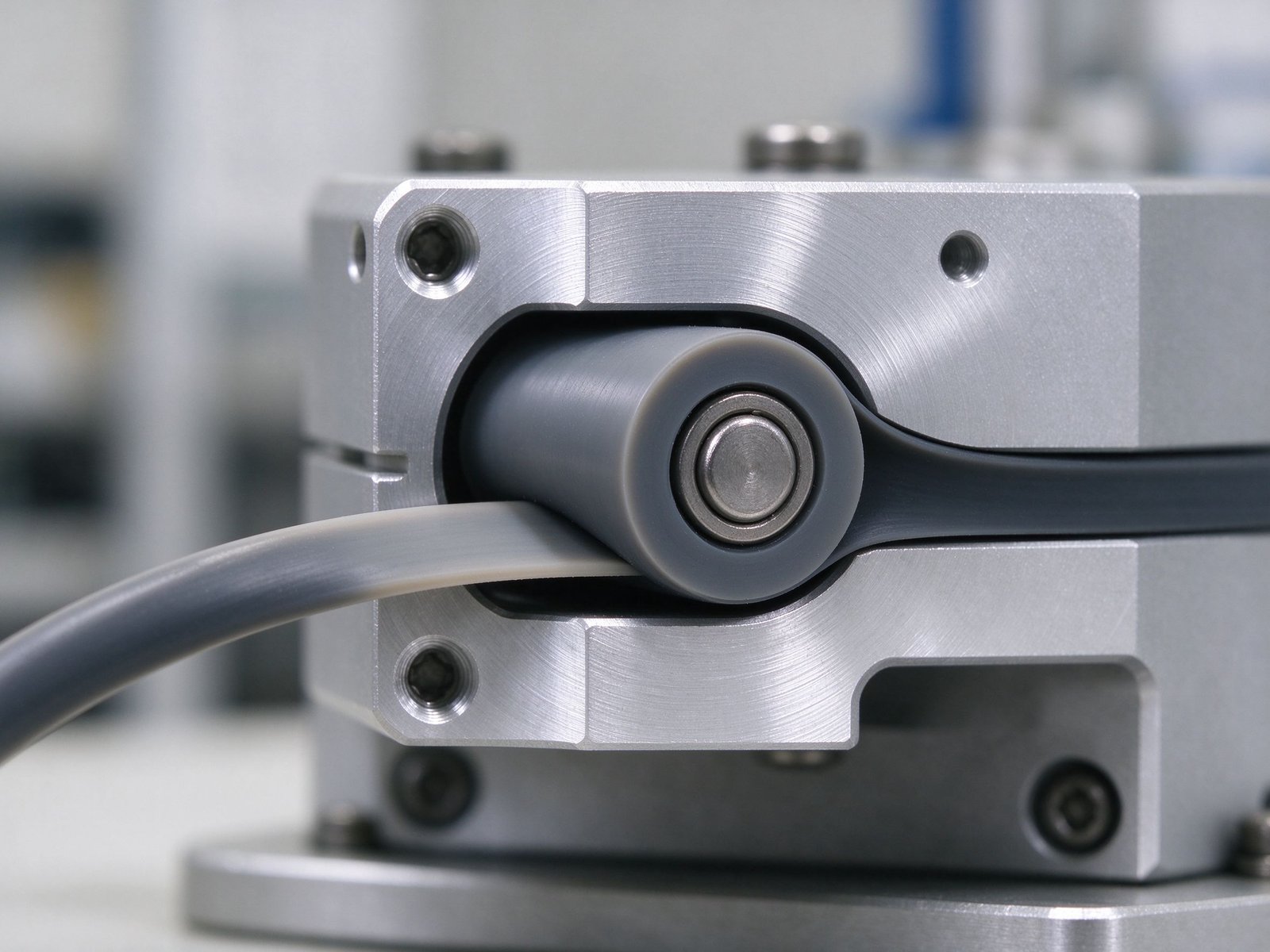
The number of rollers changes the feel of the pump more than its occlusion setting. A two-roller head gives a smooth, lower-pulse flow but must seal fully at each pinch. A multi-roller head seals more frequently, which improves suction and reduces pulse, but each roller adds a compression cycle on the tube per revolution. More rollers mean more flex cycles per revolution, which shortens tube life for the same occlusion.
This is why head choice is coupled to tube life. A head chosen for low pulse may wear tubes faster, and that is a known trade-off, not a defect. The small peristaltic pump heads and the large-flow peristaltic pump heads use different roller counts for their flow ranges, and the tube life for each assumes the correct occlusion for that head.
Setting and Measuring Occlusion on the Bench
You do not need a special gauge to set occlusion well; a flow test reveals it. Run the pump on water, measure the output over a fixed time, and compare it to the expected displacement. If the output is low and the pump cannot lift fluid from a flooded intake, it is under-compressed. If the output is right but the head is warm after a run and the motor draws more current than expected, it is over-compressed. The adjustment, where the head allows it, is a screw or spacer that sets the bed distance from the roller path.
For production consistency, the check should be repeatable: a fixed run time, a measured volume, and a current or temperature read. This is the kind of gravimetric, point-of-use measurement described by NIST’s Physical Measurement Laboratory — weigh the delivered volume rather than trusting the RPM reading. A supplier that ships heads with a recommended occlusion for a given tube should state it, and the paired motor-driver operating manual often lists the current draw that indicates correct loading.
| Bench check | Under-compressed | Over-compressed |
|---|---|---|
| Delivered volume vs expected | Below expected | At or near expected |
| Suction lift test | Fails to draw | Holds suction |
| Motor current at run | Normal or low | High, warm head |
| Turning feel by hand | Loose, floppy | Hard, stiff |
| Tube wear after hours | Little wear, poor seal | Fast wear, splits at pinch |
How Occlusion Drives Tube Life
Tube life is dominated by compression fatigue, and fatigue rises steeply with over-compression. A tube set at the correct occlusion may last its rated hours; the same tube squeezed too hard can fail in a small fraction of that. This is why pump suppliers publish tube life as an expected range, not a guarantee: the real number depends almost entirely on the occlusion, the speed, the fluid, and the temperature.
Speed compounds it. A head run fast flexes the tube more times per hour, and a fast over-compressed pump is the fastest way to a failed tube. If an application needs a high flow, the right answer is a larger head turning slowly rather than a small head spinning fast — that reduces both flex cycles and the sensitivity to occlusion. A mini peristaltic pump run slowly and correctly occluded will outlast the same pump run fast and over-compressed by a wide margin.
Occlusion and Noise
Noise follows the same curve. Under-compressed heads are quiet but slip. Over-compressed heads are noisy and hard-turning because the roller is forcing the tube past its elastic limit against the bed. The quiet working point is again the correct occlusion, not the tightest. In a clinical or office device, a noisy pump is almost always an over-compressed or wrong-size tube, and easing the occlusion or fitting the correct tube quiets it more than any damping material.
Temperature and Fluid Effects on the Seal
Occlusion behaves differently as temperature changes. A cold tube is stiffer, so the same roller compression that seals at room temperature may under-compress it on a winter morning, and the pump loses suction. A warm tube softens, so it seals more easily but also fatigues faster. The practical consequence is that the occlusion should be set at the coldest expected operating temperature, because a setting that works cold will still work warm; the reverse is not true.
The fluid itself changes the picture. A low-viscosity fluid like water slips past a marginal seal more easily than a thick fluid, so a pump that seals fine on oil may leak back on water. Viscous fluids need less absolute seal but more torque to push through, which raises the load on the drive. When the application spans fluids or seasons, the bench test should cover the worst case rather than the average. The U.S. National Science Foundation’s engineering research on fluid handling supports the same point: seal performance is a function of the whole system, not the head alone.
Occlusion Across Common Tube Materials
Different tubing materials compress differently, and the occlusion that suits one will not suit another. Soft silicone closes with little extra squeeze and is forgiving, but it wears faster. Fluoroelastomer and reinforced tubes are stiffer and need a more deliberate compression, and they are less forgiving of over-tightening. The table below is qualitative, not a specification — the supplier’s recommended setting for the exact tube grade governs.
| Tube material | Compression feel | Occlusion sensitivity |
|---|---|---|
| Silicone | Soft, easy to close | Forgiving; wears faster |
| Pharmed / thermoplastic elastomer | Medium, elastic | Balanced, common in lab use |
| Fluoroelastomer | Stiffer, chemical-resistant | Less forgiving of over-compression |
| Reinforced / thick-wall | Firm, needs more closure | Set by supplier recommendation |
This is why swapping tubing for chemical compatibility without re-checking occlusion is risky. The new material may need a different bed setting, and a head left as-is can either under-seal or over-compress it. When the application requires a chemical-resistant tube, ask for the recommended occlusion for that grade rather than carrying over the old setting.
Setting Occlusion in OEM Production
For a one-off bench pump, setting occlusion by flow test is enough. For an OEM building hundreds of units, the setting must be repeatable. That means a fixed assembly procedure: the correct tube, a reference setting on the head, and a final 30-second flow check against a tolerance. Units that deliver outside the tolerance are adjusted or rejected. This turns a subjective feel into a verifiable number, and it catches a head that was assembled with the wrong spacer.
A supplier that builds pumps in volume can pre-set the occlusion and supply a test method, which removes this task from your line. The peristaltic pump driver reference describes the kind of controlled-speed drive that makes the final flow check repeatable, because the pump runs at a known RPM rather than a noisy open-loop speed. That consistency is what lets you compare one unit to the next on the production line.
How Occlusion Interacts With the Drive
Occlusion does not live in isolation; it loads the motor. An over-compressed head draws more current and runs warm, which the drive sees as a higher load. A drive with over-current protection can even trip on an over-tightened head, and a user who increases the current limit to stop the trip is masking a mechanical problem. The correct response is to reduce the occlusion, not to override the protection.
Conversely, an under-compressed head draws little current and looks healthy on the bench, but it delivers less flow than expected. The drive reads a light load and assumes all is well, so the electrical readings alone cannot diagnose the seal. That is why a flow measurement, not a current reading, is the confirmation. A matched drive and head, as in the peristaltic pump driver range, lets you monitor both speed and load together, which is the right way to catch an occlusion that has drifted.
Common Questions
Can I set occlusion once and leave it? Only for a fixed tube, fluid, and speed. Re-check it whenever the tube material, diameter, or fluid temperature changes, and on a scheduled basis because the bed and roller can settle.
Does a new tube need a break-in? Yes, briefly. A fresh tube may run in as it flexes; take the flow measurement after a short warm-up run rather than on the first seconds.
My pump is accurate on water but slips on oil. What is wrong? Likely under-compression for the lower-viscosity slip, or a long intake that needs a better seal. Re-check occlusion and shorten the intake.
Why does my tube split at one spot? That is the pinch-point fatigue from over-compression or high speed. Reduce occlusion or slow the head, and confirm the tube matches the head.
What to Ask the Supplier
- What tube sizes and materials is this head designed for, and what occlusion range applies to each?
- Is the occlusion field-adjustable, and how is the setting verified?
- What is the expected tube life at my flow and speed, and how does it change if the occlusion is off?
- Can a sample be tested on my fluid so the occlusion can be set before production?
If you are specifying a peristaltic pump and want the head, tube, and occlusion matched to your fluid and duty cycle, contact YOORAIN with the fluid, the required flow, the tube material you need, and the temperature range. We can recommend the head and tube combination and supply a sample so the occlusion is set on the bench before production rather than discovered after the first failed tube.