
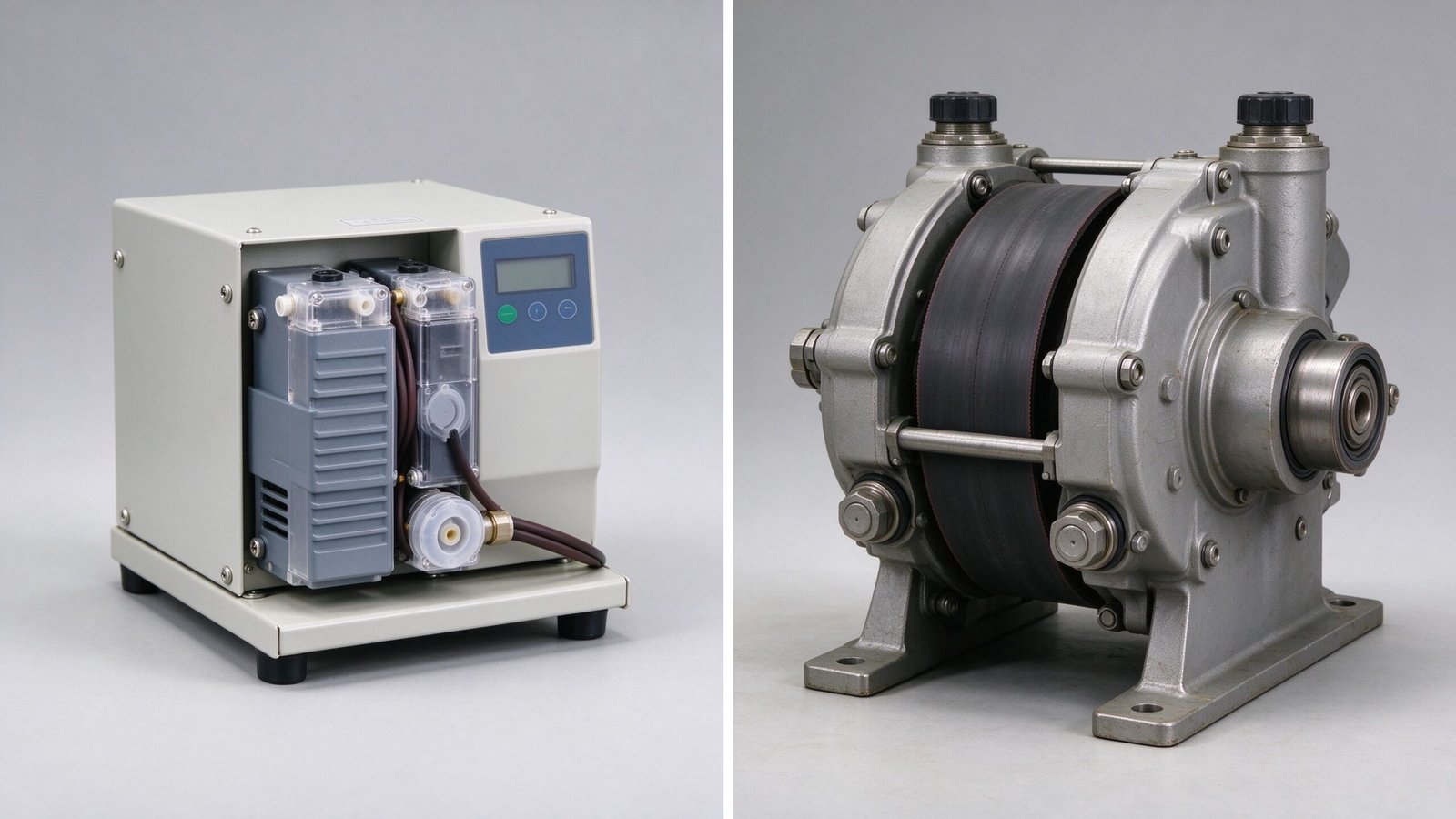
“Peristaltic pump” covers two very different machines. On one side is the small bench or OEM tubing pump that moves milliliters to a few liters a minute through a flexible tube. On the other is the industrial hose pump that moves hundreds or thousands of liters an hour through a thick reinforced hose. They share a rolling-roller principle, but they are built, sized, and maintained differently. This comparison explains when the small tubing pump is the right tool and when you actually need the industrial hose pump.
The Core Difference: Tube Size and Volume
A tubing peristaltic pump uses a thin, flexible tube clamped in a head, and the flow is set by the small bore of that tube. It is built for low-to-medium flow, precise metering, and clean or corrosive fluids. An industrial hose pump uses a thick, reinforced hose as the pressure member, with a much larger bore, and it is built for high flow, slurries, and abrasive fluids. The principle is the same, but the scale, the drive, and the consumable are not.
| Factor | Tubing peristaltic pump | Industrial hose pump |
|---|---|---|
| Typical flow range | mL/min to a few L/min | Tens to thousands of L/hour |
| Fluid handled | Clean, dosing, corrosive, viscous | Slurries, solids, abrasive media |
| Consumable | Thin replaceable tube | Thick reinforced hose |
| Drive | Small geared motor, 12/24V | Heavy gear motor, line power |
| Installation | Bench or OEM panel | Floor-mounted process unit |
| Best at | Accurate metering, low duty, clean fluid | High-volume transfer, abrasives |
When the Tubing Pump Is the Right Choice
Choose a tubing pump when the volume is modest and accuracy or cleanliness matters. Instrument dosing, laboratory transfer, OEM dispensing, and small process skids all fall here. The tubing is cheap and easy to swap, the pump is small enough to mount inside equipment, and the 12V or 24V drive fits portable and panel designs. A 24V dosing pump or a micro peristaltic pump delivers repeatable small shots and isolates the fluid in the tube, which is ideal when contamination, corrosivity, or a cleanable wetted path matters.
The tubing pump is not built to move a slurry with grit. Abrasive solids wear the thin tube quickly, and pushing large volumes through a small bore asks the head to run fast, which shortens tube life and wastes power. If your fluid is clean or gently viscous and the flow is under roughly a liter a minute, the tubing pump is simpler, cheaper, and more accurate than scaling up to a hose pump.
When the Industrial Hose Pump Takes Over
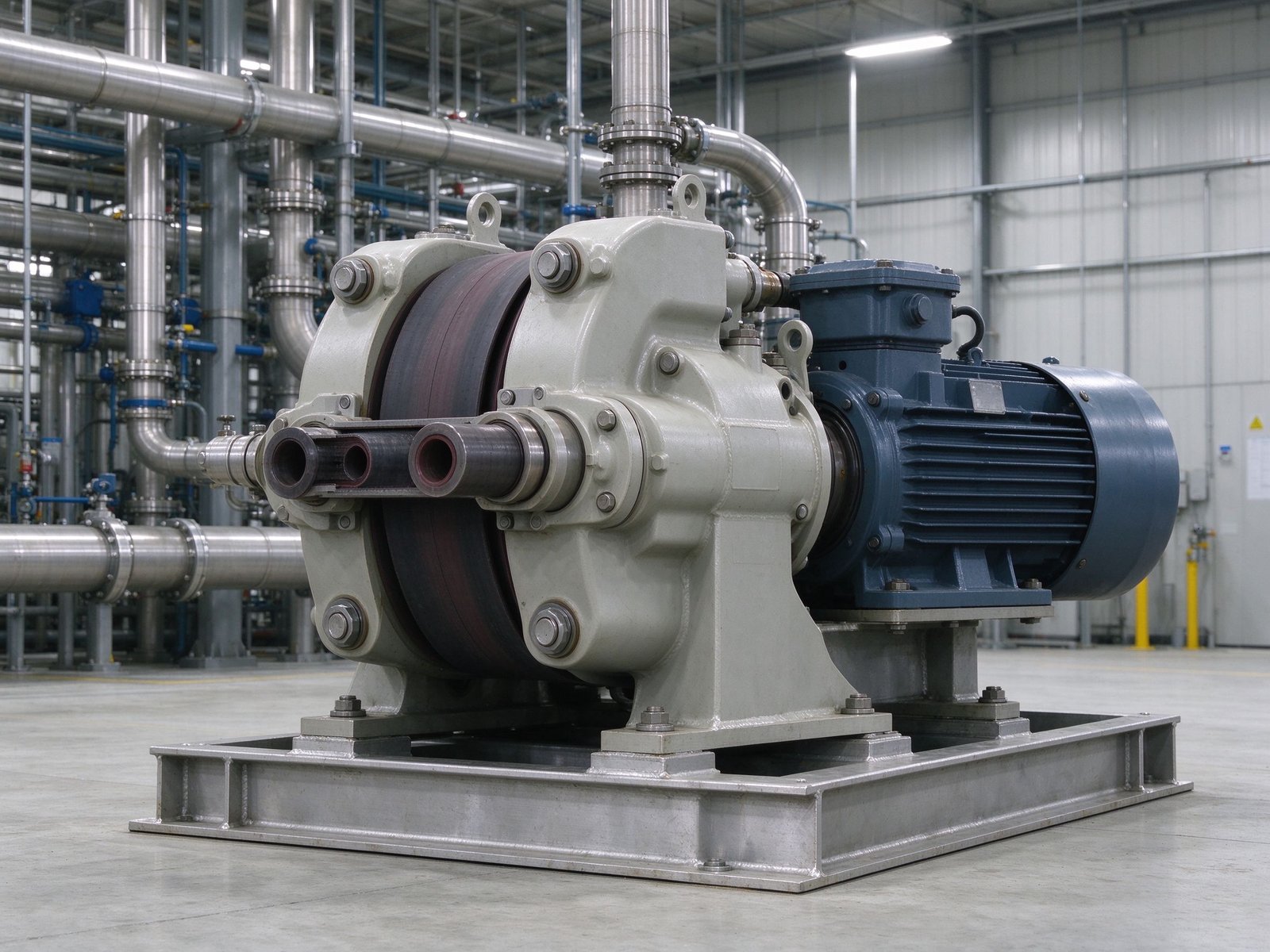
Choose the hose pump when the volume or the fluid demands it. Slurries, concrete admixtures, mining reagents, and high-volume chemical transfer move too much material for a tubing head. The reinforced hose handles the larger bore and the higher pressure, and the heavy geared drive supplies the torque to compress it. These machines are floor-mounted, plumbed into a process line, and run for long periods at high output.
The trade-off is size, weight, and cost. A hose pump is not something you mount inside an instrument; it is a process asset with its own foundation and drive. It is also less of a precision meter and more of a positive-displacement transfer pump. If you are dosing a few milliliters repeatedly, a hose pump is overkill, expensive, and harder to control. A driver built for the smaller scale, as in the motor-driver operating manual, is the control layer that makes the tubing pump meter accurately.
Pressure, Accuracy, and Control
Accuracy is another dividing line. A tubing pump with the right head, tube, and speed control delivers repeatable small volumes, which is why it dominates dosing and instrumentation. Its flow is set by the tube displacement and the RPM, and a controlled drive holds that RPM steady. A hose pump is rated for throughput against back-pressure; it can move fluid against a head, but it is not tuned for repeatable milliliter shots. If your spec reads “within a few percent of a set dose,” a tubing pump is the category that meets it, and a 12V DC peristaltic pump with a known driver is the building block.
Pressure follows the same split. A tubing pump handles modest discharge pressure, bounded by the tube’s ability to stay sealed. A hose pump is built for higher line pressure in a process loop. Pushing a small tubing pump against a tall discharge or a restricted line stresses the tube and wears it fast. The right way to confirm pressure margin is to measure the delivered flow and head temperature under real back-pressure, the point-of-use practice described by NIST’s Physical Measurement Laboratory, rather than assuming the nameplate pressure applies to your installation.
Cost, Footprint, and Integration
The economics favor the tubing pump for small duties. It is light, it mounts on a panel or bench, and its consumables are cheap. It integrates into OEM equipment as a sub-component with a 12V or 24V supply and a speed signal. The hose pump is a capital item: floor space, a heavy drive, plumbed connections, and a larger replacement part. Where the equipment is a product you sell repeatedly, the tubing pump’s small footprint and low consumable cost are hard to beat.
For a plant transferring bulk slurry, the hose pump’s durability against abrasives pays back even at higher purchase cost, because the alternative — a centrifugal or gear pump wearing on grit — fails faster. The decision is therefore not which is “better,” but which scale your duty sits at. A controlled-speed drive such as the peristaltic pump driver reference describes the kind of repeatable small-pump control that makes the tubing option predictable in production.
Consumables and Maintenance
Both machines have one wearing part, but the part is very different. The tubing pump’s tube is a low-cost, quick-change item that an operator swaps in minutes. The hose pump’s reinforced hose is a larger, heavier component that carries the pressure and lasts a long time but costs more to replace. In both cases the wear follows the compression cycle, and occlusion or hose compression must be set correctly for the consumable to reach its expected life.
For the tubing pump, the maintenance schedule is simply a tube replacement interval tied to running hours. For the hose pump, it is the hose life plus the roller and shoe wear on the heavy drive. The peristaltic pump driver on the small side is a compact board, while the hose pump uses a large gear motor and often a variable-speed drive. Matching the consumable to the duty is what keeps maintenance predictable on either machine.
How to Decide
Start with the required flow and the fluid. If the flow is small and the fluid is clean or gently viscous, a tubing pump is almost always the right answer, and the question becomes which head, tube, and 12V/24V drive fit the equipment. If the flow is large or the fluid carries abrasive solids, move to an industrial hose pump. The mistake to avoid is trying to push a high-volume or abrasive duty through a small tubing head — it will wear tubes fast and disappoint on flow. Equally, do not buy a floor-standing hose pump to meter a few milliliters into an analyzer.
| Ask yourself | Points to |
|---|---|
| Flow under ~1 L/min? | Tubing pump |
| Fluid clean or gently viscous? | Tubing pump |
| Mounted inside equipment or portable? | Tubing pump |
| Flow tens of L/min or more? | Hose pump |
| Fluid carries solids or abrasives? | Hose pump |
| Floor-mounted process transfer? | Hose pump |
If you are unsure whether your duty fits a tubing pump or needs an industrial hose pump, contact YOORAIN with the required flow, the fluid and any solids, the pressure, and how the pump will be mounted. We can tell you honestly whether a small tubing pump and driver will cover it, or whether you are beyond the tubing-pump range and should spec a process hose pump.