
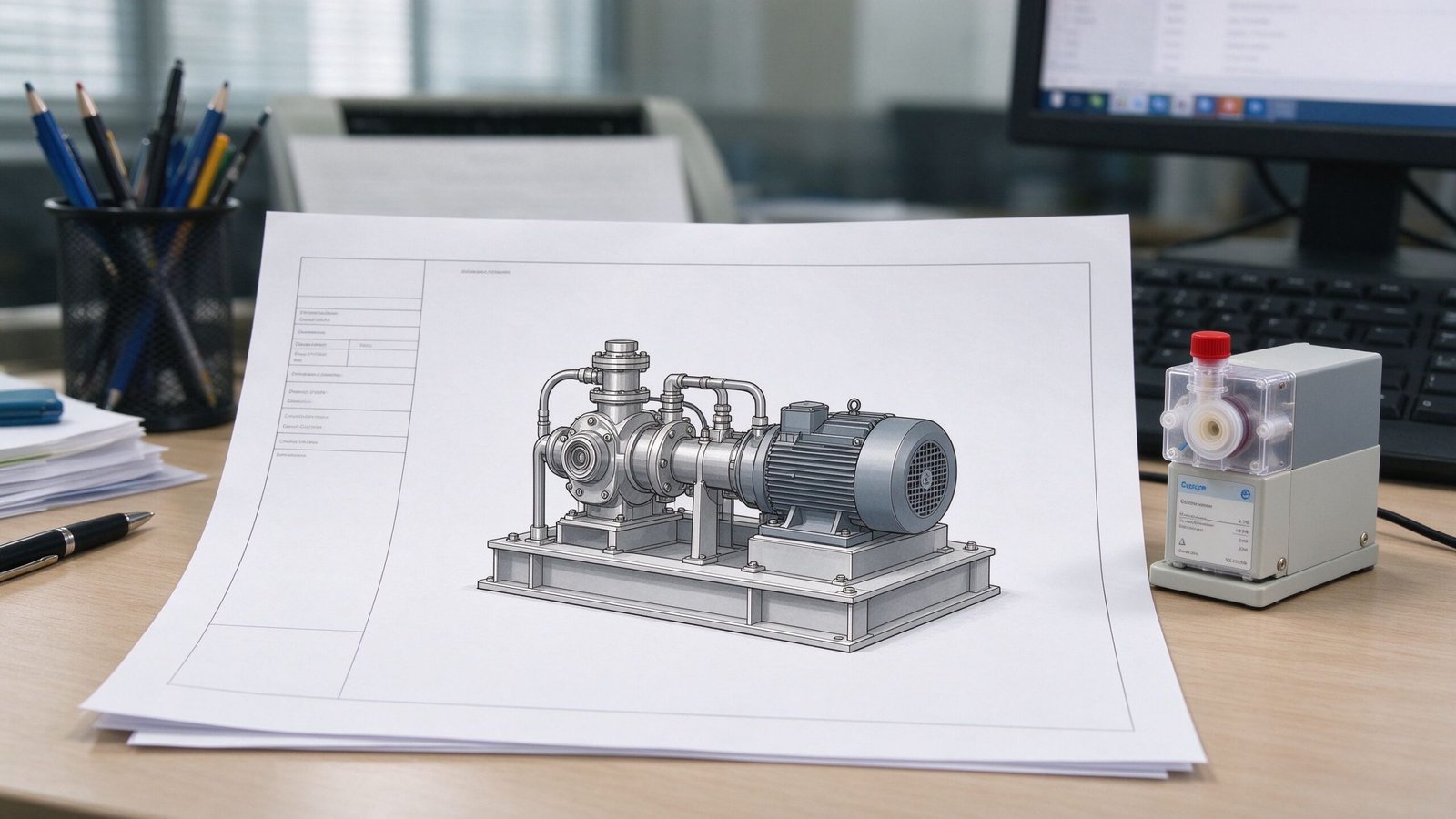
Sending a vague “send me a quote for a peristaltic pump” email gets you a vague quote, and usually the wrong pump. A peristaltic pump is a small, configurable system — the head, the tube, the drive, the voltage, the fittings, and the speed range all matter, and two pumps with the same catalog flow can behave very differently on your fluid. This procurement checklist lists the information you should put in every RFQ, so the supplier quotes the right pump the first time and you avoid a two-week back-and-forth.
The Basics the Supplier Cannot Guess
Three things set the whole sizing conversation: the fluid, the required flow, and the back-pressure. Without these, any quote is a guess. The fluid is not just “chemical” — name it, and if it is a proprietary blend, give the key ingredients, the pH, and the solids loading. The required flow is the actual mL/hour or L/minute you need, at the operating condition, not the maximum you might ever want. The back-pressure is the pressure the pump has to push against on the discharge, measured at the farthest normal operating point.
A 24V dosing pump that looks fine on a 200 mL/hour spec may be wrong for a 300 mL/hour duty with 3 bar of back-pressure, because the head and tube have to be chosen for that combination. The supplier’s job is to match the head and tube to these three numbers; your job is to give them accurately.
| RFQ field | What to send |
|---|---|
| Fluid | Name, chemistry, pH, solids, temperature |
| Required flow | mL/hour or L/minute, at operating condition |
| Back-pressure | Measured discharge pressure, bar or psi |
| Viscosity | cP at operating temperature, or “like water” |
| Suction lift | Distance from reservoir to head, flooded or lifted |
Electrical and Control Information
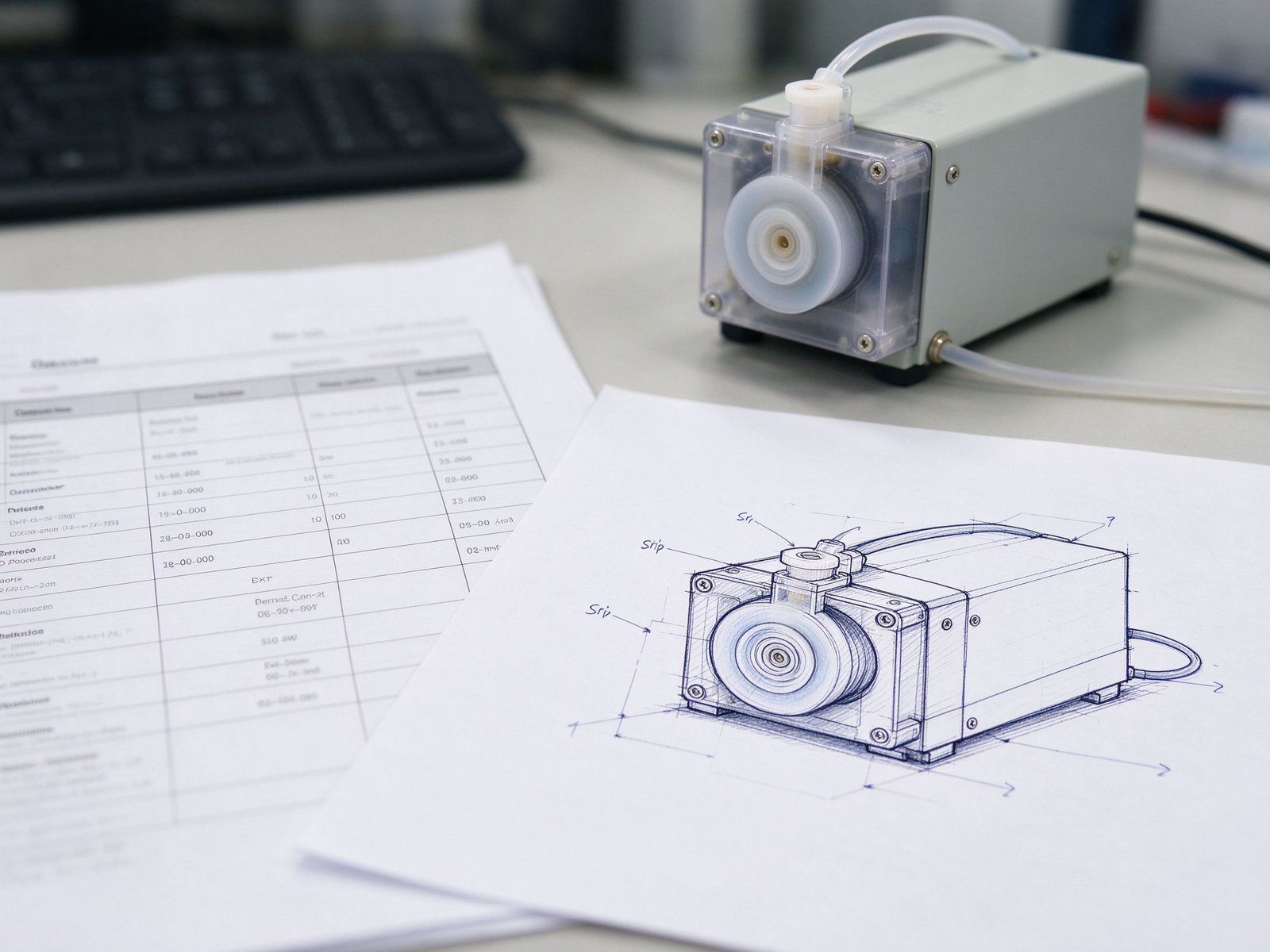
The pump is only half the system; the drive sets how it runs. Tell the supplier your supply voltage (12V DC, 24V DC, 110V AC, 230V AC), and whether the pump runs from a fixed power supply, a PLC, or a battery. If the duty is shot dosing, say how long the shot is and how often it repeats. If the duty is continuous, say 24/7 or intermittent. A 12V DC peristaltic pump on a remote skid is a different product than a peristaltic pump driver on a fixed cabinet, and the supplier needs to know which one you want.
For a controlled installation, say whether you need a speed signal (0–10V, 4–20mA, PWM), a start/stop dry contact, or a simple dial. The driver’s speed and run-time setup is described in the motor-driver operating manual, but the control wiring has to match your cabinet. Asking for “a pump with speed control” is not enough; ask for the control signal you actually have.
| Electrical question | Why it matters |
|---|---|
| Supply voltage | Selects motor and power supply |
| Duty cycle (continuous / intermittent) | Sets heat derating |
| Control signal | Selects driver model |
| Ambient temperature | Affects tube and motor selection |
| Mounting orientation | Confirms head and driver layout |
Tube Material and Chemical Compatibility
The tube is the only wetted part, and it has to be compatible with the fluid. A generic quote that lists “silicone tube” for an acid or an oxidizing biocide is going to fail in weeks. Send the supplier the SDS or the chemical name, and ask them to recommend the tube material, not to assume. A peristaltic pump tube in the right material lasts; in the wrong material it swells, hardens, and leaks. The fluid-compatibility practice described by EPA’s industrial water guidance is to match the wetted path to the chemical, and that is a question you should put on the RFQ explicitly, not leave to the supplier’s default.
Also ask what tube they are quoting against. A supplier that quotes a maximum flow on a thin silicone tube, then sends that same tube for a harsh chemical, is not doing the job. Ask: “What tube material is this quote based on, and what is the expected tube life on my fluid?”
Documentation and Testing Expectations
For a production purchase, ask for a bench test on your fluid before you commit. A supplier who will run the pump on your actual chemical and send you a delivered-volume video or a gravimetric reading is worth more than a catalog with a pretty chart. The point-of-use measurement, as described by NIST’s Physical Measurement Laboratory, is the confirmation that the pump delivers what the quote says. Ask for that as part of the sample order, not after the production order arrives.
Ask also what documentation comes with the pump: a datasheet with the displacement per revolution on the tube they ship, the operating temperature range, and the electrical wiring. A small peristaltic pump on a simple duty does not need a thick manual, but a dosing skid on a regulated application needs the wiring and the repeatability data on paper. The U.S. National Science Foundation’s engineering guidance on procurement supports the same principle: specify the test and the documentation up front, rather than arguing about it after delivery.
| Ask in the RFQ | Why |
|---|---|
| Bench test on our fluid | Confirms delivered volume before purchase |
| Displacement per revolution on shipped tube | You can calculate dosing recipes |
| Wiring diagram for the driver | Cabinet integration goes smoothly |
| Expected tube life on the chemistry | Spares planning |
| Sample unit before production | De-risks the bulk order |
Spare Parts and Lead Time
A pump on a production line is only as available as its spares. Ask the supplier, in the RFQ, what the lead time is for a replacement tube, a roller set, and a driver fuse. A supplier who holds stock locally will ship a tube in a few days; a supplier who builds to order from overseas quotes a six-week tube lead, and that is a maintenance risk on a critical duty. Also ask whether the tube is a standard part they keep on the shelf, or a custom length they cut for your order. Standard parts are cheaper and faster; custom parts are where hidden lead times live.
For a multi-pump skid, order one spare tube per head at the same time you place the production order, so the shelf has spares before the first tube wears. The spare-parts stocking principle, consistent with the U.S. National Science Foundation’s engineering guidance on maintenance, is to tie spares to the actual wear part and the actual service, not to decide it after the pump arrives. A mini peristaltic pump on a small bore uses a different spare than a larger head, and the RFQ should list the spares by head model so the supplier can price them as a kit rather than as individual surprise line items.
What a Good Quote Looks Like
A good quote does not just say “peristaltic pump, $X.” It names the head model, the tube material and bore, the driver model, the voltage, the recommended speed range for your flow, and the expected tube life. It comes with a note on suction lift and back-pressure, and it offers a sample. A quote that only lists a flow number and a price is asking you to fill in all the engineering gaps yourself, and that is where the wrong pump gets bought.
If you are putting together an RFQ for a bank of peristaltic pumps, send YOORAIN the fluid list, the required flows, the back-pressures, and the control signals you have. We will come back with a head, tube, and driver recommendation for each duty, plus a bench test on your fluid before you commit to the bulk order, so the quote you receive is engineered for your installation rather than copied from a generic catalog.