
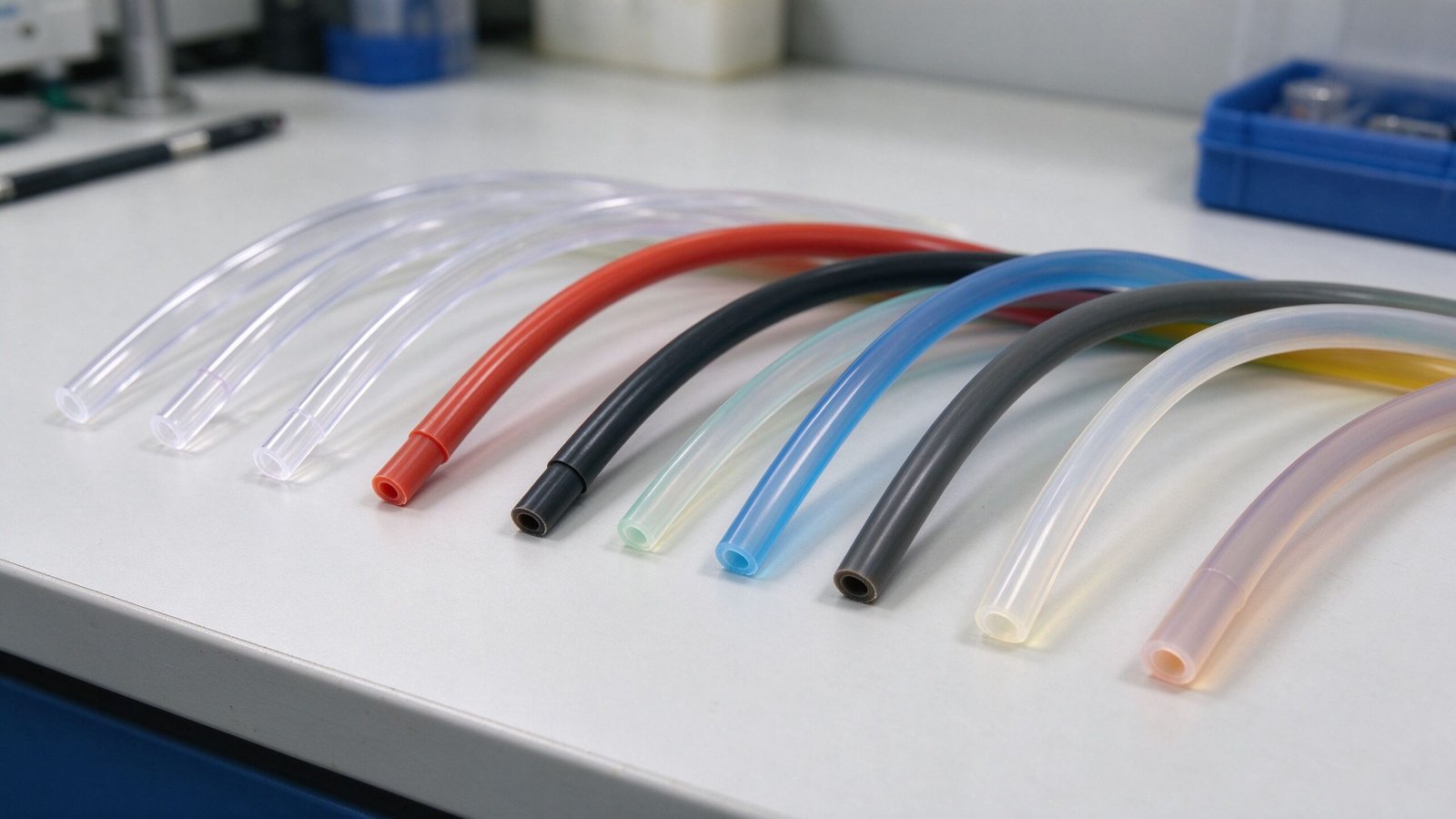
The tube is the heart of a peristaltic pump. It is the only wetted part, it flexes millions of times, and it contacts whatever you are pumping. Pick the wrong material and the tube swells, hardens, cracks, or contaminates the fluid in weeks. Pick the right one and it runs for thousands of hours with no trouble. Yet most buyers specify the pump head and the drive first and the tube last, which is backwards. This engineering guide walks through the common peristaltic pump tubing materials, what each one resists, where each one fails, and how to choose between them on your actual fluid.
What the Tube Has to Survive
Before comparing materials, it helps to list what the tube is actually asked to do. It flexes every revolution as the roller passes, so it needs good fatigue resistance. It contacts the fluid, so it needs chemical compatibility. It sits at ambient or process temperature, so it needs to stay flexible at that temperature. It may be squeezed against a bed thousands of times, so it needs to keep its memory and not flatten permanently. And in some applications it has to be cleanable, autoclavable, or food-contact rated. No single material wins on all five; the choice is a trade-off.
A peristaltic pump tube is sold by bore, wall, and material, and the material is the part that determines whether it works on your fluid. The catalog flow number on a given head assumes a specific tube material; when you change the material, the displacement and the tube life change too.
| Demand on the tube | What matters |
|---|---|
| Flex fatigue | Elastomer memory, rebound |
| Chemical contact | Compatibility with the fluid |
| Temperature | Stays flexible, not softened |
| Pressure / occlusion | Resists permanent flattening |
| Cleanability | Smooth inner surface, sterilizable |
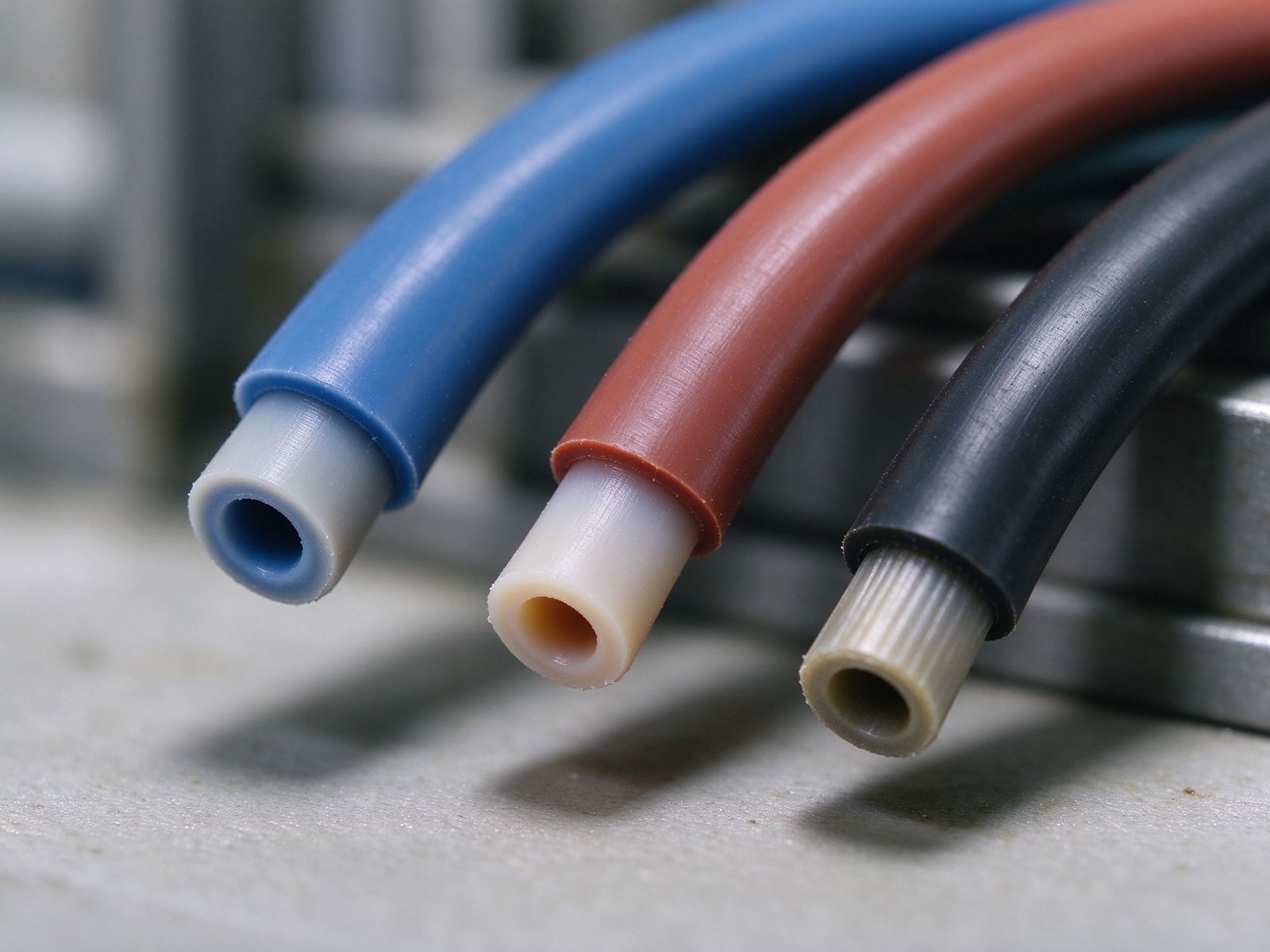
Silicone
Silicone is the default tube material people think of, and for good reasons. It is flexible over a wide temperature range, it is commonly used in food and pharmaceutical contact, and it is clear, so you can see the fluid. It is also one of the cheapest elastomers. But silicone has weaknesses that surprise new users. It swells in contact with petroleum oils and many solvents, it is not the best choice for abrasive slurries because it wears relatively fast, and it is not the strongest against high pressure. It also has a taste and odor carryover in some food applications, and it ages under UV.
Where silicone shines is aqueous, low-pressure, room-temperature duty: water-based reagents, mild chemicals, food and beverage transfer, and lab fluid handling. A micro peristaltic pump on a water-based lab duty usually runs silicone. The material-compatibility principle described by the U.S. National Science Foundation’s engineering research on fluid systems is to match the elastomer to the fluid, and silicone is the easy default when the fluid is water-based.
Thermoplastic Materials (PharMed / Tygon-style)
PharMed and similar thermoplastic tubes (often sold under Tygon or proprietary blends) are the long-life workhorses. They last much longer than silicone on the same head, because they rebound cleanly after each compression. They are clearer than many elastomers, they handle a wider range of aqueous chemicals, and they are a common choice on OEM and OEM-equipment duties where tube life matters. They are not as flexible as silicone at very low temperatures, and they are not the best choice for strong solvents, but on a water-based process that runs 24/7 they usually outlast silicone by a wide margin.
This is the tube most dosing skids should consider before defaulting to silicone. The fatigue resistance is what gives the longer life, and that longer life means fewer tube changes and a more repeatable dose over time. The speed and run-time setup on a peristaltic pump driver is tuned to the tube material, because a longer-life tube lets you set the maintenance interval by calendar rather than by surprise failure.
| Material family | Strengths | Watch out for |
|---|---|---|
| Silicone | Flexible, food/pharma friendly, cheap | Swells in oils/solvents, wears faster |
| Thermoplastic (PharMed/Tygon-style) | Long fatigue life, good aqueous chemical resistance | Not for strong solvents, stiffer when cold |
| Viton / fluoroelastomer | Excellent chemical and heat resistance | Stiff, expensive, not for amines/bases |
| Norprene / thermoplastic rubber | Abrasion-resistant, long life | Not for strong oxidizers or very aggressive solvents |
Viton and Fluoroelastomers
Viton (FKM) is the high-chemical-resistance choice. It handles oils, fuels, many aggressive chemicals, and high temperatures better than silicone or thermoplastics. If you are pumping a solvent, a fuel, or a hot aggressive chemical, Viton is the tube you look at. The trade-offs are real: Viton is stiff, so it needs a lower occlusion setting and a slower speed on the same head; it is expensive; and it is not compatible with every chemical — strong bases, amines, and some polar solvents attack it.
A large-flow peristaltic pump on an oil or solvent duty is a typical Viton application. The stiff tube also means the displacement per revolution is a little different from silicone, so after switching materials, re-weigh the delivered volume. The point-of-use measurement, as described by NIST’s Physical Measurement Laboratory, is not optional when you change tube chemistry.
Norprene and Abrasion-Resistant Blends
Norprene and similar thermoplastic rubber tubes are the abrasion-resistant choice. They are the tube to reach for on slurries, pigments, dispersions, and any fluid with suspended solids, because they hold up to the grit longer than silicone. They are not the most chemically resistant, and they are not the clearest, but they earn their keep when the fluid would eat through a softer tube. On a slurry or a coating line, the abrasion resistance is more important than optical clarity.
This is also the tube that handles slightly oily or greasy fluids better than silicone. The wear-and-fatigue trade-off between materials is described in the motor-driver operating manual, which recommends matching the tube to the duty rather than defaulting to the cheapest option.
| Fluid type | First tube choice |
|---|---|
| Water-based, mild chemical | Thermoplastic long-life or silicone |
| Aqueous with solids / slurry | Abrasion-resistant thermoplastic rubber |
| Oil, fuel, solvent | Fluoroelastomer (check compatibility) |
| Food / pharma, aqueous | Silicone or pharma-grade thermoplastic |
| Strong oxidizer / biocide | Verify against compatibility chart |
Temperature, Pressure, and Flex Life
Two other specifications matter beyond chemistry. Temperature: a tube that is fine at room temperature gets soft at 80C and hardens at -10C. Match the material to the warmest and coldest the installation sees. Pressure: every tube has a burst and a working pressure, and the peristaltic’s discharge pressure is limited by the tube wall. A thin silicone tube on a high back-pressure line bulges and wears fast; a thicker wall or a pressure-rated material handles it. Flex life is the number of hours a tube lasts on a given head at a given speed, and it is shorter than the catalog suggests because the catalog is usually on water at room temperature.
The honest approach is to run your own fluid on your own head and measure the tube life. A supplier’s chart on water is a starting point, not a guarantee on your chemical. The controlled speed on a 24V dosing pump makes that life test repeatable: run the same duty, note when the tube hardens, and use that as the interval.
Durometer and Wall Thickness
Two tube specifications that buyers overlook are the durometer (hardness) and the wall thickness. A softer tube seals more easily against the bed and is quiet, but it flattens faster under occlusion and wears quicker. A harder tube lasts longer but needs a tighter occlusion and more motor torque, and it is noisier on the head. The right durometer is the softest one that still delivers the required life on your duty, not the hardest one in the catalog. Wall thickness interacts with durometer: a thin wall is gentle on the rollers but limits pressure; a thick wall handles pressure but needs more occlusion and torque. The head you are using has a recommended wall range, and the tube should be picked inside that range rather than arbitrarily.
When you change tube material, also re-check the occlusion. A stiffer tube needs a slightly tighter setting to seal, while a softer tube needs less. The bench weigh after a tube change catches both the displacement change and the occlusion change in one step.
| Tube attribute | Softer / thinner | Harder / thicker |
|---|---|---|
| Sealing | Easy, low occlusion | Needs tighter occlusion |
| Tube life | Shorter | Longer |
| Pressure handling | Lower | Higher |
| Motor load | Lower | Higher |
| Noise | Quieter | Audible |
Sterilization and Cleanability
On food, beverage, and pharma duty, the tube has to survive cleaning cycles. Some tubing materials survive repeated autoclaving; others go brittle after a few cycles. Silicone is the traditional autoclaveable choice, but it wears faster, so pharma skids often run a pharma-grade thermoplastic and accept chemical sanitization instead of heat. If the duty requires clean-in-place or steam-in-place, ask the supplier how many cycles the rated tube survives, and budget for tube replacement on a schedule tied to the sanitization count rather than the calendar.
Surface finish also matters. A tube with a smooth, non-pitted inner surface resists biofilm; a tube that has a rough inner wall grows it. On a recirculating food or pharma loop, the inner finish is part of the cleanability, not an aesthetic detail. The peristaltic pump tube on such a duty should be specified to the required finish, not just to the chemical.
Storage and Shelf Life
Tubes age on the shelf. An elastomer that sits in a warehouse for two years hardens before it ever runs, and a plant that orders a ten-year supply of spares is buying a shelf-life problem. Store tubes in their original packaging, away from UV, heat, and ozone, and rotate the stock by date. The shelf life of an elastomer is typically measured in years, not decades, and a tube that has hardened on the shelf will fail within days of being installed. When you open a spare bag, note the date, and use the oldest stock first.
This also applies to the tube on the pump. A pump that sits idle for months with a compressed tube in the head develops a flat spot at the roller contact. On a standby pump that is not run regularly, release the occlusion or rotate the tube before putting it back into service, so the flat spot does not ruin the seal.
Mixing Materials Between Runs
On a skid that handles multiple fluids over time, it is tempting to reuse the same tube. But the tube absorbs the previous fluid, and swapping chemicals without swapping the tube risks cross-contamination. If the duty switches between chemicals, either keep a dedicated tube per fluid or flush thoroughly and accept the flush volume. The displacement also changes between materials, so every material swap ends with a gravimetric re-check. The controlled speed on a 24V dosing pump makes that re-check a one-minute bench job, not a calibration exercise.
How to Pick: A Step-by-Step
Step one, name the fluid and look it up on the supplier’s compatibility chart. Do not trust memory; check. Step two, note the temperature range and the back-pressure. Step three, decide whether optical clarity, food contact, or autoclavability matters. Step four, start with the most compatible material that also has acceptable flex life, and buy a sample length. Step five, run the sample on your head and weigh the delivery after an hour, after a day, and after a week. If the delivery drifts, the tube is swelling or hardening; change material.
| Step | Action |
|---|---|
| 1 | Check fluid on supplier compatibility chart |
| 2 | Note temperature and back-pressure |
| 3 | Note clarity / food / sterilization needs |
| 4 | Buy a sample length |
| 5 | Run on your duty, weigh delivery over time |
Common Questions
Can I mix tube materials on the same head? Yes, but re-calibrate after each change; the displacement per revolution differs between materials.
Why does my new silicone tube smell? New silicone has a manufacturing release that off-gasses in the first hours. Flush with clean fluid before putting the pump on product duty.
Does a thicker wall extend tube life? Sometimes, but a thicker wall also needs more occlusion and more motor torque. Match the wall to the head, do not over-spec.
How do I know when the tube needs changing? Watch for hardening, cracking, swelling, or a slow drift in delivered volume. Do not wait for a split.
Procurement Checklist
When you order peristaltic tubing, ask for the bore, the wall, the material, and the durometer. Ask whether the material is rated for your fluid, your temperature, and your pressure. Ask for a sample length before the bulk order. A small peristaltic pump is easy to sample on, because the sample length is short and the test duty is cheap. A supplier who cannot tell you which material fits your chemical is not worth the order.
If you are choosing peristaltic pump tubing for a new duty, send YOORAIN the fluid, the temperature, the back-pressure, and the bore you need. We can recommend a tube material, send a sample, and bench-test the delivered volume on your fluid so the first production order is not the trial run.