
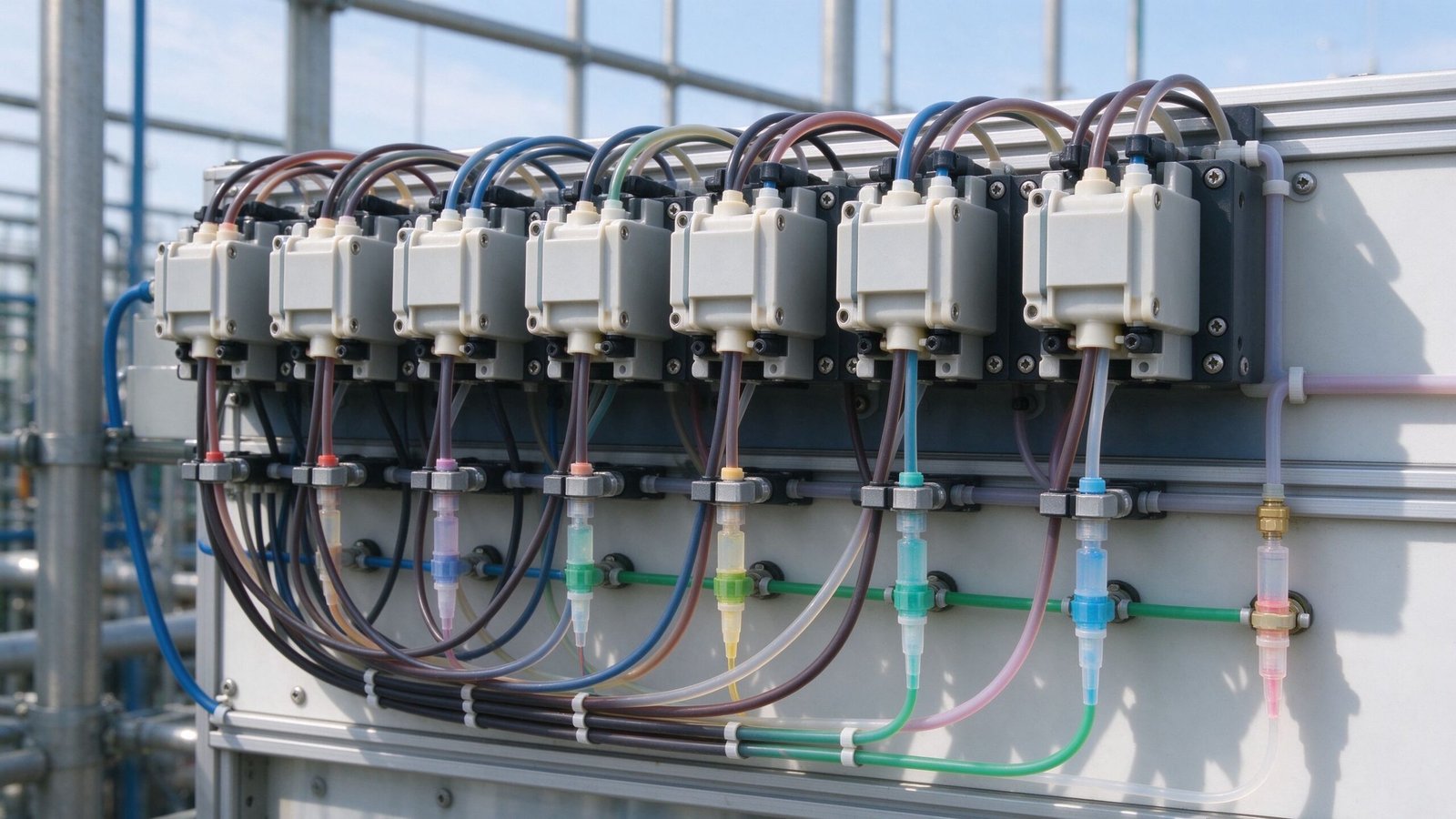
Many dosing duties do not use one chemical. A water-treatment skid may feed acid, alkali, and biocide; an instrument may dispense reagent A, reagent B, and a diluent; a conditioning line may dose several additives on one schedule. When several liquids have to be fed in parallel, buyers face a choice between stringing together single pumps and specifying a multi-channel peristaltic dosing unit. This buyer guide explains what multi-channel peristaltic arrangements look like, how the channels stay isolated, and what to compare before you buy so the unit matches the chemicals, the per-channel dose, and the control scheme on your line.
What “Multi-Channel” Means on a Peristaltic
A peristaltic channel is one tube path squeezed by the head. In a multi-channel arrangement, several such tube paths are mounted on one unit, driven either by a shared motor or by grouped heads on one drive. Each channel draws from its own reservoir and discharges to its own injection point. Because the fluid only touches its own tube, the channels stay chemically isolated from one another. That isolation is the main reason buyers choose peristaltic multi-channel units over pumps that share a common manifold or wetted block.
The peristaltic pump driver sets how the channels run together. On a shared-speed unit all channels move at the same rate; on independently controlled channels each one has its own speed or dose setting. The peristaltic pump tube on each channel is replaced separately, so service does not require breaking into a shared fluid block.
| Configuration | How it works | Best fit |
|---|---|---|
| Shared motor, multi-tube head | One drive turns a head that carries several tubes together | Several chemicals dosed on a common schedule, similar flows |
| One drive, multiple heads | Several heads mounted on a common drive, each with its own tube | Channels that can run at a common speed but need different bore/flow |
| Independent pump modules | Separate small pumps grouped in one panel | Channels needing independent speed, timing, or future expansion |
Why Specify Multi-Channel Instead of Separate Pumps
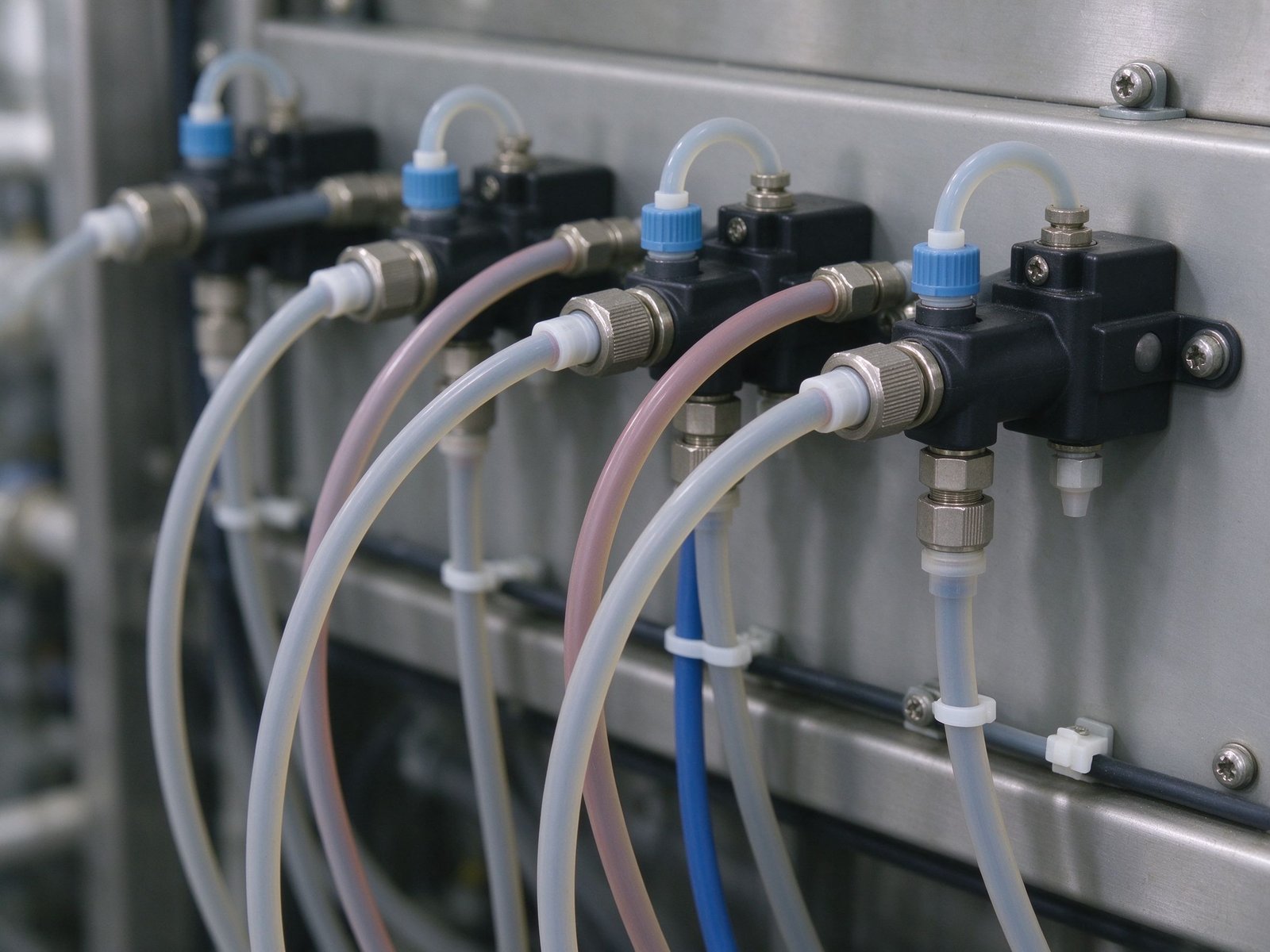
Grouping channels into one unit saves panel space, simplifies wiring and mounting, and lets one controller trigger several feeds on the same schedule. For a line where additives are always dosed together, a shared drive cuts parts count and keeps the doses synchronized. The trade-off is that a shared-speed unit cannot give each channel its own flow; if one chemical needs a much smaller dose than the others, independent control or a different tube bore per channel has to be planned in. A row of separate single pumps gives full independence but costs more in space, wiring, and service points.
For low-channel-count instrument feed, a micro peristaltic pump per channel keeps each dispense point compact. For higher-flow additive feed, a small peristaltic pump head per channel handles larger volumes; the 24V dosing pump form factor is common on controlled dosing panels.
What to Compare Before You Buy
The buyer checklist for a multi-channel unit centers on the channels, the chemicals, and the control. Match each item to your actual process rather than to a generic “multi-pump” listing.
| Checklist item | What to confirm |
|---|---|
| Number of channels | Active channels now, plus any spare channel reserved for future additives |
| Flow per channel | Daily or hourly dose for each chemical; whether flows differ channel to channel |
| Channel isolation | Dedicated tube per channel; no shared wetted path that could cross chemicals |
| Control per channel | Common speed versus independent speed or dose; signal type accepted |
| Motor torque margin | Drive sized to carry all channels under load, not one head at a time |
| Tube compatibility | Material resistant to each chemical, concentration, and temperature |
| Service access | Each tube swaps without disturbing other channels; consumables kept in stock |
Isolation and Cross-Contamination
The main risk in multi-channel dosing is mixing chemicals that react. Dedicated tubes per channel are the baseline, but isolation also depends on clean routing and labeling. Keep each discharge line on its own route to its injection point, label reservoirs and tubes together, and never reuse a tube that carried one chemical on another channel. Where two chemicals could react if they met in a shared injection fitting, separate the injection points or stagger the dose events. The NSF fluid-handling guidance treats segregation of incompatible chemicals as a design requirement, not a housekeeping detail.
Sizing the Drive for All Channels
A common mistake is sizing the motor for one channel and assuming the drive will carry several. Each tube adds compression load, so the shared motor has to provide enough torque to squeeze all channels at once, especially with thicker-walled or stiffer tubes. If channels run different fluids, account for the most viscous or most restrictive line when judging the load. Review the duty cycle: a panel feeding continuously all day loads the drive and tubes differently from one that doses in short pulses. The motor-driver operating manual and the driver reference describe how drive load and continuous duty are rated.
For the largest per-channel flows, a large-flow peristaltic head may be required; mixing a high-flow channel with micro channels on one shared drive usually calls for independent heads rather than a single common head.
Common Buying Mistakes
| Mistake | Result | Better practice |
|---|---|---|
| Assuming all channels use the same chemical | Wrong tube material, cross-reaction risk | List each fluid and its concentration; match tube per channel |
| Sizing drive for one head | Motor strains or stalls under all channels | Rate the shared drive against total compression load |
| Buying common-speed when flows differ | Low-flow channel over-doses, high-flow under-doses | Independent control or per-channel bore sizing |
| Ignoring future additives | Panel has no spare channel; retrofit later | Reserve spare channels and head capacity up front |
| Forgetting tube service across channels | Unplanned downtime when one tube ages | Spare tubes stocked per channel; scheduled replacement |
Documentation, Spares, and After-Sales
A multi-channel unit carries more consumables than a single pump, so spare-part planning should cover every channel rather than one head. Keep spare tubes for each fluid, note the tube material and bore per channel on the panel, and record the calibration dose per channel so a replacement tube can be set back to the same delivery. Ask the supplier how tubes are ordered, whether channel spares ship as a set, and what wear parts besides the tube the head carries. Good documentation also lists the control wiring, the signal per channel, and the reservoir each line feeds, which cuts troubleshooting time when a channel under-delivers.
On installation, route the discharge lines so chemicals do not share a fitting unless that is intended, and leave enough slack for a tube to be removed without pulling on the reservoir or injection point. Label both ends of each tube, and where the panel is accessible to non-specialist service staff, keep the tube-swap procedure written down so channels are restored to the same chemical after service.
Common Questions
Can one multi-channel unit feed both acid and alkali? Yes, provided each chemical has its own dedicated tube and discharge line and the injection points are arranged so they do not meet immediately. The tube material has to be compatible with both sides, and channels must not share a wetted block.
Do all channels have to dose at the same time? Not necessarily. Independent modules or a multi-channel controller can trigger channels on different schedules. A shared-speed head keeps the channels running together; pick the configuration that matches your dose timing.
How do I handle channels with very different flows? Different tube bores per channel, or independent heads and speeds, usually solve this. A common bore on a shared head forces a compromise between the largest and smallest dose.
How are channels calibrated? Calibrate each channel separately by weight over a set number of dose events, because tube bore and slip differ from channel to channel. The NIST gravimetric measurement practice supports checking each dispense path on its own.
If you are comparing multi-channel peristaltic dosing units for a skid or instrument, contact YOORAIN with the number of channels, the chemical list and concentrations, the per-channel flow or daily dose, the control signal, and the operating hours. We can recommend the head arrangement, shared or independent drive, and tube set that keep every channel isolated and in range.