
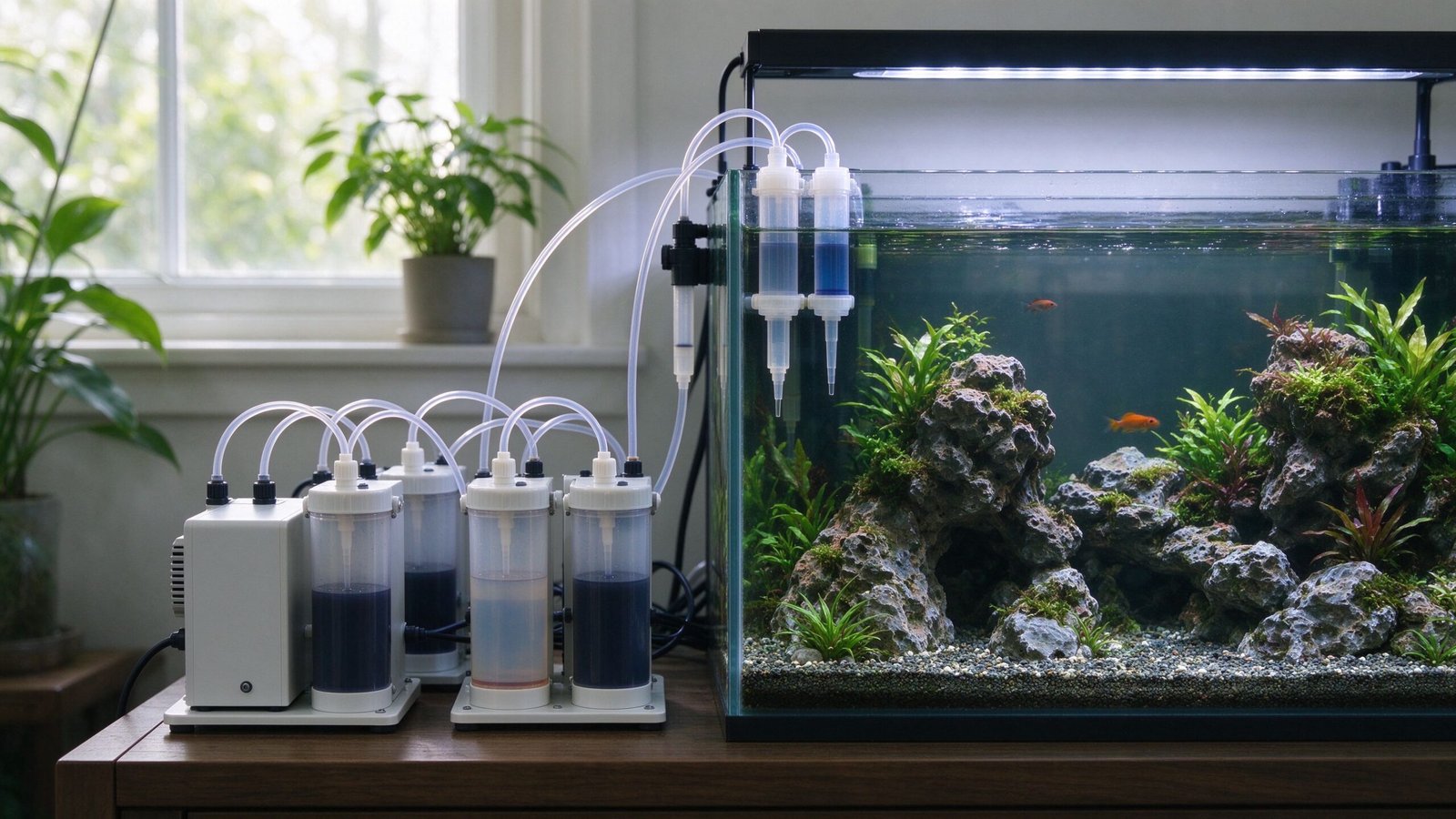
Reef keepers and aquaculture systems do not dose water the way a swimming pool does. A reef tank holds a limited volume of saltwater, and the coral and coralline algae continuously pull calcium and carbonate alkalinity out of it. To keep growth steady, those elements have to be topped up in small, repeatable doses every day, along with magnesium and a rotating set of trace elements. The dosing has to be precise down to small daily volumes, gentle enough not to shock the tank, and sealed so the reservoirs do not off-gas or contaminate. This application guide looks at why small peristaltic pumps are a common fit for reef and aquarium dosing, what the different elements call for, and how to set the pumps up so the doses stay consistent over time.
What the Reef Dosing Pump Actually Delivers
Most two-part reef dosing systems split the chemistry into a calcium solution and an alkalinity (carbonate/buffer) solution, sometimes with magnesium as a third part and trace-element or iodine mixes as occasional feeds. Each part is dosed separately so they do not react and precipitate in the same line or reservoir. A peristaltic dosing pump moves each part through its own dedicated tube, keeping the wetted path closed and isolated between channels. The peristaltic pump tube is the only fluid-contact part, which makes it easy to keep each chemical on its own channel.
| Dosing part | Role in the tank | Dosing note |
|---|---|---|
| Calcium solution | Supplies calcium for coral skeleton and coralline growth | Dosed on its own channel; keep apart from alkalinity part |
| Alkalinity / buffer solution | Replenishes carbonate alkalinity consumed by coral and calcification | High-pH solution; check tube compatibility and sealing |
| Magnesium solution | Supports the calcium-alkalinity balance and crystal formation | Often a separate channel on multi-channel setups |
| Trace element mixes | Replace elements used up by livestock and water changes | Usually small, intermittent doses rather than a constant feed |
Why Peristaltic Suits This Duty
Aquarium dosing calls for small, repeatable volumes at a low flow, over long periods, with chemicals that are salt solutions and moderately alkaline. A peristaltic matches that on several points. The fluid only touches the tube, so a salt solution does not contact seals, diaphragms, or check valves that could crystallize and stick. The pump can run dry without damage if a reservoir runs empty, which matters on unattended home and commercial tanks. Flow is adjusted by motor speed, so the daily dose can be turned down to a small setting rather than stepped through coarse pulses. And when the tube ages or a channel needs a chemical change, swapping the tube is a short field job.
For a single small channel, a K15 micro peristaltic pump targets the low-flow dosing range typical of reef tanks. For instruments and compact controllers where mounting space is tight, the K4024 mini peristaltic pump fits the small-head form factor. On a multi-part setup, channels can be run from separate heads or a multi-tube arrangement so each chemical stays isolated.
Sizing the Pump for the Daily Dose
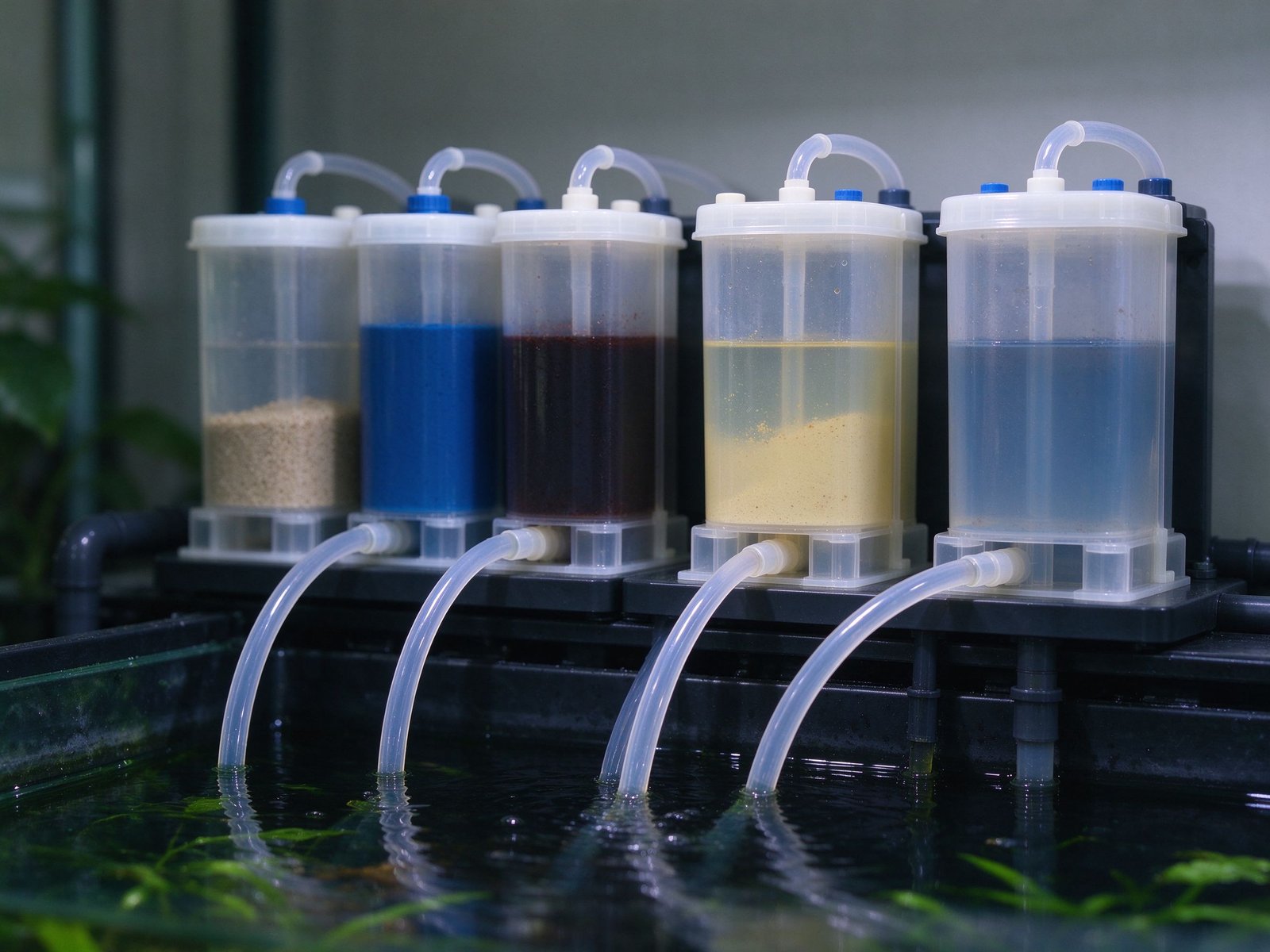
Start from the daily volume each part needs, not from a pump catalog flow. Reef dosing is usually a few milliliters to tens of milliliters per part per day, split into several small doses rather than one large pour. A pump that is oversized for that range spends most of its time near its minimum speed, where repeatability is poorer; a pump sized so the working speed sits in a comfortable middle of its range holds a steadier dose. Work out how many channels you need, whether any part is dosed only occasionally, and what voltage and control signal the controller or timer uses. The motor-driver operating manual covers the speed and control range for the driver type.
| Decision point | What to confirm |
|---|---|
| Channels | Number of separate parts to dose; whether trace elements are occasional |
| Daily volume per part | Target daily dose, split into dose events per day |
| Working speed | Pump sized so the set speed sits mid-range, not at the minimum |
| Voltage and control | 12V/24V supply, timer, PWM or analog signal from the tank controller |
| Tube compatibility | Tube material tolerant to salt and alkaline solutions |
Setting Up and Calibrating
Install the reservoirs where they stay accessible, route each tube down to the sump or injection point, and fit a check valve or air gap near the tank to prevent back-siphonage when the pump rests. Prime each channel before relying on the reading. Calibrate by weighing the liquid a channel dispenses over a known number of dose events, rather than trusting the timer setting alone; the NIST measurement guidance on gravimetric volume is the reliable way to confirm a small dose. Record the dose per event for each channel and revisit it as stocking load or coral growth changes.
On a commercial or display system, the dosing arrangement may feed a 24V dosing pump head off a controlled driver, with each channel labeled to its reservoir so a tube swap does not cross chemicals. The NSF fluid-handling guidance on controlled water systems supports keeping reservoirs covered, lines labeled, and chemical segregation intact, which matters in any closed recirculating tank.
Common Reef Dosing Issues and Fixes
| Issue | Likely cause | Fix |
|---|---|---|
| Channel delivers less than set | Tube slipped, partially clogged, or air in the line | Reprime, inspect tube, check for salt crystals |
| Crystals at the fitting | Salt solution drying on an open tube end | Rinse fitting, keep tube ends immersed or capped when idle |
| Drip after the dose stops | Siphon through the line or residual tube relaxation | Check valve, air gap, short rise after the injection point |
| Dose drifts over weeks | Tube aging and softening under repeated compression | Re-calibrate on schedule, plan tube replacement |
| Cross-contamination between parts | Shared tube or rinsed-through channel | Dedicated tube per part, never reuse a chemical tube across parts |
Tube Choice for Salt and Alkaline Solutions
Reef chemicals are salt solutions, and the alkalinity part is moderately alkaline. The tube has to resist swelling, hardening, or cracking in that environment over long run hours, and it has to stay flexible enough to recover after each compression. Salt that crystallizes at the tube end or fitting is a sign the solution is drying out where the line is open to air; rinsing the fitting and keeping the end immersed reduces crystal buildup. Because tube behavior differs between materials, confirm compatibility against the actual solution and concentration rather than assuming one tube suits every reef part. Inspect tubes periodically for whitening, cracking, or loss of elasticity, and replace a channel’s tube before its dose drifts out of range.
Keep in mind that dosing works alongside water changes and evaporation top-up. Evaporation concentrates salts in the tank, while water changes dilute trace elements, so the dosing schedule may need to be adjusted as stocking and coral growth change. Record baseline readings and dose history so a change in tank chemistry can be traced back to a specific channel rather than guessed at.
Common Questions
Can one pump dose both calcium and alkalinity? They must not share a wetted path, because the two solutions react and precipitate if mixed. Use a separate tube and channel for each part, even on a shared motor or manifold.
How often should the tube be replaced? On salt and alkaline solutions, inspect the tube periodically for softening, cracking, or discoloration, and re-calibrate when the dose starts to drift. Replacement interval depends on tube material, run hours, and chemical concentration, so watch the delivered volume rather than a fixed calendar date.
Does a reef dosing pump need a pressure rating? Reef lines are short and open to the sump, so back-pressure is usually low. Keep the discharge line open and unrestricted; a closed valve or blocked injection point is the main pressure risk.
What control do I need? A timer or aquarium controller that triggers each channel on a schedule, with adjustable dose length or speed, is typical. The control signal should match what the driver accepts.
If you are putting together a reef or aquarium dosing setup, contact YOORAIN with the number of parts to dose, the daily volume per part, the tank voltage, and the control signal you plan to use. We can suggest the micro or mini peristaltic head, channel arrangement, and tube material that keep each dose isolated and consistent.