
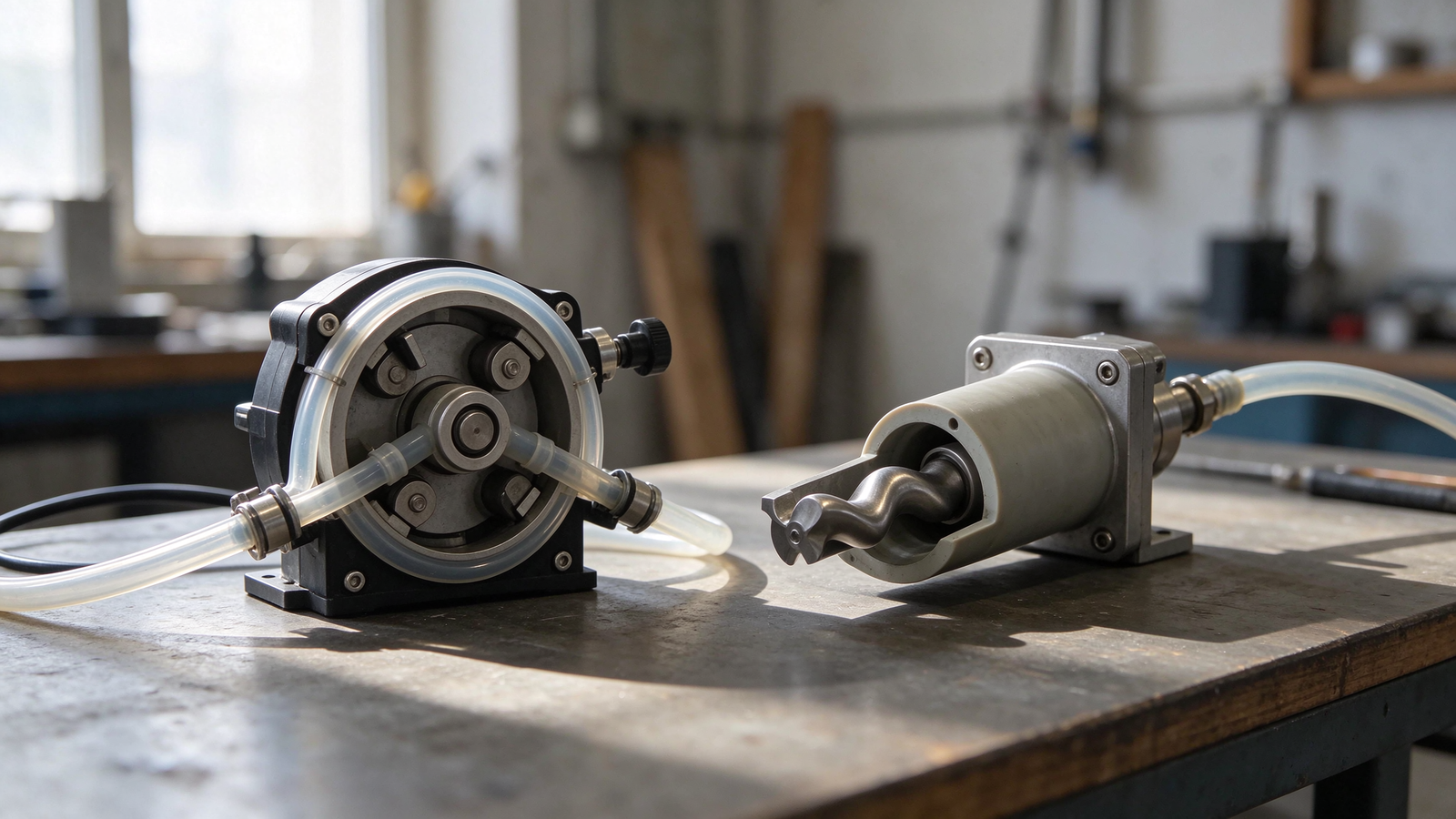
When a duty calls for moving viscous liquids, mild slurries, or shear-sensitive formulations, engineers often compare peristaltic tube pumps with progressive cavity (screw) pumps. Both are positive-displacement machines: they trap a fixed volume and push it along rather than relying on an impeller to throw the fluid. That shared trait makes both suitable for thicker fluids than a centrifugal pump can handle, but the two machines reach that result in different ways, and the wetted parts, wear pattern, cleanout, and service routine are not interchangeable. Choosing between them comes down to the fluid’s viscosity and solids, how gently it must be handled, how often the product changes, the suction and discharge conditions, and how the pump will be maintained on site. This comparison walks through how each pump works, where each one fits, the engineering factors that separate them, and the questions to ask before specifying either.
How Each Pump Moves the Fluid
A peristaltic pump encloses the fluid in a flexible tube routed around the head. A rotor carries rollers that press the tube flat in sequence, occluding the bore and pushing the fluid ahead; behind each released roller the tube springs back to its round shape and draws in the next charge. The fluid never touches the rotor, rollers, or housing internals, and the only wetted parts are the tube and its end fittings. A peristaltic pump tube is the main consumable, and the peristaltic pump driver sets the rotor speed and control scheme.
A progressive cavity pump uses a helical rotor turning inside a fixed elastomer stator. As the rotor turns, sealed cavities form and travel from the suction side toward the discharge side in a continuous series. The rotor and stator sit in the wetted path, and the fluid moves through the spaces between them. Wear concentrates on the stator liner and the rotor surface, and the seal between rotor and stator is what holds the discharge pressure.
| Factor | Peristaltic tube pump | Progressive cavity pump |
|---|---|---|
| Principle | Roller occlusion and tube recovery in a flexible tube | Rotor turning in a helical stator forms moving cavities |
| Wetted parts | Tube and end fittings only | Rotor, stator, seal and housing flow path |
| Main wear parts | Tube; rollers and housing over long service | Stator elastomer; rotor surface; seals |
| Fluid isolation from internals | Full isolation inside the tube | Fluid contacts rotor, stator and seals |
| Dry running | Short dry periods tolerated; tube is not lubricated by the fluid | Stator and rotor rely on fluid film; dry running accelerates stator wear |
| Cleanout / product change | Flush the tube or swap it; no chamber to strip | Strip and clean the rotor-stator cavity and seals |
| Flow character | Pulses with each roller pass; smoother with more rollers | Stepper but generally lower-pulse flow per cavity |
| Suction capability | Good suction lift when tube and inlet are sound | Good suction lift on correctly primed units |
| Solids handling | Limited by tube bore and roller occlusion; soft particles pass | Can pass larger solids through the cavity; depends on rotor-stator gap |
| Shear on fluid | Gentle; fluid travels in a flexible bore without close clearances | Moderate; rotor-stator clearances and nip can shear some formulations |
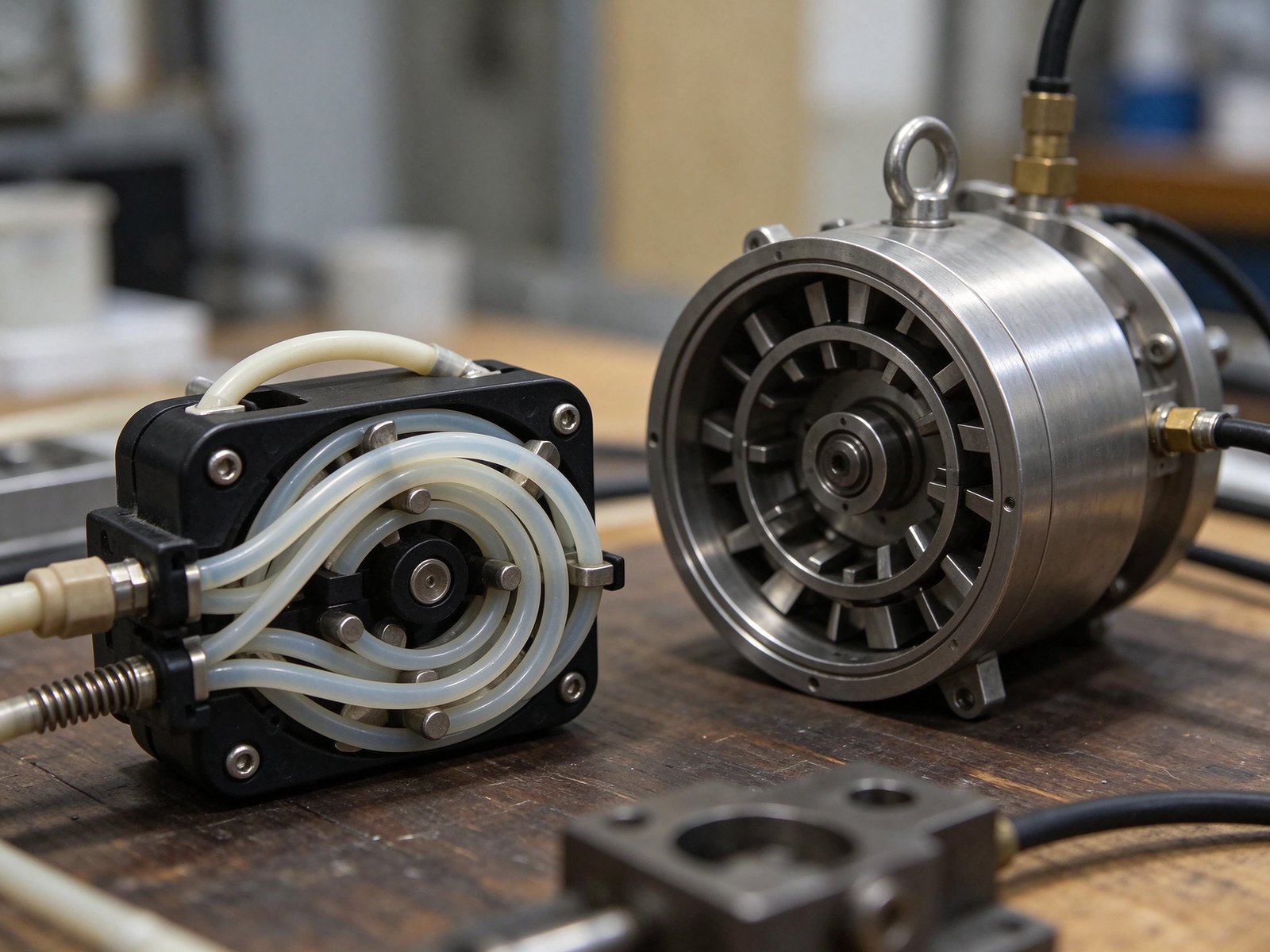
Fluid-by-Fluid Selection
The right pump follows the fluid rather than a generic “viscous liquid” label. The same viscosity can behave very differently with particles, emulsifiers, shear sensitivity, or a tendency to settle, and those traits push the choice in different directions.
Viscous Liquids and Concentrates
Thick concentrates, slurries, pastes, and syrups are the territory both pumps are built for. A progressive cavity often moves higher viscosity and larger volumes per unit with a steadier stream, and it is a common choice on transfer duties where the product flows through a rotor-stator set. A peristaltic handles viscous fluids through the tube bore and rotor speed; it is frequently chosen at smaller dosing and transfer points where the duty is moderate and the product changes often. Match the tube bore and material to the viscosity and chemistry, and keep suction lines short and free of kinks so the viscous fluid can fill the bore.
Abrasive Slurries and Particles
An abrasive fluid wears whichever wetted part it contacts. In a peristaltic pump the abrasive sits in the tube, which is itself a replaceable consumable; the rollers and housing stay outside the fluid. In a progressive cavity the abrasive passes through the rotor-stator gap, and wear appears on the stator liner and rotor. For abrasive service, review material hardness, particle size, and concentration with the supplier, and budget the wear part accordingly. The earlier coverage of small peristaltic pump heads and abrasive duty describes how tube speed and bore are trimmed to reduce tube wear; a larger flow abrasive transfer tends toward the head range a large-flow-rate peristaltic pump covers.
Shear-Sensitive Emulsions and Cell Cultures
Emulsions that can break, polymers that can shear, and cell or reagent suspensions that must stay intact need a gentle fluid path. A peristaltic moves the fluid inside a smooth flexible bore without tight clearances or a rotor-nip, which is why it appears in reagent, media, and low-shear dosing points. A progressive cavity moves fluid through closely fitted helical parts; whether that shear is acceptable depends on the formulation, the rotor speed, and the clearance design. If the product separates, degrades, or flocs under mechanical action, run a sample check before committing to either pump.
Frequent Product Changes and Sanitary Cleanout
Where several products or chemistries share the same pump, cleanout and cross-contamination matter. A peristaltic’s wetted path is the tube: a flush clears the bore, or a spare tube can be fitted for the next chemistry. The rotor and housing stay dry and untouched by the product. A progressive cavity requires the rotor-stator and seals to be flushed or disassembled between incompatible products, which adds service time and a place for residue to collect. Frequent changeover, cleanwater duties, and reagent switching tend to favor the peristaltic arrangement; a single product on a continuous transfer line makes the cavity pump’s cleanout burden less relevant.
Engineering Factors That Separate the Two
Beyond the fluid, the duty conditions decide whether a pump holds up over a shift. The points below are worth checking before either pump is quoted.
| Condition | Peristaltic consideration | Progressive cavity consideration |
|---|---|---|
| Discharge pressure / back-pressure | Tube must hold the pressure without bulging; excessive back-pressure opens slip and ages the tube | Rotor-stator contact must hold pressure; higher pressure stages add stator length or reduction |
| Suction lift and inlet condition | Tube recovery draws the charge; a collapsed or kinked inlet breaks prime | Cavity fill depends on inlet flooding or suction lift; seal condition affects prime |
| Continuous versus intermittent duty | Tube life depends on cycles, speed and chemistry; schedule tube replacement | Stator life depends on running time, fluid film and abrasives |
| Dry running risk | Short dry runs do not damage internals; watch tube condition | Running without fluid film accelerates stator and rotor wear |
| Flow regulation | Speed sets dose; slip rises with wear or back-pressure; calibrate after tube changes | Speed sets cavity displacement; slip rises with stator wear and pressure |
| Noise and vibration | Roller passage produces a stepping load; mounting and tube tension matter | Rotating rotor and reduction drive produce mechanical load and vibration |
| Spare parts on site | Replacement tube and fittings; consumable kept in stock | Stator, rotor and seals; wear parts sized to the pump model |
Where a Peristaltic Is the Better Fit
A peristaltic tube pump tends to fit when the duty is at a dosing, metering, or moderate transfer point; when the chemistry changes often and the path must stay clean; when the fluid must stay isolated from the pump internals; when the wetted path should reduce to a simple replaceable tube; and when service on site should not require stripping a chamber. The micro and small head ranges suit low-flow reagent and additive duties, while larger heads cover higher transfer flows. The micro peristaltic pump head is used for low-volume reagent and additive feeds; drivers range from fixed-speed units to adjustable or signaled controls that follow a batch or line controller.
Where a Progressive Cavity Is the Better Fit
A progressive cavity pump tends to fit continuous, higher-volume transfer of a single product where a steady stream and larger displacement are valued; where the fluid carries larger solids the cavity can accommodate; and where cleanout between products is infrequent. It is a conventional transfer pump in process lines rather than a compact dosing head. It expects the rotor-stator wear parts to be serviced on schedule and the fluid to provide the running film that protects the stator.
Common Selection Mistakes
| Mistake | Why it causes problems | Better check |
|---|---|---|
| Choosing on flow rating alone | Ignores viscosity, solids, shear and back-pressure that affect real performance | State fluid, concentration, temperature, solids and target flow together |
| Assuming both handle the same abrasives equally | Abrasive contacts different wear parts in each design | Compare the wetted wear part and its replacement cost and life |
| Overlooking product changeover | A cavity pump needs more strip-down between incompatible products | Map changeover frequency and cleanout method before sizing |
| Ignoring dry-run exposure | Stator and rotor wear fast without a fluid film | Check whether the line may run dry and how the pump is protected |
| Underestimating consumables | Tube or stator replacement is part of ongoing cost, not a defect | Keep the correct consumable in stock and track service life |
| Mismatched control scheme | A dosing recipe needs adjustable or signaled speed, not a fixed drive | Confirm manual, adjustable, or controlled feed before order |
Maintenance and Consumables
The service routine follows the wear part. On a peristaltic, inspection centers on the tube: check for swelling, hardening, cracking, flattening that does not recover, or reduced output, and replace the tube at the interval the duty and chemistry suggest. Keep the bore matched to the fluid and inspect rollers and housing where the tube sits. On a progressive cavity, inspection centers on the stator elastomer and rotor: track output loss, increased slip under pressure, and stator wear, and replace the wear set on schedule. In both designs output can slip as the wear part ages, so a delivered-volume check after service is the practical way to confirm the pump still meets the dose.
Documentation for service matters in either case: the fluid record, the consumable material in use, the replacement date, and the measured output give the baseline for the next service. The motor-driver operating manual and driver reference describe drive-side setup and control; supplier guidance should cover the wear parts for the chosen pump type. Measurement practice for checking delivered volume follows the weighing and timing methods described by the NIST measurement practice, and engineering guidance on fluid handling is available from NSF engineering research.
Questions to Bring to the Supplier
Whether the final choice is a peristaltic or a progressive cavity, the supplier quote should be built on the same duty facts. Prepare the fluid name and concentration, viscosity and temperature, any solids in size and proportion, the target flow and addition time, the discharge pressure or back-pressure, the suction condition, whether products change over the pump, the control signal expected, and how often the pump runs. Ask which wetted materials are compatible, which consumable to keep on site, what service interval the duty suggests, and how output is verified after a wear part change. Comparing the two pump types on those facts, rather than on headline flow alone, gives a selection that holds up on the line.
Frequently Asked Questions
Can a peristaltic pump replace a progressive cavity pump for viscous transfer? It can on moderate duties and at dosing or smaller transfer points, but higher-volume continuous transfer or larger solids may be better served by a cavity pump. Confirm the viscosity, solids, pressure and flow before swapping.
Which is easier to clean between products? A peristaltic limits the wetted path to the tube, so a flush or tube swap usually covers the change; a progressive cavity needs the rotor-stator and seals flushed or stripped. Frequent product changes favor the peristaltic.
Which pump handles abrasive slurries longer? It depends on the abrasive and the wear part budget. Peristaltic wear concentrates in the replaceable tube; cavity wear concentrates in the stator and rotor. Compare material, particle size, and expected consumable life for the actual slurry.
Do both pumps pulse? A peristaltic output steps with each roller pass, smoothing out with more rollers or a damper; a progressive cavity produces a lower-pulse cavity stream. Match the output character to the process tolerance.
What breaks down first on each? In a peristaltic, the tube ages with chemistry, cycles and speed; in a cavity pump, the stator and rotor carry the wear. Keep the relevant consumable in stock and track service life.
If you are weighing a peristaltic against a progressive cavity for a dosing or transfer duty, send YOORAIN the fluid and concentration, viscosity and temperature, solids content, target flow, discharge pressure, product changeover frequency, and the control arrangement. We can advise on the peristaltic head, tube material, and drive that suit the duty, and note when a different pump type would be the better fit.