
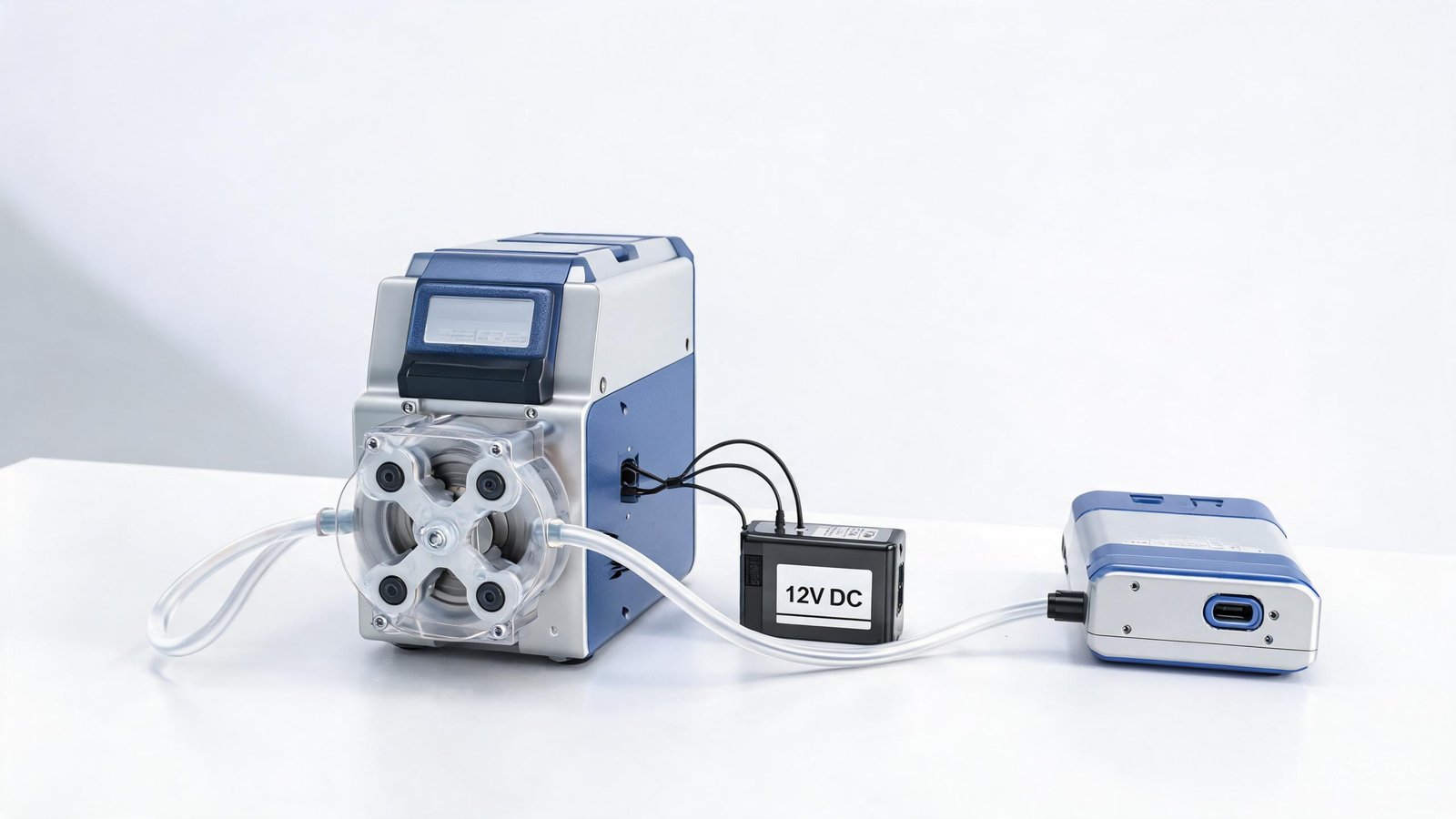
Portable and battery-powered devices increasingly rely on peristaltic pumps for precise fluid handling — from aquarium dosing systems and pH dispensers to portable medical instruments and field sampling equipment. For design engineers, selecting a 12V DC peristaltic pump involves more than matching a flow rate. Power consumption, motor type, tubing compatibility, and physical footprint all determine whether the pump will perform reliably in a battery-operated system. This article examines the key selection criteria for DC-powered peristaltic pumps in portable applications, with specific reference to pump configurations available from YOORAIN’s micro peristaltic pump lineup.
Why 12V DC Peristaltic Pumps Dominate Portable Applications
The 12V DC voltage standard is ubiquitous in portable electronics because it aligns with common battery configurations — including sealed lead-acid (SLA) batteries, lithium-ion packs with nominal 11.1V or 12.6V outputs, and automotive power systems. A 12V DC peristaltic pump draws minimal current during operation, allowing battery-powered devices to run for extended periods without recharge.
Several characteristics make DC-powered peristaltic pumps particularly suitable for portable and battery-operated devices:
- Low power consumption: The KCR 12V DC peristaltic pump operates at just 5W, making it practical for battery-driven systems where energy budget is constrained.
- Compact size: Mini pump formats like the K4024 mini peristaltic pump use direct-plug snap-assembly construction, reducing overall device footprint.
- Controllable speed: DC motors accept pulse-width modulation (PWM) for precise flow rate adjustment, which is critical for dosing applications.
- Tube isolation: Only the tubing contacts the fluid, eliminating contamination risk and simplifying maintenance in field-use scenarios.
For portable devices that incorporate rechargeable lithium-ion batteries, safety standards such as IEC 62133-2 define requirements for battery cells and packs used in portable applications. Compliance with these standards ensures that the battery system supporting the pump operates safely under intended use and foreseeable misuse conditions.
| Pump Model | Voltage Options | Flow Rate Range | Motor Type | Key Feature |
|---|---|---|---|---|
| KCR 12V DC | 3V / 6V / 12V / 24V | 5.2 – 85 ml/min | DC motor (brush) | Low 5W power, 3-roller low pulse |
| KFS DC brush motor | 6V / 12V / 24V | 15 – 95 ml/min (single gear) | DC brush / brushless | Transparent body, BPT/Viton/Silicone tube |
| K4024 mini pump | DC motor compatible | Varies by motor selection | DC / stepper | Snap assembly, guide roller design |
| TH15 spring pump | Stepper / DC / synchronous | Up to 700 ml/min | Stepper / DC / sync | Adaptive tube wall, longer tube life |
Motor Selection: Brush DC vs. Brushless DC vs. Stepper
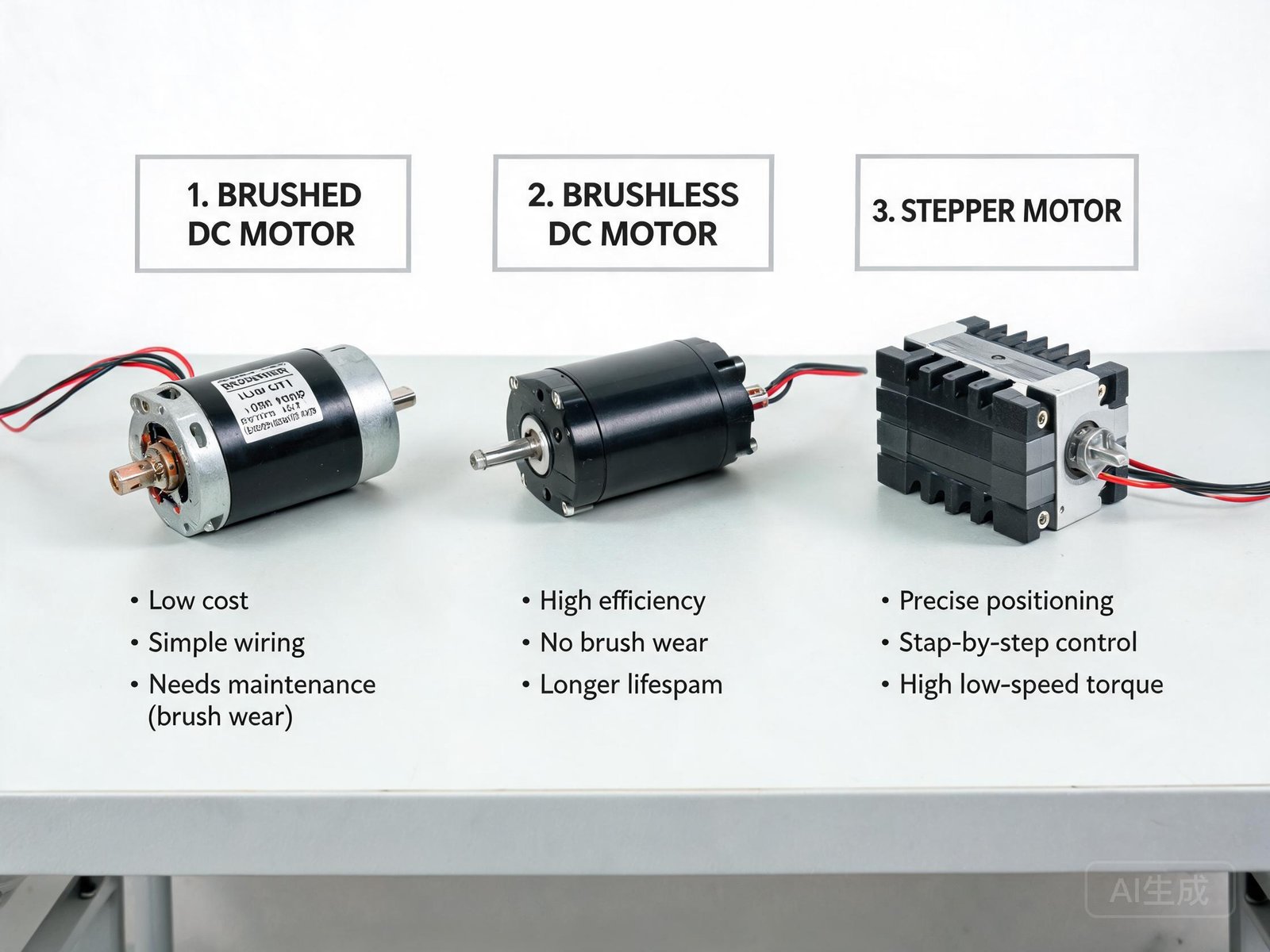
The motor type in a peristaltic pump affects not only performance but also battery life, noise output, and maintenance requirements. Three motor types are commonly available for DC-powered peristaltic pumps:
Brush DC motors are the most economical option. They provide high starting torque and simple speed control via voltage adjustment or PWM. The KCR pump uses a standard DC motor with a maximum speed of 300 rpm. Brush motors have a finite service life due to brush wear, typically rated in hundreds to thousands of operating hours, making them suitable for intermittent-duty portable applications such as aquarium dosing or pH adjustment.
Brushless DC (BLDC) motors eliminate brush wear, extending operational lifetime and reducing electrical noise. The KFS pump series offers both brush and brushless options at 12V and 24V. For portable medical devices where reliability and long service intervals are critical, brushless configurations provide measurable advantages. Electrical safety requirements for medical equipment are defined in IEC 60601-1, which sets general requirements for basic safety and essential performance of medical electrical equipment — a relevant reference when integrating pumps into portable medical devices.
Stepper motors provide precise rotational control without feedback sensors, enabling accurate volumetric dispensing. The TH15 spring-type pump accepts stepper motors alongside DC and synchronous options. Stepper-driven pumps are preferred in analytical instruments and laboratory automation where dosing precision is more important than power efficiency.
For portable devices where audible noise matters — such as home-use medical devices or indoor analytical equipment — DC motor noise reduction techniques become relevant. The KFS series addresses this through engineering plastic gears designed for low-noise, long-life operation.
| Motor Type | Speed Control | Typical Lifetime | Noise Level | Best For |
|---|---|---|---|---|
| Brush DC | Voltage / PWM | 500-2000 hours | Moderate | Intermittent duty, aquarium, pH dosing |
| Brushless DC (BLDC) | Electronic controller | 5000+ hours | Low | Portable medical devices, continuous duty |
| Stepper | Step pulse control | 5000+ hours | Low to moderate | Precision dispensing, analytical instruments |
Power Budget Calculation for Battery-Operated Pumps
When designing a battery-powered device with a peristaltic pump, engineers must calculate the power budget to ensure adequate battery capacity. The calculation depends on the pump’s operating current, duty cycle, and required runtime between charges.
For a KCR pump drawing 5W at 12V, the operating current is approximately 0.42A. With a duty cycle of 10 percent (6 minutes per hour), daily energy consumption would be:
- 5W x 0.1 (duty cycle) x 24 hours = 12 Wh per day
- A 12V 2000mAh lithium-ion pack stores approximately 24 Wh
- Expected runtime: approximately 2 days per charge
This calculation illustrates why 12V DC peristaltic pumps are practical for portable dosing devices. The low power draw allows compact battery packs to support operation for days or weeks, depending on the dosing frequency and volume per cycle. Engineers should also account for standby power consumption of control electronics, display screens, and sensor circuits when sizing the battery pack.
For devices using lithium-ion batteries, the NIST Fire Research Division has published data on thermal runaway characteristics of lithium-polymer cells, providing reference material for engineers designing battery-powered devices with safety considerations.
Tubing Material Selection for Portable Pump Applications
Tubing choice affects flow accuracy, chemical compatibility, and maintenance interval — all critical factors in portable devices where field servicing may be infrequent. The KCR pump supports standard silicone tubing with inner diameters of 1mm, 2mm, and 3mm, while the KFS DC brush motor pump offers PharMed BPT, Viton, and Silicone tubing options.
Silicone tubing is suitable for most aqueous solutions, reagents, and biological fluids. It offers good elasticity for consistent pump occlusion and is compatible with FDA-regulated applications. For more aggressive chemical environments — such as solvent-based formulations or strong acids — BPT (PharMed) tubing provides broader chemical resistance. Viton tubing is selected for hydrocarbon-based fluids and high-temperature applications.
The TH15 spring-type peristaltic pump features an adaptive tube wall design that extends tubing life — an advantage in portable devices where tubing replacement intervals directly affect service frequency.
| Tubing Material | Chemical Resistance | Typical Application | Relative Tubing Life |
|---|---|---|---|
| Silicone | Good (aqueous, mild chemicals) | Reagent dispensing, aquarium dosing | Standard |
| PharMed BPT | Excellent (broad chemical range) | Pharmaceutical, aggressive reagents | Extended |
| Viton | Excellent (hydrocarbons, oils) | Solvent transfer, fuel-related fluids | Extended |
Integration Considerations for OEM Device Designers
Beyond pump specifications, several integration factors affect the success of a portable pump implementation:
Physical mounting: The K4024 mini pump uses a snap-type assembly with a hemispherical pump head design. This construction simplifies integration into compact device enclosures and allows quick tubing changes without disassembling the pump head. The transparent upper cover lets operators visually confirm pump operation during field use.
Electrical interface: DC motor pumps require a motor drive circuit compatible with the battery management system. For brushless motors, an electronic speed controller (ESC) is needed. The KFS series offers 6V, 12V, and 24V options, allowing designers to select the voltage that matches their battery architecture.
Flow path isolation: In portable devices, the pump tubing must be routed to prevent kinking and minimize discharge line length. The TH15 pump features a drainage tank design that prevents fluid accumulation in the pump housing — an important safety feature for portable devices that may be transported in various orientations.
Regulatory compliance: For portable devices intended for medical or laboratory use, manufacturers must comply with applicable quality system regulations. 21 CFR Part 820 establishes the quality system regulation requirements for medical devices marketed in the United States, covering design controls, production processes, and corrective actions.
Independent product comparisons, such as this battery-powered peristaltic pump guide from Industrial Ridge, provide additional context for evaluating commercially available DC-powered pump options alongside YOORAIN products.
Frequently Asked Questions
What is the typical flow rate range of a 12V DC peristaltic pump?
Flow rates for 12V DC peristaltic pumps vary by motor speed, roller count, and tubing inner diameter. The KCR pump delivers 5.2 to 85 ml/min, while the KFS series with different gear configurations can reach 15 to 95 ml/min. For higher flow requirements, the TH15 spring-type pump achieves up to 700 ml/min when paired with a suitable DC motor.
How long can a battery-powered peristaltic pump operate on a single charge?
Runtime depends on the pump’s power consumption, battery capacity, and duty cycle. A KCR pump drawing 5W at 12V with a 2000mAh battery pack and 10 percent duty cycle can operate for approximately 2 days between charges. Increasing battery capacity or reducing the duty cycle extends runtime proportionally.
What tubing materials are compatible with 12V DC peristaltic pumps?
Common tubing materials include silicone (for aqueous solutions and biological fluids), PharMed BPT (for aggressive chemicals and pharmaceutical applications), and Viton (for hydrocarbons and solvents). The KCR pump uses 1-3mm ID silicone tubing, while the KFS pump supports BPT, Viton, and silicone options.
Can I use PWM to control the flow rate of a DC peristaltic pump?
Yes. Brush DC motors in peristaltic pumps respond linearly to PWM control, allowing precise flow rate adjustment. For applications requiring finer volumetric accuracy, stepper motor options such as those available on the TH15 pump provide discrete step-based control without the need for feedback sensors.
What is the difference between brush and brushless DC motors for peristaltic pumps?
Brush DC motors are economical and simple to control but have a finite brush life (typically 500-2000 hours). Brushless DC motors eliminate brush wear, extend service life beyond 5000 hours, and produce less electrical noise — making them preferred for portable medical devices and continuous-duty applications.
If your portable device requires a 12V DC peristaltic pump, contact YOORAIN with your target flow rate, battery voltage, tubing size, and application details. Specifying these parameters helps identify whether the KCR, KFS, K4024, or TH15 configuration matches your requirements — or whether a customized motor and tubing combination would better suit your device.