
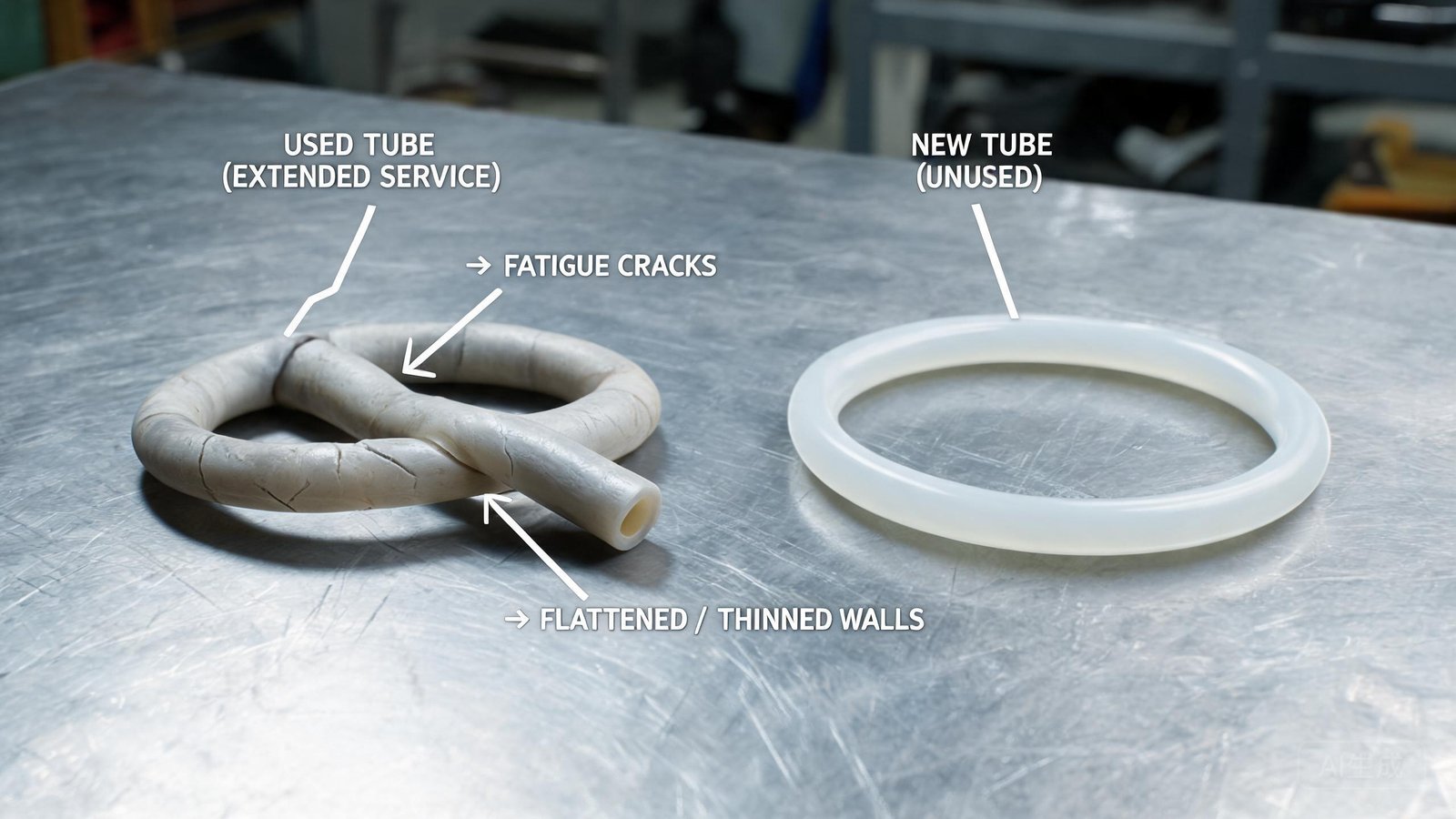
Tubing is the single wearing component in a peristaltic pump system, and it accounts for the majority of unplanned pump downtime across biopharmaceutical, chemical dosing, and industrial transfer applications. When a tube fails, the symptom is usually obvious: flow rate drops, output becomes inconsistent, or the tube ruptures and leaks product. The root cause is often less obvious, and misdiagnosis leads to repeated failures that could have been prevented. Industry data from water and wastewater treatment indicates that nearly 70% of premature hose failures stem from incorrect installation, poor suction conditions, or improper occlusion settings rather than natural material fatigue, according to a troubleshooting analysis published by Water and Wastewater.
This article walks through the main failure modes for peristaltic pump tubing, how to diagnose each one, and what preventive measures engineers and maintenance planners can take. Whether you are running a peristaltic hose pump in a chemical dosing line or a compact pump head in a laboratory analyzer, the same physical mechanisms govern tube life.
What Causes Tubing to Fail
Peristaltic pump tubing fails through a combination of mechanical, chemical, and operational mechanisms. Understanding which mechanism is at work is the first step toward a correct diagnosis.
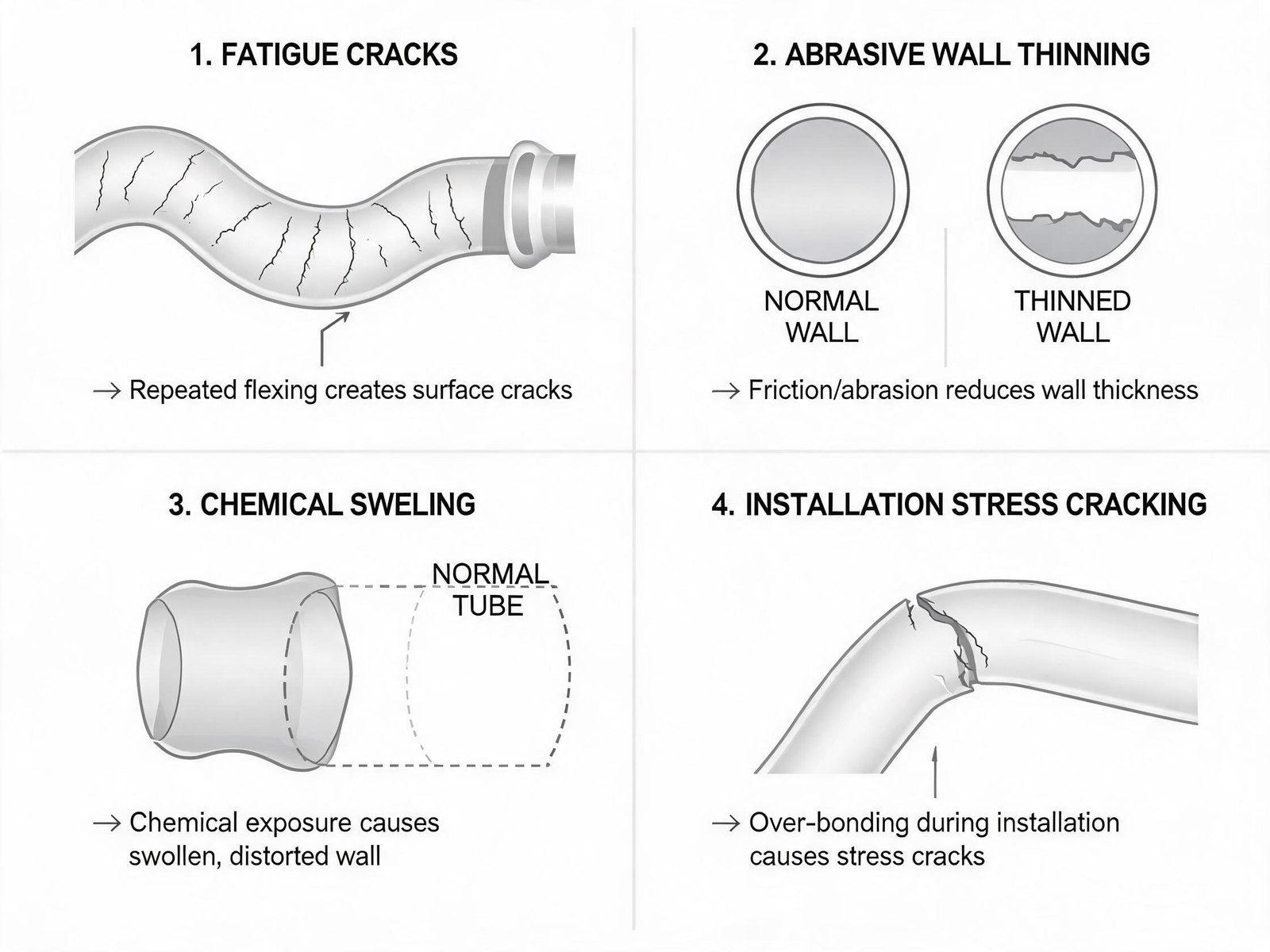
Mechanical fatigue. Every rotation of the pump head compresses and releases the tube. Over thousands of cycles, the elastomer loses elasticity and cannot fully recover its original round shape between compressions. The internal bore narrows, the wall thins, and micro-cracks may form. This is the natural end-of-life mechanism, and it is accelerated by higher pump speeds, tighter occlusion, and sharper roller profiles. For a deeper look at how flow rate interacts with tube wear, see YOORAIN’s guide on peristaltic pump flow rate selection.
Abrasive wear. When the pumped fluid contains particulate matter, solids act as an abrasive against the inner tube wall. This thins the wall from the inside, reducing compression effectiveness and increasing internal back-flow (slip). The effect is most pronounced in slurry transfer, lime dosing, and fermentation broth handling.
Chemical attack. No elastomer is universally compatible. Strong acids, bases, organic solvents, and oxidizing agents can swell, harden, embrittle, or soften the tube material. A tube that performs well in aqueous media may degrade rapidly when exposed to a solvent it was not designed for. Chemical compatibility must be checked for each specific fluid, not assumed from the material name.
Installation errors. A tube that is twisted, stretched, kinked, or loaded into the pump head at the wrong orientation experiences uneven stress concentration. This accelerates fatigue at specific points rather than uniformly along the tube length, causing premature cracking or rupture. Similarly, using tubing with the wrong wall thickness or outer diameter for a given pump head leads to either over-compression (rapid wear) or under-compression (slip and flow loss).
| Failure Mode | Primary Cause | Characteristic Symptom |
|---|---|---|
| Mechanical fatigue | Repeated compression cycles | Gradual flow decline, wall thinning |
| Abrasive wear | Particulate in fluid | Internal wall thinning, slip |
| Chemical attack | Incompatible fluid chemistry | Swelling, hardening, cracking |
| Installation error | Wrong size, twist, or stretch | Localized cracking, uneven wear |
How to Diagnose Tubing Problems
Effective diagnosis starts with observing the symptom and working backward to the mechanism. The following diagnostic approach helps narrow the root cause quickly.
Flow rate decline. If output drops gradually over hours or days, the most likely cause is mechanical fatigue. The tube has lost elasticity and the suction pocket volume is reduced. Check whether the tube feels permanently flattened when removed from the pump head. If the tube wall has visibly thinned, abrasive wear may be a contributing factor.
Sudden flow loss. If flow drops abruptly with no gradual warning, check for a blocked suction line, a pinched inlet, or a tube that has split internally. A split may not always leak externally if the rupture is on the suction side under negative pressure.
Inconsistent output. Pulsation or fluctuating flow that was not present when the tube was new suggests uneven wear, partial occlusion loss, or air ingress through a loose fitting. For a systematic approach to pulsation diagnosis, see YOORAIN’s article on reducing peristaltic pump pulsation.
Visible tube damage. When the tube is removed, inspect the contact surface. Uniform wear along the roller track indicates normal service. Localized wear or cracking at specific points points to installation stress or roller misalignment. Swelling or tackiness on the inner surface suggests chemical incompatibility. Discoloration may indicate thermal degradation from high-temperature operation.
Prevention Strategies
Preventing tubing failure is more cost-effective than reacting to it. The following measures address each failure mode directly.
Select the correct tubing material. The starting point is matching the tube material to the fluid chemistry, temperature, and required service life. Platinum-cured silicone suits most aqueous and biological fluids. Thermoplastic elastomers such as PharMed BPT provide longer flex life and better chemical resistance for aggressive fluids. Fluoroelastomer tubing handles oils and solvents but should be verified for the specific chemical. YOORAIN offers peristaltic pump tubing in multiple materials, and the specific grade should be confirmed against the application. For a detailed material comparison, refer to the earlier article on tubing selection for chemical dosing.
Match tubing dimensions to the pump head. Using the correct wall thickness and outer diameter is non-negotiable. A tube that is too thick for the head will be over-compressed and wear rapidly. A tube that is too thin will not occlude fully, producing slip and inconsistent flow. The YZ15 pump head and other YOORAIN heads specify compatible tube dimensions, and those specifications should be followed exactly.
Install tubing correctly. Load the tube straight along the rotor track without twisting, stretching, or kinking. Ensure the tube is seated fully in the pump housing and that any clamps or fittings are tightened to the manufacturer’s specification. A short installation check at each tube change prevents the most common cause of premature failure.
Set a replacement schedule. Rather than running a tube until it fails, establish a replacement interval based on validated operating hours for the specific fluid, speed, and pressure. Tubing life can range from a few hundred hours to several thousand depending on conditions, so a single replacement interval will not apply across all applications. For critical processes such as pharmaceutical filling, the tube should be replaced at the start of each batch or campaign.
| Prevention Measure | Addresses | Implementation |
|---|---|---|
| Correct material selection | Chemical attack, fatigue | Match material to fluid and temperature |
| Correct tube dimensions | Over-compression, slip | Follow pump head specifications |
| Proper installation | Localized stress, cracking | Load straight, no twist or stretch |
| Scheduled replacement | Fatigue failure | Replace based on validated hours, not failure |
| Speed and pressure management | Accelerated wear | Operate within rated speed and pressure |
Particle Shedding in Biopharmaceutical Applications
In biopharmaceutical manufacturing, tubing failure is not only about flow loss or rupture. A subtler concern is particle shedding. A study published in the Journal of Pharmaceutical Sciences found that peristaltic pumping of water and buffer through silicone tubing generates particles of approximately 200 nm, along with a smaller fraction in the lower micrometer range. The study, which used 3D laser scanning microscopy, identified inner surface roughness as a determining factor for particle shedding, and noted that the propensity varied between tubing types and could not be predicted from manufacturer specifications alone. This means that tubing qualification for biopharmaceutical fill lines should include individual particle shedding testing rather than relying on data sheets.
The regulatory environment around single-use and disposable systems reinforces this concern. The revised EU GMP Annex 1, which governs sterile manufacturing of medicinal products and is mirrored internationally through PIC/S GMP standards, places strong emphasis on contamination control and barrier isolation. Peristaltic pumps are widely specified for single-use assemblies because the tube is the only product-contact surface and can be supplied pre-sterilized. However, the tube must be qualified for particle shedding, extractables, and leachables as part of the overall system validation.
For sterile filtration validation, the ASTM F838 standard defines the test method for bacterial retention of sterilizing-grade membrane filters using Brevundimonas diminuta as the challenge organism. While this standard addresses filter validation rather than pump tubing directly, it is part of the downstream testing framework that ensures the complete fill line, including the peristaltic pump and its tubing, meets sterility assurance requirements.
When to Replace Tubing
The decision to replace tubing should be proactive, not reactive. The following indicators signal that a tube is approaching end of life and should be replaced before it fails.
| Replacement Indicator | Likely Failure Mode | Recommended Action |
|---|---|---|
| Flow drift over 5-10% | Mechanical fatigue | Recalibrate; if not restorable, replace tube |
| Permanent flattening | Elasticity loss | Replace tube immediately |
| Visible cracks or blisters | Fatigue or chemical attack | Replace and investigate chemical compatibility |
| Exceeded validated hours | End of service life | Replace per schedule |
| Rising particle counts | Surface degradation | Replace tube; verify in biopharma processes |
- Flow rate has drifted by more than 5-10% from the calibrated value at a given speed, and recalibration cannot restore the original output.
- The tube feels permanently deformed when removed from the pump head, with visible flattening or loss of roundness that does not recover.
- Visible cracks, blisters, or swelling appear on the inner or outer surface of the tube.
- The tube has been in service beyond its validated operating hours for the specific fluid, speed, and pressure combination.
- Particle counts in the product stream trend upward, which in biopharmaceutical applications may indicate tubing surface degradation before visible wear is apparent.
In all cases, the replacement tube should be the same material and dimensions as the original unless a material upgrade has been specifically qualified for the application. For help selecting the right replacement pump tubing for your YOORAIN pump, the product page lists compatible options by material and dimensions.
Root Cause Summary
Tubing failure in peristaltic pumps follows predictable patterns, and most failures can be prevented with the right material selection, correct installation, and scheduled replacement. The key takeaways for engineers and maintenance planners are:
- Most premature failures come from installation errors and incorrect tube sizing, not natural fatigue. A 30-second installation check at each tube change prevents the majority of avoidable failures.
- Match the tube material to the fluid, temperature, and regulatory requirements. Chemical compatibility is application-specific and cannot be assumed from the material name.
- Replace tubing on a validated schedule based on operating hours, not on failure. For biopharmaceutical applications, this schedule should be supported by particle shedding and extractables data.
- Diagnose failures by symptom: gradual flow decline points to fatigue, sudden loss to blockage or rupture, and inconsistent output to wear or air ingress.
- In regulated applications, tubing qualification is part of system validation. Particle shedding testing, bacterial retention validation, and GMP documentation all apply to the pump and tubing as a system.
If you are experiencing recurring tubing failures or need help selecting the correct tubing for your application, YOORAIN can review your operating conditions and recommend a suitable configuration from the available dosing pump and tubing range.