
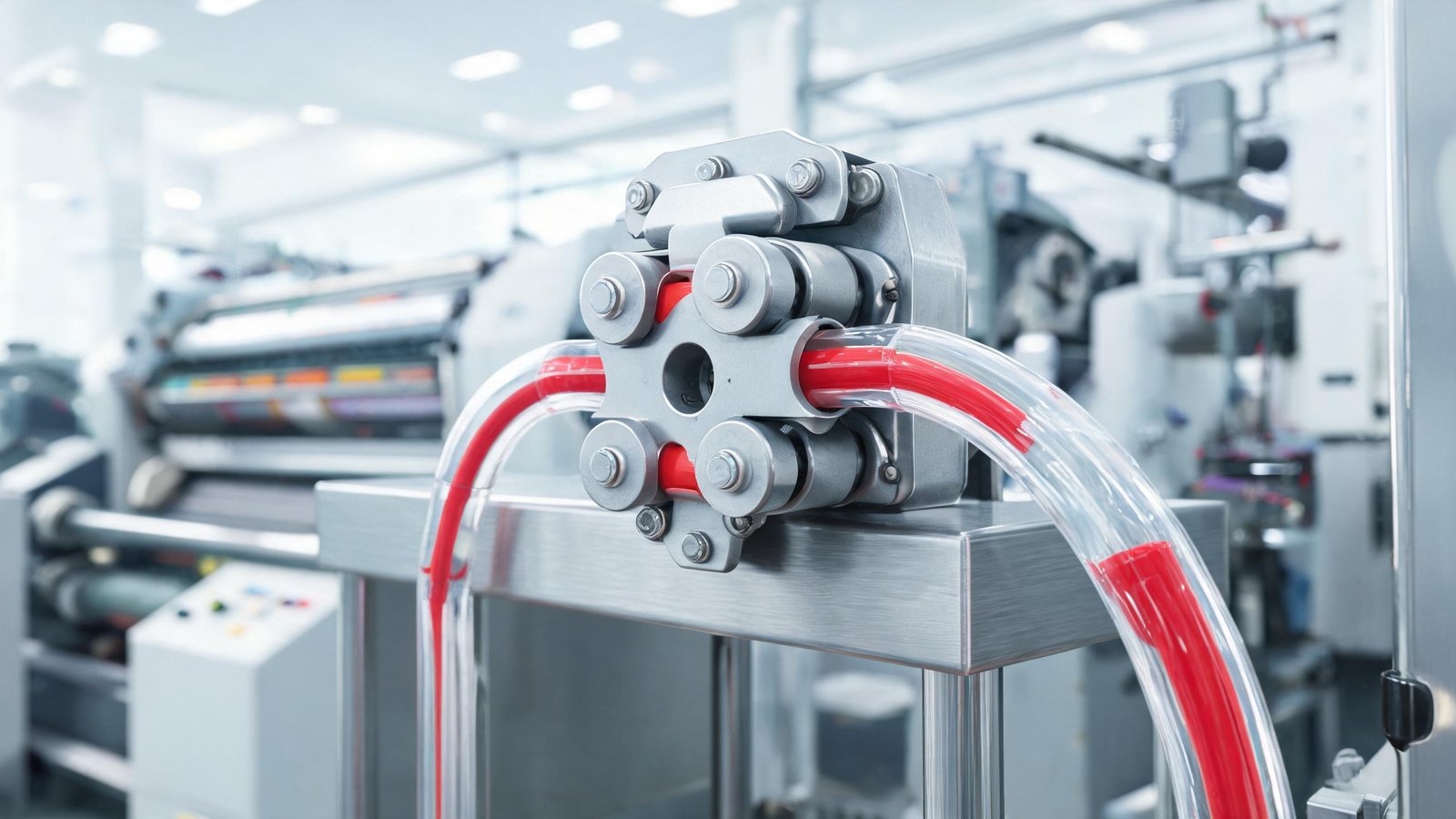
Printing press operators and equipment designers know that ink delivery is one of the most common sources of print quality problems. Uneven flow, color drift, foaming, and frequent changeovers all trace back to how ink moves from the container to the printhead. A peristaltic pump for ink delivery addresses these issues by keeping the fluid isolated inside a flexible tube, with no valves, seals, or internal cavities to clog or contaminate. For OEM equipment manufacturers and printing facility engineers, selecting the right pump configuration requires understanding viscosity behavior, tubing chemistry, flow stability, and integration constraints specific to printing applications.
What the Application Requires
Printing ink is not a simple fluid. It is a complex mixture of pigments, binders, solvents, and additives, with viscosity ranges that vary dramatically by ink type and printing process. Flexographic inks typically fall between 25 and 100 centipoise (cP) for solvent-based formulations, while UV-curable inks can exceed 2,000 cP at room temperature. Gravure inks run thinner, often between 15 and 50 cP, but require precise flow control to maintain consistent ink film thickness on the cylinder.
The printing industry categorizes approximately 97% of all printing activities into five processes: lithography, gravure, flexography, letterpress, and screen printing, according to the EPA’s printing and publishing industry profile. Each process places different demands on the ink delivery system:
| Printing Process | Typical Ink Viscosity | Key Delivery Requirement |
|---|---|---|
| Flexography | 25–100 cP (solvent), 200–2,000 cP (UV) | Consistent fountain supply, quick color changeover |
| Rotogravure | 15–50 cP | Stable low-pressure delivery to doctor blade |
| Inkjet (industrial) | 10–30 cP | Pulse-free supply, precise micro-flow |
| Screen printing | 1,000–5,000 cP | High viscosity transfer, low shear |
Beyond viscosity, ink delivery systems must handle pigmented fluids without degrading the pigment dispersion. High-shear pumping mechanisms can break down pigment particles, causing color shift and inconsistent density. Peristaltic pumps use a gentle rolling compression on the tubing, which preserves the rheological structure of the ink and maintains color fidelity across long production runs.
Key Pump Selection Factors
When specifying a peristaltic pump for ink delivery, several factors determine whether the pump will perform reliably in a production printing environment:
Flow rate range: The pump must deliver ink at a rate that matches the press consumption. Flexographic presses running wide webs may require 2 to 10 liters per minute of ink circulation, while small label presses might need only 50 to 200 milliliters per minute. A large-flow peristaltic pump handles high-volume fountain circulation, while a compact peristaltic pump suits small-format and laboratory printing equipment.
Viscosity handling: Higher viscosity inks require more torque and larger tubing bore sizes to achieve the same flow rate. The pump motor must be sized to handle the expected viscosity range without stalling. For thick UV inks and screen printing pastes, a hose pump with a powerful drive provides the necessary torque for consistent delivery.
Number of colors: Multi-color presses require separate ink circuits for each color station. A pump system that supports multiple heads driven by a single motor, or individually controlled pump modules, reduces footprint and simplifies synchronization.
Duty cycle: Printing presses run continuously for hours or days. The pump must be rated for the intended duty cycle without overheating. Stepper and brushless DC motors generally handle continuous operation better than low-cost brushed DC motors.
Flow and Pressure Considerations
Ink delivery systems operate at relatively low pressures, typically below 2 bar. The primary challenge is not pressure but flow stability. Peristaltic pumps produce a natural pulsation as each roller compresses and releases the tubing. In printing applications, this pulsation can cause visible banding or density variation in the printed output.
Several factors influence flow stability in ink delivery:
| Factor | Effect on Flow | Mitigation |
|---|---|---|
| Roller count | More rollers reduce pulsation amplitude | Choose pump heads with 3+ rollers |
| Tubing bore | Larger bore increases per-revolution volume | Match bore to required flow range |
| Motor speed stability | Speed variation causes flow drift | Use stepper or closed-loop DC motors |
| Tubing condition | Worn tubing reduces effective flow | Schedule tubing replacement by hours |
For inkjet and continuous ink supply systems, flow stability is particularly critical. These applications benefit from pump heads with multiple rollers and micro-stepping motor drivers that minimize per-revolution flow variation. The ASTM D4287 standard for high-shear viscosity measurement provides a reference for characterizing ink rheology under conditions similar to those at the printhead, helping engineers match pump performance to ink behavior.
Pressure requirements are modest but must account for the full delivery path. Ink viscosity, tubing length, elevation difference, and filter resistance all contribute to system back-pressure. The pump must maintain stable flow against this combined resistance without cavitation or flow drop.
Tubing and Fluid Compatibility
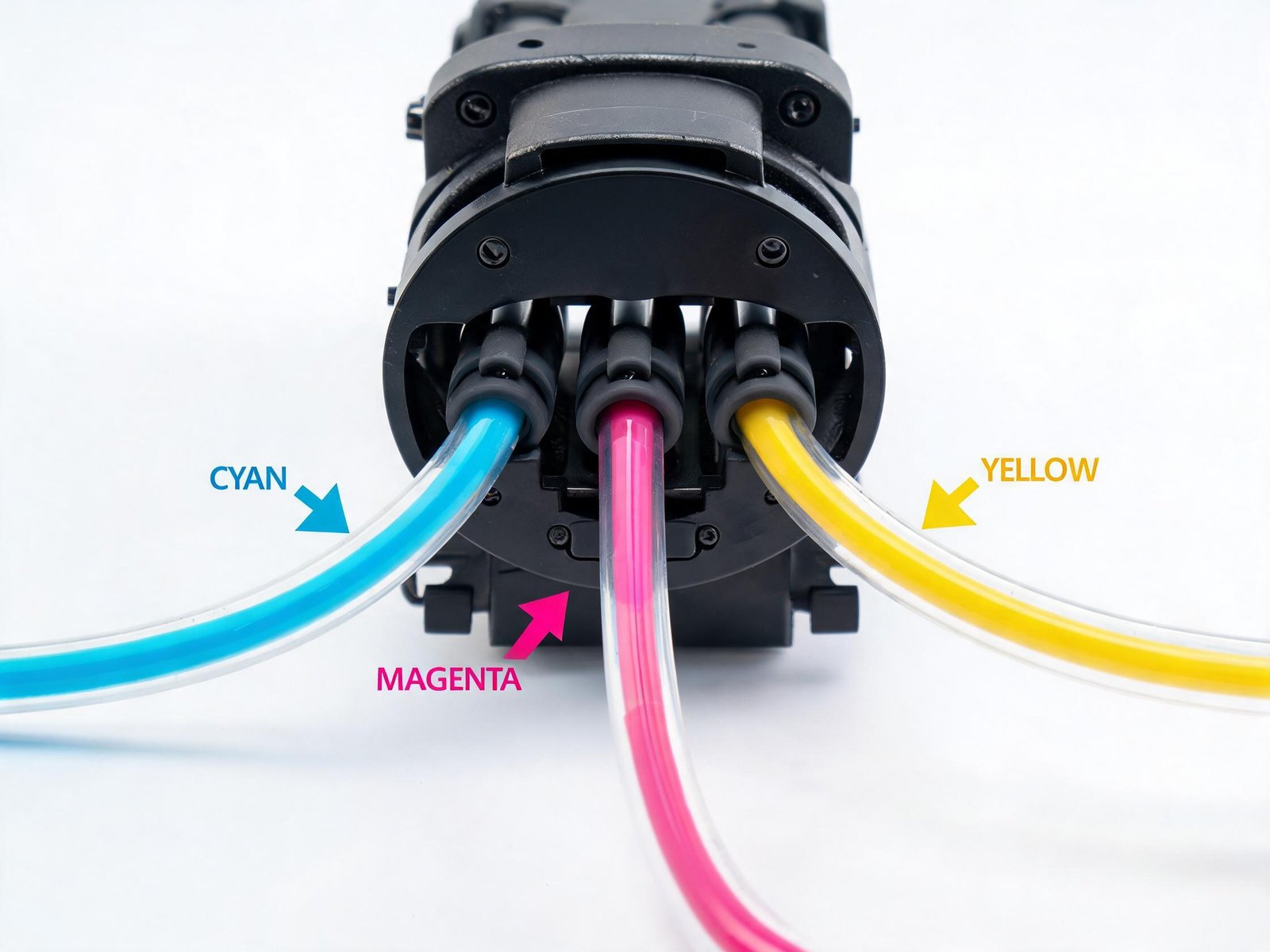
Tubing selection is arguably the most important decision in a peristaltic ink delivery system. The tubing must be chemically compatible with the ink solvent system, mechanically resilient enough to survive thousands of compression cycles, and transparent or translucent enough to allow visual inspection of ink flow and color.
Different ink chemistries require different tubing materials:
| Ink Type | Recommended Tubing | Key Consideration |
|---|---|---|
| Water-based | Silicone | Good flexibility, moderate life |
| Solvent-based | Viton (FKM) | Solvent resistance, higher cost |
| UV-curable | PharMed or Norprene | Resists acrylate monomers |
| Solvent + pigmented | Marprene | Long life with abrasive pigments |
The EPA National Emission Standards for the Printing and Publishing Industry (40 CFR Part 63, Subpart KK) regulate VOC and HAP emissions from printing operations. Tubing that resists solvent permeation helps reduce fugitive emissions and maintains a safer pressroom environment. Selecting tubing with low permeability also prevents ink from drying inside the tube during pauses, which is a common cause of blockages in solvent-based ink systems.
For printing operations that require frequent color changes, tubing replacement is a feature rather than a liability. Swapping tubing takes under a minute and eliminates cross-contamination between colors. This is a significant operational advantage over valve-based pump designs that require flushing and cleaning between ink changes. YOORAIN offers a range of peristaltic pump tubing in multiple materials and sizes to match different ink chemistries.
Integration Considerations
Integrating a peristaltic pump into a printing press or OEM ink delivery module involves mechanical, electrical, and control system decisions:
Mounting and space: Printing presses have constrained space around the ink fountain and printhead area. A peristaltic pump with integrated housing provides a compact, self-contained unit that can be mounted close to the point of use. For OEM equipment designers, the pump footprint and mounting interface must fit within the overall machine envelope.
Motor and control interface: The pump motor must be compatible with the press control system. Options include analog speed control (0–10V or 4–20mA), digital pulse/direction signals for stepper motors, and serial communication (MODBUS or similar) for networked control. Presses that synchronize ink delivery with press speed require a pump that can accept a speed reference signal and respond quickly.
Safety compliance: Printing equipment must meet safety standards including ISO 12643-1:2023 for graphic technology equipment safety. Pump integration must account for electrical safety, mechanical guarding, and emission control. The pump should include features such as run-dry protection (to prevent tubing failure when ink runs out) and thermal protection for continuous operation.
Maintenance access: Tubing replacement is a routine maintenance task. The pump must be mounted so that operators can access the pump head, open it, and replace tubing without tools or excessive downtime. Quick-release pump head designs reduce changeover time significantly.
Material documentation: For printing operations producing food packaging, pharmaceutical labels, or other regulated products, tubing material compliance documentation (such as FDA 21 CFR 177.2600 for rubber articles intended for repeated food contact) may be required. Ensure that tubing certificates are available from the supplier.
Conclusion
Selecting a peristaltic pump for ink delivery requires matching the pump configuration to the ink chemistry, viscosity range, flow requirements, and integration constraints of the specific printing process. The key decisions come down to tubing material selection, pump head size, motor type, and control interface. When these factors are properly matched, peristaltic pumps provide consistent ink delivery, simplify color changeovers, and reduce maintenance compared to alternatives that require valves, seals, and extensive cleaning procedures.
For OEM projects and printing system upgrades, providing the ink type, viscosity range, required flow rate, and installation constraints to the pump supplier will speed up the specification process and reduce the risk of mismatched components. YOORAIN can review these parameters and recommend a pump and tubing configuration for specific printing applications.