
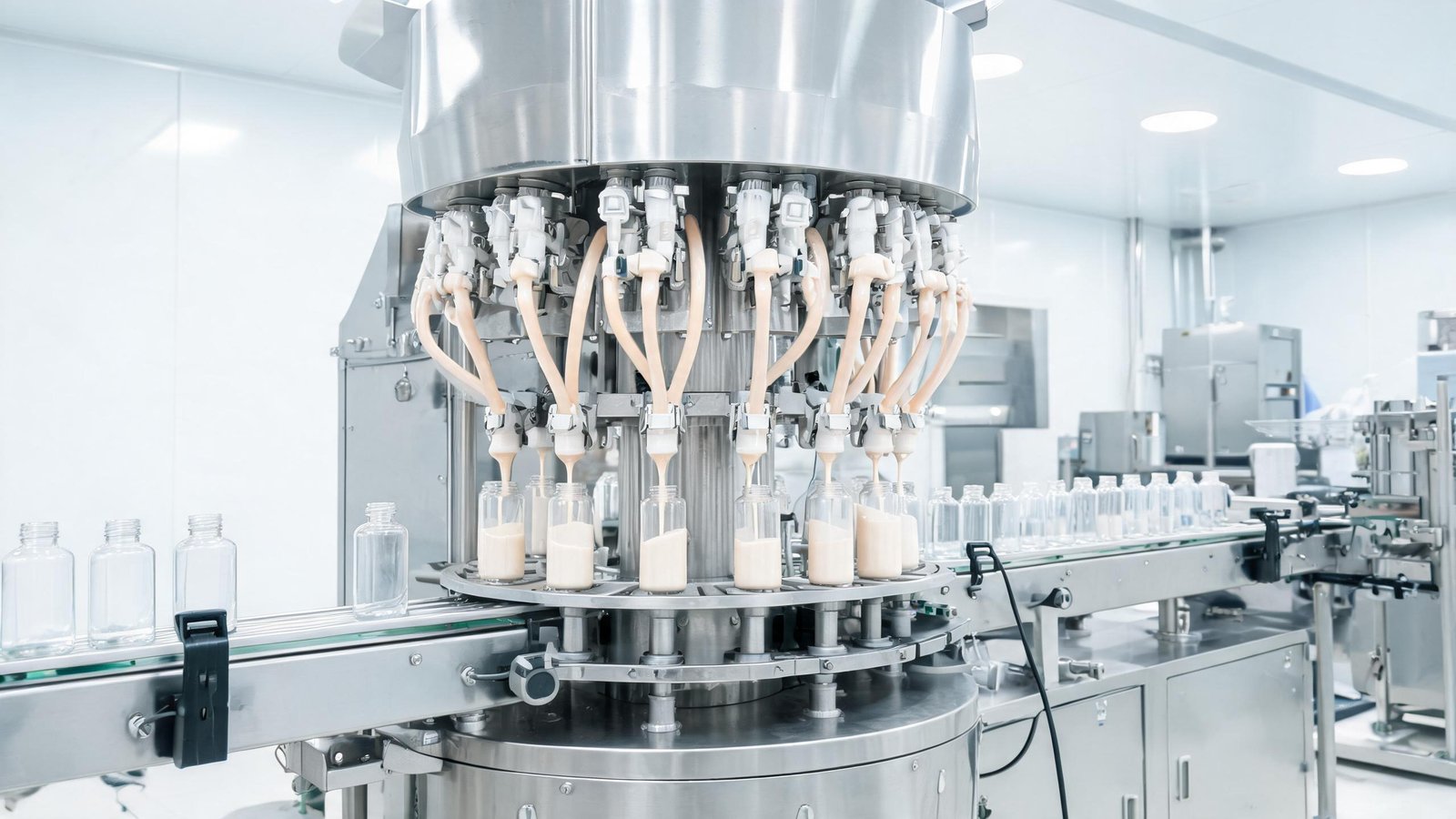
Cosmetics and personal care manufacturers face a specific set of fluid-handling challenges when filling bottles, jars, and tubes with products ranging from thin serums to thick creams. The viscosity of cosmetic formulations can exceed 10,000 centipoise, and the same production line may switch between products multiple times per shift. A peristaltic pump for cosmetics manufacturing addresses both challenges: the tubing isolates the product from the pump mechanism, and product changeover requires only a tubing flush or replacement rather than pump disassembly.
This engineering guide covers the application requirements, pump selection factors, flow and pressure considerations, tubing compatibility, and integration of peristaltic pumps into cosmetics filling equipment.
What the Application Requires
Cosmetics filling operations span several product categories, each with different rheological properties and filling requirements. Understanding the specific application drives the pump specification.
| Product Category | Typical Viscosity Range | Filling Volume | Key Pump Requirement |
|---|---|---|---|
| Serums and toners | 1–100 cP | 10–50 mL | High-speed precision dispensing |
| Lotions and shampoos | 100–5,000 cP | 50–500 mL | Consistent fill across viscosity variations |
| Creams and gels | 5,000–50,000 cP | 15–200 mL | Positive displacement for thick products |
| Essential oils and concentrates | 1–20 cP | 5–30 mL | Accurate small-volume dosing |
For thin products like serums and essential oils, a K25 small peristaltic pump provides the precision and speed needed for high-throughput filling. For thicker creams and lotions, larger pump configurations with wider tubing accommodate the higher viscosity. The YD25 peristaltic hose pump handles the upper viscosity range with reinforced tubing designed for positive displacement of thick fluids.
Key Pump Selection Factors
Selecting a peristaltic pump for cosmetics filling requires attention to factors that differ from laboratory dosing or water treatment applications. The following factors have the most impact on production performance:
Filling accuracy. Fill weight variation directly affects product cost and regulatory compliance. Peristaltic pumps achieve volumetric accuracy by controlling motor steps, but actual fill volume varies with tubing wear, fluid viscosity, and backpressure. For multi-head filling machines, each pump channel must be individually calibrated. Using peristaltic pump with housing modules with consistent manufacturing tolerances helps reduce channel-to-channel variation.
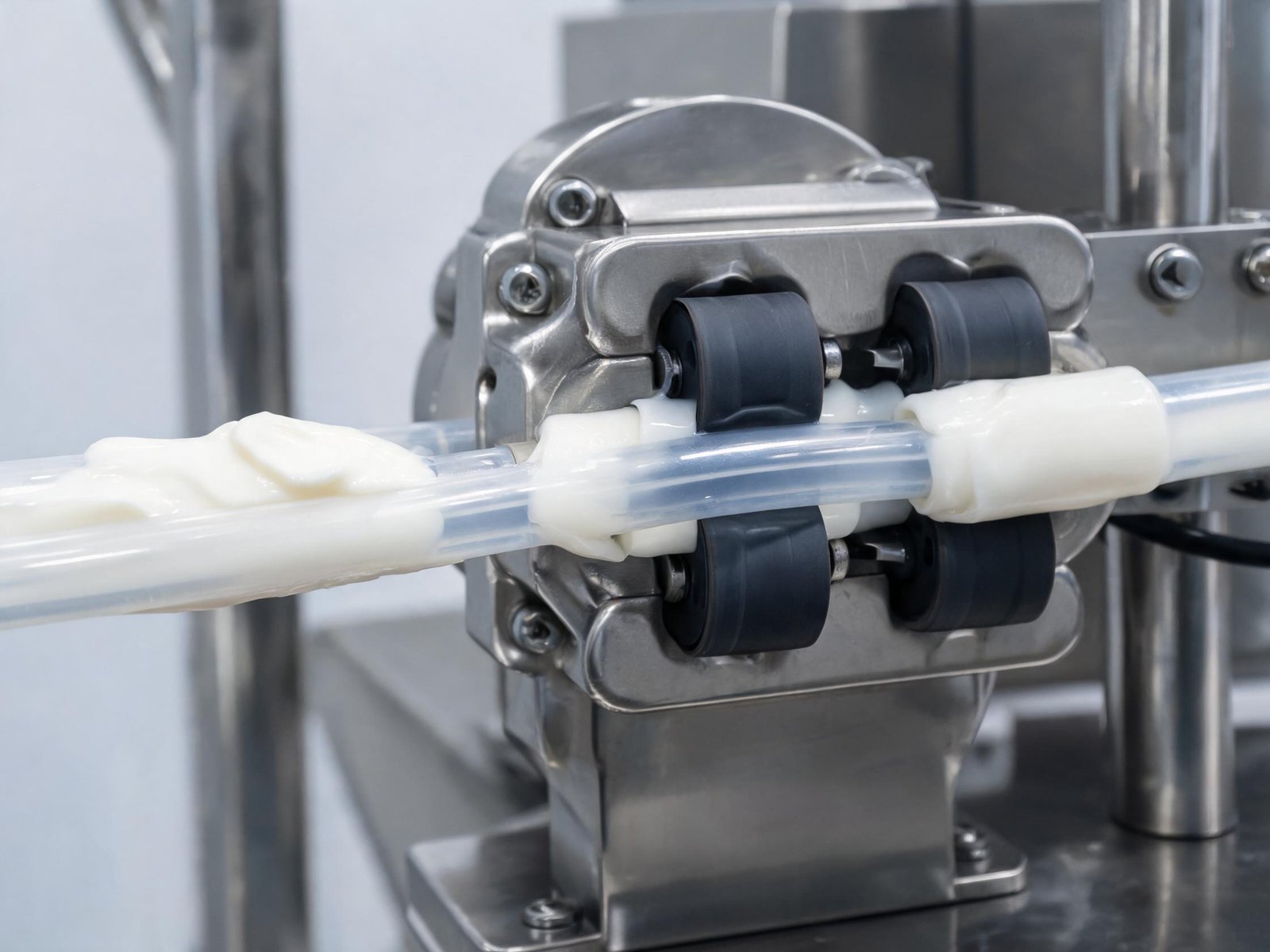
Viscosity handling. High-viscosity products resist flow through narrow tubing, requiring larger tubing diameters and more pump power. The pump must maintain positive displacement—meaning the rollers fully occlude the tubing—to prevent slip and ensure consistent fill volumes. For products above 5,000 cP, consider a K45 large flow rate peristaltic pump with reinforced tubing and adequate motor torque.
Shear sensitivity. Some cosmetic formulations—particularly emulsions, gels, and products containing encapsulated active ingredients—are sensitive to high shear. Peristaltic pumps apply relatively gentle shear compared to gear pumps or piston pumps, making them suitable for shear-sensitive formulations. The gentle pumping action also prevents foaming of surfactant-based products like shampoos.
Sanitary design. The tubing-based design is inherently sanitary: the product contacts only the inside of the tubing, not the pump mechanism. For products regulated under cosmetic GMP guidelines, this design simplifies validation of the product contact surface.
Flow and Pressure Considerations
Flow rate in peristaltic pumps is directly proportional to motor speed and tubing internal diameter. However, actual fill volume deviates from theoretical calculations under several conditions common in cosmetics manufacturing:
Viscous product backflow. At high viscosity, the tubing may not fully rebound between roller compressions, reducing the effective swept volume per revolution. This effect becomes more pronounced as tubing ages and loses elasticity. Production systems should include gravimetric feedback—weighing each filled container—and adjusting pump speed or steps to compensate for viscosity drift.
Nozzle backpressure. Filling nozzles with small orifices create backpressure, especially when dispensing thick products. Peristaltic pumps lose volumetric efficiency as discharge pressure increases. The table below shows typical pressure considerations for different filling configurations.
| Filling Configuration | Typical Discharge Pressure | Effect on Flow |
|---|---|---|
| Open nozzle, thin product | 0.1–0.3 bar | Minimal flow loss |
| Anti-drip nozzle, medium product | 0.3–1.0 bar | 5–15% flow reduction |
| Diving nozzle, thick cream | 1.0–2.5 bar | 15–30% flow reduction, needs calibration |
| Pressurized container fill | 2.0–4.0 bar | Significant flow loss, consider larger tubing |
Multi-head synchronization. Rotary filling machines with 4, 8, or 12 pump heads require synchronized dispensing to maintain fill uniformity across all positions. Motor controllers must compensate for manufacturing variations between pump heads and for different tubing lengths in the manifold. The peristaltic pump tubing should be specified with tight tolerance on internal diameter to minimize position-to-position variation.
Tubing and Fluid Compatibility
Tubing selection is the most critical decision in a cosmetics filling pump system. The tubing must be compatible with the product formulation, maintain its elastic properties over the production cycle, and meet regulatory requirements for product contact materials.
Material options. Silicone is the default choice for most cosmetic products due to its flexibility, wide temperature range, and biocompatibility. PharMed tubing offers better chemical resistance for products containing high concentrations of alcohol, acids, or solvents. For products with high oil content, verify compatibility data with the tubing manufacturer, as some silicone formulations can absorb oils and swell over time.
Tubing life. In continuous filling operations, tubing life directly affects production efficiency. When tubing wears, fill accuracy degrades and the system must be stopped for replacement. Production managers should establish a tubing replacement schedule based on fill accuracy data, not just visual inspection. A common practice is to log total fill cycles per tubing set and replace at a predetermined count, typically 50–80% of the manufacturer’s rated life.
Regulatory compliance. In the United States, cosmetic product contact materials are regulated under 21 CFR Part 700, which addresses cosmetic product safety. While cosmetics GMP is not as prescriptive as pharmaceutical GMP, manufacturers producing both cosmetic and OTC drug products should follow the stricter 21 CFR Part 211 requirements for product contact surfaces and documentation. The NIST Materials Science and Engineering Division provides reference data on material properties that supports tubing material selection and qualification.
Integration Considerations
Integrating peristaltic pumps into cosmetics filling lines involves mechanical, control, and operational integration that affects overall equipment effectiveness.
Mounting and manifold design. Multi-head filling systems mount pumps on a common manifold or a rotary turret. The mounting design must allow tool-free tubing replacement without removing the pump from the line. Quick-release pump head designs or front-loading tubing configurations reduce changeover time between product runs.
Control system architecture. Modern filling machines use PLCs or industrial PCs to control pump speed, fill volume, and sequencing. The pump motor controller must accept the host system’s communication protocol—commonly MODBUS RTU, Ethernet/IP, or analog signals. For multi-head systems, individual motor controllers allow per-nozzle calibration but add complexity to the control architecture.
Cleaning and changeover. Between product batches, the tubing must be flushed or replaced. Peristaltic pumps simplify this: flushing requires running a cleaning solution through the tubing while the pump operates, and full changeover requires only replacing the tubing set. Equipment designers should specify tubing lengths that allow easy access for replacement without tools.
Validation documentation. For filling equipment used in regulated environments, the pump system must be included in Installation Qualification (IQ), Operational Qualification (OQ), and Performance Qualification (PQ) protocols. Pump specifications, flow calibration data, and tubing lot records should be maintained as part of the equipment validation file.
What to Confirm Before Ordering
Before finalizing a peristaltic pump specification for a cosmetics filling application, confirm the following items with the supplier:
- Product viscosity range at filling temperature, including batch-to-batch variation
- Required fill volume and fill time per container, for each product on the line
- Number of filling heads and whether independent per-head flow adjustment is needed
- Nozzle type (open, anti-drip, diving) and resulting backpressure at the target flow rate
- Tubing material compatibility data for the specific cosmetic formulation
- Expected tubing life and replacement schedule in production hours or fill cycles
- Control interface specification (protocol, signal type, integration with host PLC)
- Sanitary design requirements and applicable regulatory standards (ISO 22716, 21 CFR Part 700/211)
- Sample unit availability for on-site testing with actual product
- Production lead time, minimum order quantity, and after-sales support terms
If you are designing or upgrading a cosmetics filling line, you can contact YOORAIN to discuss the fluid-handling requirements of your system. Providing the product viscosity, fill volume, container type, and desired throughput helps our team recommend the appropriate pump configuration, tubing material, and control interface for your manufacturing setup.