
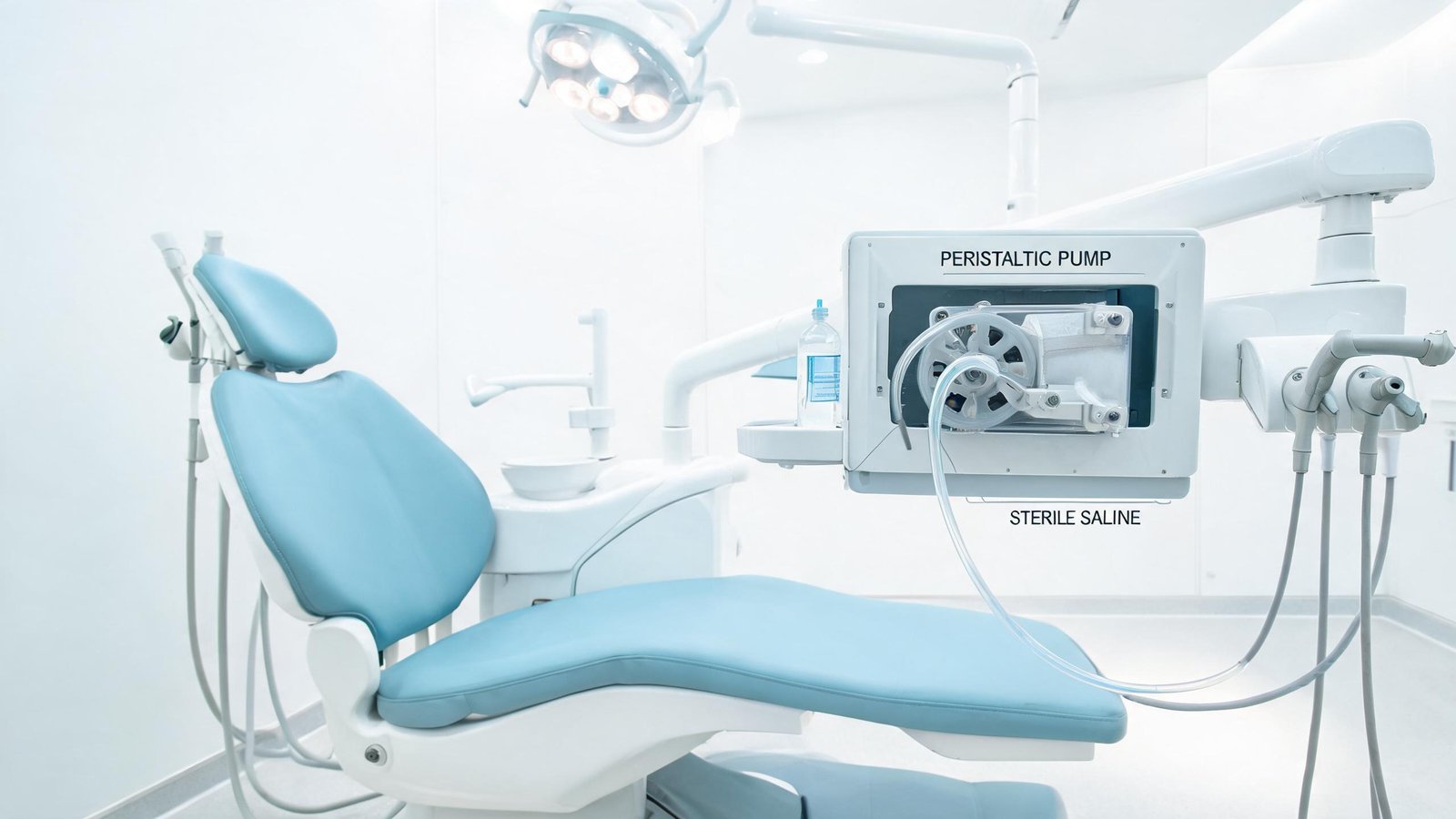
Dental equipment manufacturers building chairside units, implant motors, and operative treatment stations need compact fluid-delivery pumps that provide sterile fluid path isolation, precise flow control, and quiet operation. A peristaltic pump for dental equipment meets these requirements because the irrigating solution—typically sterile saline, distilled water, or antibacterial rinse—contacts only the inside of disposable tubing, never the pump mechanism. This design allows quick tubing changes between patients without internal cleaning or sterilization.
This application guide covers the fluid-handling requirements, pump selection criteria, integration challenges, and common questions for dental equipment manufacturers evaluating peristaltic pump options.
Why Peristaltic Pumps Fit the Application
Dental operative units require controlled irrigation during procedures such as implant placement, tooth preparation, and surgical extraction. The pump must deliver fluid at rates typically ranging from 10 mL/min for surgical irrigation to 150 mL/min for high-volume cooling and flushing. A K15 micro peristaltic pump covers the lower end of this range with the precision needed for surgical irrigation, while larger configurations handle higher flow demands.
The key advantage in dental applications is the single-use tubing concept. After each patient, the tubing is discarded or flushed, eliminating the risk of cross-contamination between patients. This is particularly important in surgical procedures where the irrigation fluid contacts open tissue. Internal pump components—the rollers, housing, and motor—never contact the fluid, so there is no need to sterilize the pump mechanism itself.
Additionally, peristaltic pumps can run dry without damage. When the irrigation reservoir empties or the tubing is intentionally cleared, the pump simply rotates without load. This eliminates the priming and dry-run protection complexity required by gear pumps or centrifugal pumps.
Main Fluid-Handling Requirements
Dental equipment applications impose specific fluid-handling demands that differ from laboratory or industrial dosing. The table below summarizes the main requirements and their implications for pump selection.
| Requirement | Specification Range | Implication for Pump Selection |
|---|---|---|
| Irrigation flow rate | 10–150 mL/min adjustable | Variable speed control with stable low-flow output |
| Fluid type | Sterile saline, distilled water, chlorhexidine | Tubing must be medical-grade and compatible with disinfectants |
| Disposable tubing | Single-patient use, autoclavable or sterile-packaged | Pump head must accept standard medical tubing sizes |
| Noise level | Below 50 dBA at operator position | DC motor with low-rpm operation and vibration damping |
| Control input | Foot pedal, touch panel, or automatic program | Pump controller must accept multiple input types |
| Size constraint | Fits within dental unit arm or console | Compact pump head and motor configuration |
Pump Selection Considerations
When selecting a peristaltic pump for dental equipment integration, manufacturers should evaluate several technical factors that affect clinical performance and equipment reliability.
Motor type and noise. Brushed DC motors are common in dental pumps due to their compact size and low cost, but they generate audible noise at higher speeds. For surgical micro-irrigation applications where the pump runs at low speed, a KCR 12V DC peristaltic pump provides adequate performance. For equipment targeting noise-sensitive environments, consider a stepper motor configuration that delivers smoother rotation and quieter operation at low speeds.
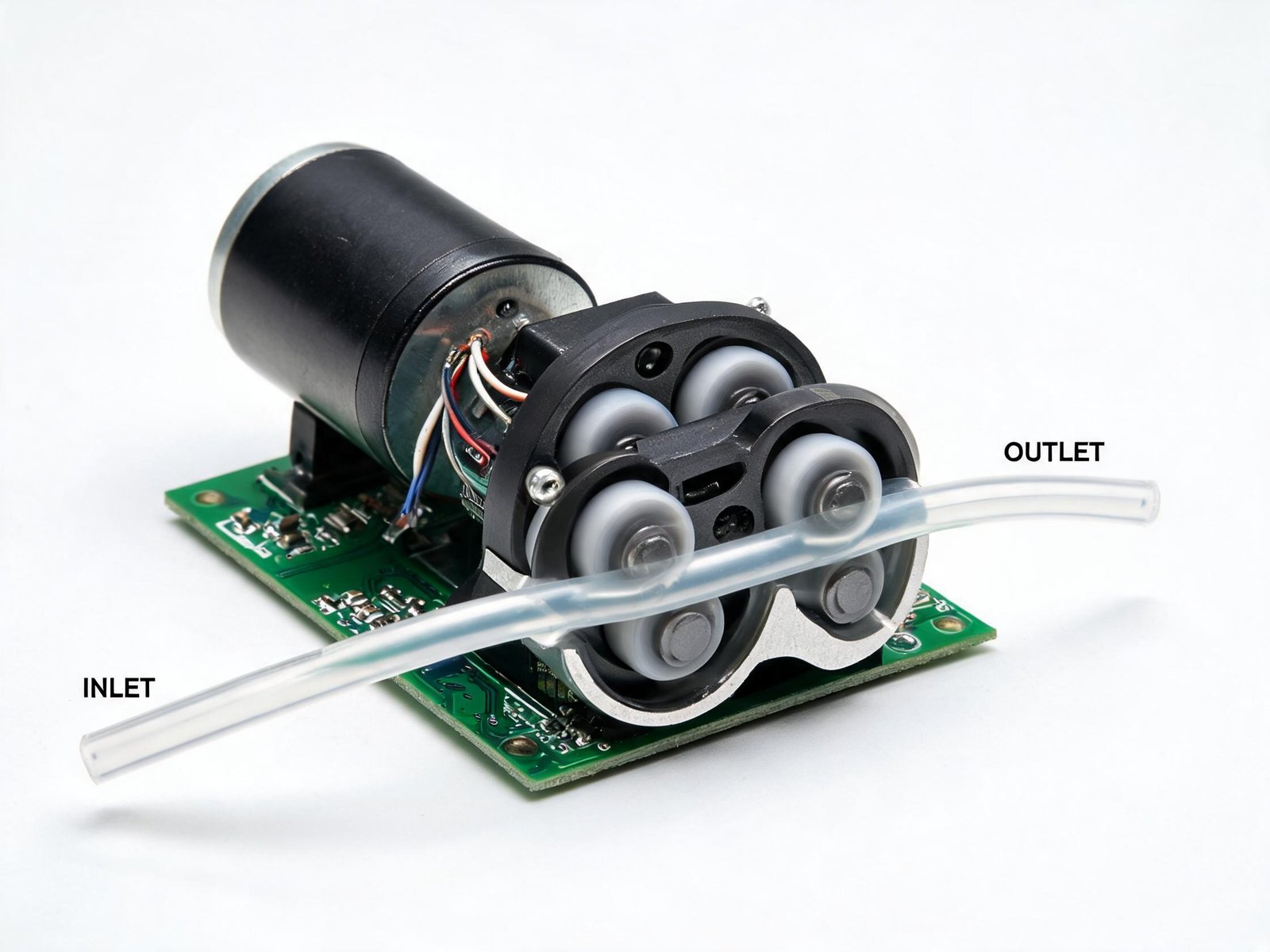
Tubing size and flow range. Dental irrigation tubing typically ranges from 1.6 mm to 4.8 mm inner diameter. Smaller tubing allows finer flow control at low rates but limits maximum output. Selecting a pump head that accommodates the tubing size used in the target dental procedure is essential. The peristaltic pump tubing should be specified in medical-grade silicone or thermoplastic elastomer materials that meet biocompatibility requirements.
Flow stability. Pulsation at low flow rates can cause uneven irrigation during surgical procedures. Multi-roller pump heads (typically 4 to 6 rollers) produce more consistent flow than 2-roller designs. The K4024 mini peristaltic pump uses a multi-roller configuration suitable for applications requiring smooth, continuous flow at low rates.
Integration footprint. Dental chair units have limited internal space. The pump must fit within the arm assembly, control console, or rear equipment bay. A peristaltic pump with housing provides a self-contained module that can be mounted directly into the equipment frame without additional brackets.
Common Design Problems
Equipment manufacturers frequently encounter several integration challenges when designing peristaltic pump systems into dental units:
Tubing creep and misalignment. During extended operation, tubing can gradually shift position within the pump head, reducing compression efficiency and causing flow drift. Designs that incorporate tubing retainers or guided loading slots prevent this. The pump head should also allow tool-free tubing loading for clinical efficiency.
Back-siphonage prevention. When the pump stops, fluid should not flow backward through the line. Peristaltic pumps inherently prevent backflow when the rollers are in a compression position, but in a stopped state between compressions, the tubing may allow brief reverse flow. For surgical applications, consider a pump controller that parks the rollers in a full-compression position when stopped.
Priming reliability. Air trapped in new tubing must be purged before patient use. Pump controllers should include a high-speed priming mode that fills the line quickly, then drops to the therapeutic flow rate. The priming volume should be predictable and repeatable to avoid fluid waste.
Multiple fluid channels. Some dental units deliver two or more fluids (e.g., water and chlorhexidine) through separate lines. Multi-channel peristaltic pumps with independent motor control per channel allow fluid switching without tubing changes, but require careful calibration of each channel.
Integration Into Equipment
Integrating a peristaltic pump into a dental operative unit involves mechanical, electrical, and software considerations. The pump must be designed as a component of the larger system, not as a standalone device.
Regulatory framework. Dental operative units are classified as medical devices. In the United States, they are regulated under 21 CFR Part 872 as Class I devices (product code EIA). Manufacturers must comply with the Quality System Regulation under 21 CFR Part 820, which includes design controls, risk analysis, and verification testing. The pump component itself does not carry independent device classification, but it must be included in the overall unit’s design dossier and risk management file.
Water quality. Dental unit water lines (DUWLs) are subject to water quality standards. The EPA has established that dental water used during nonsurgical procedures should meet a standard of no more than 500 CFU/mL of heterotrophic bacteria. Pump materials and tubing that support periodic chemical flushing of the water line help maintain this standard between maintenance cycles.
Validation. The NIST Fluid Metrology Group provides reference materials and calibration services that support flow measurement accuracy claims. Equipment manufacturers should verify pump flow accuracy using gravimetric or volumetric methods and document results as part of design validation.
Common Questions
Q: Can the same peristaltic pump be used for both irrigation and suction in a dental unit?
No. Irrigation and suction require different pump configurations. Irrigation pumps push fluid to the surgical site, while suction pumps evacuate fluid and debris away from the site. Some dental units use peristaltic pumps for irrigation and a separate vacuum system for suction.
Q: How often should dental irrigation tubing be replaced?
Single-patient-use tubing should be replaced after each patient. For autoclavable tubing, follow the manufacturer’s specified number of autoclave cycles—typically 50 to 100 cycles depending on material.
Q: What tubing material is recommended for dental irrigation?
Medical-grade silicone is the most common material for dental irrigation tubing. It is biocompatible, flexible, and tolerates autoclave temperatures. For applications involving antibacterial solutions, confirm chemical compatibility with the specific disinfectant concentration used.
Q: How is flow rate controlled during different dental procedures?
Most dental pump controllers offer preset flow rates or continuous adjustment via foot pedal, touch panel, or integrated procedure program. The controller varies motor speed to achieve the target flow, with feedback from the motor driver to maintain stability under load variations.
For OEM dental equipment projects, providing the required irrigation flow range, tubing material preference, available mounting space, and control interface specification helps suppliers recommend a suitable pump configuration matched to the clinical application.