
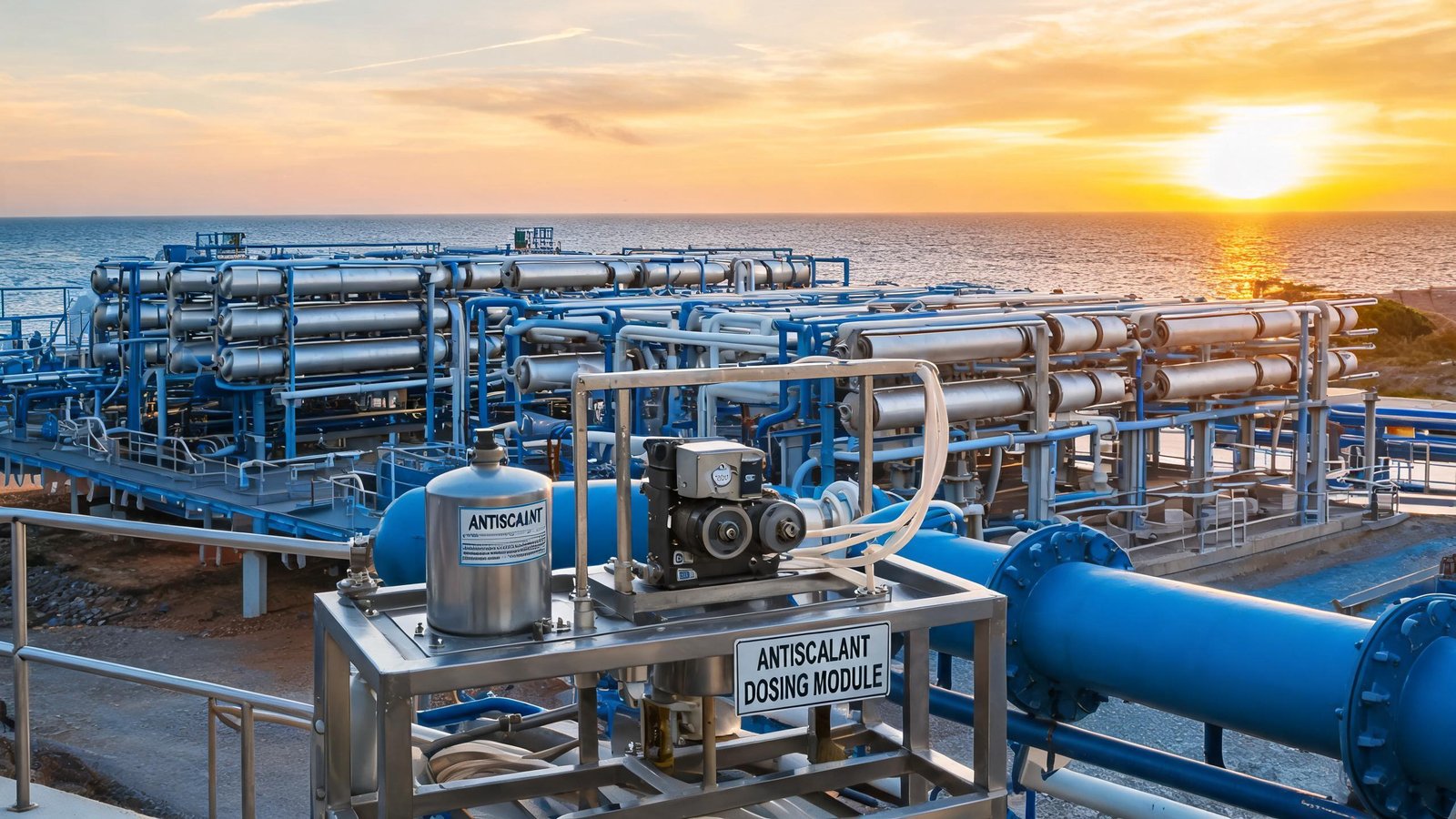
Global desalination capacity reached approximately 130 million cubic meters per day in 2026, according to industry tracking data, with Saudi Arabia alone increasing production from 9 million m³/day in 2016 to over 16 million m³/day in 2025. Every reverse osmosis plant in that footprint depends on antiscalant chemical dosing to protect membrane elements from calcium carbonate, calcium sulphate, and silica scale. The pump selected for this dosing task directly affects membrane life, chemical consumption, and plant uptime. Two pump technologies dominate antiscalant injection: peristaltic pumps and diaphragm metering pumps. Understanding where they differ helps plant engineers specify the right unit for each desalination application.
The RO antiscalant market was valued at USD 1,467 million in 2025 and is projected to reach USD 1,959 million by 2034, growing at a CAGR of 4.4%. As more plants come online, the volume of antiscalant dosed daily increases proportionally, making pump reliability and dosing accuracy a growing cost factor.
What Makes the Options Different
Peristaltic and diaphragm pumps are both positive-displacement devices, but their operating principles create different performance profiles for desalination chemical dosing.
A peristaltic pump compresses flexible tubing between rollers and a track. The fluid contacts only the tubing interior, which means the chemical never touches the pump mechanism. This isolation matters in desalination because antiscalants, biocides, and dechlorination agents like sodium bisulphite are formulated with active compounds that can crystallise or corrode metal internals over time.
A diaphragm pump uses a flexible membrane driven by a reciprocating mechanism to push chemical through inlet and outlet check valves. The chemical contacts the pump head, valves, and seals — components that require material compatibility with each dosed chemical. Diaphragm pumps typically handle higher discharge pressures than peristaltic pumps, which becomes relevant in high-pressure RO feed lines.
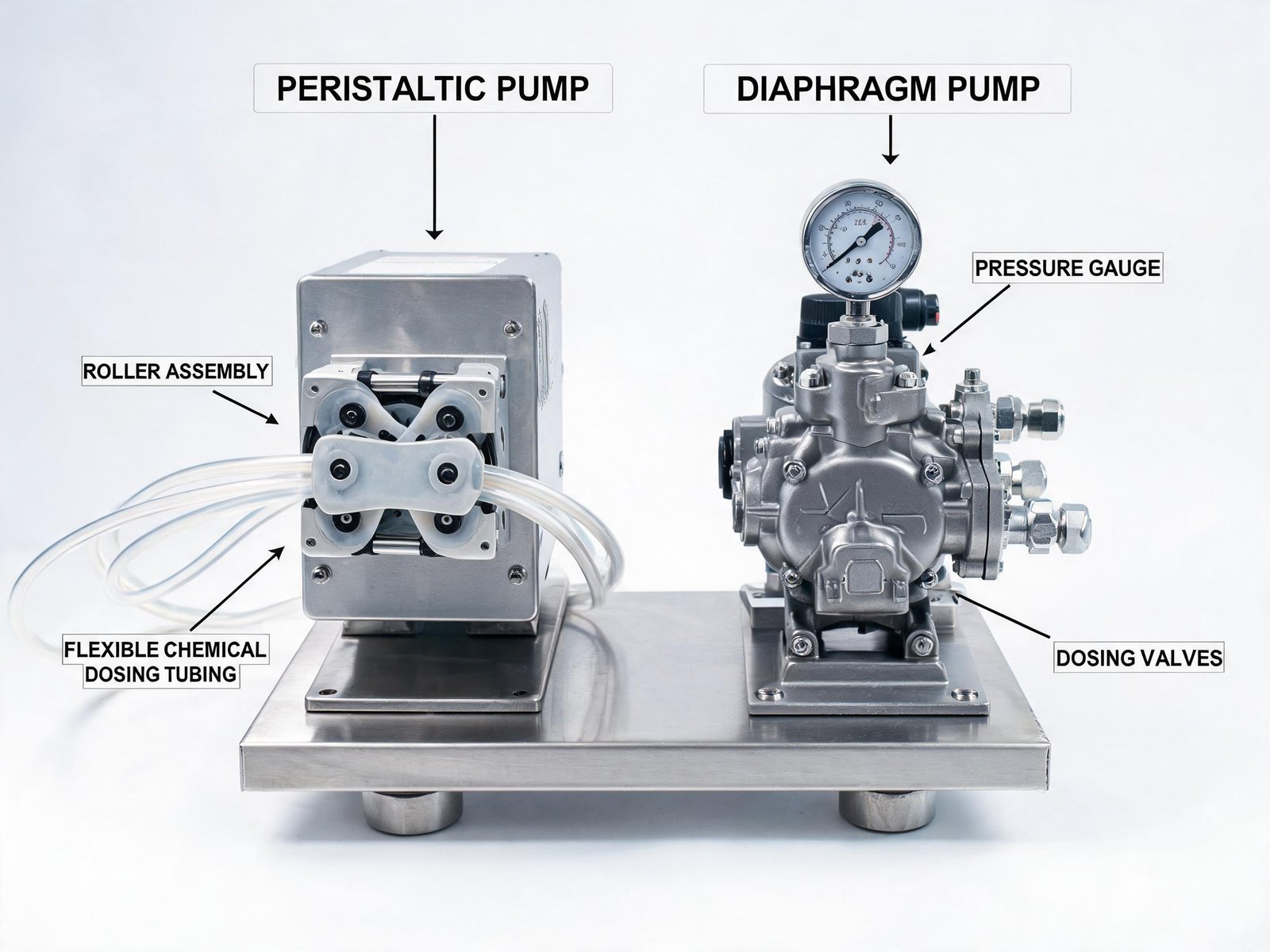
The table below summarises the fundamental differences:
| Characteristic | Peristaltic Pump | Diaphragm Metering Pump |
|---|---|---|
| Fluid contact | Tubing interior only | Pump head, valves, seals |
| Typical pressure range | Up to 2–4 bar | Up to 10–20 bar |
| Dosing accuracy | ±1–2% of set point | ±0.5–1% of set point |
| Solids handling | Passes small particles | Valve clogging risk |
| Self-priming | Yes, can run dry | Loses prime if air-locked |
| Replacement part | Tubing cartridge | Diaphragm, valves, seals |
| Chemical isolation | Complete | Depends on seal material |
Flow Control
Antiscalant dosing rates in desalination plants are low — typically 2 to 6 mg/L of feed water, with specific dosing depending on feed water chemistry. For a plant processing 100,000 m³/day of seawater at 3 mg/L antiscalant concentration, the daily chemical volume is 300 litres, delivered at roughly 12.5 mL/min continuously. This low-flow, high-precision requirement is where peristaltic pumps excel.
Peristaltic pumps deliver discrete volume per revolution, making flow rate directly proportional to motor speed. This linear relationship simplifies calibration: a known number of revolutions equals a known volume, and the controller can calculate dose by counting steps or revolutions. The K15 micro peristaltic pump and similar compact units provide the speed resolution needed for low-flow antiscalant injection.
Diaphragm pumps achieve flow control through stroke length and frequency adjustment. While they offer comparable accuracy at steady state, the check valves that govern flow direction are susceptible to crystallisation when dosing antiscalants that contain inorganic dispersants. In SWRO plants where ambient temperatures exceed 35°C, evaporation at valve seats can cause crystal formation, leading to flow drift that may not be detected until membrane scaling occurs.
The dosing rates below reflect typical antiscalant application ranges across desalination feed water types:
| Feed Water Type | Typical Dose Rate | Primary Scale Risk | Flow Rate (per 100,000 m³/day plant) |
|---|---|---|---|
| Gulf seawater SWRO | 2–4 ppm | Carbonate, sulphate, strontium | 8.3–16.7 mL/min |
| Brackish inland water | 3–5 ppm | Sulphate, carbonate, barium | 12.5–20.8 mL/min |
| High-TDS borewell | 4–6 ppm | Carbonate, sulphate, silica | 16.7–25 mL/min |
| Wastewater RO reuse | 4–8 ppm | Mixed, organics, biofouling | 16.7–33.3 mL/min |
Pressure Requirements
The discharge pressure of the dosing pump must exceed the RO feed line pressure at the injection point. In SWRO plants, the feed pressure entering the RO skid typically ranges from 55 to 70 bar, but antiscalant is injected upstream of the high-pressure pump, at the low-pressure feed side where pressure is 2 to 6 bar.
Peristaltic pumps handle this pressure range without difficulty. Standard-wall silicone tubing supports continuous operation up to 3 bar, and reinforced hoses used in industrial peristaltic hose pumps like the YD25 can operate up to 15 bar. For most antiscalant injection points, the 2 to 6 bar range is well within the peristaltic pump envelope.
Diaphragm pumps have a clear advantage at higher injection pressures. If antiscalant must be dosed into a pressurised line between the cartridge filter and the high-pressure pump boost stage, pressures of 8 to 12 bar can exceed the practical limit of standard peristaltic tubing. In such configurations, a diaphragm pump with PTFe or stainless steel head may be the better choice.
However, most desalination plants are designed with a low-pressure injection point specifically to simplify chemical dosing. The NPDES permit program administered by the EPA regulates concentrate discharge from desalination facilities, and dosing accuracy directly affects brine chemistry compliance. The lower the injection pressure, the more suitable a peristaltic pump becomes.
Tubing Considerations
Tubing is the primary wear component in a peristaltic pump, and material selection for antiscalant dosing depends on the chemical formulation. Most commercial antiscalants are proprietary blends of phosphonates, polycarboxylates, and dispersants in aqueous solution, with pH ranging from 2 to 10 depending on the product.
Silicone tubing handles most antiscalant formulations adequately and provides the longest life at low pressures. For acidic antiscalants with pH below 4, Viton or PharMed tubing offers better chemical resistance. The peristaltic pump tubing used in desalination should be selected based on compatibility testing with the specific antiscalant product in use, not generic chemical family data.
Diaphragm pumps do not use tubing in the fluid path but require compatible materials for the pump head, valves, and seals. PTFe diaphragms handle most desalination chemicals, but the check valves that regulate flow direction represent a maintenance point. Antiscalant crystallisation at valve seats can cause the pump to lose prime, requiring valve cleaning or replacement. This maintenance task is more time-consuming than replacing a tubing cartridge in a peristaltic pump.
The EU Blue Economy Observatory reports that brine byproduct from desalination plants contains residues of antifouling agents, flocculants, and antiscalants used during pretreatment, which means dosing accuracy has environmental implications beyond membrane protection. The EU desalination sector analysis notes that chemical management practices affect brine disposal compliance.
Maintenance
Maintenance frequency and cost differ significantly between the two pump types. In a peristaltic pump, the only routine maintenance task is tubing replacement. Typical tubing life for antiscalant dosing ranges from 2,000 to 5,000 hours of continuous operation, depending on pump speed, tubing material, and chemical formulation. A tubing cartridge swap takes 5 to 15 minutes and requires no special tools.
Diaphragm pumps require scheduled inspection of the diaphragm for signs of flex fatigue, cleaning or replacement of check valves, and verification of seal integrity. A diaphragm replacement typically takes 30 to 60 minutes and may require calibration of stroke length after reassembly. Valve cleaning due to antiscalant crystallisation can be an unscheduled maintenance event that interrupts dosing.
For desalination plants in remote locations — common in the Middle East, North Africa, and coastal Australia — the simplicity of peristaltic pump maintenance reduces the need for specialised technicians on site. The K45 large flow peristaltic pump and similar industrial-grade units provide the flow capacity for larger plant injection points while maintaining the simple maintenance model.
Which Option Fits the Application?
The decision between peristaltic and diaphragm pumps for desalination antiscalant dosing depends on the specific injection point, chemical formulation, and site maintenance capability.
Choose a peristaltic pump when:
- Injection pressure is below 3 bar (standard silicone) or below 10 bar (reinforced hose)
- The antiscalant formulation tends to crystallise at valve seats
- Plant maintenance staff are generalists, not chemical dosing specialists
- Dosing rate is below 500 mL/min, where peristaltic accuracy is sufficient
- The plant uses multiple chemicals that require quick changeover between dosing lines
Choose a diaphragm pump when:
- Injection pressure exceeds 10 bar and the injection point is on the high-pressure feed side
- The antiscalant formulation is highly viscous and requires high shear to dispense
- Dosing accuracy of ±0.5% or better is required by the membrane manufacturer warranty
- The plant has trained maintenance staff familiar with diaphragm pump service
Most SWRO and brackish water desalination plants use injection points on the low-pressure side, making peristaltic pumps the practical choice for antiscalant, biocide, and dechlorination chemical dosing. The International Desalination Association reports over 18,214 contracted plants worldwide, representing a substantial installed base of chemical dosing systems that require ongoing maintenance and replacement.
For plants evaluating pump options, the housed peristaltic pump designs provide environmental protection for outdoor installation in coastal plant environments. If you are specifying chemical dosing equipment for a desalination project, providing the feed water analysis, antiscalant product data sheet, injection point pressure, and required dosing rate allows suppliers to recommend the appropriate pump configuration.