
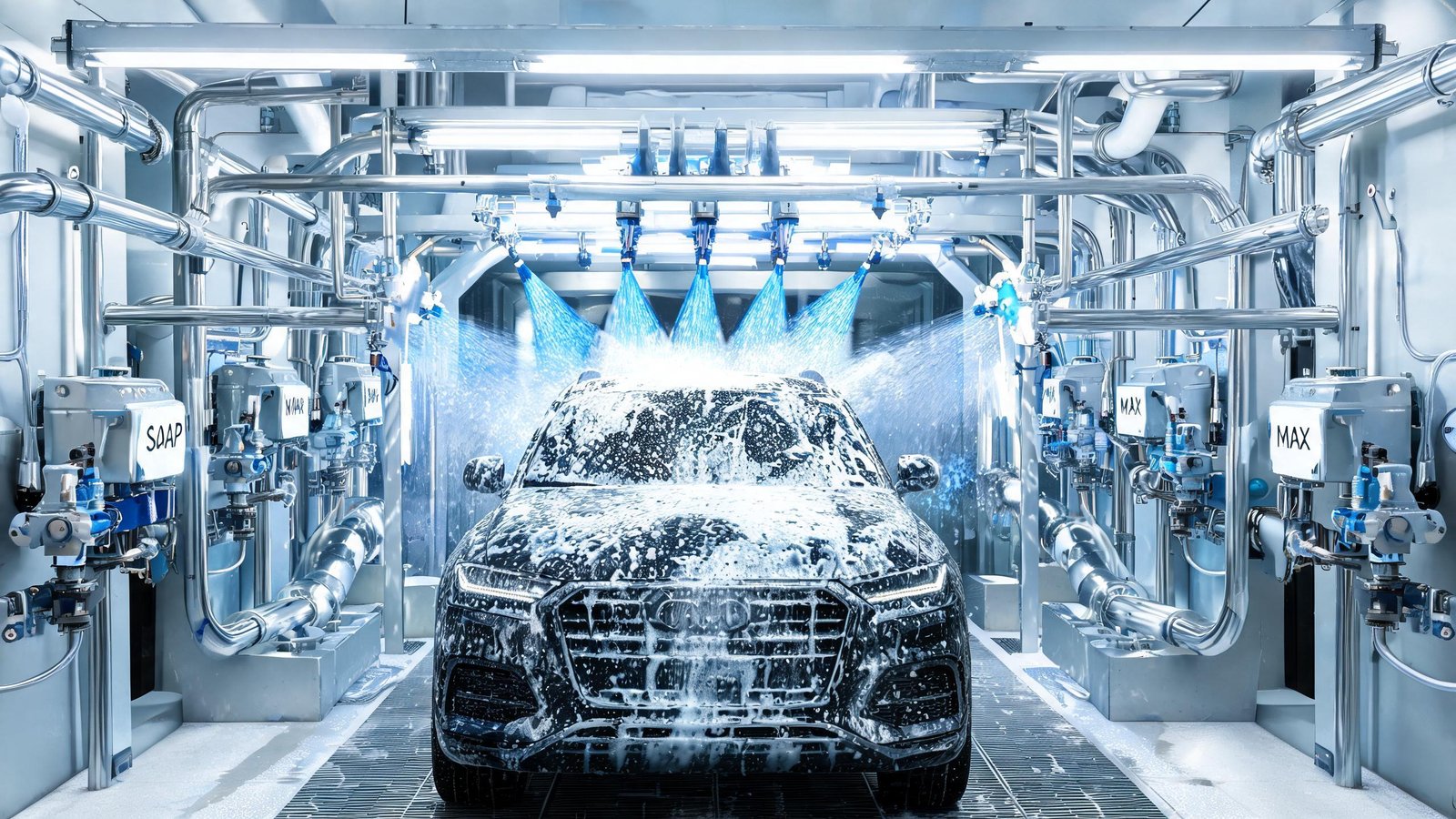
Car wash systems dose presoak, detergent, wheel cleaner, wax, and drying agent at specific points in the wash tunnel. Each chemical requires a dedicated dispensing pump that delivers the correct volume at the right concentration. Equipment manufacturers building car wash systems need pumps that handle concentrated cleaning chemicals, fit within compact equipment bays, and operate reliably through thousands of wash cycles. Peristaltic pumps address these requirements because the fluid contacts only the tubing interior, eliminating pump wear from chemical exposure.
Why Peristaltic Pumps Fit the Application
Car wash chemicals are formulated with surfactants, acids, and solvents that attack pump internals. Diaphragm pumps require chemical-resistant valves and seals, and gear pumps suffer from chemical wear on internal components. In a peristaltic pump, the chemical touches only the inside of the tubing, so the pump mechanism stays dry and does not corrode.
Additional advantages for car wash applications include:
| Advantage | Car Wash Relevance |
|---|---|
| No cross-contamination | Each chemical channel uses dedicated tubing, preventing mixing between presoak and wax |
| Self-priming | Pumps can draw from chemical reservoirs positioned below the equipment bay |
| Simple maintenance | Tubing replacement is the only routine service task |
| No seals to leak | No dynamic shaft seals that could fail and leak chemical into the equipment bay |
| Compact footprint | Multiple pump channels fit within the limited space of a car wash equipment room |
Main Fluid-Handling Requirements
Car wash systems typically dispense five to eight chemical products, each with different viscosity, pH, and concentration requirements. Understanding these properties is essential for pump and tubing selection.
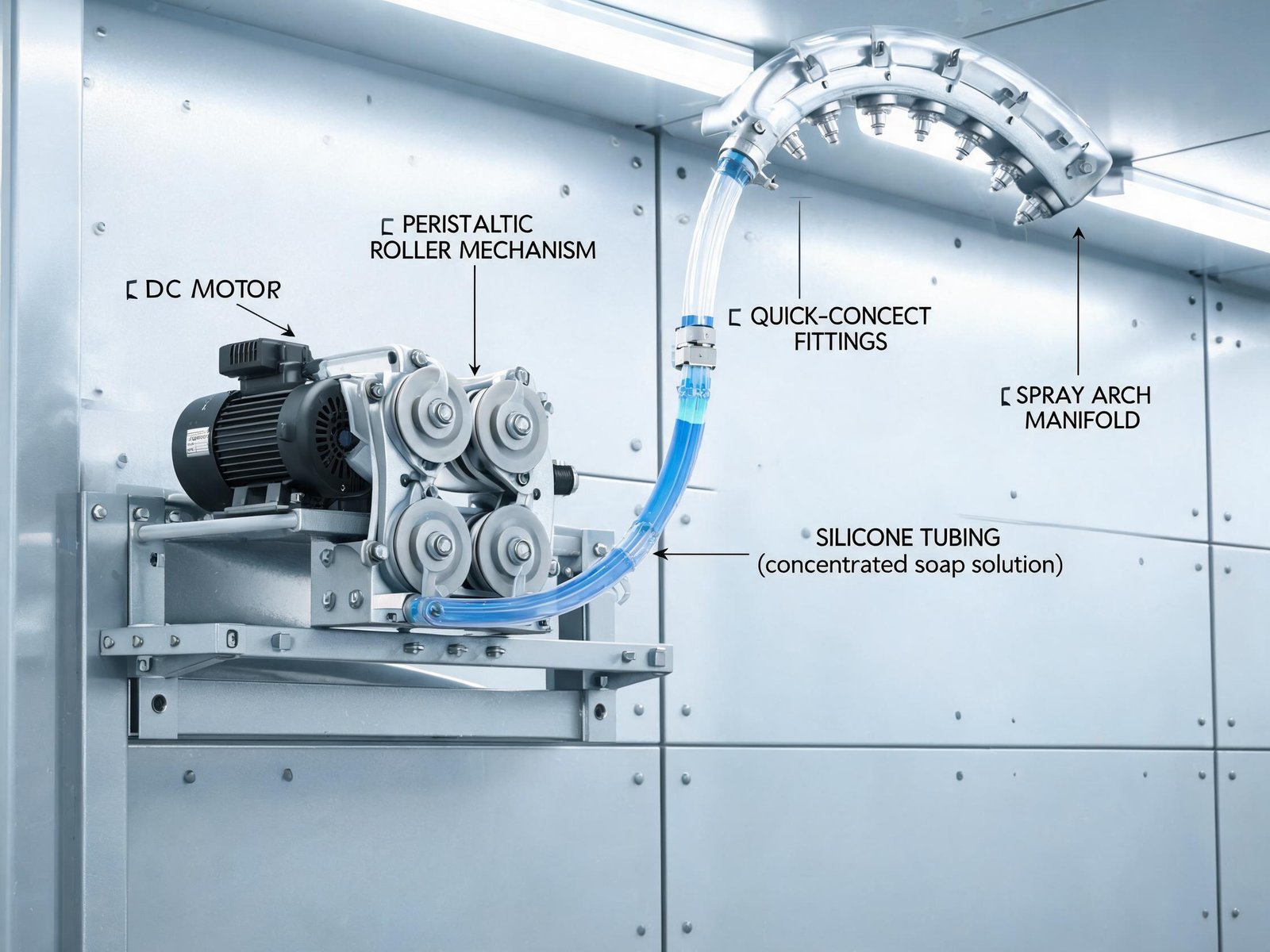
The table below outlines typical car wash chemicals and their dispensing characteristics:
| Chemical | pH Range | Viscosity | Typical Dilution | Dosing Rate |
|---|---|---|---|---|
| Presoak | 4–6 | Low to medium | 1:20 to 1:50 | 50–200 mL/min |
| Detergent (HP soap) | 8–11 | Medium | 1:100 to 1:300 | 30–150 mL/min |
| Wheel cleaner | 2–4 | Low | 1:4 to 1:10 | 20–80 mL/min |
| Drying agent | 6–8 | Low to medium | 1:200 to 1:500 | 10–60 mL/min |
| Clear coat protectant | 7–9 | Medium to high | 1:50 to 1:100 | 20–100 mL/min |
The Clean Water Act establishes the regulatory framework for car wash water discharge. Commercial car wash facilities must either discharge to a sanitary sewer or treat wash water on-site to meet effluent quality standards. Chemical dosing accuracy directly affects wash water contaminant levels, making pump performance a factor in compliance management.
Pump Selection Considerations
Selecting a peristaltic pump for car wash chemical dispensing involves matching the pump characteristics to the chemical and wash cycle requirements.
Flow rate range: Car wash dispensing typically requires 10 to 200 mL/min per channel. A K15 micro peristaltic pump handles low-volume channels like drying agent, while a K25 small peristaltic pump covers the higher-flow presoak and detergent channels. The pump speed should be adjustable to fine-tune concentration during commissioning.
Motor type and power: Car wash equipment often uses DC power supplies for safety and simplicity. The KCR 12V DC peristaltic pump operates directly from a 12V supply, common in car wash control panels. For applications requiring more torque with viscous protectants, the KFS DC brush motor pump provides additional drive power. PWM speed control allows the wash controller to adjust dosing rate per wash program.
Tubing material: Silicone tubing handles most car wash chemicals at typical concentrations and temperatures. For acidic wheel cleaners, Viton or PharMed tubing provides longer service life. The peristaltic pump tubing should be selected based on compatibility with the most aggressive chemical in each channel.
Dosing accuracy: Car wash chemical cost is a significant operating expense. Dosing accuracy of ±5% or better ensures consistent wash quality without chemical waste. Pumps with stepper motor control achieve tighter accuracy than PWM-controlled DC pumps, but DC pumps are sufficient for most car wash applications where the dilution ratio provides a wide tolerance band.
Common Design Problems
Several problems recur in car wash pump installations:
Tubing wear and flow drift: As tubing wears, the internal diameter at compression points decreases, reducing flow per revolution. If the wash controller uses time-based dispensing without flow compensation, chemical concentration drifts over the maintenance interval. Solution: use revolution-counted dispensing or schedule tubing replacement at defined intervals based on cumulative run hours.
Air locking: If the suction line from the chemical reservoir includes air pockets, the pump may lose prime and deliver inconsistent volume. This happens when the reservoir runs low or when tubing is replaced without priming. Solution: install a check valve at the reservoir outlet to maintain suction line fill, and program a priming pulse at the start of each wash cycle.
Chemical crystallization: Some car wash chemicals crystallize at the dispensing nozzle when the pump stops between cycles. Crystals restrict flow and cause dosing inaccuracy. Solution: position the dispensing nozzle at the spray arch so water flush flushes the nozzle between chemical applications, or use a purge cycle after each dose.
Viscosity variation: Clear coat protectants and some waxes thicken at low temperatures, causing the pump motor to draw more current and potentially stall. Solution: verify that the pump motor has sufficient stall torque margin for the lowest expected operating temperature, or heat-trace the chemical supply line.
Integration Into Equipment
Integrating peristaltic pumps into a car wash system involves mechanical, electrical, and control system design decisions.
Mounting: Pumps should mount on a serviceable panel in the equipment bay, with tubing runs kept short to minimize flow delay and priming time. Quick-connect fittings allow rapid tubing replacement without tools. Position pumps above the chemical reservoirs to encourage gravity drainage when tubing is disconnected for service.
Control interface: The wash controller activates each pump channel at the appropriate point in the wash cycle. For DC-driven pumps, a relay or MOSFET output provides on/off control, with a PWM signal for speed adjustment. The controller should track cumulative run time per channel and alert maintenance when tubing replacement is due.
Safety: Leak detection beneath the pump panel prevents chemical spills from damaging equipment or creating slip hazards. A drip tray with a float sensor provides a basic interlock that stops the affected pump channel and alerts the operator.
The EPA provides stormwater best management practices for vehicle and equipment washing that address wash water containment and treatment. Car wash equipment manufacturers should design chemical dispensing systems that support wash water recycling by minimizing chemical over-dosing that could overwhelm the treatment system.
What to Confirm Before Ordering
Before finalizing pump specifications for a car wash system, confirm the following:
- Chemical compatibility: Is the tubing material rated for continuous contact with each chemical at the maximum operating concentration and temperature?
- Flow range: Does the pump deliver the required volume at each channel within the wash cycle time window?
- Motor power: Does the pump motor have sufficient stall torque for the most viscous chemical at the lowest expected operating temperature?
- Power supply: Is the pump voltage compatible with the car wash control panel (12V DC, 24V DC, or other)?
- Control interface: Does the pump accept the control signal from the wash controller (relay, PWM, analog)?
- Tubing life: What is the expected tubing replacement interval per channel, and does the controller track cumulative run hours?
- Mounting: Does the pump footprint fit the equipment bay with access for tubing replacement?
- Dosing accuracy: Has the dispensing volume been verified at the spray nozzle, not just at the pump outlet?
- Leak protection: Is a drip tray or leak sensor installed beneath the pump panel?
For OEM projects involving car wash chemical dispensing, providing the required chemical list, dosing rates, power supply specifications, and installation constraints helps suppliers recommend suitable pump configurations. You can contact YOORAIN to discuss car wash fluid-handling requirements and available pump options for multi-channel dispensing systems.