
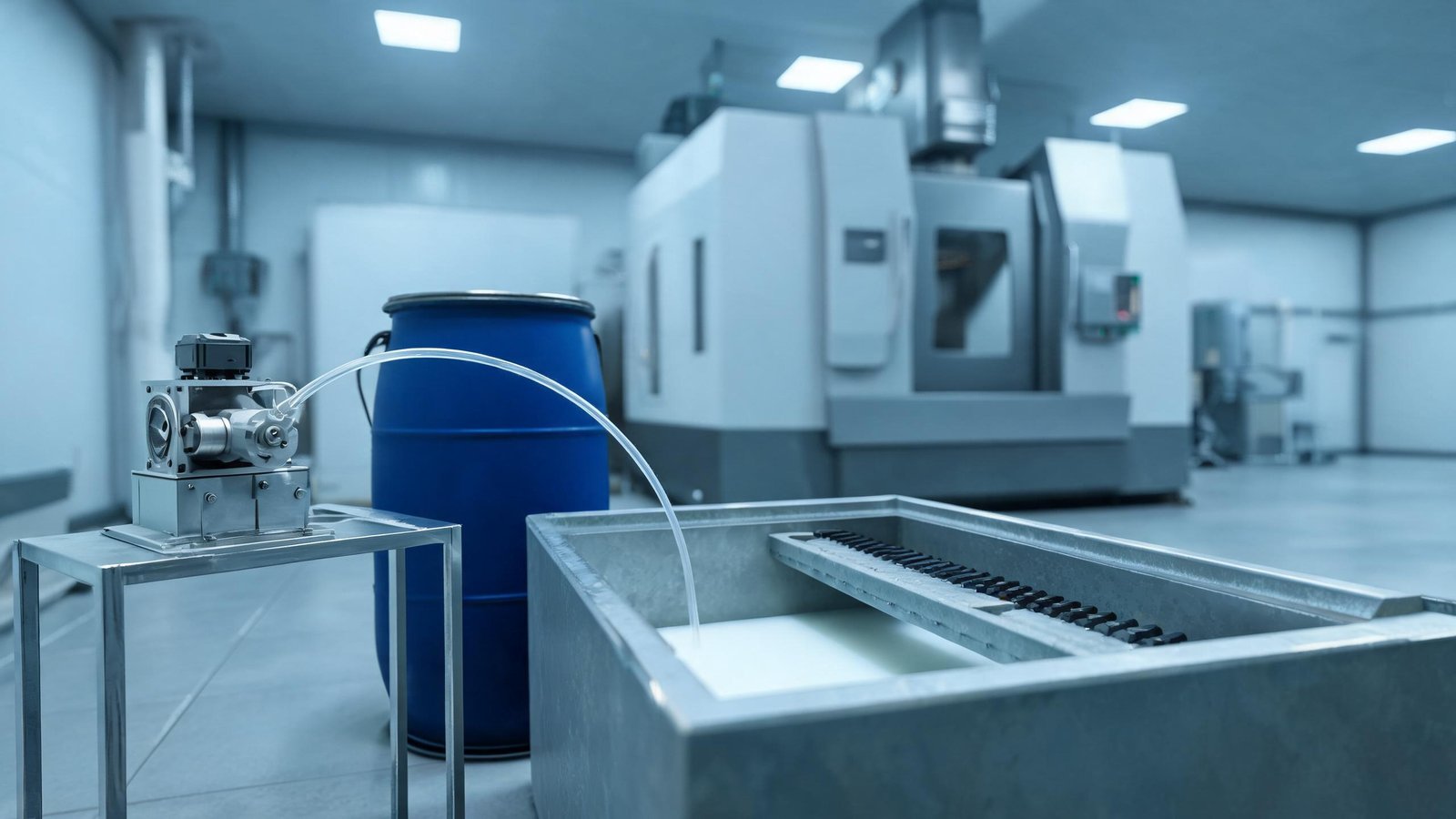
A CNC plant that runs dozens of machining centers burns through metalworking fluid in a quiet, constant way: drag-out on chips and parts, evaporation, tramp-oil contamination and weekly cleanouts all pull the sump below spec. When the make-up fluid is mixed by hand with a bucket and a venturi, concentration scatters across machines, and the fluid supplier’s technical bulletin becomes the most-read document in the plant. Purchasing a peristaltic dosing pump for automatic concentrate dosing removes that variability, but the sourcing decision has its own failure modes — an undersized pump that cannot keep up with drag-out, a hose pump ordered for a duty that only needed a small tube pump, or a tube material that swells in the concentrate.
This procurement guide is written for maintenance managers and sourcing teams specifying a peristaltic pump for metalworking fluid dosing on standalone machining centers and central coolant systems. It covers what to define before comparing models, the confirmed YOORAIN specifications that matter at this flow band, how to qualify a supplier, and what to test on a sample before committing to a fleet-wide rollout.
What Procurement Teams Should Define
Metalworking fluid handling splits into two distinct duties, and they point at different pumps. The first is make-up dosing: a controller or an operator tops up the sump with concentrate, and the fluid supplier’s dilution guidance is usually maintained within a narrow band that shops verify with a refractometer. Volumes are small and metered. The second is concentrate transfer: moving coolant from drums or totes to a mixing station or a central system’s reservoir, where the job is volume movement rather than precision.
Before requesting quotations, define these points in writing:
- Duty type: metered make-up dosing, bulk concentrate transfer, or both.
- Fluid: soluble-oil emulsion concentrate, semi-synthetic, or synthetic; viscosity and the concentrate’s tendency to separate at rest.
- Daily and peak volume to move, and the time window available for the transfer.
- Suction conditions: will the pump sit below the drum (flooded) or lift concentrate up from it?
- Control interface: PLC relay, analog signal, or manual speed knob.
- Tube service expectation: who changes tubes, how often, and whether the pump must be serviced without tools.
The last point matters more in coolant service than in clean-water duties. Emulsion concentrates are safe to handle but leave a residue film inside the tube, and a tube that sits static over a weekend can take a stiff moment on Monday morning. Easy tube access is not a luxury feature here; it is the difference between a two-minute service and an hour lost per machine.
Technical Requirements: Matching the Pump to the Duty
YOORAIN’s range covers both duties with two very different products. The K45 large flow rate peristaltic pump is a tube pump rated to 4,600 mL/min with 73# and 82# silicone tube, available with DC motor, AC motor or stepper motor, and fitted with quick-connect couplings for fast tube changes. The YD25 peristaltic hose pump is an industrial hose pump rated at 400–1,000 L/h with 1 MPa outlet pressure, running a 25R hose on a 380 V supply. The two overlap far less than their names suggest.
| Parameter | K45 large flow tube pump | YD25 hose pump |
|---|---|---|
| Rated flow | Up to 4,600 mL/min (4.6 L/min) | 400–1,000 L/h |
| Wetted element | 73# / 82# silicone tube | 25R industrial hose |
| Outlet pressure | Tube-pressure dependent | 1 MPa |
| Motor options | DC, AC, or stepper motor | 380 V power supply |
| Tube change | Quick-connect couplings | Hose replacement, longer interval |
| Typical coolant duty | Make-up dosing, small sump replenishment | Drum/tote-to-mixing-station transfer, central system feed |
Read the two flow ratings carefully: 4.6 L/min and 1,000 L/h are an order of magnitude apart, and neither number is a substitute for the other. A pump sized for a single-machine sump will run flat-out all day feeding a central system; a hose pump on a single sump will cycle so briefly that the controller barely registers it. Sizing against the real duty is the first technical gate. For teams working out the relationship between speed, tube size and output before ordering, the YOORAIN article on peristaltic pump flow rate calculation shows how the variables combine.
Tubing is the second gate. Silicone tube suits general coolant concentrate and water-based emulsions, while the 25R hose on the YD25 is built for industrial duty and higher discharge pressure. Whatever the choice, the material declaration should be checked against the concentrate’s own safety data sheet, because fluid suppliers vary their formulations and a tube that survives one brand may soften in another.
Supplier Evaluation for Coolant Dosing Projects
A peristaltic pump for coolant service is a commodity only until it fails. When comparing suppliers, weight these checks heavily:
| Evaluation point | What good looks like | Why it matters in coolant service |
|---|---|---|
| Published, verifiable specifications | Flow, tube sizes and motor options stated on the product page, not only in a private quotation | Make-up dosing rates must be calculated against real data, not brochure ranges |
| Motor and control variants | Same pump head offered on DC, AC and stepper drives | Lets the plant standardize one tube size across different machine generations |
| Tube availability | Tube sold as a consumable with the pump | Tube is the wearing part; a pump without a tube supply chain is a liability |
| OEM customization | Willingness to adjust shaft, base, connectors or motor for the machine | Retrofit projects rarely match standard mounting dimensions |
| Documentation | Dimension drawings, material declarations and CE documentation on request | Import clearance and EHS review both depend on paperwork |
Occupational exposure is part of the specification conversation, not an afterthought. OSHA’s metalworking fluids resources describe how mist and dermal contact create health exposure routes, which is one reason sealed fluid paths that keep concentrate inside a closed tube appeal to plant EHS teams. ASTM E1497, the standard practice for the safe use of water-miscible metalworking fluids, is frequently cited in fluid-management programs and is worth referencing when writing the plant’s own procedure; its scope is summarized on the ASTM E1497 standard page.
Sample Testing Before Fleet Commitment
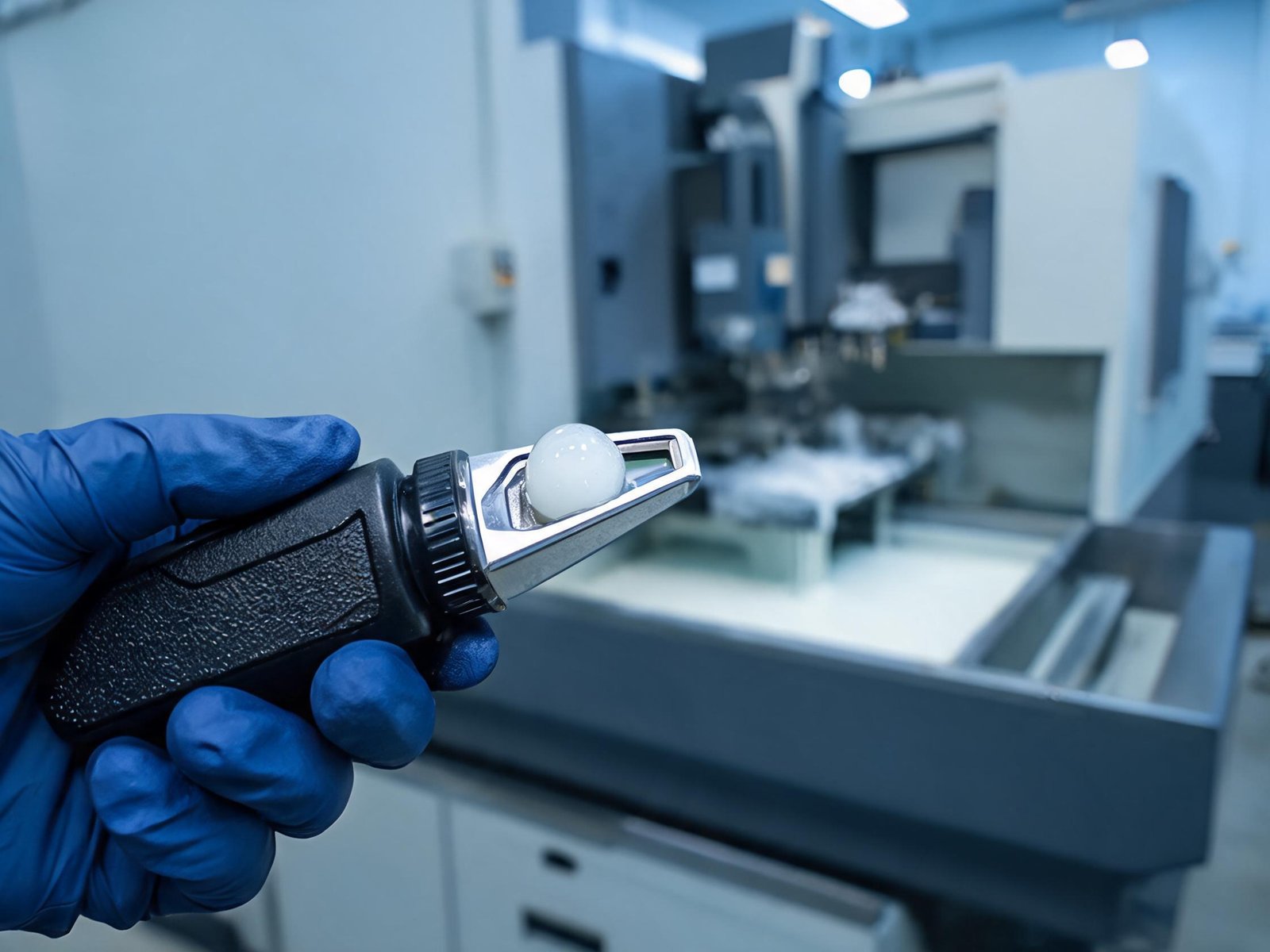
Specification sheets do not pump coolant. Order one sample unit configured exactly as the production unit would be — same tube size, same motor variant, same connectors — and run it on the plant’s own concentrate. A practical acceptance test takes half a day:
| Test step | Method | Pass criterion |
|---|---|---|
| Delivery rate verification | Time a dispensed volume into a graduated container at the intended control setting | Measured rate matches the calculated make-up rate with margin |
| Repeatability | Repeat the timed dispense three times, including one run after an overnight stop | Spread stays tight; no Monday-morning prime failure |
| Suction behaviour | Run from a drum below pump level if that reflects the installation | Pump primes and holds rate without manual filling |
| Tube service drill | Have the plant’s own technician perform a tube change | Completed quickly with standard tools |
| Concentration check | Verify mixed make-up fluid with a refractometer against the fluid supplier’s target | Mixed concentration lands in the supplier’s band |
The repeatability row catches the most common field complaint: a pump that meters beautifully when warm and freshly primed but drifts after standing. If the sample passes all five steps on the plant’s actual concentrate, the remaining purchase risk is supplier-side, not technical.
Quality Control and Ordering Considerations
For volume orders, put the quality expectations in the purchase contract rather than assuming them. Reasonable asks include batch consistency checks on supplied tube, torque or run-in verification on motor-driven units before shipment, and tube-lot traceability so a field failure can be traced to a production batch. Pumps destined for Europe should carry CE documentation; requirements for machinery being integrated into larger equipment should be confirmed with the supplier in writing. Pump test standards and terminology referenced in procurement contracts can be anchored to the Hydraulic Institute standards program, which maintains the industry’s pump test and nomenclature references.
On the order itself, confirm: the motor variant and voltage for each plant location, connector and fitting types so the tube ties into existing plumbing without adapters, a spares package (tube and hose quantities sized to the service interval found during sample testing), and lead time for both the first order and the annual consumption plan. For Southeast Asian plants planning multi-line rollouts, aligning the pump configuration across sites in one specification keeps the spares inventory and the maintenance training identical everywhere.
Procurement Checklist
- Duty defined in writing: metered make-up dosing versus bulk concentrate transfer.
- Pump class matched to duty: K45-class tube pump for dosing, YD25-class hose pump for transfer.
- Flow sized against measured drag-out and refill windows, not brochure maximums.
- Tube material checked against the concentrate’s safety data sheet.
- Suction conditions specified (flooded or lift) and tested on the sample.
- Sample tested with the plant’s own concentrate, including an overnight-stop repeatability run.
- Tube service drill completed by the plant’s own technician.
- Motor variant, voltage, connectors and spares package confirmed in the order.
- CE and material documentation requested in writing before shipment.
Next step: send YOORAIN your sump or central-system volume, target concentration band, drum or tote dimensions and available control signal. Engineering will size the K45 or YD25 for the duty, confirm the tube configuration, and ship a sample unit for a field trial on your own concentrate before you commit to the fleet order.