
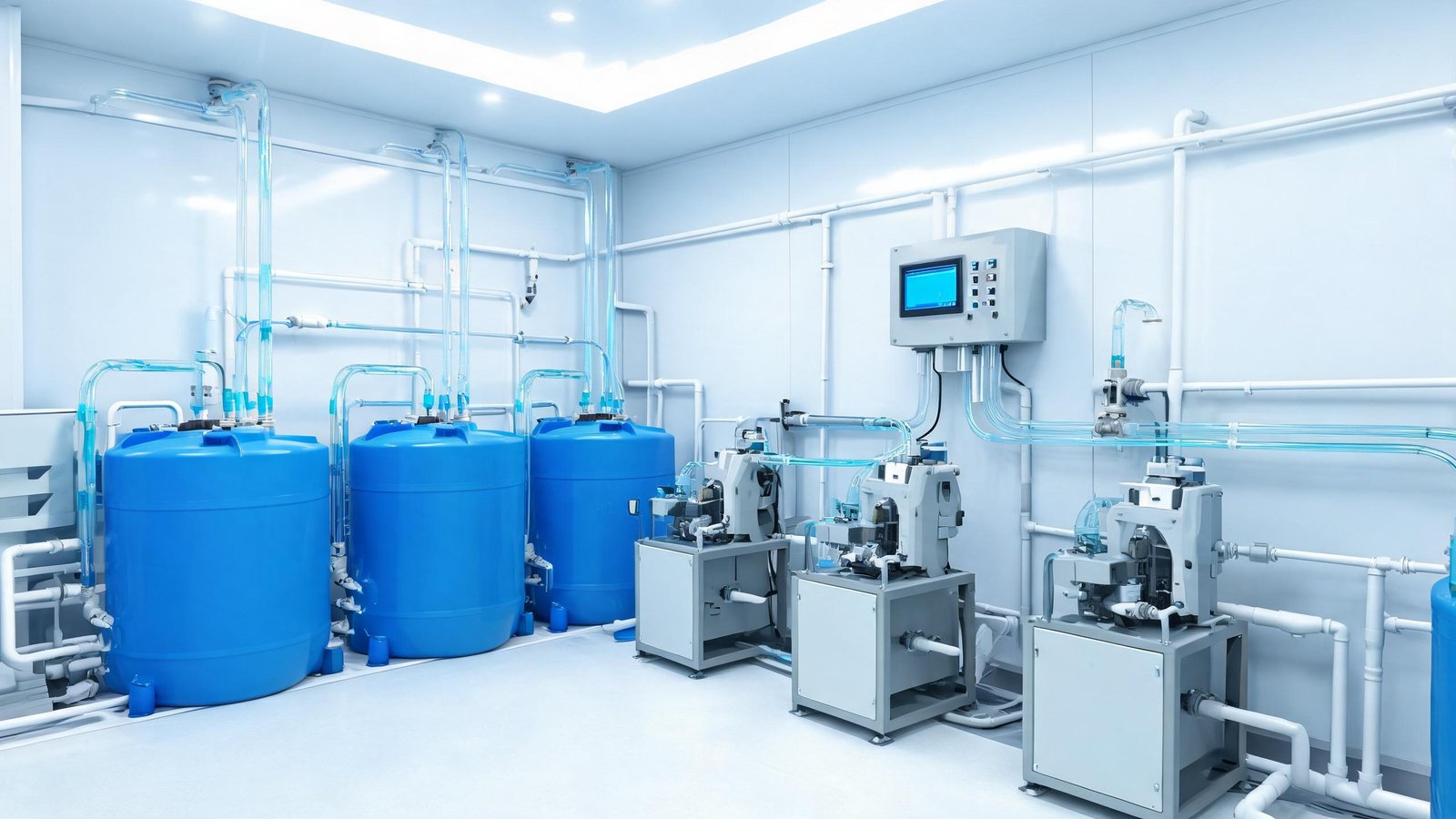
Commercial pool operators face a dosing problem that household pools never see. A municipal pool, a hotel complex or a water park runs high bather loads, wide temperature swings and strict health-code inspection, and it needs sodium hypochlorite, pH adjusters and sometimes supplementary chemicals fed automatically, around the clock, whether staff are watching or not. The equipment that does this feeding — the peristaltic pump for pool chemical dosing — is a small component with an outsized effect on water quality, chemical spend and compliance findings.
Buyers evaluating dosing pumps for commercial aquatics usually arrive with a controller specification and a budget, but the pump decision itself rewards a closer look at chemical type, dosing rate, tubing compatibility and the safety interlocks that regulators expect. This guide walks through that evaluation from a buyer’s perspective, using pumps and tubing available on the market today.
What Buyers Should Define First
Four inputs drive every downstream choice, so fix them before comparing models:
- Chemical inventory. Sodium hypochlorite (liquid chlorine), muriatic acid or sodium bisulfate for pH reduction, calcium chloride for hardness. Each attacks elastomers differently, and the tubing is the part that fails first.
- Dosing rate. Commercial facilities typically correct chlorine residual in small, frequent additions rather than large slugs. A pump sized for 0.1–5 L/h of chemical covers most controller-driven correction cycles; oversizing forces the pump into short pulses that reduce accuracy.
- System pressure. Chemical injection points are usually on the pressurized return line, after the filter. The pump must overcome line pressure at the injection fitting plus safety margin.
- Control interface. Pool chemical controllers switch the pump on and off, or pulse it, based on sensor readings. The pump must accept that external control cleanly.
Regulatory context matters in the United States. The CDC Model Aquatic Health Code (MAHC) sets out requirements for chemical feed equipment in public aquatic facilities, and many state and local codes draw on it. Equipment listed to applicable NSF standards gives procurement teams a defensible paper trail during plan review — NSF’s listing directory for flow-through chemical feeding equipment shows what certified feed systems look like in practice.
Comparing Pump Requirements
Peristaltic pumps suit pool chemistry for two specific reasons. First, the chemical only contacts the tube, so the aggressive fluid never reaches a diaphragm, check valves or seals — the components that fail first in contact with hypochlorite. Second, peristaltic pumps handle the off-gassing that hypochlorite produces: air and chlorine gas bubbles that form in the chemical line pass through a tube pump without vapor-locking the mechanism, which is why dosing specialists note that peristaltic designs excel with off-gassing chemicals in commercial aquatics.
The trade-offs are equally concrete. Tube life shortens with aggressive chemistry and high cycling, so buyers should treat tubing as a consumable with a planned replacement interval, not a fit-and-forget part. And because flow is proportional to speed, pump sizing should put the normal dosing point in the middle of the pump’s range, leaving headroom for shock-dosing events.
| Chemical | Typical Dosing Task | Tubing Consideration |
|---|---|---|
| Sodium hypochlorite | Chlorine residual correction | Confirm oxidizer resistance; inspect for stiffening |
| Muriatic acid / pH minus | pH reduction | Verify acid compatibility of tube and fittings |
| Calcium chloride | Hardness make-up | Watch for crystallization at fittings |
| Defoamer / clarifier | Bather-load management | Generally benign; follow supplier data |
YOORAIN’s range spans the flow band commercial dosing needs. The KCR 12V DC peristaltic pump covers 5.2–85 ml/min — a natural fit for controller-driven chlorine and pH correction — with 3-roller low-pulse delivery and standard silicone or optional BPT tube. Where larger chemical volumes or other duties share the plant room, the K25 small peristaltic pump delivers up to 1200 ml/min with 15#/24#/35# tubing in a compact footprint. For buyers who want a programmable dosing station rather than a bare pump, the peristaltic pump with housing combines an SUS304 enclosure, LCD touchscreen operation and flow-correction functions with the YZ15/YZ25/DG head family.
| YOORAIN Model | Flow Range | Motor / Control | Pool Dosing Fit |
|---|---|---|---|
| KCR 12V DC pump | 5.2–85 ml/min | DC motor, 3 rollers | Chlorine and pH correction from a chemical controller |
| K25 small pump | Up to 1200 ml/min | Stepper or DC | Larger chemical feeds, multi-pool plants |
| Pump with housing | 0.03–2600 ml/min | Integrated driver, LCD | Standalone dosing stations, calibration-friendly operation |
OEM Customization Considerations
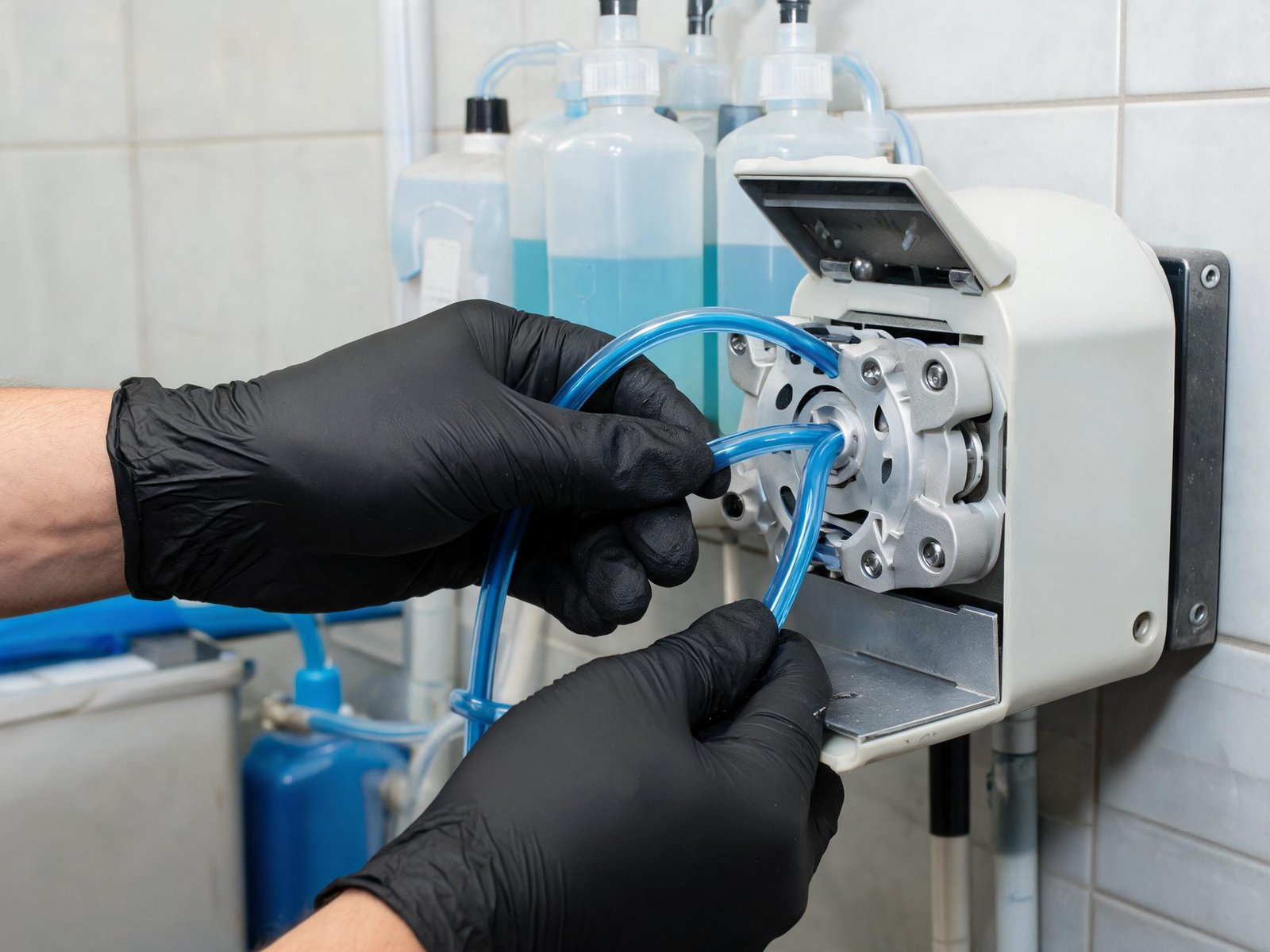
Manufacturers of pool controllers, dosing stations and prefabricated plant skids rarely buy pumps as-is. Common customization requests include mounting brackets matched to the enclosure, specific connectors so the pump drops onto the controller board, voltage variants (12 V/24 V DC from the controller supply rather than mains), and tube materials selected for the chemical set the equipment targets. A supplier that offers the pump head, motor and tube as separately configurable items shortens the integration loop considerably. YOORAIN’s OEM pump customization covers motor options, mounting and tube selection, which matters when the same platform must serve hypochlorite in one install and acid in another.
Supplier Evaluation
Chemical dosing is unforgiving of supplier surprises, so the evaluation should weight consistency and documentation as heavily as unit price:
- Batch consistency. Pump output should be repeatable across units — a controller calibrated against pump A must still land on target with pump B from the same shipment.
- Tubing supply continuity. The buyer should be able to source replacement tube in the same material and size years later.
- Documentation. Datasheets should state flow-per-revolution, pressure rating and compatible tube materials without requiring follow-up questions.
- Responsiveness. Customization queries answered in days, not weeks, keep equipment development on schedule.
A supplier audit or video factory tour reveals whether tolerances, incoming material checks and final testing actually happen. For buyers sourcing internationally, our overview of peristaltic pump tubing selection for chemical dosing lists the material properties worth demanding from any supplier.
Quality and Testing
Before committing to a volume order, run a structured sample test: mount the pump as it will be installed, run it with the actual chemicals at the actual line pressure, and log output volume against controller commands over several days. Measure drift at the start and end of the trial to estimate tube life in situ, not on a datasheet. Include an off-gassing check by letting the chemical line sit in a warm environment overnight, then verifying the pump picks up and delivers cleanly the next morning. Reliable peristaltic pumps recover from gas pockets without operator intervention; unreliable ones stall.
Incident data underlines why the pump and its controls need testing together. The CDC’s report on inhalational chlorine injuries at public aquatic venues documents cases where chemical feed continued while the main recirculation pump was stopped — precisely the scenario that a flow-sensor interlock and overfeed alarm are designed to prevent. Buyers should verify that the dosing pump, controller and recirculation interlock behave as a system, with the pump disabled whenever recirculation flow is absent.
Questions to Ask Before Ordering
- Which tube materials are offered for this pump, and which one is recommended for sodium hypochlorite service specifically?
- What is the pump’s output drift over a full tube life at my cycling rate?
- Can the pump accept 12 V or 24 V DC supply from my controller rather than mains power?
- What is the replacement tube part number and lead time for my region?
- Which samples and test reports can you provide to support equipment certification?
The YOORAIN tubing range is produced to meet USP Class VI, FDA 21 CFR 177.2600 and European Pharmacopoeia requirements — a useful starting point for qualification, though final chemical suitability should be confirmed against the supplier’s compatibility data.
Key Takeaways
- Define chemical set, dosing rate, line pressure and control interface before comparing pumps — every other decision follows from them.
- Peristaltic pumps fit pool chemistry because fluid contacts only the tube and off-gassing hypochlorite does not vapor-lock the mechanism.
- Size the pump so normal dosing sits mid-range, and treat tubing as a scheduled consumable.
- Test pumps with the real chemicals and real controller, and verify the recirculation interlock — CDC incident reports show what happens when feed continues without flow.
- Weight supplier consistency, documentation and tube supply continuity alongside price.
Configuring a dosing station or controller for commercial aquatics? Share your chemical type, tank volume and dosing frequency with YOORAIN, and we will recommend a pump and tube configuration for your duty point.