
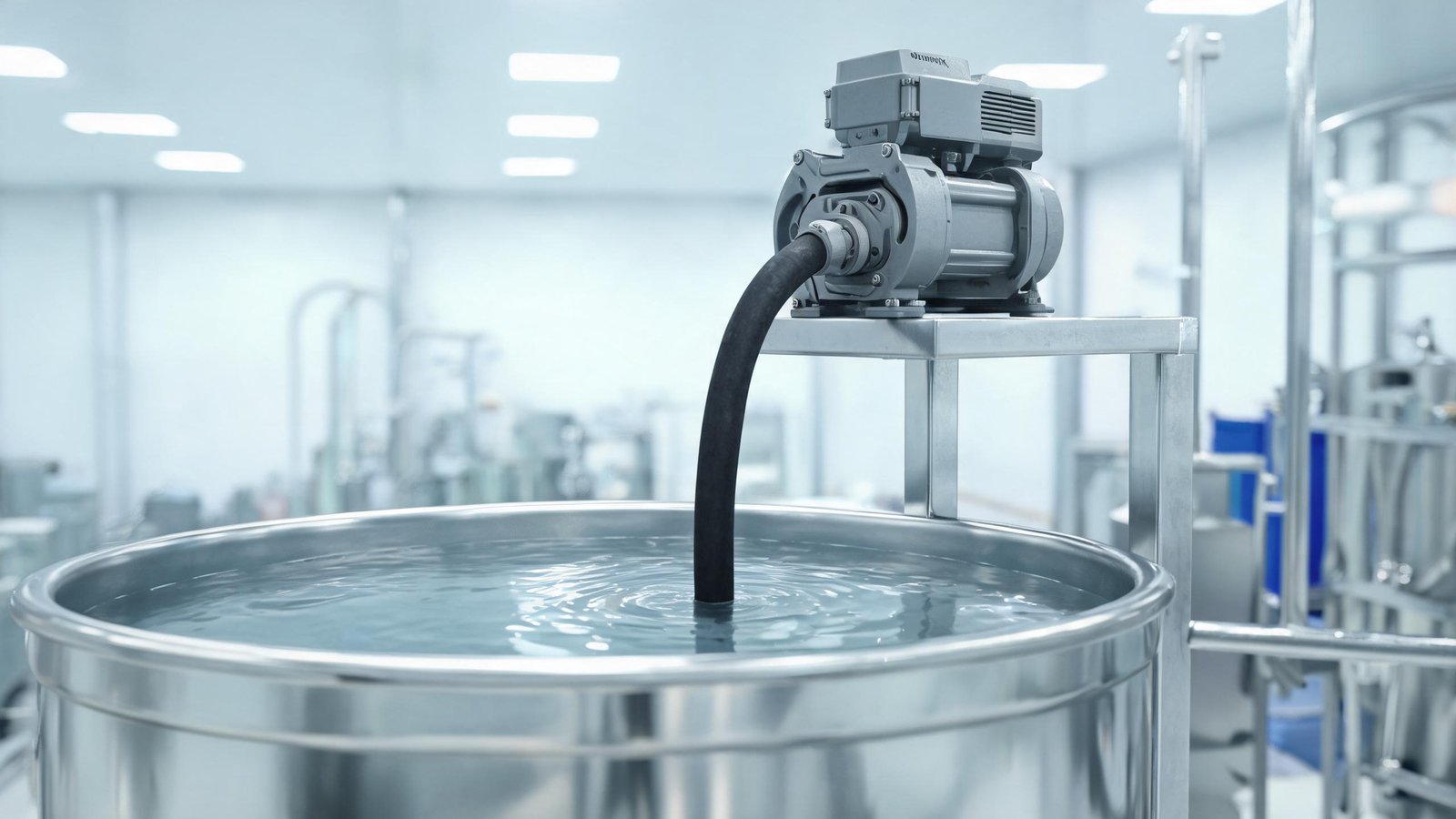
A pump that has to sit above the fluid it moves creates a familiar commissioning problem: the equipment team mounts a peristaltic pump on a frame or inside a cabinet, connects the suction line down to a tank or sump, switches on, and the pump runs dry for a minute before fluid finally arrives — or never arrives at all. Whether that installation works depends on how well the suction side was designed, not just on the pump model itself.
Peristaltic pumps are positive displacement machines that move fluid by compressing a tube or hose with rollers or shoes. Because the fluid never touches the pump mechanism, the tube is the only wetted part, and the same compression that pushes fluid forward also leaves a vacuum behind the roller as the tube recovers. That recovery is what makes the design self-priming: the expanding tube draws air out of the suction line and pulls liquid up into it. This article explains how far that self-priming ability can actually be pushed, what limits suction lift in practice, and how to design the installation so the pump delivers its rated flow without wasting tube life.
Why a Peristaltic Pump Can Self-Prime — and What Limits the Lift
Every suction lift ultimately depends on atmospheric pressure. At sea level, atmospheric pressure is about 101.3 kPa, which balances a column of water roughly 10.3 m tall. No pump — peristaltic or otherwise — can lift cold water higher than that theoretical limit, because the pump cannot create a perfect vacuum on the suction side. The Hydraulic Institute publishes guidance on pump suction design, and the same physics applies across pump types: friction losses, vapor pressure and tube condition all reduce the usable lift well below the theoretical ceiling.
For peristaltic designs specifically, the practical limit comes from tube recovery. The tube must snap back to its original shape fast enough to draw in fluid between roller passes. Heavy-wall hose pumps, which use reinforced elastomer hose inside a lubricated housing, generally recover well and are commonly rated to self-prime from dry conditions at lifts of up to around 8–9 m of water. An example from the market is the Boyser AMP16/C hose pump, rated to self-prime up to 8 m.w.c. Smaller tube pumps behave differently: as tube diameter and wall thickness decrease, the vacuum the tube can hold stays useful but the flow available during priming drops, and priming time grows quickly with lift height. Tube wear matters too — a tube that has taken a compression set no longer recovers fully, and the first symptom is usually a pump that used to prime quickly and now takes longer or loses prime on hot days.
Dry-running capability is the other half of self-priming. Because nothing inside a peristaltic pump depends on the liquid for sealing or lubrication, the pump can run dry while pulling air without immediate damage — a genuine advantage when suction lines are emptied between batches. The limit is heat: a tube running dry against rollers for extended periods heats up and loses life, so dry running should be a transient condition, not an operating mode.
What the Application Requires
Before sizing, define four numbers: vertical lift from the lowest liquid level to the pump centerline, total suction line length, fluid viscosity at the lowest expected temperature, and required flow at the pump discharge. The first two determine whether a lift installation is realistic; the third determines how fast the tube can recover; the fourth determines how much margin you need. Two installations that demand the same flow can behave very differently if one has a 1 m flooded suction and the other a 5 m lift through 10 m of small-bore tubing.
| Application Condition | Effect on Suction Lift | Design Response |
|---|---|---|
| Large vertical lift (5–8 m) | Longer priming time, flow derating | Use hose pump class, minimize fittings |
| High viscosity fluid | Slower tube rebound, poor priming | Flooded suction or gravity feed |
| Warm fluid or volatile media | Vapor pressure reduces usable lift | Reduce lift, shorten suction line |
| Worn or fatigued tube | Loss of vacuum, lost prime | Scheduled tube replacement |
| Long small-bore suction line | High friction, tube collapse risk | Increase diameter, shorten run |
Suction-Side Design: Tubing Length, Diameter and Collapse
The suction side is where most lift installations fail. Keep the suction line as short and as straight as the equipment layout allows, and use the largest tube diameter the pump head accepts. Every meter of small-bore tube adds friction that the recovering tube has to overcome, and every elbow adds more. If the pump must be placed above the tank, plan the route so the line rises continuously — high points collect air and prolong priming.
Tube collapse is the second failure mode. On the suction stroke the tube is under vacuum; if the vacuum exceeds what the tube wall can withstand, the tube flattens and flow stops even though the pump keeps turning. Thicker-wall tubing resists collapse better, which is one reason hose pumps dominate lift duties. Reinforced suction hose on the inlet side is a standard response on larger installations. Material compatibility follows the same rules as any chemical duty — the peristaltic pump tubing selected must suit the fluid as well as the vacuum conditions.
| Suction-Side Parameter | Recommendation | Why It Matters |
|---|---|---|
| Line length | Shortest practical route | Less friction, faster priming |
| Tube diameter | Largest accepted by pump head | Lower resistance, less collapse risk |
| Wall thickness | Heavy wall for lift duties | Withstands vacuum, longer life |
| Fittings | Minimum count, full-bore type | Fewer air traps and restrictions |
| Strainer | Low-differential-loss type, oversized | Prevents added vacuum loss |
Flow and Pressure Considerations
A pump’s published flow curve is normally based on near-zero suction lift, so a lift installation should be sized with margin. As lift increases, the effective fill of the tube per revolution decreases, and delivered flow falls below the nominal figure — the effect is modest at 2 m but significant at the top of the usable range. The relationship between nominal and delivered flow, and how to correct for it, is covered in detail in our guide to peristaltic pump flow rate calculation.
Discharge pressure interacts with suction conditions too. Energy that goes into lifting fluid on the inlet side is no longer available at the outlet, so a system with a high lift and a high discharge head needs a pump selected for the sum of both. The YD25 peristaltic hose pump, for example, is rated for outlet pressures up to 1 MPa with flows of 400–1000 L/h through a 25R hose, which places it firmly in industrial transfer and dosing duties where lift and pressure must be handled together. Where the duty is lower flow but still requires lift, mid-range tube pumps fill the gap: the K45 large flow rate peristaltic pump reaches 4600 ml/min with 73# and 82# silicone tube, and housed lab-class units such as the peristaltic pump with housing cover 0.03–2600 ml/min with YZ15/YZ25/DG heads for instrument duties.
Manufacturer-peristaltic specialists describe the same derating pattern in their own guidance — JIH Pump’s technical guide on peristaltic self-priming notes that long suction distances, high viscosity and large particles all reduce achievable lift, and recommends flooded suction where those conditions combine.
Installation and Integration Considerations
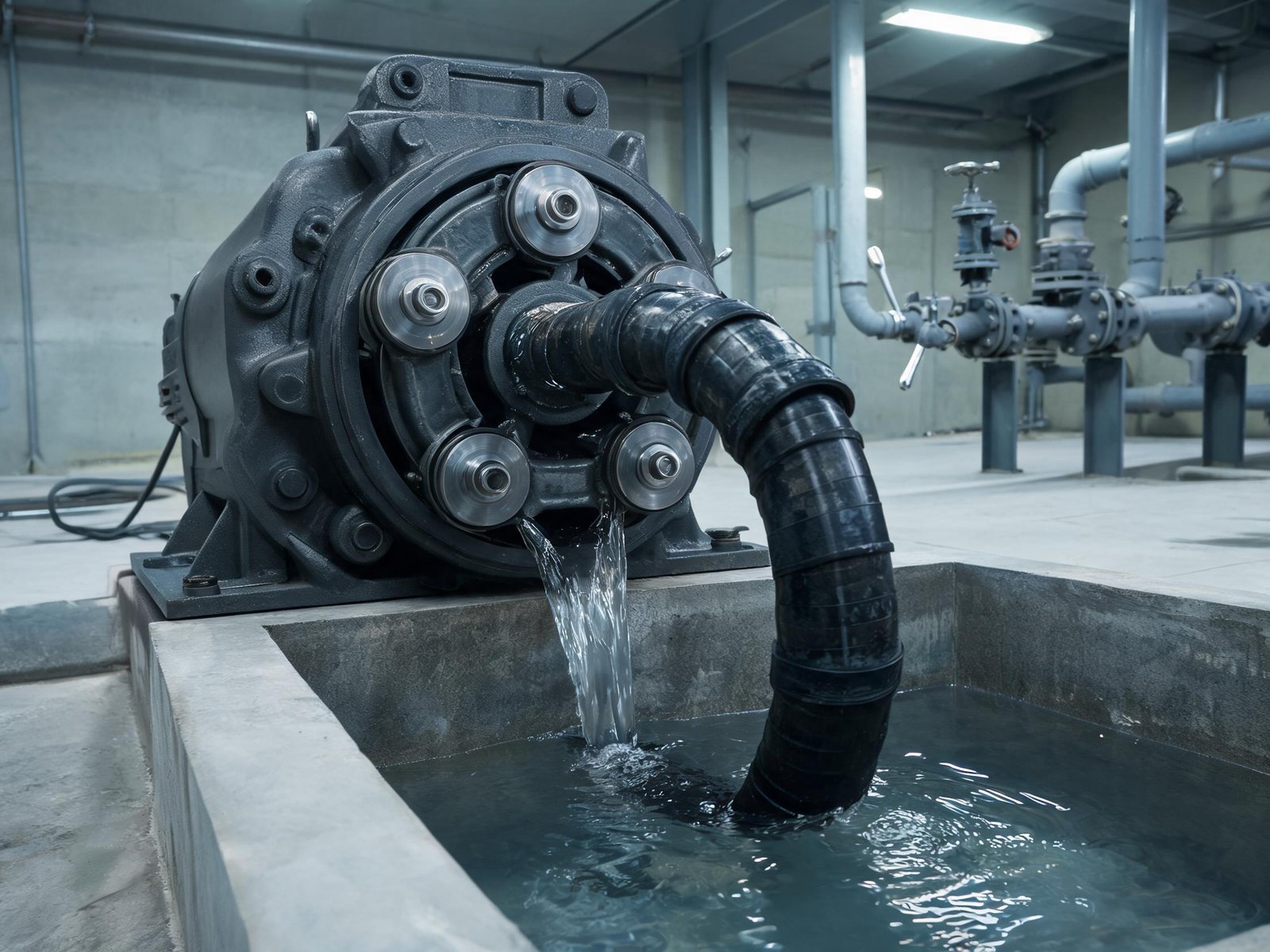
Placement is the cheapest lever an engineer has. Mounting the pump below the tank (flooded suction) removes priming as a failure mode entirely, shortens suction runs and extends tube life because the tube stays charged. When a lift is unavoidable — drain-emptying duties, mobile equipment, sump applications — a few integration details pay off:
- Install a vacuum gauge on the suction side. Rising vacuum at constant flow is the earliest warning of a strainer blocking or a tube softening.
- Use a foot valve or check valve on long lifts so the line stays charged between cycles and the pump does not re-prime at every start.
- Protect against dry run when the source can empty: level switches or current-based detection stop the pump before heat destroys the tube.
- Allow tube access. Lift duties work the tube hardest, so replacement intervals should be planned, not reactive.
For OEM equipment designers, the same points apply at layout stage: position the pump head as low as the product architecture allows, give the suction tube a generous bend radius, and route it away from heat sources, since warm tube holds less vacuum.
| YOORAIN Model | Max Flow | Tubing | Typical Fit for Lift Duties |
|---|---|---|---|
| YD25 hose pump | 400–1000 L/h | 25R hose, 1 MPa outlet | High-lift industrial transfer, sludge, viscous media |
| K45 large flow pump | 4600 ml/min | 73#/82# silicone | Medium-lift transfer, make-up dosing |
| Pump with housing (YZ15/YZ25/DG) | 0.03–2600 ml/min | 14#–18# family | Instrument and analyzer duties with modest lift |
FAQ
How high can a peristaltic pump lift water?
The theoretical ceiling is about 10.3 m at sea level, set by atmospheric pressure. Practical dry self-priming lifts for hose-type peristaltic pumps are typically rated up to 8–9 m, and tube pumps manage less depending on tube size, condition and viscosity. Treat manufacturer ratings as maximums, not design targets — size installations with margin.
Does suction lift reduce flow rate?
Yes. Higher lift means the tube fills less completely on each revolution, so delivered flow drops below the nominal curve. The effect grows with lift height, viscosity and suction line friction. Verify delivered flow at the installed condition and adjust speed accordingly.
Can a peristaltic pump run dry?
It can run dry temporarily without the seal damage that would stop other pump types, because sealing and lubrication do not depend on the fluid. However, a dry tube heats against the rollers and loses life quickly, so dry running should trigger a stop condition rather than be accepted as normal operation.
Why does my pump prime when new but lose prime after some weeks?
Tube fatigue is the most common cause. A tube that has taken a compression set recovers slowly and holds less vacuum, which shows up first as slower priming and then as lost prime on lifts. Replacing the tube usually restores priming immediately; if it does not, inspect the suction line for air leaks at fittings.
Flooded suction or lift — which should I choose?
Choose flooded suction whenever the equipment layout allows it. Lift installations are fully workable when designed correctly, but flooded suction removes priming as a variable, improves volumetric efficiency, and extends tube life. Reserve lift duties for cases where the fluid source physically sits below the pump.
Planning a suction-lift installation? Contact YOORAIN with your vertical lift height, fluid type and duty cycle, and our engineers can confirm which pump and tube combination suits the application.