
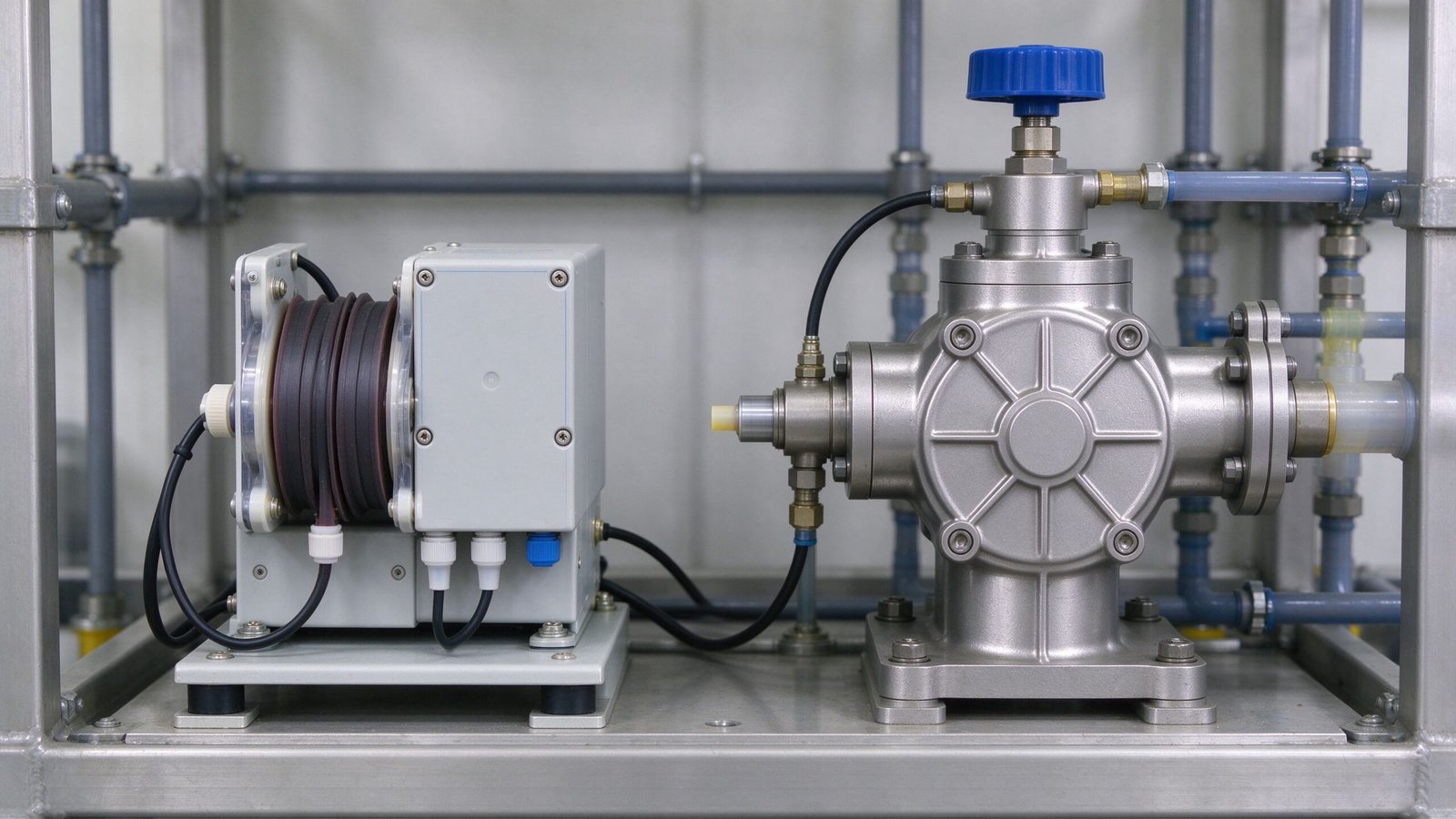
For chemical dosing, the two pumps most engineers compare are the peristaltic and the diaphragm metering pump. Both dose a small, controlled volume of chemical into a process. Both have been around for decades, and both work. But they fail in different ways, service differently, and suit different fluids. This comparison walks through where each pump earns its place, where the other one wins, and how to choose without defaulting to the one you bought last time.
How Each Pumps Chemical
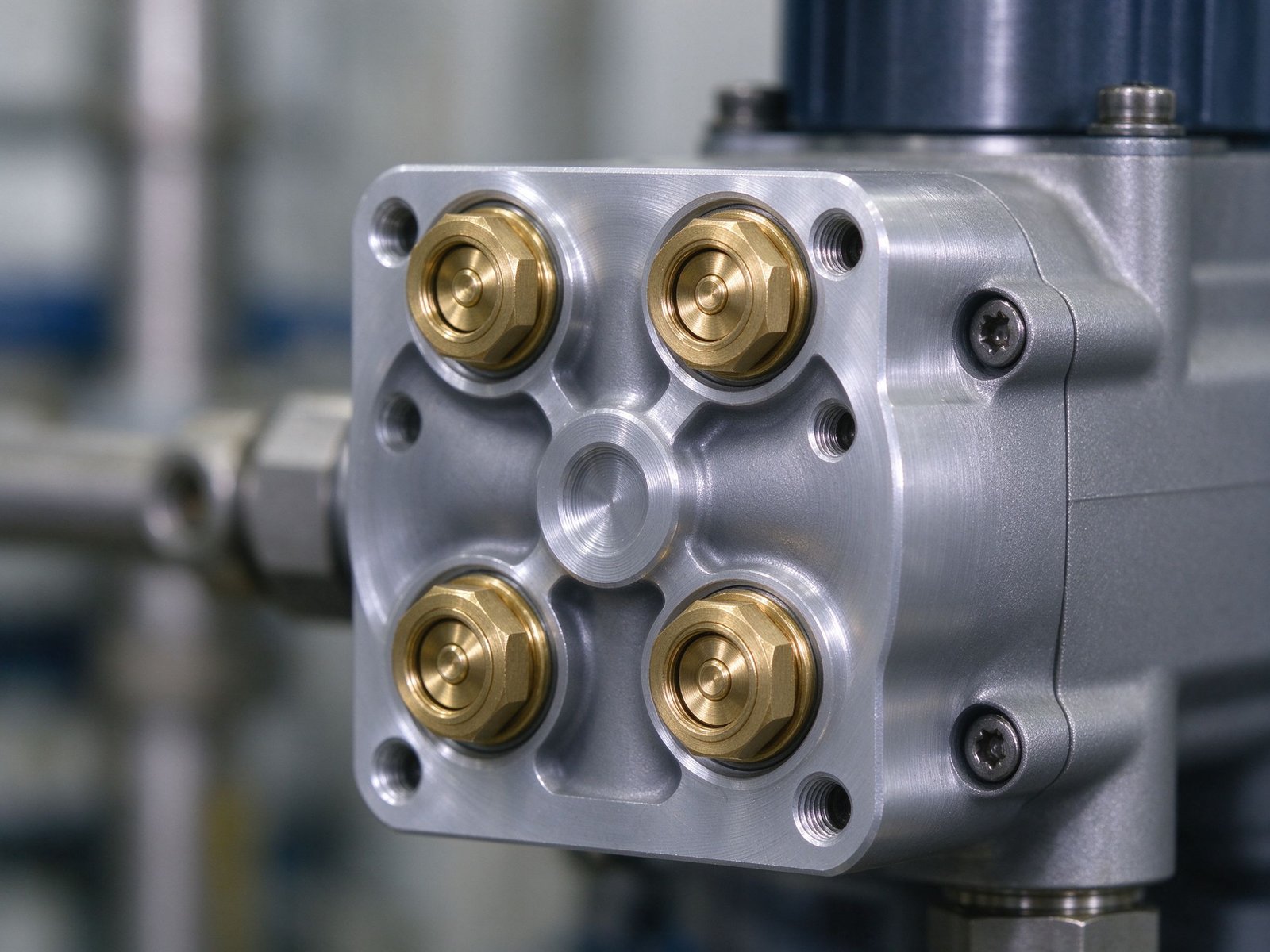
A diaphragm metering pump moves a flexible diaphragm back and forth in a small chamber. On the suction stroke, an inlet ball valve opens and fluid fills the chamber; on the discharge stroke, the inlet closes, the outlet opens, and the chemical is pushed out. It is a precision positive-displacement design, and it can build real pressure — tens of bar, which a peristaltic cannot. But it has two check valves in the wetted path, and those valves are the part that clogs, sticks, or wears.
A peristaltic pump pinches a flexible tube with rollers. There are no valves in the wetted path — the tube is the valve, the seal, and the pump. The fluid lives inside a sealed tube and never touches a plunger, a diaphragm, or a ball check. It cannot build the high pressure a diaphragm can, but it is more tolerant of small particles, it will not weep through a seal, and a worn part is a cheap tube swap rather than a diaphragm and valve rebuild.
| Factor | Peristaltic pump | Diaphragm metering pump |
|---|---|---|
| Principle | Rollers pinch a tube | Diaphragm strokes a chamber |
| Valves in wetted path | None | Inlet and outlet ball checks |
| Seal leakage | Sealed tube, no leak path | Diaphragm seal, eventually weeps |
| Pressure capability | Low to moderate | High, tens of bar |
| Solids tolerance | Good, passes small particles | Poor, valves clog |
| Dry running | Handles it | Seal damage, overheats |
Pressure and Flow Range
The diaphragm metering pump wins on pressure. If you are injecting chemical into a high-pressure line — a boiler feed, a reverse-osmosis reject, a reactor at 20 bar — the diaphragm pump is the tool, because a peristaltic tube cannot hold that kind of back-pressure without bulging and wearing fast. The diaphragm also doses very small volumes accurately, down to fractions of a milliliter per shot, which is useful on a lab skid or a reagent dosing application where the recipe calls for a precise shot every cycle.
The peristaltic wins on flow range in the other direction. It moves more fluid per unit than a small diaphragm, and it does so at a lower cost for a given mL/hour. A 24V dosing pump on a small peristaltic head covers the few-milliliters to a few-liters-per-hour range that most water-treatment and process dosing needs. Above that, a large-flow peristaltic pump reaches several liters per minute. For high pressure at low flow, choose diaphragm; for low to moderate pressure at moderate flow, choose peristaltic.
| Duty | Peristaltic | Diaphragm |
|---|---|---|
| High-pressure injection (over ~6 bar) | Poor, tube bulges | Best |
| Low-pressure chemical feed | Best, simple | Works, over-specified |
| Dosing with small solids | Good, no valves to clog | Poor, ball valves jam |
| Sub-milliliter shot accuracy | Moderate | Best |
| Several liters per hour | Efficient | Multiple heads needed |
| Dry running risk | Tolerated | Avoid |
Solids, Shear, and Fluid Compatibility
The peristaltic’s valve-free wetted path is its biggest advantage on dirty or particulate-laden chemicals. A dispersant with a little suspended solids, a polymer that gels if it sits in a dead chamber, or a slurry chemical will pass through a peristaltic tube without issue. The same fluid in a diaphragm pump collects in the chamber and gums the ball checks. The ball checks are small, and a single particle holding one open ruins the dose.
The diaphragm pump wins on fluid compatibility for very aggressive chemistry, because its head can be PVDF or stainless with PTFE diaphragms, while a peristaltic is limited to the tube materials available. On a strong acid or oxidizer, confirm the tube chemistry before you commit. The peristaltic pump tube is the only wetted part, so the material choice is straightforward, but it has to be the right one. The fluid-compatibility practice described by EPA’s industrial water guidance is to match the wetted path to the chemical, and both pumps let you do that — just through different parts.
Maintenance and Skill Required
This is where the peristaltic pays back the most. A diaphragm metering pump, when it wears, needs a diaphragm replacement, new ball checks, and usually a technician who knows which way the valves go. A peristaltic needs a tube swap that an operator can do in minutes, no tools, no alignment, no calibration of a mechanical stroke. The peristaltic pump driver controls the speed, so after the tube swap you run the same recipe and weigh a minute of discharge to confirm. The speed-setting approach in the motor-driver operating manual is the same on either pump, but the mechanical service behind it is very different.
For a plant that runs a small crew and wants low-skill maintenance, the peristaltic wins. For a plant with a dedicated instrument technician and a high-pressure duty, the diaphragm’s service model is acceptable. The point-of-use calibration, as described by NIST’s Physical Measurement Laboratory, applies to both: weigh the delivered volume after any maintenance, and do not trust the stroke setting on faith.
| Maintenance task | Peristaltic | Diaphragm |
|---|---|---|
| Routine wear part | Tube, minutes, operator | Diaphragm + valves, technician |
| Clearing a clog | Rarely needed | Strip and clean ball checks |
| After maintenance | Re-weigh dose | Re-weigh dose + stroke tune |
| Spare parts on shelf | Tubes, barbs | Diaphragms, balls, seats |
Noise, Vibration, and Installation Footprint
A diaphragm metering pump strokes rapidly, and that stroke shows up as a rhythmic buzz and a small vibration on the skid. It is mounted on a bracket, it works, but the buzz is part of the machine. A peristaltic pump also pulses, but the pulse is smoother — one long roller pass rather than a sharp diaphragm stroke — and on a small head it is quiet enough to mount near a workspace. Neither pump is silent, but the peristaltic is the quieter of the two on a small dosing duty.
Footprint-wise, both are small, but the peristaltic has the simpler plumbing. No strainer, no back-pressure valve tuning, no relief valve to set. A diaphragm skid usually comes with a pulsation damper, a back-pressure valve, and a relief valve, because the sharp stroke and the high pressure demand them. A peristaltic skid on low pressure needs none of that, which is why it fits on a smaller panel and integrates faster. The controlled speed that makes the peristaltic simple is described in the driver reference, and the low part count on the wetted side is what keeps the install cheap.
Cost Up Front and Over Time
The diaphragm metering pump has a higher sticker price for a given flow, but it handles high pressure and sub-mL dosing. The peristaltic is cheaper at the moderate-flow end and has lower running maintenance. Over five years, a peristaltic on a low-pressure chemical feed often costs less, because the tube is cheap and the labor is low. A diaphragm on a high-pressure injection duty earns its price because there is no real alternative. The mistake to avoid is buying a diaphragm for a low-pressure, dirty-fluid duty where a peristaltic would have been simpler, or buying a peristaltic for a high-pressure line where it cannot hold the back-pressure.
If you are choosing between a peristaltic and a diaphragm metering pump for a chemical feed, contact YOORAIN with the chemical, the required mL/hour, the back-pressure, and whether the fluid contains solids. We can tell you honestly which one fits the duty, and bench-test the peristaltic option on your fluid so you are not guessing from a catalog or a sales sheet.