
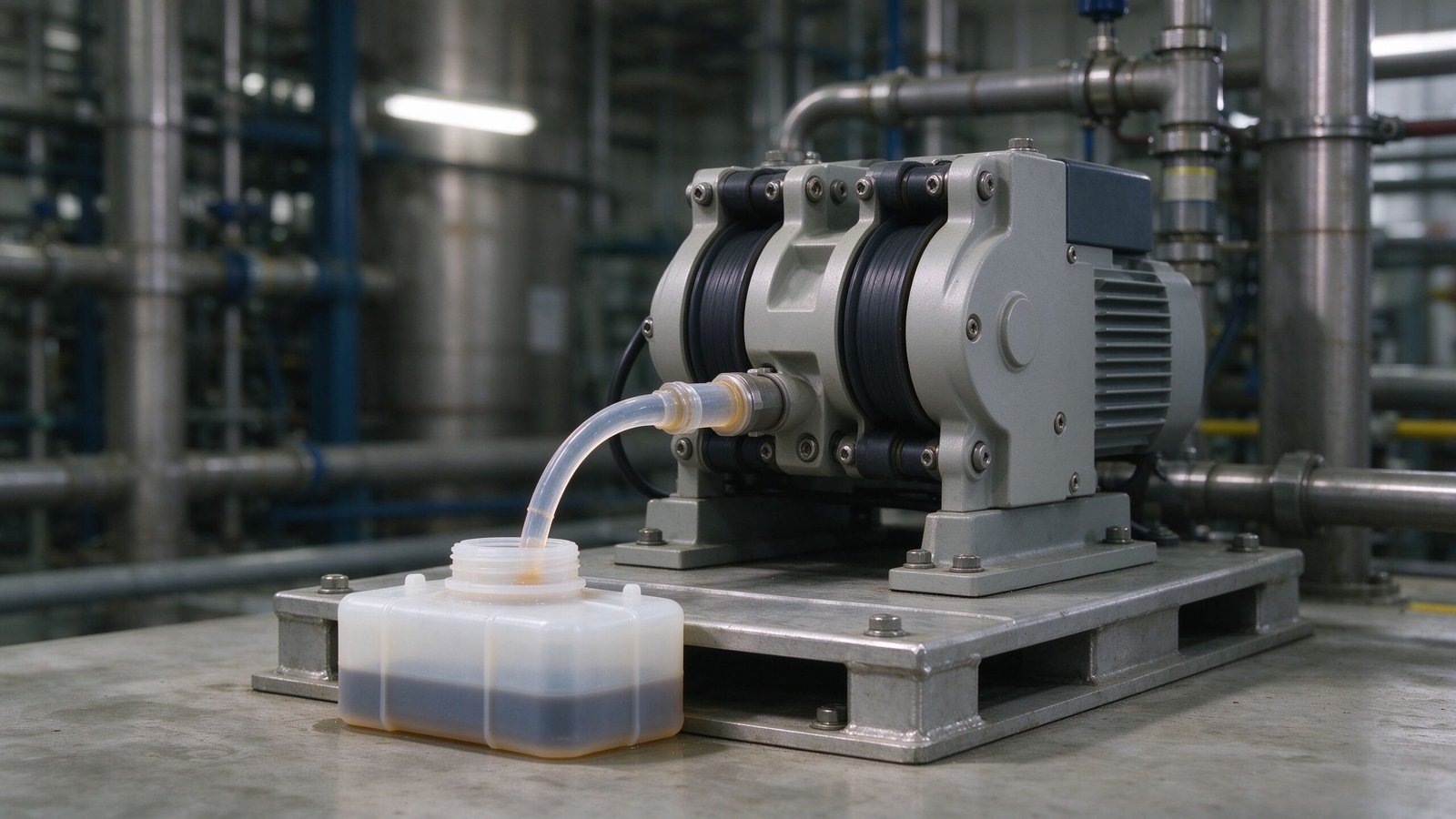
A peristaltic pump is often sold as a self-priming pump, and that is true up to a point. Put the head above the liquid, give it a few seconds, and it will pull fluid up the suction line. But engineers who size the suction line loosely learn quickly that “self-priming” has a ceiling. The tube collapses, the delivery drops, the pump runs loud, and the dose becomes erratic. This troubleshooting guide explains why the suction side sets the limit on a peristaltic pump, how the tube collapses under vacuum, how high you can actually lift fluid, and how to size the suction line so the pump performs the way its catalog suggests.
How a Peristaltic Pump Priming Works
When the pump starts, the roller pinches the tube and pushes the air in the head toward the discharge. That creates a partial vacuum in the suction side, and atmospheric pressure on the reservoir pushes fluid up the line. This is the same physics that lets any suction pump lift fluid, but a peristaltic has a weak point the others do not: the suction tube itself is a thin-walled elastomer that is only open when the roller is not on it. Under vacuum, that tube wants to collapse inward, and if it collapses, the pump can no longer draw a clean slug of fluid.
Positive-displacement priming is more forgiving than a centrifugal’s, because the peristaltic does not depend on a fluid-filled impeller. But the suction hose, the fittings, and the tube wall all have to hold their shape under the vacuum. A peristaltic pump tube that is rated for pressure is not automatically rated for full vacuum on the suction side, and this mismatch is where most suction-lift problems start.
| Symptom on suction side | What it usually means |
|---|---|
| Slow priming, bubbles for minutes | Air leak on suction fitting or foot valve |
| Tube visibly flattens while running | Suction line too long, small bore, or high lift |
| Delivery drops after warm-up | Viscous fluid, small bore suction |
| Pump gurgles, pulsing shots | Foot valve letting air back, or tube collapsing |
| Flow stops after a few minutes | Tube fully collapsed or reservoir empty |
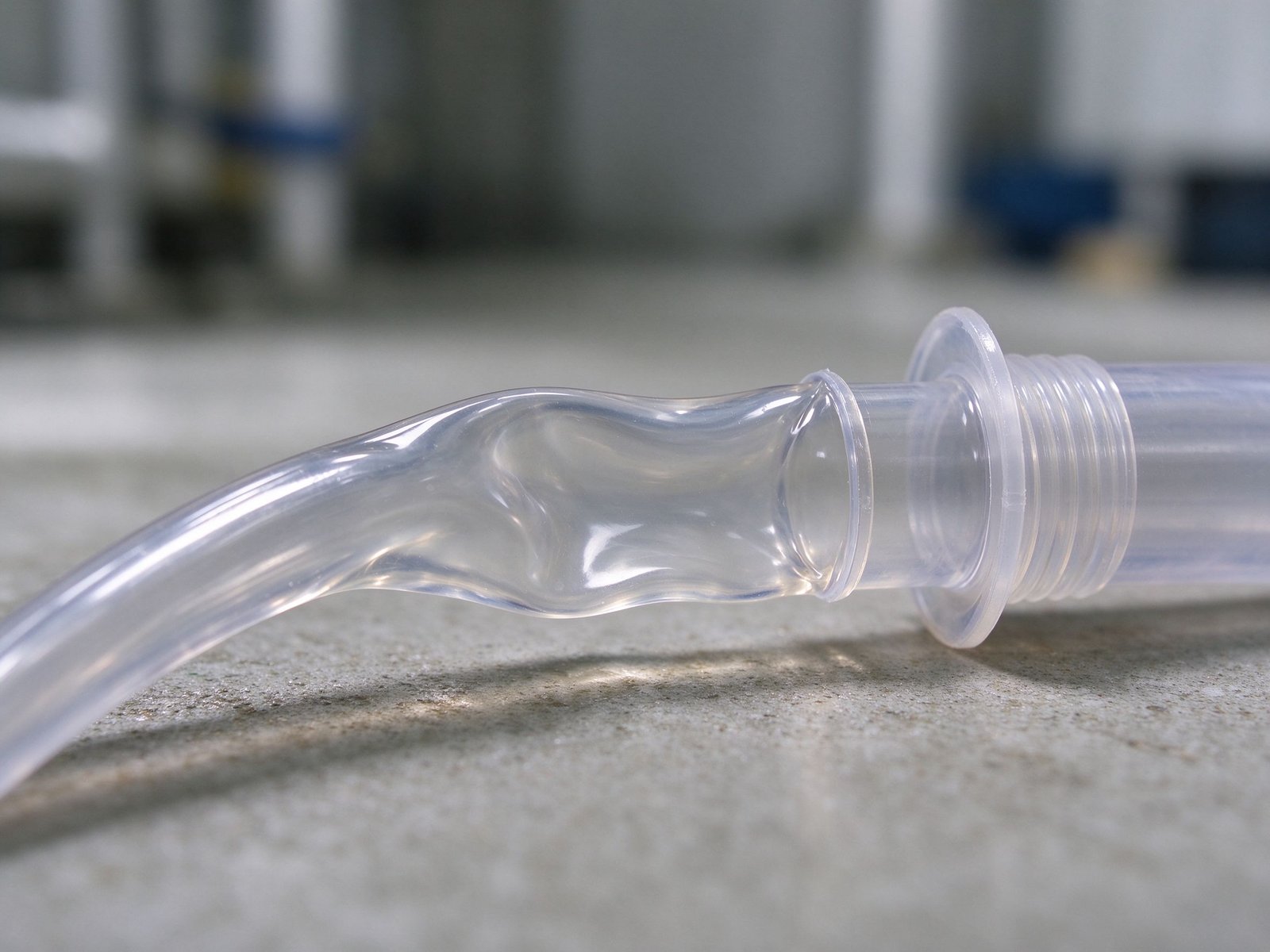
Why the Tube Collapses on the Suction Side
The discharge side sees positive pressure; the suction side sees negative pressure. On the discharge, the tube wants to bulge outward, and the head and the roller hold it. On the suction, the tube wants to cave inward, and nothing holds it open — the tube wall itself has to resist atmospheric pressure. A thin, soft silicone tube that works fine on the discharge will suck flat on the suction if the lift is more than a meter or two, or if the suction hose is long and narrow.
The collapse is progressive. At first, the tube flattens only on the long straight run between the reservoir and the head. The pump still delivers, but the line resistance rises. As the lift grows or the fluid gets colder and more viscous, the collapse reaches the head itself, and the roller pinches a tube that is already partly flat. The volume per revolution drops, and the dose drifts low. If you open the cover mid-run and see the suction end of the tube squeezed shut, that is the diagnosis.
The fluid-handling and piping practice described by the U.S. National Science Foundation’s engineering research on fluid systems is to treat the suction side as the side that sets the pump’s real limit, not the discharge. Most piping mistakes are made on the suction, and the symptoms — low flow, noise, overheating — get blamed on the pump.
How High Can You Actually Lift?
The theoretical limit for lifting water by atmospheric pressure is about ten meters, but that is a physics ceiling, not a pump rating. A peristaltic pump never reaches it, because the tube collapses and the suction line leaks long before. A practical rule of thumb for water at room temperature is that a clean, properly sized peristaltic installation self-primes reliably at up to about three to four meters of lift. Above that, expect longer priming, smaller bore suction, and a reinforced suction hose.
These are qualitative ranges, not guaranteed numbers. The actual lift you get depends on the tube material, the suction bore, the fluid viscosity, the temperature, and the condition of the foot valve. Cold, viscous fluid lifts far less than warm water. A small micro peristaltic pump on a narrow tube lifts less than a large-flow peristaltic pump on a wide one. The way to confirm your own number is to prime the pump on your actual lift and fluid, time it, and weigh the delivered volume — the point-of-use measurement approach described by NIST’s Physical Measurement Laboratory.
| Condition | Expected practical lift (water, room temp) |
|---|---|
| Flooded suction (reservoir above pump) | No limit, easiest case |
| Lift under ~1.5 m, short line, reinforced tube | Reliable, fast prime |
| Lift ~1.5–3 m | Reliable with correct bore and foot valve |
| Lift ~3–4.5 m | Slow prime, reinforced suction, expect air bubbles |
| Lift above ~4.5 m | Use a flooded suction or a booster pump |
Sizing the Suction Line
The single biggest mistake on the suction side is using the same small bore on the suction that the pump head uses on the discharge. The suction line should be wider than the head tube, not the same. A wider suction hose lowers the velocity, lowers the friction loss, and gives the atmospheric pressure more help lifting the fluid. As a rule, size the suction line one bore size larger than the pump tube, and keep it as short and straight as you can. Every extra meter of narrow hose is another meter of friction the pump has to overcome on every cycle.
Also keep the suction line airtight. A pinhole on the suction side does not leak fluid outward; it sucks air inward, and the pump spends its first minutes trying to clear bubbles. Tight hose barbs, clamped connections, and a foot valve that seals when the pump stops all reduce the air load. A small peristaltic pump on a small bore is especially sensitive, because the air volume in a narrow line is small but the velocity is high.
| Suction line choice | Effect on priming |
|---|---|
| Same narrow bore as head tube | High friction, slow prime, collapse |
| One size wider, short, smooth | Fast prime, low resistance |
| Long narrow coiled hose | Friction and volume to clear, slow |
| Reinforced vacuum-rated hose | Resists collapse at higher lift |
| Thin unsupported tube on suction | Collapses under vacuum |
The Foot Valve and the Check Valve
A foot valve on the end of the suction hose keeps the line primed when the pump stops. Without it, every cycle starts with a dry suction line, and the pump spends its run time re-priming instead of dosing. With a foot valve that sticks open or clogs, the line drains back between cycles and the same problem returns. Inspect the foot valve at every tube change, rinse it, and confirm it seals. A cheap plastic foot valve on a chemical duty gets hard and leaks; use a material compatible with the fluid.
On the discharge side, a simple check valve or back-pressure fitting keeps fluid from draining back through the head. This matters for shot dosing: without a discharge check, the fluid in the line falls back when the pump stops, and the first shot after a pause is short. The speed and run-time setup that makes the shot repeatable is described in the motor-driver operating manual, and the discharge check is part of that setup.
Viscous Fluids and Cold Duty
The lift number for water does not apply to honey, oil, syrup, or a cold chemical. Viscous fluid moves slowly up the suction line, the friction loss climbs fast, and the tube has more trouble filling between rollers. For viscous duty, slow the pump down, widen the suction line, and keep the lift as short as possible. A pump that primes water in five seconds may take a minute to prime a viscous fluid, and if you time out the recipe before the prime finishes, the first shot is short.
Cold fluids are worse. A thick fluid in an unheated shed in winter behaves like a viscous fluid even if it is water-thin in summer. Warm the tank, or size the suction generously. The 24V dosing pump on a skid with a small bore will struggle; the same pump on a wider suction and a slower speed will deliver.
Vapor Pressure and Hot Fluids
There is a second suction limit that has nothing to do with the tube collapsing: the fluid itself. When you pull a vacuum on a warm liquid, you lower its boiling point. A hot chemical in a tank that sits in a sun-warmed plant can boil on the suction side under the vacuum, turning from a liquid into a gas. When that happens, the pump is no longer pulling a liquid column; it is pulling a mix of liquid and vapor, and the delivery becomes erratic. The hotter the fluid and the higher the lift, the more likely this is.
The fix is not to fight the physics. Either lower the lift, cool the tank, or mount the pump so it has a flooded suction. A hot fluid on a 3 m lift is a recipe for cavitation and vapor lock, and no amount of tube reinforcement fixes that. The fluid-handling and thermodynamics practice described by NSF’s engineering research on fluid systems treats suction-side vapor pressure as a design input, not an afterthought, and the same discipline applies here. If the chemical is warm, ask the supplier whether the planned lift puts the fluid near its vapor pressure at that temperature.
| Fluid condition | Suction risk | Mitigation |
|---|---|---|
| Warm liquid, low lift | Low risk | Standard install |
| Warm liquid, high lift | Vapor bubbles on suction | Lower lift, cool tank, flooded suction |
| Near boiling at ambient | Cavitation, vapor lock | Flooded suction only |
| Cold viscous fluid | Slow prime, collapse | Warm tank, wider suction |
Priming Frequency and Shot Timing
On a shot-dosing duty, the priming problem shows up in a sneaky way. The first shot after the pump has sat for hours is short, because the suction line has drained back. If the recipe runs a fixed on-time, that first short shot under-doses the process. The fix is a short pre-prime pulse at the start of each batch: run the pump for a few seconds before the main shot, to pull fluid back up the line, then discard or account for that pre-dose. A good foot valve reduces how often you need this, but it does not eliminate it on long lines.
For a continuous duty, priming happens once at start-up and then the line stays full. That is why continuous skids are simpler to commission than shot skids. The 24V dosing pump on a timer can be programmed to add that pre-prime pulse automatically, so the operator does not have to remember it. The point-of-use check is to run a full batch cycle and weigh the first shot separately, so the pre-prime is accounted for in the recipe rather than guessed.
Common Installation Mistakes
Most suction-side failures are not the pump; they are the install. The most common mistake is a long, narrow suction hose coiled behind the skid “because it was convenient.” The second is a suction fitting that is barely hand-tight, sucking air that shows up only as a slow, steady under-dose. The third is a foot valve that rests on the bottom of the drum, picking up settled sludge and clogging within weeks. Mount the foot valve off the bottom, clamp every barb, and run the suction hose straight and short. The small peristaltic pump is unforgiving of these mistakes because its bore is small; a larger pump tolerates them better, but they are still the wrong way to plumb any positive-displacement suction.
| Mistake | Symptom | Fix |
|---|---|---|
| Narrow, long, coiled suction | Slow prime, collapse | Wider, shorter, straight |
| Hand-tight barb, no clamp | Slow under-dose, bubbles | Clamp every suction fitting |
| Foot valve on drum bottom | Clogs, poor seal | Mount off the bottom |
| Thin soft tube on suction | Visible collapse | Reinforced suction hose |
| No discharge check | First shot short after pause | Add back-pressure check valve |
Worked Example
Suppose a dosing skid sits on a platform 2.5 m above a chemical drum, and the required dose is 200 mL per minute. The pump head uses a 4 mm bore tube. If the suction line is the same 4 mm bore and runs 3 m up to the skid, the friction loss is high and the tube collapses under the vacuum. The fix is to run an 6 or 8 mm reinforced suction hose from the drum to just above the head, keep it short, fit a compatible foot valve, and drop the pump speed so the dose still hits 200 mL/min. The priming time drops, the collapse goes away, and the delivery becomes repeatable. The actual number of mL per minute is confirmed by weighing a minute of discharge, as NIST’s measurement practice describes, not by reading the motor RPM.
| Parameter | Problem install | Fixed install |
|---|---|---|
| Lift | 2.5 m | 2.5 m (same) |
| Suction bore | 4 mm (same as head) | 8 mm reinforced |
| Suction length | 4 m coiled | 2 m straight |
| Foot valve | None | Compatible, sealing |
| Result | Slow prime, collapsing tube | Fast prime, stable dose |
Common Questions
Can I run the pump below the reservoir? Yes, and that is the easiest case. A flooded suction removes the lift problem entirely. If you can mount the head below the fluid level, do it.
Why does the pump prime fine for a week and then start bubbling? The foot valve has likely picked up debris and no longer seals. Clean or replace it.
Can I increase the speed to lift higher? No. Faster speed makes the vacuum worse, not better. The tube collapses faster and the delivery drops. Slow down, widen the suction, or lower the tank.
Does the discharge pressure affect priming? It adds load to the pump but does not change the suction lift. A discharge back-pressure that is too high shows up as heat and wear, not as poor priming.
Procurement Questions to Ask
When you buy a peristaltic pump for an above-tank installation, tell the supplier the actual lift, the suction line length, the fluid viscosity and temperature, and whether the foot valve is included. Ask which suction hose they recommend for the lift, and whether the tube you are buying is rated for full vacuum on the suction side. A supplier who sells you a thin tube for a 3 m lift without warning is not doing the sizing. A peristaltic pump driver that lets you slow the speed and read the load is worth asking for, because it is how you confirm the suction install works before you commit the skid.
If your peristaltic pump is slow to prime, the tube collapses on suction, or the dose drifts after a few minutes, contact YOORAIN with the lift, the suction hose bore and length, the fluid, and the temperature. We can recommend a head, tube, and suction arrangement that primes reliably at your installation height.