
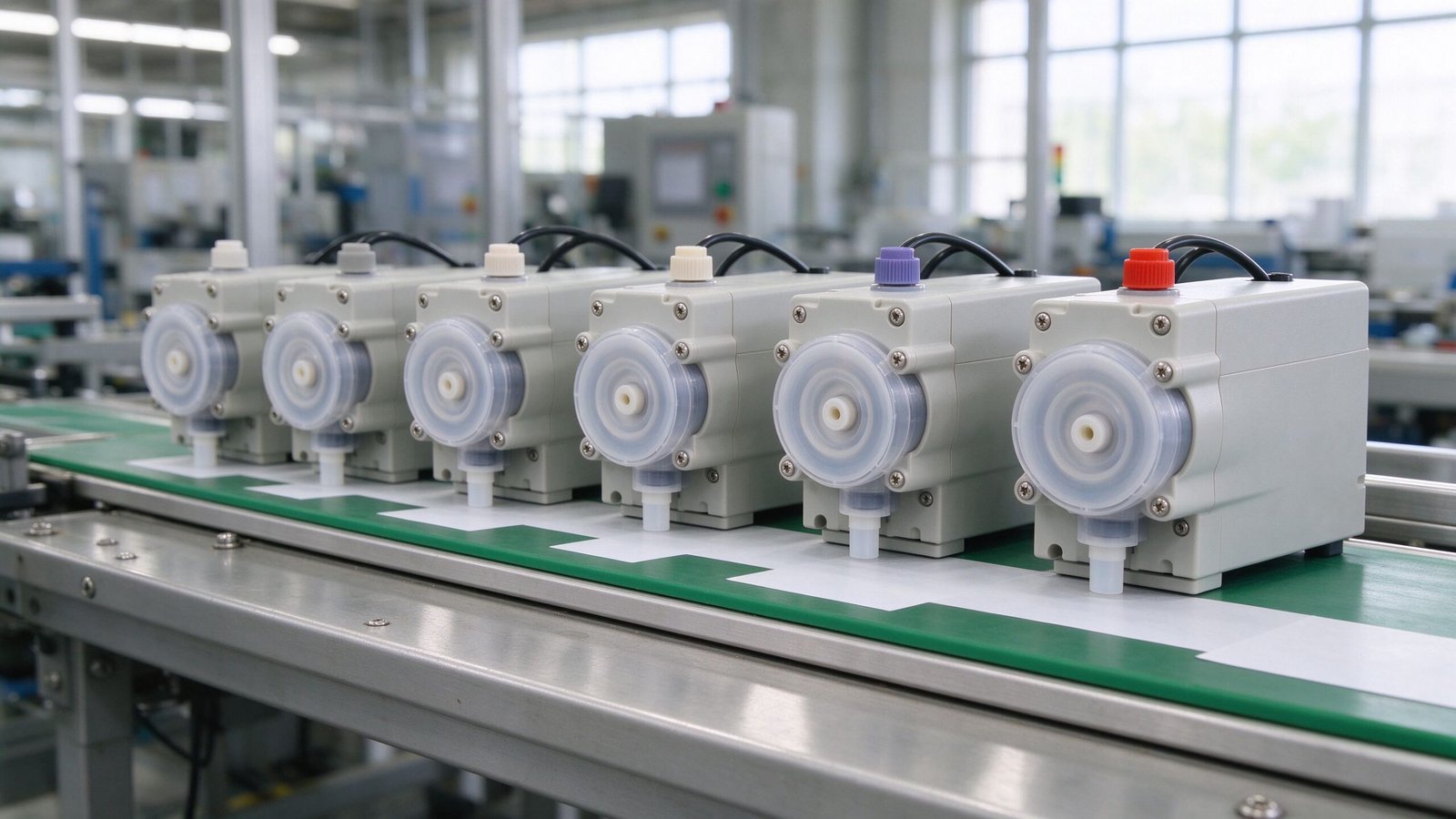
Distributors, system integrators, and OEM builders who sell peristaltic pumps under their own brand face a specific sourcing problem: the pump has to be reliable enough to carry the buyer’s name, flexible enough to match the integrator’s spec, and priced so the reseller still makes margin. Buying off-the-shelf from a catalog is one option, but an OEM program with a pump maker who will build to your spec, ship on your schedule, and support your customer is usually the better long-term move. This procurement guide walks through what to ask a peristaltic pump OEM, what to expect, and where resellers most often get burned.
What an OEM Program Actually Includes
An OEM program is more than a discount on a catalog pump. It means the pump maker builds to your spec, applies your branding, holds stock for your forecast, and supports the units in the field. At minimum, that covers a custom label or housing color, a specified cable length and connector, a driver pre-set to your voltage and speed range, and packaging with your manual. At the deeper end, it covers a custom head ratio, a custom bracket, and firmware tuned to your signal. A micro peristaltic pump, a small peristaltic pump, and a large-flow peristaltic pump all have OEM options, and the minimum order quantity scales with the customization depth.
| OEM level | What changes | Typical MOQ |
|---|---|---|
| Reseller label | Sticker, box, manual | Low |
| Custom cable / connector | Cable length, plug | Medium |
| Custom driver setting | Voltage, speed, signal | Medium |
| Custom head / bracket | Mechanical design change | Higher |
| Firmware / signal integration | Firmware work | Project-based |
Spec the Unit Before You Ask for a Quote
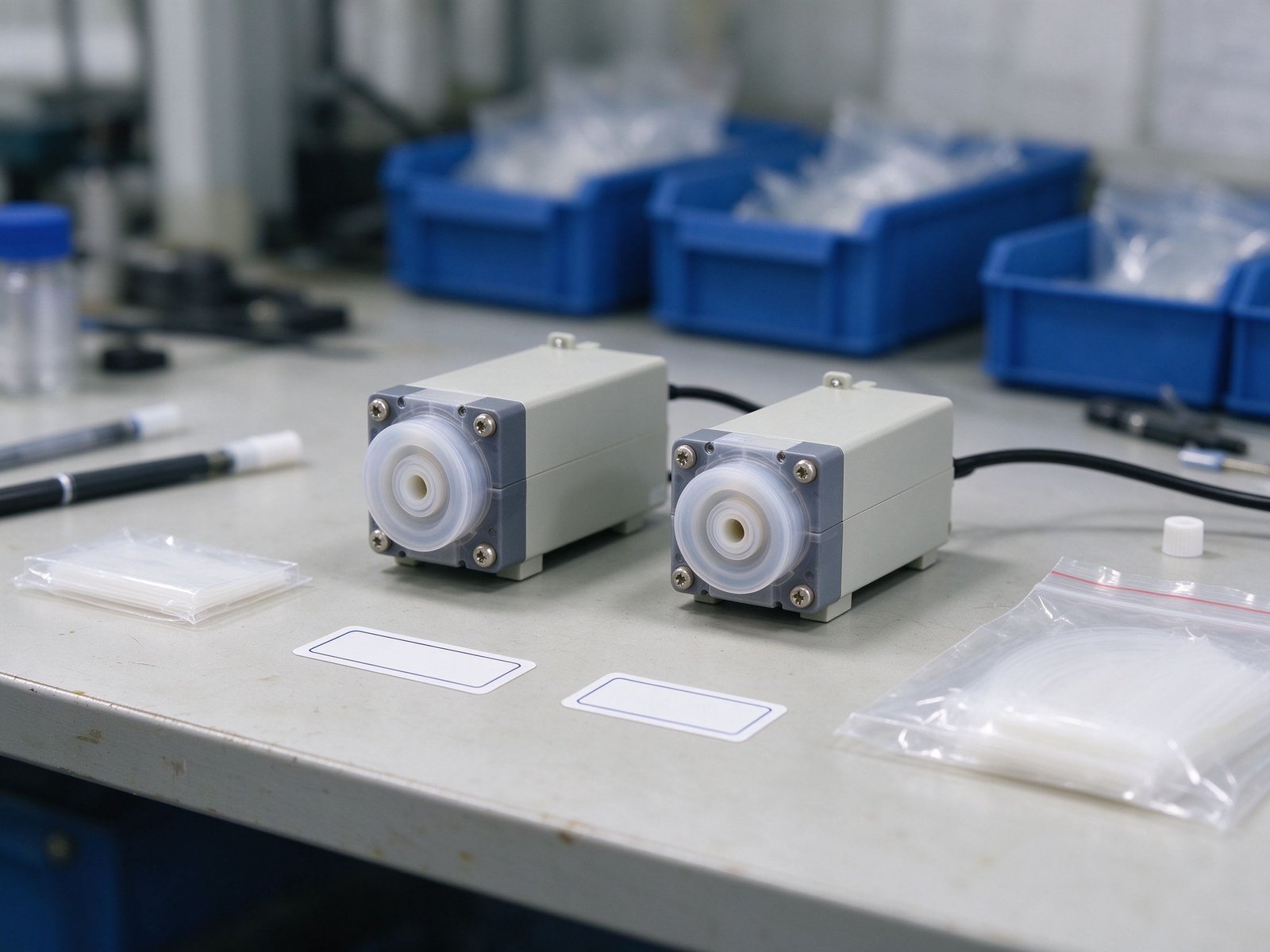
The most common sourcing mistake is asking for “a peristaltic pump for our machine” without numbers. The pump maker cannot quote accurately without the flow range, the fluid and its temperature, the back-pressure, the voltage available, the duty cycle, and whether the pump needs to run dry. A 24V dosing pump spec sheet should list these on page one. If you cannot fill in those numbers, ask the pump maker’s engineer to walk your duty; the result is a pump that fits, not a pump that almost fits.
The speed and run-time setup on the peristaltic pump driver, as described in the motor-driver operating manual, is set to your duty before the unit ships. The peristaltic pump tube material is also chosen by the fluid, not by default. The engineering process, as described by NSF’s engineering guidance on fluid systems, is to match the wetted path to the fluid before quoting.
What to Ask the OEM Supplier
Before signing an OEM agreement, ask the supplier the questions that separate a serious pump maker from a trader. What is the minimum order for a custom label, and what is the price break at higher volumes? How long is the lead time on a repeat order, and can they hold a safety stock? What is the warranty, and who handles a warranty claim in your market — you, or the factory directly? What spare parts (tubes, rollers, drivers) do they stock for your model, and how long does a part take to ship? Can they send a sample unit for your bench test before the bulk order? The NIST point-of-use measurement practice point applies: bench-test the sample on your fluid, and weigh the delivered volume, before you commit the volume.
| Question | Why it matters |
|---|---|
| MOQ for custom label | Cash tied up in inventory |
| Repeat lead time | Machine build schedule |
| Warranty handling | Who your customer calls |
| Spare parts stock | Field service support |
| Sample before bulk | Avoids a costly mis-spec |
Quality, Compliance, and Documentation
If the pump goes into a machine sold into the U.S., EU, or other regulated markets, you need the documentation to support it. Ask the supplier for the declarations and test reports they can actually provide for the materials and the electrical parts. Do not accept vague promises of “CE” or “FDA” paperwork; ask for the specific document for the specific material on the wetted path. A food-contact tube has a different certificate than a general-purpose tube. A 12V DC peristaltic pump has different electrical compliance than a mains-powered one. The supplier who can hand you the actual document on the first ask is the supplier who has done this before.
Documentation for an OEM program also includes a unit-level label with your part number, a serial number, and a manufacturing date. That label is what makes a warranty claim traceable years later. Without it, a returned unit is an argument, not a repair.
Lead Time, Forecast, and Stock
A reseller’s worst week is the one where their customer needs ten pumps and the factory’s lead time is eight weeks. An OEM program should address that up front. Agree on a rolling forecast — the next quarter’s expected volume — and ask the factory to hold a safety stock of the standard units. The factory benefits from a predictable build schedule; the reseller benefits from two-day shipments instead of two-month waits. Custom-labeled units are usually held as blanks at the factory and labeled on order, which keeps the stock flexible. The NSF guidance on supply-chain fluid systems treats spare-parts availability as part of the design, not an afterthought.
Also agree on what happens when your forecast changes. A small order-up or order-down tolerance each quarter is reasonable; a hard commitment to a volume you cannot move ties up cash. For a new product line, start with a small pilot order, sell it through, and ramp the second order based on actual demand rather than on the projection in the deck.
| Inventory question | What to agree |
|---|---|
| Rolling forecast horizon | Next quarter |
| Safety stock held by | Factory or reseller |
| Blank units labeled on order | Shortens lead time |
| Forecast flexibility | Up/down tolerance |
After-Sales and Warranty
The reseller stands behind the pump in front of the customer, even when the pump was built by the factory. That means the reseller needs a warranty process that does not involve shipping a failed unit across the world for every claim. Agree on a simple return-and-replace for the first year, on a warranty policy that covers the pump head and driver but not the consumable tube (which is expected to wear), and on a credit for units that fail out of box. A 24V dosing pump in the field should have a known replacement path, so the reseller can hand the customer a working unit while the failed one is diagnosed.
Spare tubes are the consumable that keeps resellers in touch with their customers. Stock a small range of tube sizes and materials for the models you sell, and sell them as a recurring order. The customer who buys a box of tubes every quarter is a customer you do not lose to a cheaper competitor.
Common Reseller Mistakes
The first mistake is chasing the lowest unit price without including the cost of spare tubes, freight, and warranty handling. A pump that is one dollar cheaper but ships without spare tubes, and whose lead time is eight weeks, costs more in service headaches. The second mistake is committing to a volume before a sample has run on the actual fluid. The third is under-specifying the driver: buying a basic speed driver when the machine needs a 0-10V or PWM control, and then finding the driver cannot be upgraded in the field. Spec the signal interface on day one.
| Mistake | Result |
|---|---|
| Lowest unit price only | Service and freight eat the margin |
| Bulk order before sample | Wrong tube material, wrong flow |
| Basic driver, no signal | Cannot integrate with machine control |
| No serial number on label | Warranty claims untraceable |
If you are sourcing peristaltic pumps for resale or OEM integration, send YOORAIN the flow range, the fluid and temperature, the voltage and signal interface, the expected annual volume, and the markets you sell into. We can quote a labeled or built-to-spec pump, send a bench sample for your testing, and hold repeat stock on your forecast.