
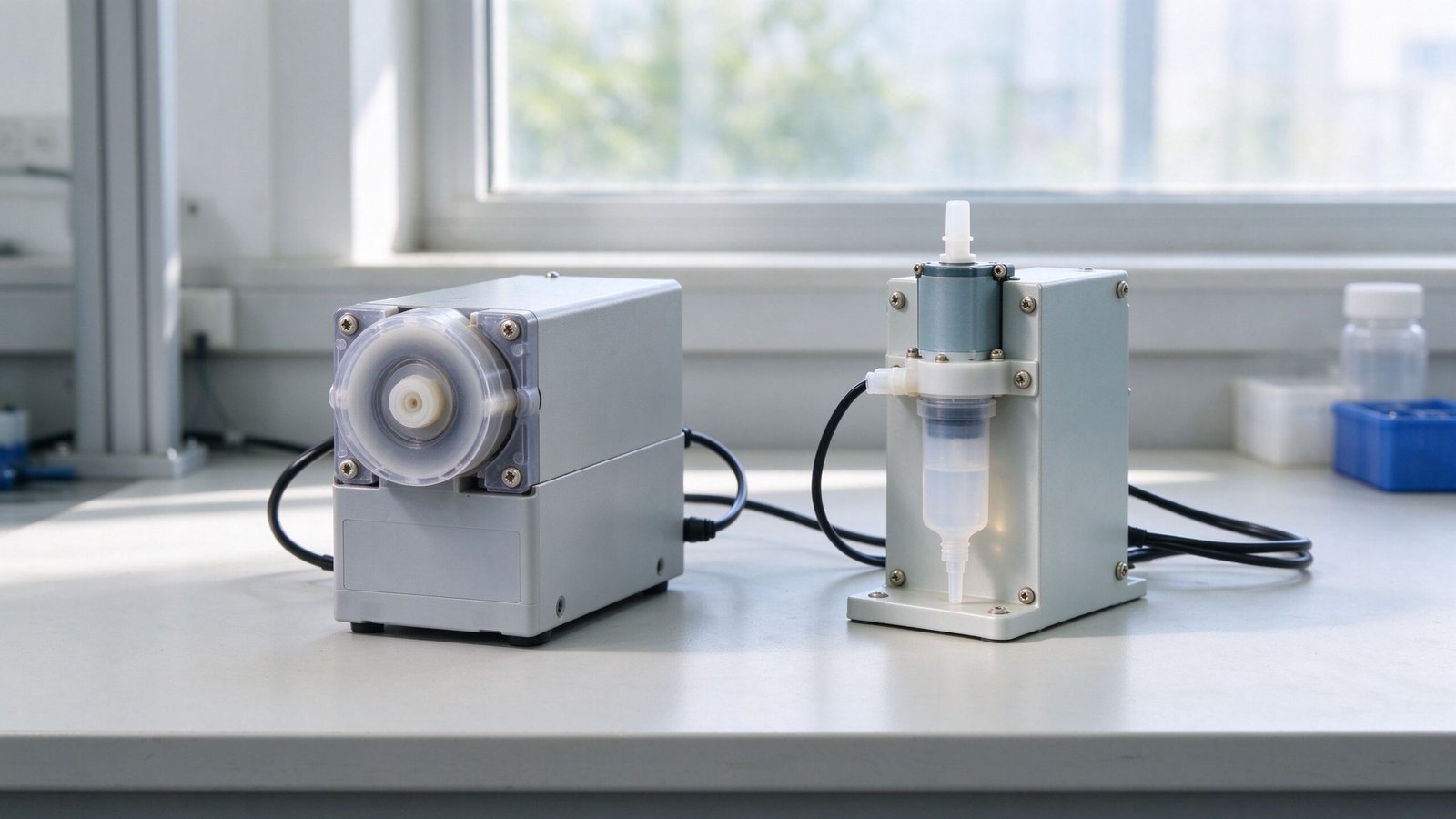
On a small chemical feed — pool chlorination, cooling tower biocide, pH adjustment, boiler treatment — the two pumps engineers reach for are the peristaltic and the solenoid-driven dosing pump. Both are cheap, both are positive displacement, both dose milliliters an hour. But they handle chemicals, run times, and maintenance very differently. This comparison lays out where each one fits, so you do not pick the cheapest on the shelf and regret it on a remote skid.
How Each Pump Doses
A solenoid-driven dosing pump pushes a diaphragm back and forth with an electromagnetic solenoid. Each pulse pushes a small, fixed slug of chemical out the discharge. The dose per pulse is set by the stroke length, and the rate by pulses per minute. It is a simple, cheap, proven design for water treatment. A peristaltic pump squeezes a flexible tube with a roller, delivering a continuous (though pulsing) flow whose rate is set by motor speed. Both are positive displacement, but the solenoid doses in discrete electrical pulses, while the peristaltic doses in continuous revolutions.
A 24V dosing pump on a small chemical skid is the peristaltic form factor. The peristaltic pump tube is the wetted path; on the solenoid pump, the wetted path is a diaphragm and check valves. The motor-driver operating manual covers the speed and pulse range where each design is a good fit.
| Attribute | Peristaltic | Solenoid dosing |
|---|---|---|
| Delivery | Continuous, motor-driven | Discrete electrical pulses |
| Wetted parts | Tube only | Diaphragm + check valves |
| Run dry | Yes | Yes (diaphragm not lubricated by fluid) |
| Adjustment | Speed, continuous | Stroke length + pulses/min |
| Cost (small) | Low to medium | Low |
Where Peristaltic Wins
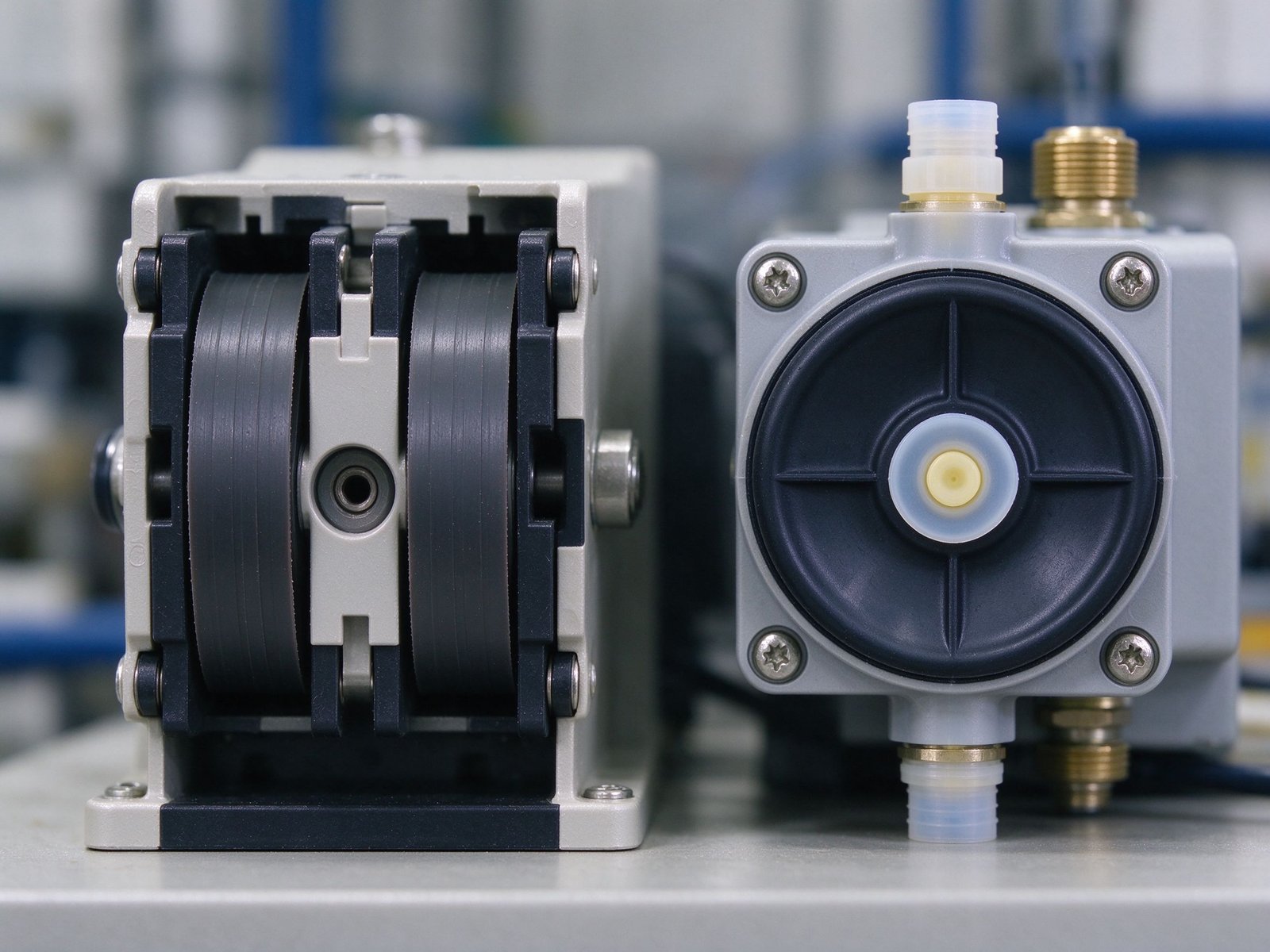
The peristaltic wins on fluids that are not clean water. Because the fluid only touches the tube, a corrosive chemical, a viscous liquid, or a slightly abrasive dispersion is handled by picking the right tube material. The solenoid’s diaphragm and check valves are wetted by the chemical, and check valves stick on anything that crystallizes, has solids, or is viscous. A peristaltic also delivers a smoother, more adjustable flow: turn the speed down and the flow turns down proportionally, with no minimum pulse rate to worry about. On a remote skid where the chemical drum can run dry, the peristaltic’s run-dry tolerance and easy tube swap are advantages. A 12V DC peristaltic pump on a remote chemical feed is a typical peristaltic choice.
The peristaltic also handles higher viscosity than a small solenoid pump, because the roller squeezes the tube closed regardless of how thick the fluid is. The solenoid’s check valves rely on the fluid being thin enough to seat cleanly. The NIST measurement practice point is the same for either: weigh the delivered volume on your chemical, because the catalog dose is on water.
Where Solenoid Dosing Wins
The solenoid dosing pump wins on price and on very small, fixed doses of clean water-based chemicals. It is the standard pool and cooling-tower pump for a reason: cheap, simple, and reliable on clean bleach or acid. It uses very little power, it tolerates mains voltage directly, and it has no tube to replace. On a clean-water chlorination duty where the chemical is fresh bleach and the duty is a few pulses a minute, the solenoid is hard to beat on cost.
But solenoid pumps have weak spots. The check valves stick if the chemical crystallizes or has solids. The diaphragm has a finite pulse life and eventually splits. The minimum dose is limited by the smallest stroke, so very small adjustments are coarse. And on a chemical that outgasses or vapor-locks, the solenoid loses prime because the check valves cannot self-prime the way a peristaltic can. The NSF engineering guidance on water treatment treats check-valve reliability as a maintenance line item, not a free feature.
| Duty | Pick peristaltic | Pick solenoid |
|---|---|---|
| Clean bleach / acid, low dose | OK | Cheaper, classic |
| Viscous or slightly abrasive chemical | Yes | No (valves stick) |
| Remote station, run-dry | Yes | OK but diaphragm wears |
| Continuous adjustable flow | Yes | Coarse pulse steps |
| Very low purchase price | No | Yes |
| Multi-chemical on one skid | Yes (tube swap) | No (valve maintenance) |
Maintenance and Consumables
A peristaltic has one cheap consumable: the tube. Swap it on a schedule, and the wetted path is new. A solenoid has two wear parts: the diaphragm and the two check valves. On a clean water duty those last a long time; on a crystallizing chemical they are replaced every few months. The peristaltic’s consumable is easier to change in the field, because a tube swap takes minutes and needs no tools beyond your fingers. A small peristaltic pump on a remote station carries a spare tube in the service bag; a solenoid carries spare valves and a diaphragm kit. When you price the two options over five years, do not forget to count those annual service visits on the solenoid, because they are what close the price gap.
| Wear part | Peristaltic | Solenoid |
|---|---|---|
| Consumable | Tube | Diaphragm + check valves |
| Field replacement | Minutes, no tools | Needs tools, careful reassembly |
| On crystallizing chemical | Swap tube | Clean or replace valves |
| Cost of consumable | Low | Low to medium |
Control and Signal Integration
On a modern skid, the pump has to accept a control signal, not just run at a fixed speed. A peristaltic on a peristaltic pump driver takes a 0-10V, PWM, or Modbus signal and varies the motor speed smoothly across the range, which lets a PLC or a controller dial the dose up or down continuously. A solenoid dosing pump takes the same signal types but adjusts the pulse rate and stroke length in steps; the turndown is coarser, and the lowest setting may still deliver a minimum pulse that is too large for a very small dose. On a closed-loop pH or chlorine controller, that continuous turndown matters, because the process needs small corrections, not on-off chunks.
For a remote station, the peristaltic’s low-voltage DC driver also fits a solar battery system cleanly, while a solenoid dosing pump usually runs on mains or a dedicated power supply. The signal integration on a remote solar skid is easier with a 12V or 24V peristaltic, because the same battery that runs the telemetry radio can run the pump.
| Control need | Peristaltic | Solenoid dosing |
|---|---|---|
| Continuous speed turndown | Smooth | Stepped pulses |
| Minimum dose adjustment | Fine | Limited by smallest stroke |
| 0-10V / PWM / Modbus | Common on driver | Available on premium models |
| Remote solar battery | 12V/24V friendly | Usually mains |
Common Questions
Which is more accurate on small doses? Both are repeatable to a few percent once calibrated. The peristaltic’s continuous speed adjustment is finer than the solenoid’s stroke-plus-pulse steps, so on a process that needs a smooth turndown, the peristaltic is easier.
Can a solenoid pump handle bleach? Yes, that is its classic duty, with the right head material. It is the check valves that need attention, not the diaphragm.
Which is quieter? A small peristaltic is quiet. A solenoid ticks on every pulse, which is audible in a quiet plant room.
Which uses less power? The solenoid uses very little power on intermittent pulses. The peristaltic’s motor draws more continuous current, but on a 12V battery system the difference is small, and the peristaltic’s smooth speed control often lets you run at the slowest speed that still hits the target dose, which keeps the average power draw low and the battery charge stretched through the night.
If you are choosing between a peristaltic and a solenoid dosing pump for a small chemical feed, send YOORAIN the chemical, the dose per day, the back-pressure, and whether the chemical crystallizes or has solids. We can recommend the pump type and size that fits the duty, and bench-test the delivered volume on your chemical before you commit. On a clean, cheap water-treatment duty, the solenoid wins on price; on a remote, slightly aggressive, or adjustable duty, the peristaltic wins on total cost and uptime.