
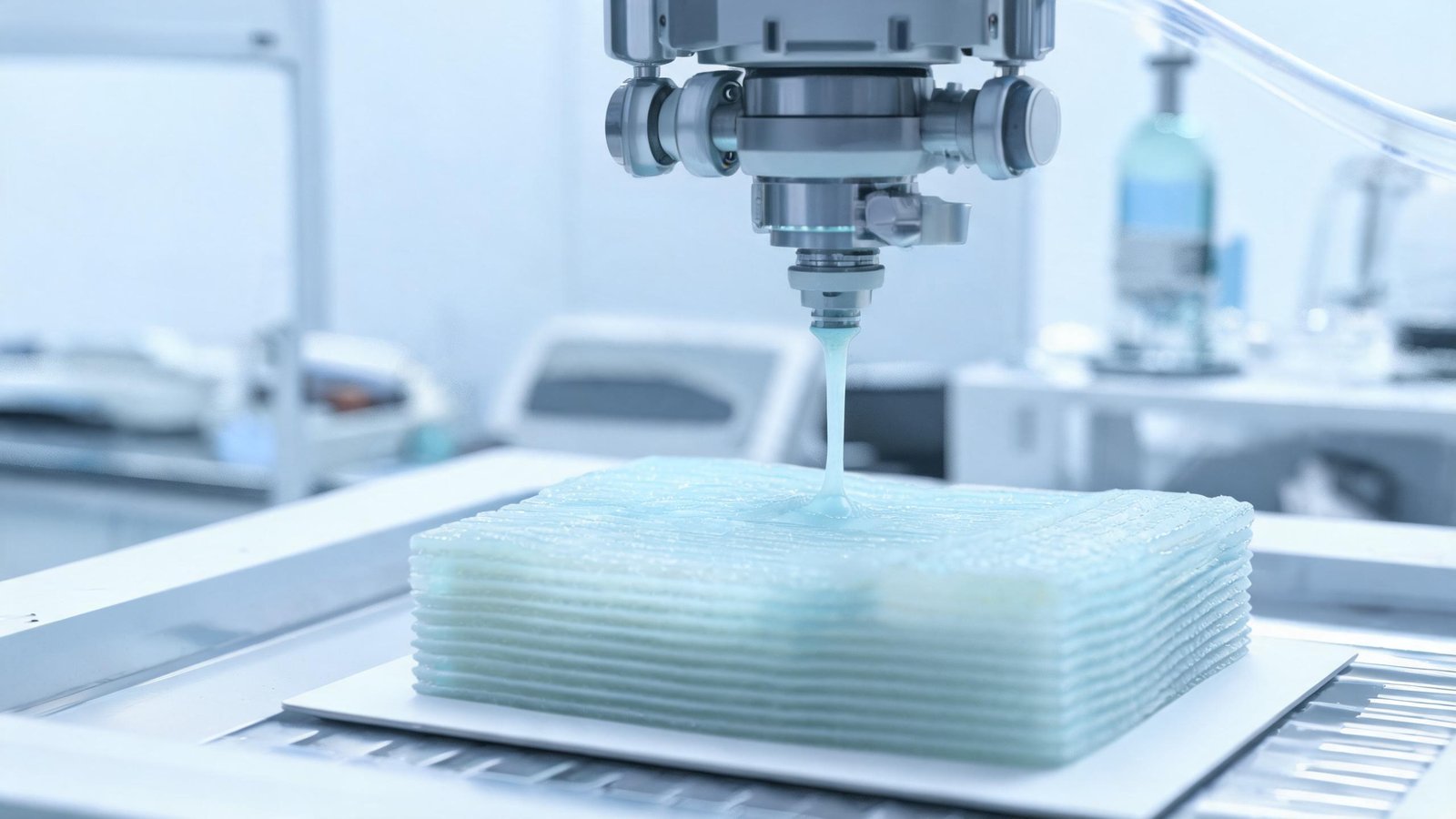
3D bioprinting equipment manufacturers need fluid handling systems that can extrude bioinks with viscosities ranging from water-like cell suspensions to thick hydrogels containing ceramic particles or collagen matrices. The pump must deliver material at controlled flow rates through fine nozzles without damaging living cells or denaturing proteins. Peristaltic pumps are increasingly used in bioprinting systems because they offer gentle positive displacement, easy sterilization by tube replacement, and straightforward integration into multi-material printing platforms. This buyer’s guide explains what bioprinting equipment developers should define before sourcing a peristaltic pump, how to compare pump specifications, and what to verify during supplier qualification.
What Buyers Should Define First
Before contacting pump suppliers, bioprinting equipment developers should document the following parameters:
- Bioink viscosity range: Cell-laden hydrogels typically range from 10 to 10,000 mPa·s depending on polymer concentration, crosslinking strategy, and cell density. Low-viscosity alginate solutions flow easily, while high-concentration collagen or decellularized extracellular matrix pastes require significantly more extrusion force.
- Target extrusion rate: Extrusion-based bioprinters dispense bioink at rates from 0.1 to 10 mL/min depending on scaffold size, nozzle diameter, and printing speed. The pump must provide stable flow across this range without pulsation that would create irregular strand diameters.
- Nozzle diameter: Fine structures require nozzles as small as 100 to 300 μm. The pump must generate sufficient pressure to push viscous material through these small orifices without causing cell lysis from excessive shear.
- Shear sensitivity: Mammalian cells experience shear stress when passing through narrow tubes and nozzles. Studies indicate that shear stress below 1,000 Pa preserves high cell viability for most cell types. The pump and tubing configuration should be selected to keep shear stress within acceptable limits.
- Sterility requirements: Bioprinting for regenerative medicine applications requires sterile fluid paths. Peristaltic pumps accommodate this by using sterilizable or disposable tubing rather than requiring autoclaving of the entire pump head.
Buyers who arrive at supplier discussions with these parameters defined receive more accurate recommendations and avoid costly prototyping iterations.
Comparing Pump Requirements
Not all peristaltic pumps suit bioprinting applications. Buyers should compare candidates across these dimensions:
| Requirement | Low-Viscosity Bioink | High-Viscosity Bioink | Pumping Implication |
|---|---|---|---|
| Viscosity | 10 to 500 mPa·s | 1,000 to 10,000 mPa·s | High-viscosity requires high-torque drive and reinforced tubing |
| Flow rate | 0.5 to 5 mL/min | 0.1 to 2 mL/min | Lower flow rates need fine-pitch tubing and precise motor control |
| Nozzle diameter | 200 to 500 μm | 300 to 800 μm | Smaller nozzles increase backpressure significantly |
| Cell density | 1 to 10 million cells/mL | 10 to 50 million cells/mL | Higher density increases viscosity and clogging risk |
| Shear concern | Moderate | High | Multiple rollers and larger tubing reduce peak shear |
A micro peristaltic pump with stepper motor control provides the fine flow resolution needed for low-viscosity cell suspensions and precise hydrogel deposition. For high-viscosity pastes, a small peristaltic pump with higher torque and larger tubing may be necessary to generate the required extrusion pressure without stalling.
The relationship between viscosity, nozzle size, and required pressure follows basic fluid mechanics. For a Newtonian fluid, the pressure drop through a cylindrical nozzle is proportional to viscosity, flow rate, and nozzle length, and inversely proportional to the fourth power of nozzle diameter. Doubling the nozzle diameter reduces the required pressure by a factor of sixteen. This explains why high-viscosity bioinks are typically printed through larger nozzles at lower speeds.
OEM Customization Considerations
Bioprinting equipment often requires pump configurations that differ from standard catalog products:
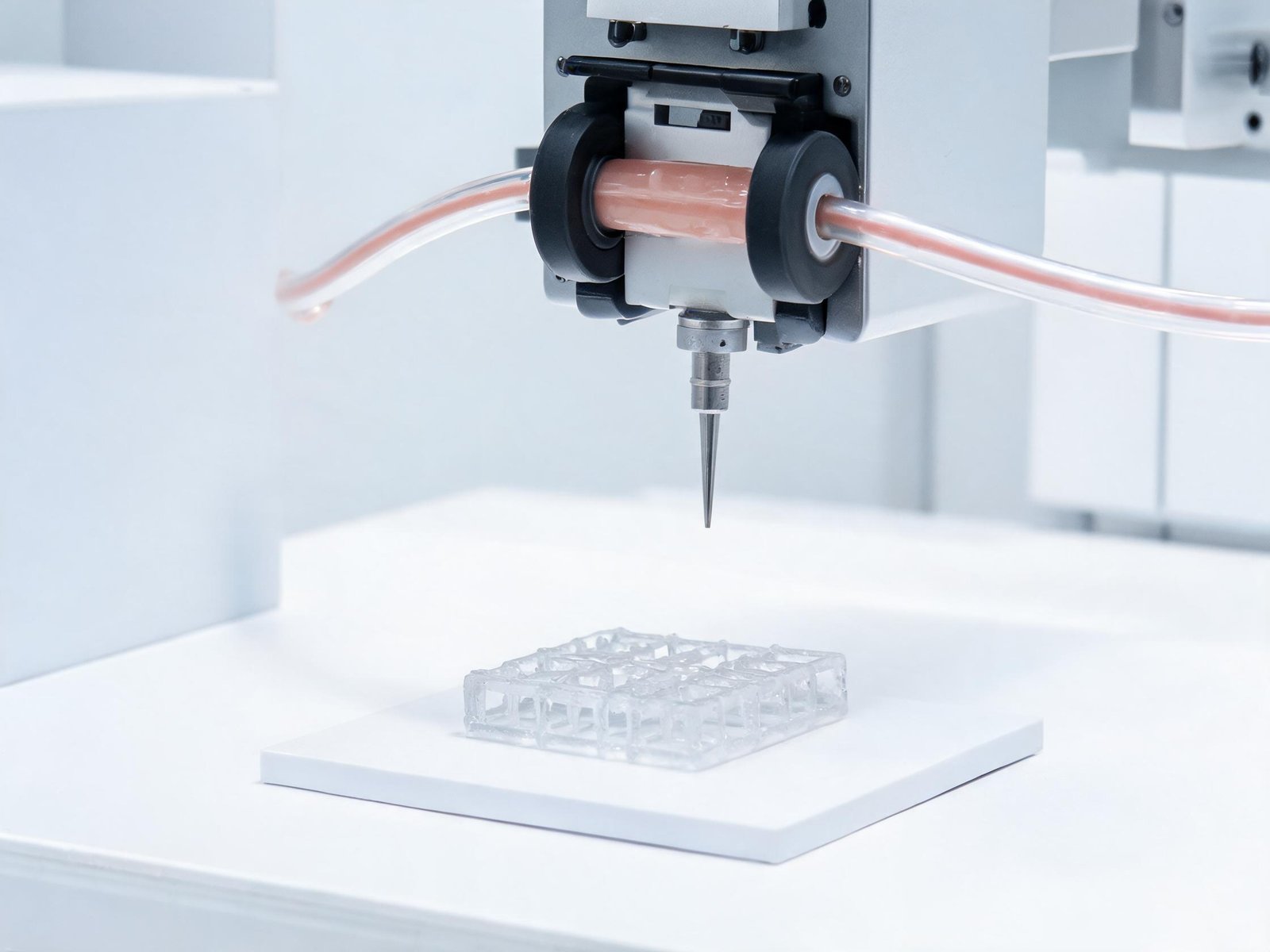
Multi-material printing: Advanced bioprinters deposit multiple bioinks, support materials, and crosslinking agents in a single construct. Rather than using multiple independent pumps, some OEMs prefer multi-channel pump heads driven by a single motor. The YZ15 easy-load peristaltic pump head accepts various tubing sizes and can be configured with multiple channels for synchronized multi-material extrusion.
Temperature control: Some bioinks require heated reservoirs or heated nozzles to maintain appropriate viscosity during extrusion. Gelatin-based bioinks, for example, remain liquid above 37°C and gel upon cooling. The pump tubing must withstand the elevated temperature without degradation. Silicone tubing maintains flexibility across a wide temperature range but may not resist certain bioink chemistries at high temperature.
Crosslinking integration: Many bioinks crosslink during or immediately after extrusion using ultraviolet light, ionic solutions, or enzyme catalysts. The pump must dispense the bioink accurately while the crosslinking agent is delivered through a separate channel. Coordinating the two flows requires precise timing control between the pump and the motion system.
Footprint and mounting: Bioprinters have limited space around the print head. Compact pump heads with flexible mounting orientations allow designers to position the pump remotely and route tubing through cable chains to the moving gantry.
Supplier Evaluation
Evaluating peristaltic pump suppliers for bioprinting applications requires going beyond catalog specifications:
Material documentation: Request certificates of analysis for tubing materials, particularly if the bioprinted constructs will be used for regenerative medicine applications. FDA guidance on tissue-engineered products emphasizes the importance of material traceability and biocompatibility. Suppliers should provide documentation that tubing materials meet ISO 10993 biocompatibility requirements for the intended contact duration.
Customization capability: Standard pumps may not meet all requirements. Ask whether the supplier offers custom tubing formulations, modified pump heads, or integrated control electronics. OEM suppliers who design pumps specifically for instrument integration typically provide 3D models, technical drawings, and application engineering support.
Production consistency: Bioprinting equipment manufacturers need pumps with consistent performance across production batches. Inquire about the supplier’s quality control processes, including motor torque testing, tubing dimensional verification, and final assembly testing. Suppliers with ISO 9001-certified manufacturing processes provide greater assurance of batch-to-batch consistency.
Technical support: Bioprinting is a specialized application. Suppliers with experience in medical device or laboratory instrumentation can offer relevant advice on tubing selection, motor sizing, and control integration. Generic industrial pump distributors may lack the specific knowledge needed for bioink handling.
Quality and Testing
Before committing to a pump for a bioprinting platform, buyers should conduct validation testing:
Flow accuracy testing: Measure the actual dispensed volume over a range of commanded volumes and flow rates. Use gravimetric measurement with a precision balance for volumes above 100 μL, and optical measurement or fluorescent tracer methods for smaller volumes. Accuracy should be verified with the actual bioink rather than water, because viscosity and non-Newtonian behavior affect slip and compression recovery in the tubing.
Cell viability testing: Pass cell-laden bioink through the pump and nozzle, then culture the cells to assess viability and proliferation compared to a control sample that did not pass through the pump. A reduction in viability of more than 10% relative to control indicates excessive shear or other mechanical damage.
Tubing life testing: Run the pump continuously with the actual bioink and measure flow rate drift over time. Bioinks containing cells or ceramic particles cause more rapid tubing wear than homogeneous polymer solutions. Establish a replacement interval that maintains accuracy within the application’s tolerance.
Sterilization validation: If the tubing will be sterilized by autoclave, gamma irradiation, or ethylene oxide, verify that the sterilization method does not alter tubing dimensions or mechanical properties. Changes in tubing inner diameter directly affect dispensing accuracy.
Buyer Checklist
Use this checklist when sourcing a peristaltic pump for a 3D bioprinting system:
- Document the complete bioink formulation including polymer type, concentration, cell density, and additives
- Measure bioink viscosity at the planned extrusion temperature using a rheometer
- Define the target extrusion rate range and nozzle diameter for each material
- Establish the maximum acceptable shear stress based on cell viability requirements
- Determine the number of simultaneous materials and whether multi-channel pumping is appropriate
- Specify temperature control requirements for the reservoir, tubing, or nozzle
- Request tubing material biocompatibility documentation and ISO 10993 test reports
- Obtain pump head dimensional drawings and verify fit within the instrument envelope
- Confirm the supplier offers application engineering support for bioprinting or medical device applications
- Plan flow accuracy, cell viability, and tubing life validation tests before design freeze
For OEM projects, providing the required flow range, pressure, tubing, and installation constraints can help suppliers recommend a suitable pump configuration.