
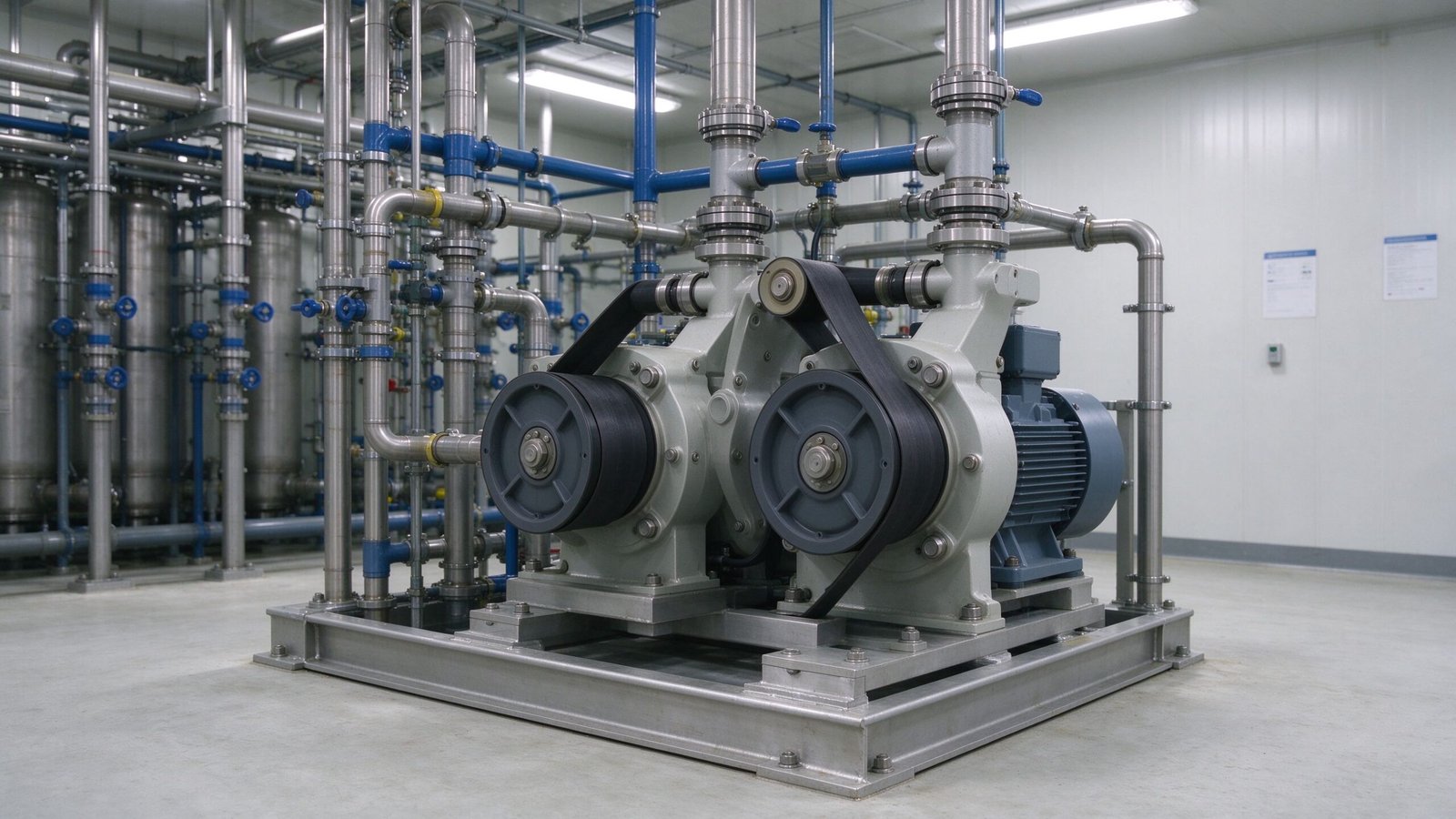
A pump that runs fine on an intermittent dosing cycle can overheat and fail within weeks when moved to a continuous circulation loop. The reason is rarely the motor nameplate; it is the duty cycle. A peristaltic pump generates heat two ways — the motor and drive, and the repeated compression of the tube against the rollers. On an intermittent duty, the head cools between shots. On continuous duty, that heat never leaves, the tube softens, and both the tube and the motor wear faster. This guide explains how duty cycle changes the sizing calculation, how to read the heat, and what to specify for a 24/7 dosing skid.
What Duty Cycle Actually Means for a Peristaltic Pump
Duty cycle is the fraction of time the pump is actually running, expressed as a percentage. A pump that runs 30 seconds every five minutes has a 10 percent duty cycle. A pump that runs nonstop has a 100 percent duty cycle. For most pumps this matters mainly for the motor, because a fan-cooled motor is designed to shed heat while turning. For a peristaltic pump it matters more for the tube, because every compression event deposits a little heat in the elastomer, and a low duty cycle lets that heat dissipate between events.
The mistake buyers make is treating the catalog flow number as if it were available 24 hours a day. The catalog flow is measured on a clean tube at a comfortable ambient temperature for a short run. On a continuous skid, the tube is warmer, slightly swollen by the fluid, and losing a few percent of its volume per revolution as it beds in. A pump sized to the catalog flow on a continuous duty will under-deliver within weeks. A peristaltic pump driver with a known speed and current draw is the tool that lets you see this, because the current rises as the tube heats and resists compression.
| Duty cycle | Typical use | Heat handling | Sizing approach |
|---|---|---|---|
| Intermittent, <20% | Batch dosing, shot feed | Cools between shots | Size to flow, check tube life |
| Moderate, 20-60% | Cyclic process, batch skid | Stays warm, reaches steady state | Derate speed 10-20% |
| Continuous, 100% | Circulation, continuous injection | Steady high temperature | Derate, larger head, cooler speed |
| 24/7 critical duty | pH control, reagent feed | Must stay near ambient | Oversize head, slow RPM |
Where the Heat Comes From
The motor and drive are the easier heat source to understand. A DC or gear motor turning under load dissipates waste heat through its body. If the motor is rated for intermittent duty, running it continuously overheats the winding. But the tube compression is the heat source people forget. Every roller pass flexes the elastomer, and elastomers are not perfect springs: a fraction of the flex energy becomes heat inside the material. The faster the pump runs, the more flex events per minute, and the hotter the tube gets.
This is why a pump at high RPM on intermittent duty feels fine, but the same pump at the same RPM on continuous duty runs too hot to hold. The flex events never stop, and the heat has nowhere to go. The material-fatigue principle described by the U.S. National Science Foundation’s engineering research applies directly: as the tube warms, its tensile strength drops, its resistance to grit drops, and its life drops nonlinearly. A tube that lasts months at a cool, low-speed intermittent duty may last days at a hot, high-speed continuous duty.
How to Measure the Heat on Your Skid
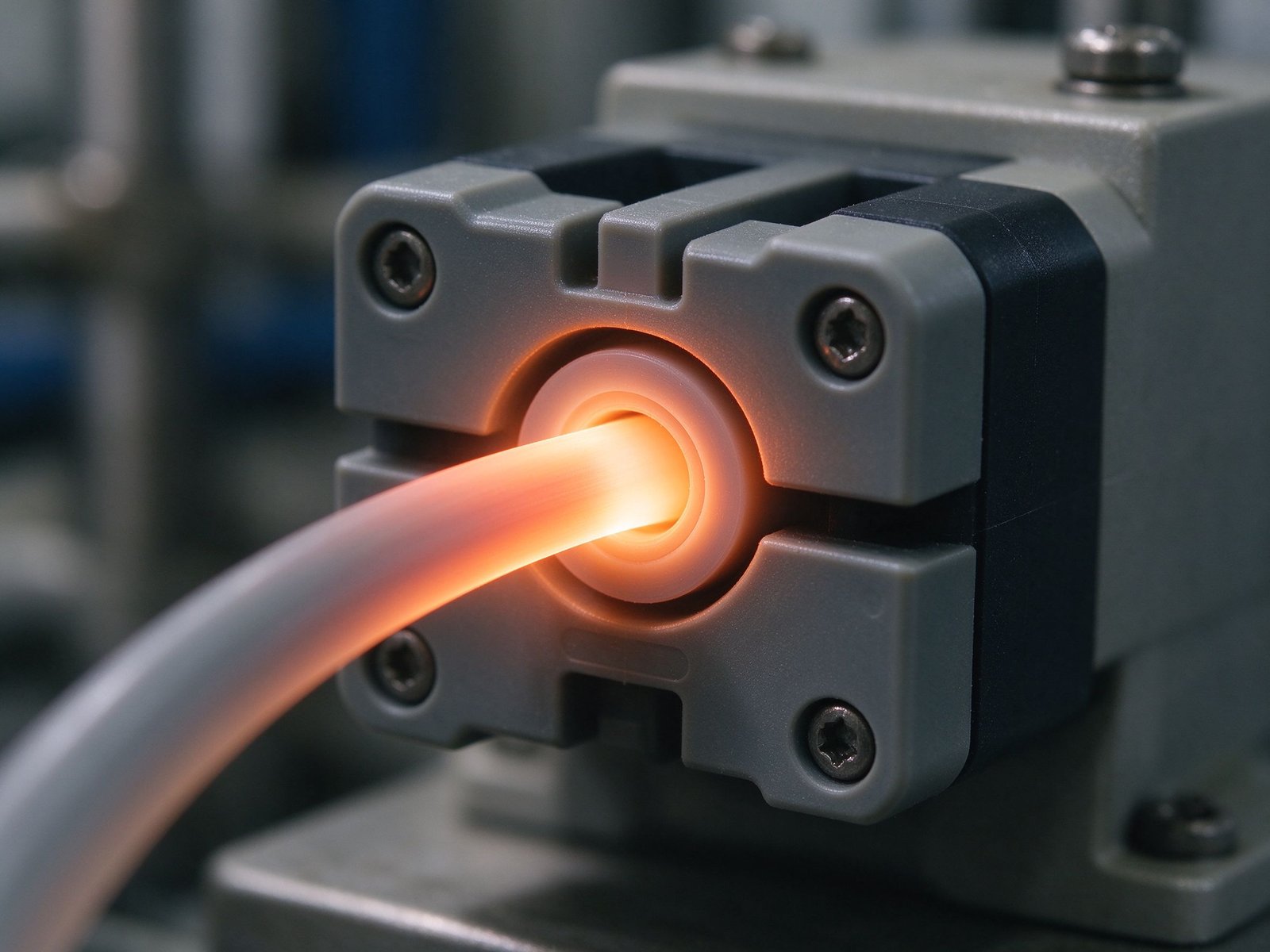
You do not need a laboratory. Run the pump on the actual duty for an hour, then touch the head and the motor. The rule of thumb: if the head is too hot to hold comfortably on the palm for three seconds, it is too hot for continuous duty and the tube will fail early. A small handheld infrared thermometer makes this objective; read the tube surface where it leaves the bed, not the metal cover. The point-of-use measurement approach, as described by NIST’s Physical Measurement Laboratory, is the same idea: measure the actual condition under duty, not the nameplate.
Watch the current draw on the driver. A tube that is warming and softening resists the rollers more, and the drive current rises. A rising current over the first hour, then stabilizing, is normal break-in. A current that keeps climbing after the first hour means the pump is running hot and the tube will fail. A 24V dosing pump with current readout makes this visible; on a small pump without a display, the hand test and the temperature check are the practical tools.
| Observation after 1 hour continuous | What it means | Action |
|---|---|---|
| Head near ambient, current stable | Good thermal margin | Runs as sized |
| Head warm but holdable, current stable | Marginal, acceptable | Monitor tube life |
| Too hot to hold, current climbing | Over duty cycle | Derate speed or upsize head |
| Motor hot, head cool | Motor undersized | Change motor/driver |
| Tube swells or softens | Heat plus chemical attack | Change tube material |
Sizing for Continuous Duty: The Derate Step
The fix for continuous duty is not a bigger motor of the same speed. It is a larger head turning more slowly. A larger head moves more fluid per revolution, so the pump reaches the required flow at a lower RPM. Lower RPM means fewer flex events per minute, less heat per minute, and a tube that lives longer. The motor also runs cooler, because it is not working hard to fight a high-speed tube.
A practical starting point: for 100 percent duty, derate the catalog flow by 20 to 30 percent and upsize the head so the operating RPM sits in the lower half of the head’s range. If the required flow is 500 mL/min and a small head delivers 600 mL/min at its top speed, do not run that small head at 500 mL/min continuously. Move to a head that delivers 600 mL/min at half its top speed, and run it there. The large-flow peristaltic pump line is built for this kind of low-RPM continuous duty, and the speed-setting approach in the motor-driver operating manual describes how to confirm the operating RPM under load.
Worked Example: Replacing an Intermittent Pump with a Continuous One
A plant has a small pump that doses 500 mL of reagent per hour, 24 hours a day, into a neutralization tank. The original pump was sized to 500 mL/min and runs at about half its top speed on an intermittent skid. On the continuous skid it overheats within a week, the tube swells, and the dose drifts. The required hourly volume is 500 mL per hour, which is under 9 mL per minute — a very small flow.
The correct solution is not a smaller pump at high speed. It is a head that delivers, say, 50 mL per minute at half its top speed, turned down to deliver 9 mL per minute at a low, cool RPM. The tube flexes once or twice per second instead of ten times per second, the head stays near ambient, and the tube life stretches from days to the expected interval. A small peristaltic pump with the right head and a slow, controlled driver handles this easily; the failure was the high-RPM intermittent-sized pump on a continuous duty.
| Parameter | Wrong (intermittent-sized, continuous) | Right (derated, larger head, slow RPM) |
|---|---|---|
| Required flow | 500 mL/hour (9 mL/min) | 500 mL/hour (9 mL/min) |
| Head delivery at chosen RPM | 500 mL/min at high RPM | 50 mL/min at low RPM |
| Operating RPM | High, near top | Low, lower half of range |
| Flex events per minute | High | Low |
| Head temperature after 1 hour | Too hot to hold | Near ambient |
| Tube life | Days | Expected interval |
Ambient Temperature Derating
The derate step compounds with ambient temperature. A plant room at 35 C (95 F) has less ability to shed heat than a lab at 20 C. In a warm plant, near a heater or a summer wall, apply an extra 10 to 20 percent derate, and choose a tube material that tolerates the warm condition. A tube rated for 20 C duty will not live as long at 40 C. This is the same elastomer fatigue curve that material references describe, and the conservative move is to assume the worst-case room temperature, not the reading on a cool spring day.
For outdoor or unheated installations, the opposite problem appears: a tube that is too cold becomes stiff and does not seal. A 12V DC peristaltic pump in a remote cabinet in winter needs a tube material that stays flexible at the coldest expected temperature, not one that hardens and slips. Both ends of the temperature range are duty-cycle sizing questions, not just tube-material questions.
Thermal Protection and Failure Signals
On a critical continuous skid, ask for a driver with a thermal cutout or a current-limit that alarms before the motor or tube is damaged. A pump that keeps running into a stalled or over-compressed head draws high current, heats the motor, and eventually fails. A current-limit that trips on over-current is a cheap insurance. For unattended remote skids, a dry-run or blockage alarm that shuts the pump before the tube burns through is worth more than the pump itself, because a failed tube in a remote cabinet can leak reagent over the controls.
| Protection feature | What it prevents |
|---|---|
| Thermal cutout in motor | Winding burn-out on continuous duty |
| Over-current trip | Stalled head, over-compressed tube |
| Dry-run detection | Run-dry heating on suction loss |
| Temperature alarm on head | Early warning before tube failure |
| Watchdog / duty counter | Reminds of tube change by cycles |
Tube Choice on Continuous Duty
On continuous duty, the tube material matters more than on intermittent duty, because the heat plus the chemical exposure together age the elastomer faster. A tube that is fine on a 10 percent duty cycle may not be the right choice on 100 percent. Match the tube to both the chemistry and the temperature, and accept that on continuous duty the tube change interval will be shorter than the catalog estimate. A peristaltic pump tube chosen for continuous chemical service should be the material that stays flexible and resistant at the warm operating temperature, not just the cheapest option that works on the bench.
Suction Side and Run-Dry on Continuous Duty
Continuous duty puts a different kind of stress on the suction side. A pump that runs nonstop spends its whole working life pulling fluid through the suction line, and any air leak or blockage shows up immediately as a weak, pulsing delivery. On intermittent duty, a small air leak is hidden between shots; on continuous duty it is visible as a steady stream of bubbles. Keep the suction line short, the barbs tight, and the foot strainer clean. A peristaltic pump tolerates run-dry far better than a seal pump, but that does not mean you should run it dry — a dry tube flexes against air and heats faster, because there is no fluid to carry heat away from the wall.
On a continuous skid that pulls from a drum, install a low-level switch that stops the pump when the drum is empty. A pump that keeps turning on an empty drum is not damaged, but it is delivering nothing while the process continues, and the downstream concentration drifts. A low-level alarm also tells the operator when a drum change is due, which prevents the most common cause of unplanned dosing gaps.
Redundancy: Two Small Pumps vs One Big Pump
For a critical continuous duty, the sizing question is not only about heat; it is about availability. One large pump running at a comfortable slow RPM is efficient, but when the tube needs changing the whole skid stops. Two smaller pumps, each sized for half the flow and run in parallel with an automatic switchover, let one pump run while the other is serviced. Each smaller pump runs at a moderate duty cycle and stays cool, and the plant never has to choose between maintenance and production.
This is a common setup on pH control, reagent feed, and any skid where a missed dose upsets a downstream process. The cost of two small pumps is modest compared with the cost of an unplanned outage, and the duty cycle on each unit is gentler than on one oversized unit. The driver controls for the lead and lag pumps, and the switchover happens on a timer or on a low-level alarm.
| Setup | Pros | Cons |
|---|---|---|
| One large pump, slow RPM | Efficient, simple, low cost | Skid stops for tube change |
| Two small pumps, lead/lag | Continuous coverage, gentler duty | Higher cost, more controls |
| One small pump, spare on shelf | Lowest cost | Manual swap, downtime |
Discharge Back-Pressure on Continuous Duty
A continuous skid often pushes fluid through a filter, a long line, or a back-pressure valve, and that back-pressure adds to the tube’s workload. The rollers have to seal against not only the tube but also the pressure behind it, and the flex energy rises. On a long discharge line, add a pressure relief or a bypass that returns fluid to the tank if the line blocks, so the tube is not fighting a dead-ended line. This is not a peristaltic-specific concern; it is a pumping concern that the continuous-duty sizing must account for.
Check the discharge pressure by reading the line gauge at the farthest normal operating point, and size the tube and head to that pressure, not to the tank level alone. A pump that runs against high back-pressure wears the tube faster, and the heat from that extra work is part of the duty-cycle equation. The controlled speed and current feedback described in the driver references make this visible: if the current rises when the filter clogs, the pump is working harder and the tube is taking more heat.
Common Questions
Can I run an intermittent-duty pump continuously if I slow it down? Sometimes, but only if the motor itself is rated for continuous service. Slowing the tube flex helps the tube, but the motor winding still needs to shed heat. Check the motor duty rating; if it is marked intermittent, do not rely on slow RPM to make it continuous. A continuous-rated motor with a slow, larger head is the correct answer.
How often should I change the tube on a 24/7 skid? Track cycles or run time, not the calendar. Start with the supplier’s recommended interval for the chemistry and temperature, then shorten it based on what you observe. A tube that is swelling, hardening, or losing delivery before the interval means the duty is hotter or more aggressive than assumed, and the interval should move earlier.
Is a cooling fan or vent required? In a warm cabinet, yes. A small vent or fan that moves plant air over the head and motor extends life. Sealing the cabinet for dust while also trapping heat is a common mistake; the pump needs both dust protection and cooling air.
Procurement Checklist
When specifying a peristaltic pump for continuous duty, ask the supplier for the operating RPM at the required flow on the actual head, the motor duty rating, the expected tube life on your chemistry at your warmest ambient, and whether the driver has over-current and thermal protection. Reject a sizing based only on the catalog maximum flow. The useful answer is the flow at a slow, cool RPM on a continuous-rated head and motor. Bench-test the pump on your fluid for a full shift, read the head temperature and the current, and confirm the dose holds before putting the skid into service.
If you are sizing a peristaltic pump for a 24/7 dosing skid and want a derated, low-RPM recommendation, contact YOORAIN with the required flow, the fluid, the warmest ambient temperature, and the duty cycle. We can match a head, tube, and continuous-rated driver that stays cool on your actual duty and give you the expected tube-change interval.