
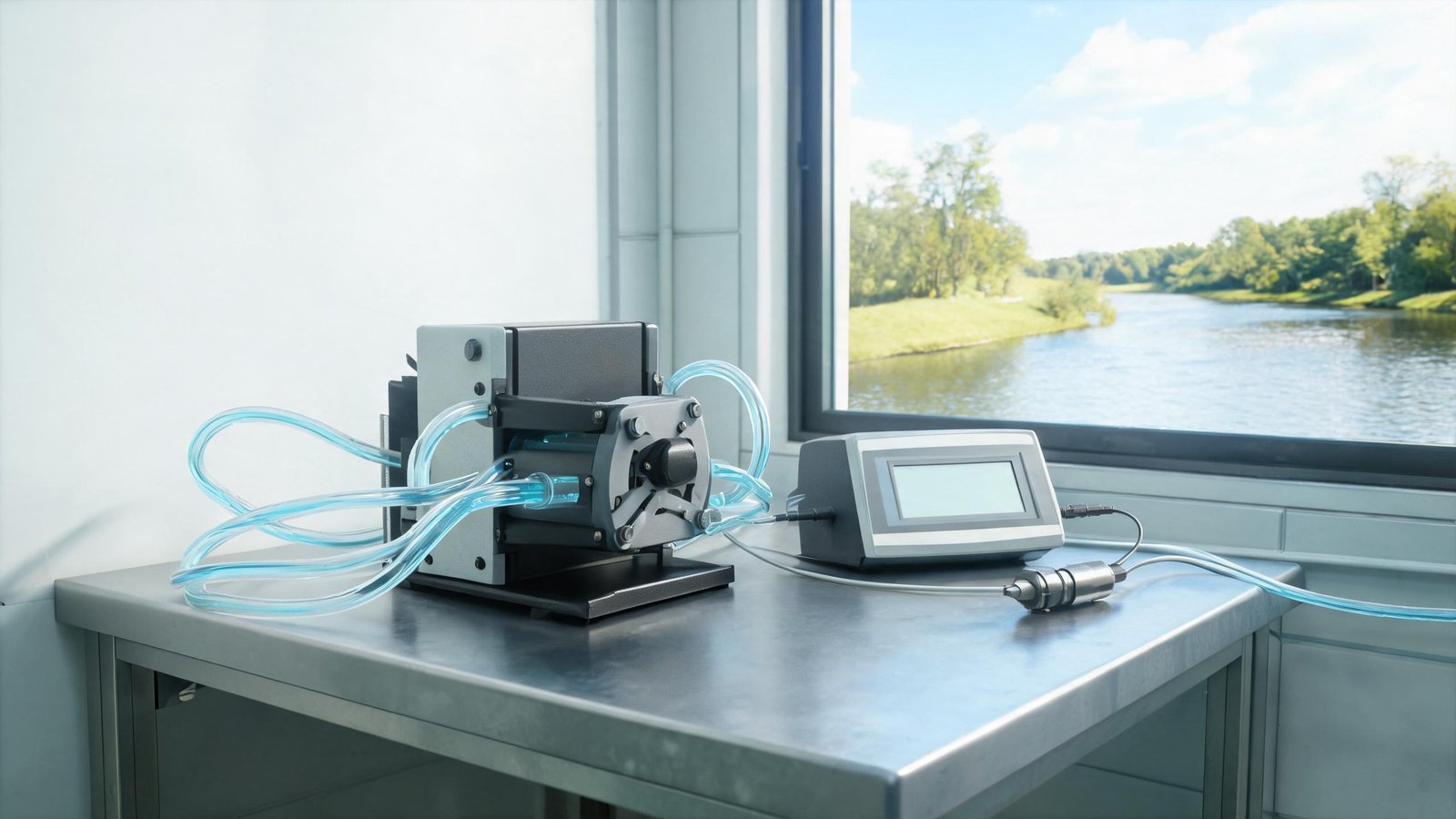
Environmental monitoring instrument manufacturers face a distinct set of fluid-handling constraints. The pump must pull representative water samples from rivers, lakes, wastewater outfalls, or industrial process lines, deliver consistent volumes for analysis, and withstand variable field conditions including temperature swings and intermittent power. Peristaltic pumps are widely used in these systems because the fluid contacts only the tubing bore, eliminating cross-contamination between sampling events and simplifying maintenance for field technicians.
However, selecting a small peristaltic pump for environmental monitoring equipment involves more than matching a flow rate. Suction lift, tubing durability, motor type, and control method all influence whether a pump performs reliably over months of unattended operation. This guide examines why peristaltic pumps suit water sampling applications, what requirements matter most, and what OEM designers should evaluate when specifying a pump for monitoring instruments or automatic samplers.
Why Peristaltic Pumps Fit Environmental Monitoring
Water sampling and environmental monitoring applications share a core requirement: the sample must remain representative from the point of collection to the analytical sensor or collection bottle. Any pump mechanism that introduces seals, valves, or dead zones can trap residual fluid from a previous sample, compromising the next measurement.
Peristaltic pumps address this through tubing-based fluid transfer. Rollers or shoes compress a flexible tube against the pump housing, pushing a discrete volume of fluid forward with each rotation. Because nothing but the tubing wall touches the sample, cross-contamination is limited to tubing rinsing, and the entire fluid path can be replaced during routine maintenance by changing the tube segment.
This design offers several practical advantages for monitoring equipment:
- Self-priming capability. Peristaltic pumps can draw fluid from a level below the pump inlet, which matters when sampling from surface water bodies or below-grade discharge points.
- Dry-running tolerance. If the sample line runs dry during probe placement or low-flow conditions, the pump can continue operating without immediate damage.
- Reversible flow. The same pump can flush sample lines by reversing direction, reducing the number of valves needed in the fluid circuit.
- Simple field maintenance. Tube replacement requires no tools on many pump head designs, which matters for technicians servicing equipment at remote monitoring sites.
Regulatory frameworks such as the U.S. Clean Water Act and EU Water Framework Directive drive demand for continuous and event-based water quality monitoring, creating ongoing volume for instrument OEMs that specify reliable pump systems. The EPA summary of the Clean Water Act outlines the discharge monitoring and reporting requirements that industrial and municipal facilities must meet, many of which depend on automated sampling equipment.
Main Fluid-Handling Requirements
Environmental monitoring covers several deployment scenarios, each with different pump demands. Bench-top laboratory analyzers have stable conditions, while field-deployed samplers face temperature variation, debris-laden water, and limited power. Before selecting a pump, define which of the following requirements apply to the target application.
| Requirement Category | What to Define | Why It Matters for Monitoring Equipment |
|---|---|---|
| Flow rate range | Minimum and maximum volume per sample, fill time per bottle | Determines pump size, motor speed, and tubing diameter selection |
| Suction lift | Vertical distance from water source to pump inlet | Affects whether the pump can prime reliably and maintain consistent flow |
| Sample integrity | Allowable carryover between samples, required rinse volume | Tube bore smoothness and pump dead volume affect cross-contamination risk |
| Operating environment | Temperature range, humidity, exposure to dust or water spray | Influences motor rating, housing material, and tubing life expectations |
| Power source | AC mains, DC battery, or solar-charged system | Determines motor voltage selection and power budget allocation |
| Duty cycle | Frequency of sampling events, daily runtime, total expected life | Affects tubing replacement intervals and motor durability requirements |
For automatic samplers used in NPDES compliance monitoring, consistency between sampling events is critical. The EPA NPDES permit program requires facilities to monitor discharge characteristics according to specified methods, and sample collection accuracy is a foundational part of the measurement chain.
Pump Selection Considerations
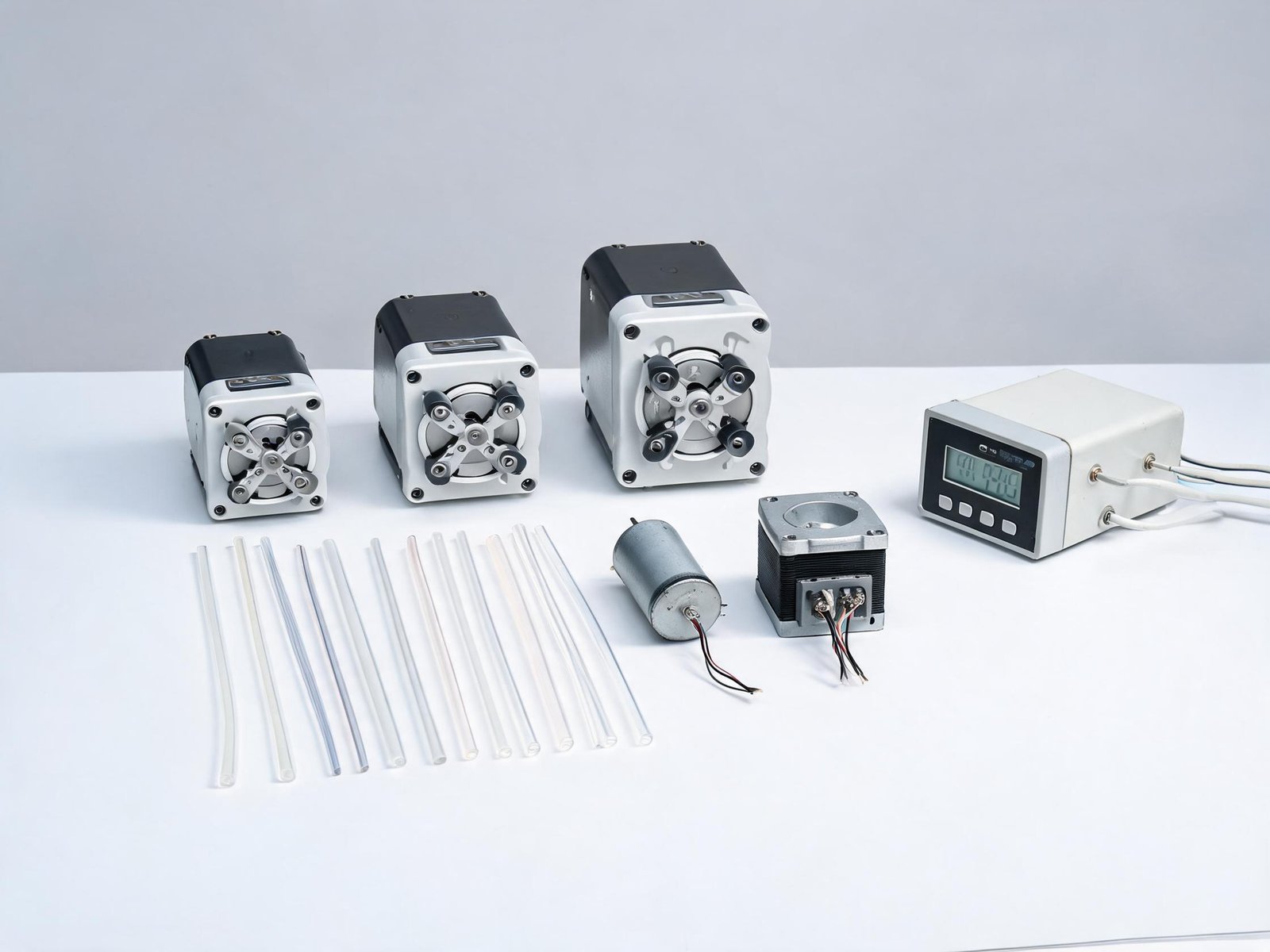
Once the application requirements are clear, evaluate pump options against the following selection factors. For most environmental monitoring instruments, the choice comes down to pump head style, motor type, and tubing compatibility.
Pump Head Style
Two pump head categories are common in monitoring equipment: easy-load designs with a single roller or shoe assembly, and multi-roller heads with 2, 3, or more rollers. Easy-load heads such as the YZ15 easy load peristaltic pump head simplify tube replacement, which is valuable for field-maintained equipment. Multi-roller heads produce lower pulsation at the cost of more complex tubing installation.
Flow Range and Tubing Size
The required sample volume and collection time determine the necessary flow rate. A composite sampler filling 500 mL bottles over several minutes has different needs than a continuous analyzer pulling a few milliliters per minute through a sensor flow cell. Tubing inner diameter is the primary variable affecting flow per revolution.
For compact instruments such as portable water quality analyzers, a peristaltic pump with housing provides a self-contained assembly that mounts directly to the instrument chassis. For larger automated samplers with higher flow requirements, a K25 small peristaltic pump paired with appropriate tubing delivers the necessary volume within a compact footprint.
Motor Type
The motor selection affects accuracy, power consumption, and control flexibility:
| Motor Type | Typical Use Case in Monitoring | Key Advantage |
|---|---|---|
| DC brushed motor | Portable samplers, battery-powered field units | Low cost, simple speed control with PWM or voltage adjustment |
| Stepper motor | Laboratory analyzers, precision dosing samplers | Repeatable volume dispensing, digital position control |
| Brushless DC (BLDC) | High-duty-cycle continuous monitors | Long service life, low electrical noise, reduced brush wear |
Battery-powered or solar monitoring stations should pay close attention to motor efficiency. Pump power consumption directly affects battery size, solar panel rating, and the number of sampling events possible between charges.
Tubing Material Compatibility
Environmental samples can contain oils, detergents, mildly corrosive chemicals, or organic matter. The peristaltic pump tubing material must resist swelling, degradation, and permeation from the expected sample matrix. Silicone works well for aqueous samples but can swell in contact with certain hydrocarbons. For more aggressive sample streams, consult the tubing supplier’s compatibility chart before finalizing the design.
For regulatory monitoring where sample integrity is audited, tubing that meets relevant food-contact or biocompatibility standards may be required, even for environmental samples, to avoid leaching contaminants that could interfere with analytical methods such as TOC or trace metal analysis.
Common Design Problems
OEM teams new to peristaltic pump specification often encounter predictable issues during prototype testing. Addressing these during the design phase reduces field service calls and improves instrument reliability.
Insufficient suction lift. Peristaltic pumps have practical suction limits determined by tubing stiffness, pump speed, and fluid vapor pressure. If the monitoring station must draw water from several meters below the pump, verify the pump’s priming capability at the expected ambient temperature range. Cold water has lower vapor pressure, which helps, but cold tubing is stiffer and may not fully recover between roller passes, reducing effective suction.
Tubing fatigue in continuous duty. In 24/7 monitoring applications, tubing undergoes repeated compression cycles. Over time, the tube wall loses resiliency and flow rate drifts. Design the instrument with accessible tubing that can be replaced during routine maintenance, and include calibration procedures that detect flow drift before it affects sample accuracy.
Particulate damage. Environmental water samples often contain sediment, algae, or small debris. While peristaltic pumps can pass soft particles better than gear or diaphragm pumps, sharp or abrasive particles accelerate tubing wear. Adding an inline strainer at the sample probe extends tube life and prevents large particles from lodging in pump components.
Temperature effects on accuracy. Tubing flexibility changes with temperature, which means a pump calibrated at 25°C may deliver a different volume at 5°C or 40°C. For field-deployed instruments with wide operating temperature ranges, periodic calibration or a gravimetric verification routine helps maintain sampling accuracy. The NIST Fluid Metrology Group provides reference information on flow measurement principles and calibration standards relevant to liquid volume accuracy.
Integration Into Monitoring Equipment
Integrating a peristaltic pump into an environmental monitoring instrument involves mechanical, electrical, and fluidic design decisions. The following considerations help OEM teams avoid integration delays.
Mechanical mounting. Determine whether the pump mounts directly to a chassis panel, uses bracket hardware, or sits inside a pump module assembly. Enclosed pump designs with mounting flanges simplify installation and protect the rotor and tubing from dust and moisture. For outdoor or wash-down environments, verify the motor and housing rating against the expected exposure level.
Control interface. Define how the instrument controller communicates with the pump. Simple on/off control works for basic samplers that run at a fixed speed. More sophisticated instruments use variable speed control for adjustable fill rates or stepper motor control for precise volume dosing. RS-485 or analog control inputs allow the main controller to adjust flow rate dynamically.
Fluidic connections. Specify the tubing connection method at both the inlet and outlet sides. Barbed fittings are common and cost-effective, but ensure the barb size matches the tubing inner diameter to avoid leaks or tube blow-off under pressure. For applications where technicians swap tubing in the field, quick-connect fittings reduce replacement time and improve consistency between service events.
Calibration and validation. Every monitoring instrument should include a calibration procedure that lets users verify the actual dispensed volume against a reference. Gravimetric calibration—weighing the dispensed water on a precision balance—provides the most straightforward verification method. For continuous monitoring systems, schedule periodic flow verification as part of the maintenance plan.
Environmental monitoring equipment shares many design considerations with water treatment dosing systems, where accurate fluid transfer and reliable operation under variable conditions are equally important. Readers interested in broader water industry applications can refer to this overview of peristaltic pumps in the water treatment industry. Across the Atlantic, the EU water policy framework sets similar monitoring obligations for member states, creating a global market for instrument manufacturers that can meet both U.S. and European regulatory expectations.
Engineering Checklist
Use this checklist when specifying a peristaltic pump for environmental monitoring or water sampling equipment:
| Check Item | Confirmation | Notes |
|---|---|---|
| Flow rate range | Minimum and maximum flow match application requirements | Include margin for tubing wear and temperature effects |
| Suction lift capability | Pump can reliably prime from maximum source depth | Test at lowest expected temperature |
| Tubing material | Compatible with sample matrix and expected contaminants | Request compatibility data from supplier |
| Motor type | Matches accuracy, power, and durability requirements | Consider duty cycle and power source |
| Pump head style | Easy-load for field maintenance, multi-roller for low pulsation | Match to service model and application |
| Control interface | Pump control method compatible with instrument electronics | Define analog, digital, or serial control early |
| Mounting envelope | Pump fits within available mechanical space | Include tubing connection clearance |
| Tubing replacement | Tube access allows service without disassembly | Critical for field-deployed instruments |
| Calibration method | Procedure defined for verifying dispensed volume | Gravimetric method recommended |
| Environmental rating | Motor and housing rated for deployment conditions | Temperature, humidity, and ingress protection |
If you are developing environmental monitoring equipment, automatic water samplers, or field-deployed analytical instruments, you can contact YOORAIN to discuss the fluid-handling requirements of your system. Providing the required flow range, suction lift, tubing compatibility needs, and operating environment helps suppliers recommend a pump configuration that matches the application.