
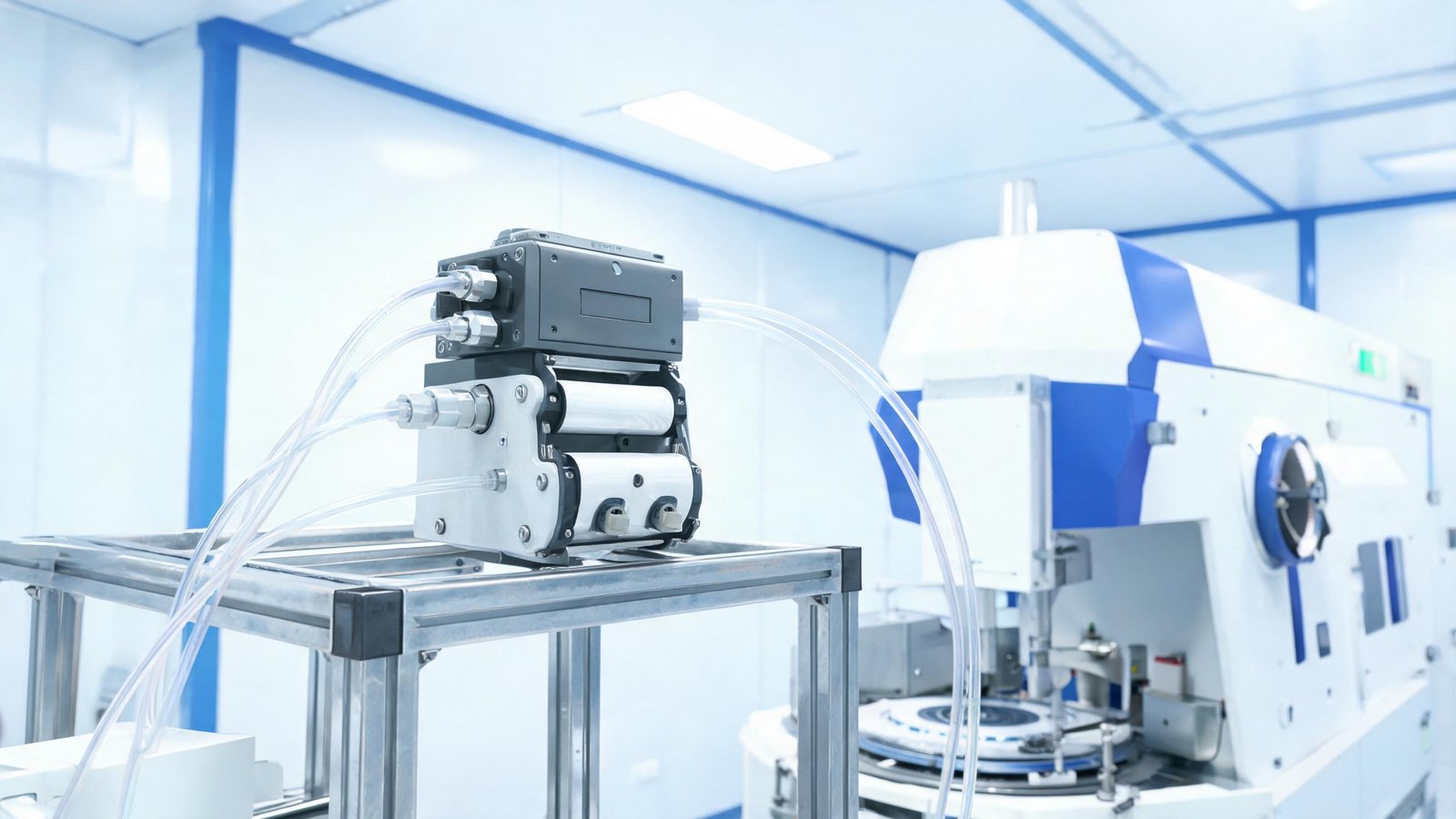
Semiconductor manufacturing involves hundreds of fluid transfer steps, many of which require precise chemical dosing in cleanroom environments. Engineers selecting pumps for wet benches, CMP stations, and photoresist lines face a specific set of constraints: the fluid must not contact pump seals or valves, the dosing accuracy must remain stable across varying viscosities, and the wetted materials must survive aggressive chemistries including acids, solvents, and slurries. Peristaltic pumps address these constraints because the fluid travels entirely inside a replaceable tube, eliminating seal wear and cross-contamination between batches. This article explains the engineering factors that determine whether a peristaltic pump fits a semiconductor chemical dosing application and how to specify the right configuration.
What Semiconductor Wet Processes Require
Semiconductor fabs use peristaltic pumps in several process areas:
- Wet bench chemical delivery: Transfer of acids, bases, and solvents for wafer cleaning, etching, and stripping. Common chemistries include sulfuric acid, hydrogen peroxide, ammonium hydroxide, and hydrofluoric acid mixtures.
- CMP slurry handling: Controlled feed of abrasive slurries containing colloidal silica or alumina particles for chemical mechanical planarization. The pump must handle moderate viscosity and particle-laden fluid without clogging.
- Photoresist and developer delivery: Low-pulsation dispensing of photoresists, developers, and rinse solutions onto wafer spin coaters or in developing tracks.
- Waste collection and neutralization: Transfer of spent chemicals to waste handling or neutralization systems where chemical compatibility and containment are critical.
Each application imposes different requirements on flow rate, pressure, pulsation, and materials. A wet bench sulfuric acid line may need continuous flow at several liters per minute with fluoropolymer tubing, while a photoresist dispenser may need microliter-level accuracy with minimal pulsation.
Key Pump Selection Factors
Selecting a peristaltic pump for semiconductor manufacturing requires evaluation across six main areas:
| Selection Factor | What to Check | Why It Matters |
|---|---|---|
| Flow rate range | Required minimum and maximum flow for the process step | Determines pump head size, tubing diameter, and motor specification |
| Chemical compatibility | Tube material resistance to acids, bases, solvents, and slurries | Prevents tube degradation, chemical leakage, and process contamination |
| Pulsation | Acceptable flow variation for the application | Photoresist lines need smooth flow; waste lines tolerate more pulsation |
| Pressure requirement | System backpressure including filters and vertical lifts | Affects tubing wall thickness, pump head design, and motor torque |
| Cleanroom compatibility | Particle generation, outgassing, and material cleanliness | Semiconductor fabs operate at ISO Class 3-5; pump materials must comply |
| Control interface | Analog, digital, or fieldbus integration with the tool controller | Modern fabs require SECS/GEM or EtherNet/IP compatibility for tool automation |
Engineers should define these parameters in the tool specification before approaching pump suppliers. Vague requirements such as “chemical resistant” are not sufficient; the specific chemistry, concentration, temperature, and exposure time must be documented.
Flow and Pressure Considerations
Peristaltic pumps generate flow by compressing tubing with rotating rollers or shoes. The flow rate depends on the tubing inner diameter, pump speed, and the number of rollers. In semiconductor applications, the required flow range varies significantly:
- Wet bench chemical delivery: 0.5 to 10 L/min
- CMP slurry feed: 0.1 to 5 L/min
- Photoresist dispensing: 1 to 100 mL/min
- Waste collection: 2 to 20 L/min
The pump must be sized to operate in the middle 60% of its speed range for stable flow. Operating at the extreme low end reduces accuracy; operating at the extreme high end accelerates tubing wear. For applications requiring precise dosing, a compact micro peristaltic pump with stepper motor control can deliver repeatable microliter volumes by adjusting the rotation angle rather than continuous speed.
Pressure capability is equally important. Wet bench systems often include inline filters, vertical lifts to overhead dispense manifolds, and backpressure from restricted nozzles. A peristaltic pump with reinforced tubing and a spring-loaded track can typically handle 1 to 3 bar of discharge pressure. For higher pressure requirements, a small peristaltic pump with high-torque drive may be necessary.
Tubing and Chemical Compatibility
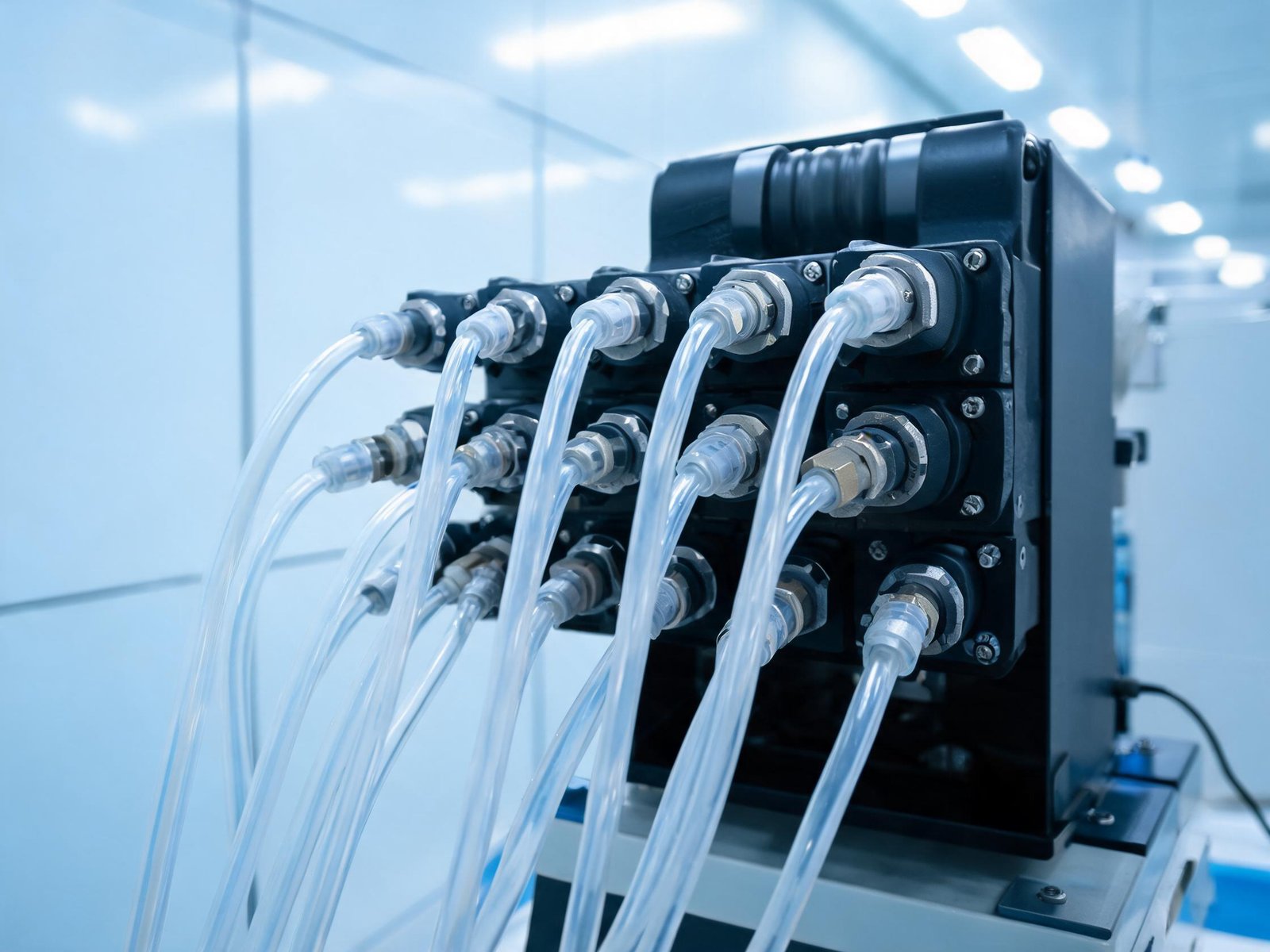
The tubing is the only wetted component in a peristaltic pump, which makes material selection the most critical reliability factor. Semiconductor chemistries are among the most aggressive industrial fluids:
| Chemistry | Typical Concentration | Compatible Tubing Material |
|---|---|---|
| Sulfuric acid | Up to 98% | Viton, Chemraz, perfluoroelastomer |
| Hydrofluoric acid | Up to 49% | PTFE, PFA, FEP fluoropolymers |
| Ammonium hydroxide | Up to 30% | Silicone, EPDM, Viton |
| Hydrogen peroxide | Up to 30% | Silicone, PTFE, PFA |
| Photoresist solvents | Various organic solvents | PTFE, Viton, norprene |
| CMP slurry | Colloidal silica or alumina | Reinforced PVC, polyurethane, norprene |
Tube suppliers publish chemical compatibility charts, but engineers should verify compatibility under actual operating conditions including temperature and concentration. A material that resists dilute sulfuric acid at room temperature may degrade rapidly at elevated temperature or higher concentration. Peristaltic pump tubing designed for chemical resistance should be sourced from suppliers who provide semiconductor-grade certification and batch traceability.
Tubing life in semiconductor applications ranges from 200 to 2,000 hours depending on chemistry, pump speed, and compression setting. Implementing a predictive replacement schedule based on flow drift monitoring prevents unplanned downtime. Some pump controllers include flow verification algorithms that detect tubing degradation by comparing actual flow against the commanded setpoint.
Integration Considerations
Integrating a peristaltic pump into semiconductor equipment involves more than mechanical mounting. The pump must communicate with the tool controller, fit within space constraints, and meet safety standards.
Control and communication: Modern semiconductor tools require pumps to accept commands from PLCs or embedded controllers. Analog signals (4-20 mA, 0-10 V) remain common, but digital interfaces (RS-485, Modbus RTU, EtherNet/IP) are increasingly expected. A peristaltic pump with housing and integrated driver simplifies wiring and reduces installation time.
Mechanical packaging: Wet bench tools have limited space. Compact pump heads with vertical or horizontal mounting options allow flexible integration. The pump should be positioned so tubing can be replaced without disassembling adjacent components. Tool designers should provide a drip tray or containment area below the pump head to catch any leakage during tube replacement.
Safety and compliance: Semiconductor manufacturing equipment sold in the United States should comply with SEMI S2 environmental health and safety guidelines for semiconductor manufacturing equipment. The pump’s electrical safety, emergency stop behavior, and material fire ratings must be documented. For facilities subject to environmental regulation, the EPA guidelines for semiconductor manufacturing outline chemical handling and waste management requirements that affect pump system design.
Flow verification: Semiconductor fabs require process verification. Installing a flow sensor downstream of the pump provides closed-loop control and alarm generation if flow deviates from the setpoint. Coriolis or ultrasonic flow sensors are preferred because they do not obstruct the fluid path or introduce contamination.
Engineering Checklist
Before finalizing a peristaltic pump specification for semiconductor chemical dosing, confirm the following:
- Document the complete chemistry list including concentration and temperature range
- Define the required flow range, accuracy, and repeatability
- Measure the system backpressure under worst-case conditions
- Select tubing material based on verified chemical compatibility data
- Specify the required control interface and communication protocol
- Verify pump dimensions and mounting orientation fit the tool envelope
- Confirm electrical compliance with SEMI S2 and local safety codes
- Plan a tube replacement schedule based on expected tubing life
- Include flow verification sensors for critical process steps
- Request material certifications and batch traceability from the tubing supplier
Need help selecting a pump for a semiconductor wet bench or CMP tool? Contact YOORAIN with your target flow range, tubing requirements, and chemical compatibility constraints.