
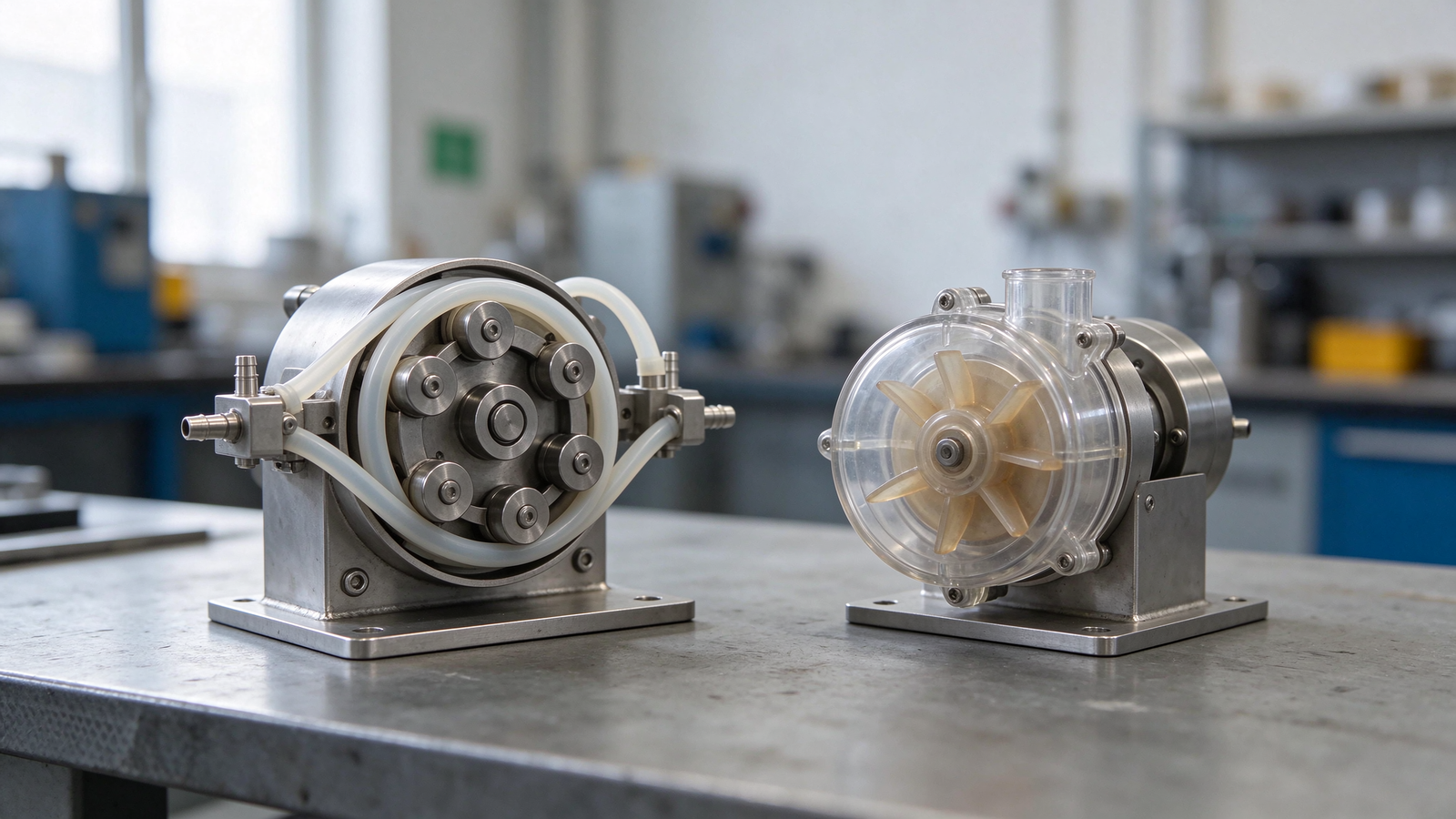
When a process needs a self-priming pump for transfer or gentle handling of a viscous or particle-carrying fluid, buyers often narrow the choice to a peristaltic tube pump and a flexible impeller pump. Both can prime without a flooded inlet and both move fluids that a clean centrifugal would struggle with, but they handle the fluid through different mechanisms, and their wetted parts, service points, and suitability for dosing do not line up. This comparison explains how each pump works, where each earns its place, the trade-offs on fluid contact, suction, service life, and control, and the duty signals that point to one type over the other. The aim is to match the pump to the fluid, the duty cycle, and the maintenance expectation rather than to a generic self-priming label.
How Each Pump Moves Fluid
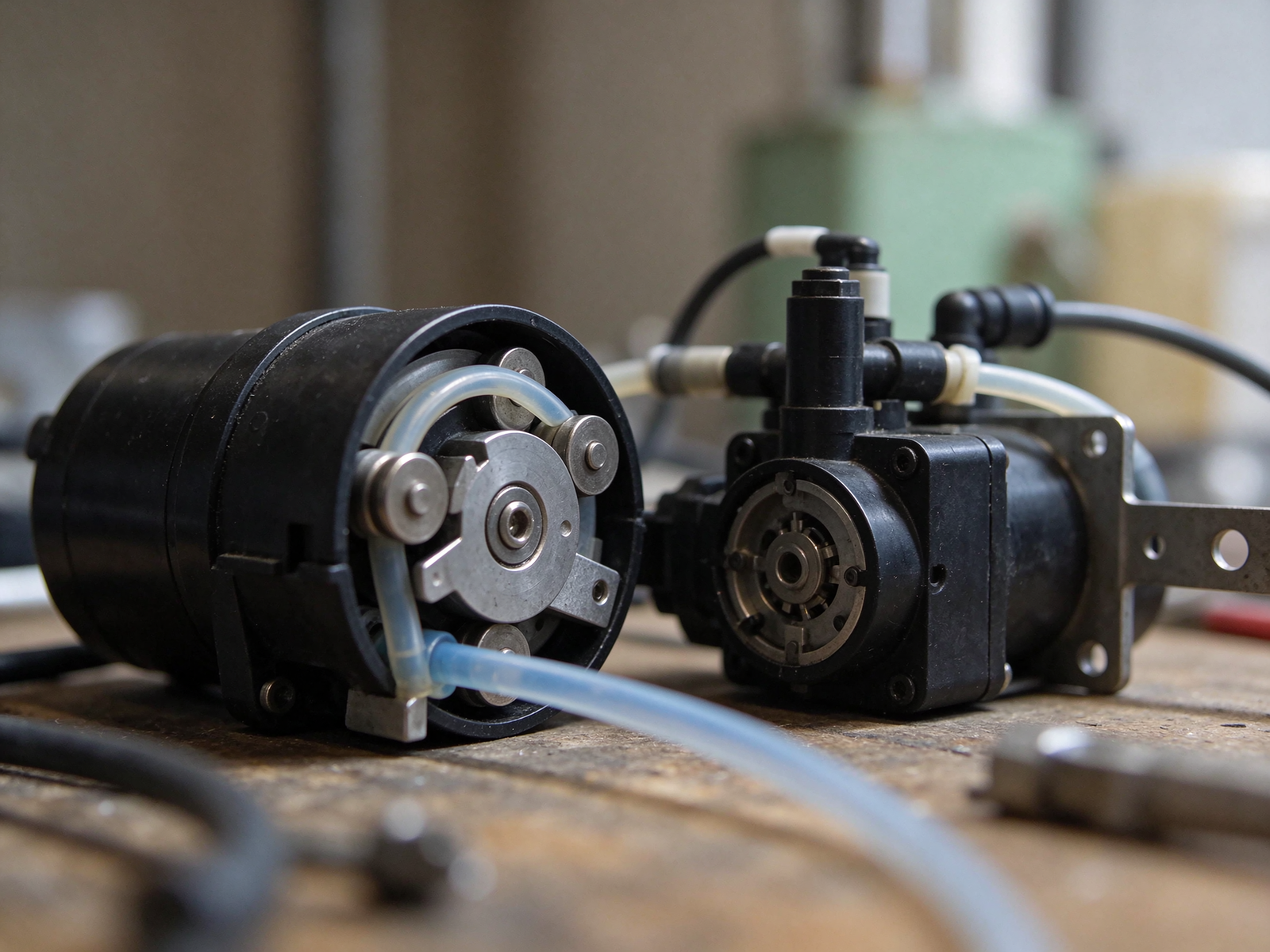
A peristaltic pump occludes a flexible tube with one or more rollers and lets the tube spring back to its round bore, which draws the next charge into the head. The fluid stays entirely inside the replaceable tube; the rollers, track, and drive never touch the liquid. There are no internal valves, gears, or seals in the wetted path to foul or wear against the fluid.
A flexible impeller pump uses an elastomer impeller inside a casing. As the impeller rotates, its blades flex against the casing wall and the spaces between blades enlarge to draw fluid in, then shrink to push it out toward the outlet. The impeller blades and casing are wetted parts that contact the fluid directly, and their flexing and contact with the casing are part of how the pump produces flow.
| Point of comparison | Peristaltic tube pump | Flexible impeller pump |
|---|---|---|
| Fluid contact | Fluid stays inside the replaceable tube; rollers and drive do not contact the liquid | Impeller blades and casing contact the fluid directly |
| Internal wetted parts | Tube only in the wetted path; no internal valves or seals | Elastomer impeller, casing, and shaft seal in the wetted path |
| Self-priming | Primes through tube recovery; suction depends on tube condition and inlet line | Primes by the expanding impeller vane chambers; suction depends on impeller and seal condition |
| Gentleness to fluid | Fluid moves in a closed tube with roller occlusion; shear and particle shear track the tube and speed | Fluid passes between flexing vanes and casing; particles can sit between vane and wall |
| Consumable wear | The tube fatigues with each occlusion and is replaced as a scheduled consumable | The impeller flexes against the casing and wears over time; seal and casing condition matter |
| Flow control | Dose follows rotor speed; suited to metering and proportional feeding | Flow follows impeller speed, but accuracy and repeatability depend on impeller condition and slip |
| Flush and clean between fluids | Wetted path is a single tube that can be flushed or swapped | Casing and impeller have internal chambers and clearances to clean or replace |
Suction and Priming Behavior
Both pump types are recognized as self-priming compared with a standard centrifugal, but the reason differs. The peristaltic draws on the vacuum created as the tube recovers; its suction ability tracks the bore, the tube’s spring, and how airtight the inlet line is. A leak on the suction side lets air in and weakens the prime. The flexible impeller draws on the vane chambers opening up against the casing; its prime depends on the impeller still seating well against the casing and on the seal holding. If either consumable ages, the pump loses lift before it loses raw rotation.
For suction duties that see a high lift, a long inlet, or a fluid that releases gas, the peristaltic arrangement keeps the wetted path simple: inspect the inlet line and replace the tube, and there are no internal clearances to rebuild. The impeller pump’s prime is tied to the fit between a wearing part and the casing, so its suction should be checked against impeller condition rather than assumed over a long service life.
Fluid and Material Handling
Peristaltic pumps are chosen where the fluid must stay in a closed, replaceable path: aggressive reagents, shear-sensitive materials, fluids with traces of solids, or duties where changing between products means swapping a tube rather than cleaning internal chambers. The tube material is selected against the chemistry and temperature, and the rest of the head stays out of contact. Larger transfer duties can use a head such as the large-flow-rate peristaltic pump, while low-volume feeds use smaller heads; the peristaltic pump tube defines the wetted material in either case.
Flexible impeller pumps are common for thicker, oil-like and moderately viscous fluids in transfer and transfer-to-fill duties, where the vane action moves the fluid efficiently through the casing. The direct contact between impeller and fluid means the elastomer has to be compatible with the chemistry, and fluids with hard or abrasive particles can wear the vane tips and casing faster. Where the fluid is abrasive, highly aggressive, or prone to leaving residue that is hard to clear from internal chambers, the closed-tube path of the peristaltic is usually the easier arrangement to keep clean and compatible.
Service and Consumable Routine
| Duty situation | Peristaltic tube pump | Flexible impeller pump |
|---|---|---|
| Low-volume, repeatable dosing or reagent feed | Favored: dose follows rotor speed; closed tube for chemistry contact | Less typical: metering accuracy tracks impeller slip and wear |
| Moderately viscous, non-aggressive transfer | Suitable where closed path or cleanability matters | Common: vane action handles thicker fluids in transfer service |
| Fluid with abrasive solids or fines | Tube contains the fluid; check tube wear against the duty | Vane tips and casing can wear against particles; inspect impeller condition |
| Product changeover or clean-between-batches | Flush or swap the single wetted tube | Clean casing chambers, impeller, and seal; replace worn impeller as needed |
| Continuous transfer run | Tube fatigue tied to duty cycle; schedule consumable replacement | Impeller and seal wear over continuous flexing; inspect vane condition |
| Compact instrument or analyzer feed | Small heads such as the small peristaltic pump fit built-in installations | Casing and impeller body usually suit skid or equipment transfer rather than compact instrument feed |
The service point for a peristaltic pump is the tube: it is a scheduled consumable that can be changed without tools that open the internal fluid chambers, and the peristaltic pump driver continues running while the consumable is renewed. For an impeller pump, service centers on the impeller, casing fit, and seal, which are internal parts that have to be accessed and reassembled to their clearances. A maintenance team that wants a simple, predictable consumable change often prefers the tube pump; a team familiar with rebuilding internal positive-displacement parts may be comfortable with the impeller arrangement.
Control and Repeatability
Where the duty is a metering feed, the peristaltic’s flow follows rotor speed and the tube displacement, which makes it straightforward to tie dosing to a speed signal or cycle count. The output can be checked with a timed catch, and consumable wear is the main drift source. Impeller pumps also vary flow with speed, but slip past the impeller can change as the vane and casing wear, so repeatability over the service life depends on keeping those internal parts in good condition. For proportional reagent addition, analyzer feeds, or any duty where the dose has to be consistent batch after batch, the closed tube path is the easier basis to control.
Signals That Point to the Right Type
Choose the peristaltic tube pump when the fluid is aggressive or shear-sensitive, when the wetted path must be a single replaceable part, when the duty is dosing or proportional feed, or when cleanability and a simple consumable change matter. Choose the flexible impeller pump when the duty is a straightforward transfer of moderately viscous, non-abrasive fluid, the fluid is compatible with the impeller elastomer, and the installation already supports impeller and seal service. Neither type should be selected on the self-priming label alone; the fluid contact, the solids in the stream, the required repeatability, and the maintenance routine should drive the choice.
General measurement and metering practice that applies to comparing delivered flow is described in guidance from the NIST Physical Measurement Laboratory, and pump and fluid-handling engineering research is summarized in programs listed by the U.S. National Science Foundation. Drive configuration and occlusion or vane behavior can be checked against reference material such as the peristaltic pump driver reference and the motor-driver operating manual.
Talk to the Supplier About the Duty
Before placing an order, describe the fluid and its concentration, viscosity, temperature, and any solids, whether the duty is transfer or dosing, the target flow and duty cycle, the suction arrangement, and how often the product changes. The supplier can compare the peristaltic tube arrangement against the impeller option and confirm which wetted material and consumable schedule fit the service.