
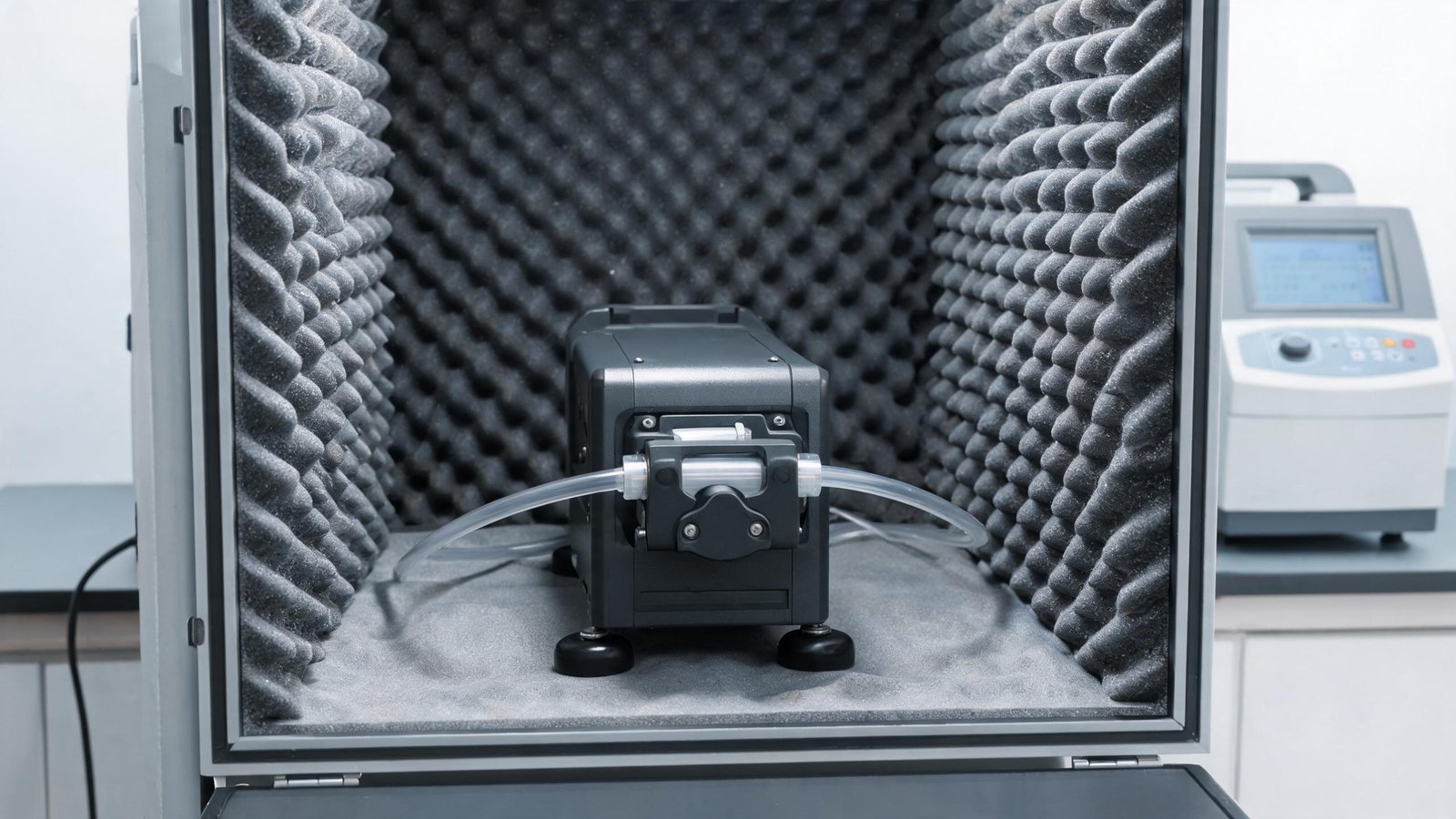
OEM engineers designing benchtop laboratory, medical, and diagnostic equipment often encounter an unexpected challenge: peristaltic pump noise. While the pump itself may be compact and functionally suitable, audible noise from motor, roller mechanism, and tubing vibration can push the instrument above acceptable sound levels for quiet working environments. For equipment intended for hospital wards, research labs, or open-plan offices, noise performance is as important as flow accuracy.
Reducing pump noise requires understanding where the sound comes from and which design changes produce measurable results. A 12V DC peristaltic pump may produce different noise characteristics than a stepper-driven model, and the installation method affects how much sound reaches the user. This article examines common noise sources in peristaltic pumps, how to diagnose them, and what engineering changes effectively reduce audible output in OEM equipment.
Where Peristaltic Pump Noise Comes From
Peristaltic pump noise has several distinct sources, each with different frequency characteristics and mitigation approaches. Identifying the dominant source is the first step toward a quieter design.
Motor noise. The drive motor contributes both airborne sound and structure-borne vibration. Brushed DC motors produce commutator brush noise and electromagnetic hum. Stepper motors generate high-pitched whine at certain step rates, especially in microstepping mode. Brushless DC motors tend to be the quietest option at equivalent power levels, though drive electronics can introduce switching noise.
Roller and tube noise. As each roller compresses the tubing, the tube wall snaps back into shape, producing a characteristic rhythmic ticking sound. The frequency of this sound equals the roller pass rate, which depends on the number of rollers and pump speed. More rollers mean a higher frequency but lower amplitude per pulse, which sometimes makes the pump sound quieter subjectively even if the overall sound pressure level is similar.
Mechanical vibration. The pump assembly vibrates as rollers pass top and bottom dead center, and this vibration transfers through the mounting structure to the instrument chassis. If the chassis has a resonant frequency near the pump’s operating speed, the vibration amplifies and radiates more sound. This is often the dominant noise path in poorly isolated installations.
Fluid noise. At higher flow rates, fluid movement through the tubing and fittings generates turbulence noise, particularly at bends, restrictions, and outlet points. This is usually less significant than mechanical noise in small peristaltic pumps but can become noticeable in larger models or with viscous fluids.
Occupational safety standards provide context for why noise matters in equipment design. The OSHA occupational noise exposure standard sets permissible exposure limits for workers, and while laboratory equipment alone rarely exceeds these limits, cumulative exposure from multiple instruments in a shared workspace can approach action levels. Equipment manufacturers targeting regulated markets design for sound levels that keep the total workplace environment within acceptable ranges.
How to Diagnose Noise Issues
Before making design changes, determine which noise source dominates. A systematic diagnostic approach saves time and avoids changes that do not address the real problem.
Step 1: Measure baseline sound level. Use a sound level meter on the A-weighted scale (dBA) at a standard distance, typically one meter from the front of the instrument. Record the level at the target operating speed. This provides a baseline to evaluate potential improvements.
Step 2: Isolate the pump from the chassis. Temporarily suspend the pump assembly on soft foam or rubber bands while keeping the fluid connections intact. If the sound level drops significantly, structure-borne vibration is the main pathway and mechanical isolation will yield the most improvement.
Step 3: Run the motor without tubing. Remove the tubing from the pump head and run the motor at the same speed. Compare the sound to the baseline. If most of the noise disappears, the roller-tube interaction is the primary source and changes to tubing, pump head design, or speed will be most effective.
Step 4: Change pump speed. Run the pump at half speed and full speed. If noise increases more than proportionally with speed, aerodynamic or turbulence effects may be contributing. If it tracks roughly linearly with speed, mechanical sources are likely dominant.
Step 5: Check for resonance. Sweep the pump speed slowly and listen for specific speeds where the noise suddenly increases. These peaks indicate structural resonance in the mounting assembly and suggest that stiffening the structure or adding damping will help.
Accurate measurement matters for objective comparison. The NIST Fluid Metrology Group provides reference standards for flow measurement, and for acoustic measurement, calibrated sound level meters and appropriate measurement distances ensure consistent results between prototype iterations.
Engineering Solutions for Quieter Operation
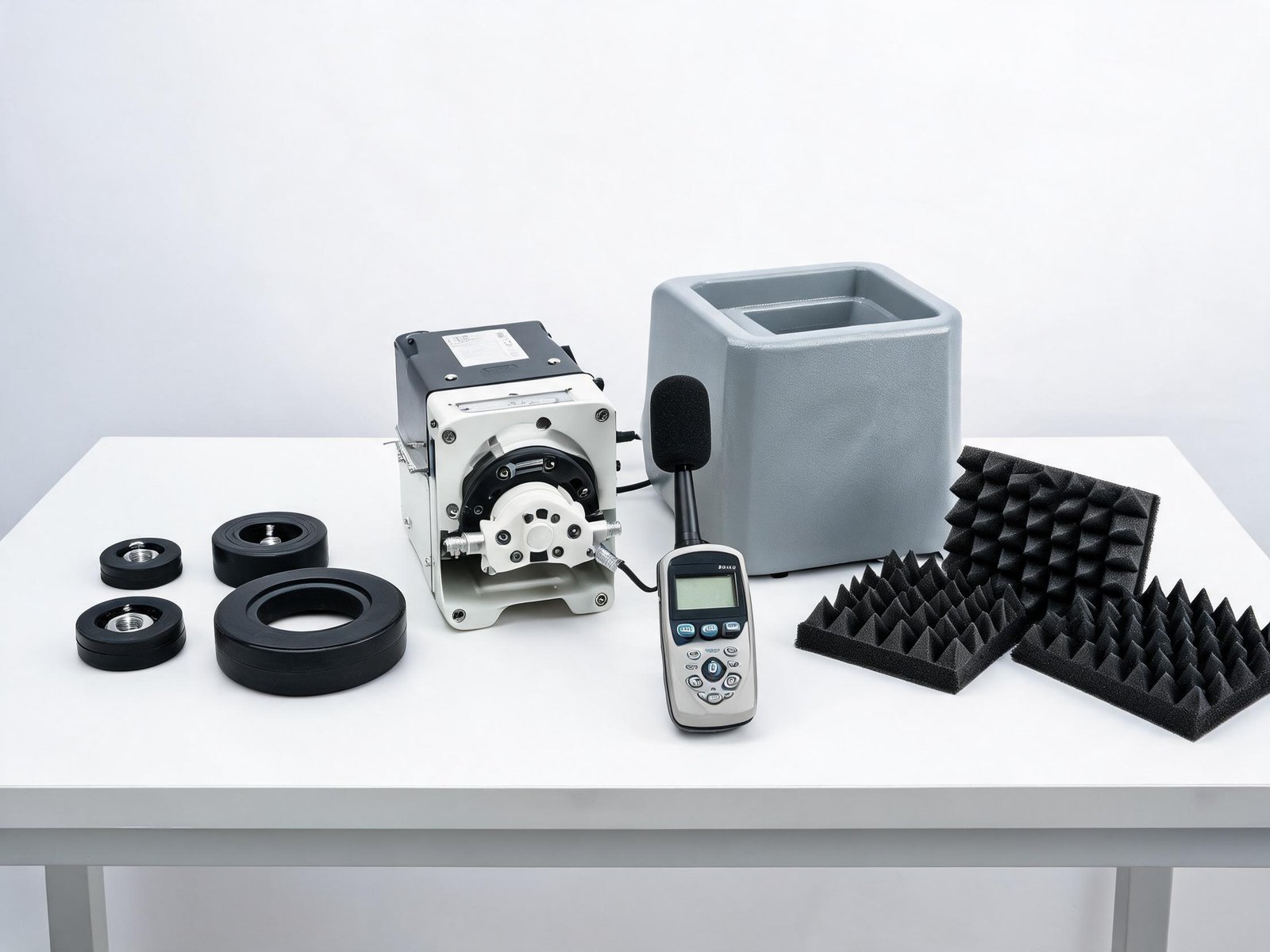
Once the primary noise source is identified, apply the most effective countermeasures. The following approaches address different noise paths and are typically used in combination.
| Noise Source | Solution | Expected Improvement |
|---|---|---|
| Structure-borne vibration | Rubber or silicone isolation mounts between pump and chassis | 3–10 dBA reduction, depending on isolation quality |
| Motor noise (brushed DC) | Switch to brushless DC or stepper with quiet driver | 5–15 dBA reduction at equivalent power |
| Roller-tube ticking | Use more rollers or lower speed with larger tubing | 2–6 dBA reduction, plus better subjective quality |
| Chassis resonance | Add damping material or stiffen mounting panel | 4–12 dBA reduction at resonant frequencies |
| Airborne motor sound | Acoustic enclosure or foam lining around pump compartment | 3–8 dBA reduction, more with sealed enclosure |
| Fluid turbulence | Smooth tubing bends, larger outlet tubing, avoid restrictions | 2–4 dBA reduction in high-flow applications |
Motor Selection
Motor type is often the single largest factor in pump noise. A DC brush motor peristaltic pump provides low cost and simple control but produces brush noise that becomes more apparent at higher speeds. For noise-sensitive applications, a brushless DC motor or a properly driven stepper motor produces less audible noise, especially under continuous duty. When using stepper motors, selecting a driver with smooth current decay and microstepping reduces the characteristic stepper whine.
Mounting and Isolation
How the pump mounts to the chassis significantly affects transmitted vibration. A peristaltic pump with housing provides a rigid structure that simplifies isolation because the complete assembly mounts through vibration-dampening grommets or rubber feet. The isolation material should be soft enough to decouple pump vibration from the chassis but firm enough to maintain alignment and prevent excessive movement during transport.
Speed and Tubing Trade-off
Running the pump at a lower speed with larger-diameter tubing reduces both roller-pass frequency and motor noise while maintaining the same flow rate. The trade-off is a larger pump head and slightly increased pulsation at very low speeds with fewer rollers. For applications where noise is critical and size is secondary, this is often the most cost-effective improvement.
Pump Head Design
Pump heads with more rollers distribute the compression events more evenly, reducing the amplitude of each individual tick. The YZ15 easy load peristaltic pump head is designed for quick tubing changes, and its roller geometry produces relatively smooth operation. For even lower pulsation and associated noise, pump heads with 3 or more rollers spread the tube compression across more contact points.
When to Change the Pump or Tubing
Some noise problems point to wear rather than design issues. If a pump that was quiet becomes noticeably louder over time, investigate the following causes.
Worn tubing. As tubing fatigues, it loses elasticity and the roller compression produces different sound characteristics. The tube may also start to slip in the pump head, creating irregular noise. Replacing the tubing often restores original noise levels and should be part of routine maintenance.
Worn motor bearings. Motor bearings degrade over time, especially in high-duty-cycle applications. A grinding or rumbling sound that increases with speed suggests bearing wear. In this case, the motor or complete pump assembly should be replaced.
Loose mounting hardware. Vibration can loosen screws over time, allowing the pump to rattle against the mounting surface. Check mounting fasteners periodically and use thread-locking compound where appropriate.
Debris in pump head. Particulate matter that enters the pump head area can cause irregular noise and accelerate roller or tubing wear. Keeping the pump area clean and ensuring tubing ends are cut cleanly reduces this risk.
FAQ
How much noise does a typical small peristaltic pump produce?
Small peristaltic pumps for OEM applications typically produce 40–60 dBA at one meter, depending on motor type, speed, and mounting. Brushless DC models at moderate speeds tend to fall in the 40–50 dBA range, while brushed DC motors at high speed can reach 55–60 dBA. Mounting directly to a metal chassis can add 5–10 dBA through structure-borne radiation.
Can I reduce noise just by changing the tubing?
Partially. Softer tubing materials can reduce the snap-back sound when rollers release, but the effect is usually 2–4 dBA. Tubing size has a larger indirect effect: using larger tubing at lower speed reduces both motor and roller noise while maintaining flow rate. Always verify that the alternative tubing material is compatible with the fluid and meets any required standards.
What is the quietest motor type for a peristaltic pump?
Brushless DC (BLDC) motors generally produce the least audible noise at equivalent power levels because they have no brushes and operate with electronic commutation. Stepper motors can also be quiet when driven with good microstepping drivers, but they may produce audible noise at certain resonant step rates. Brushed DC motors are typically the loudest option, especially at higher speeds or as brushes wear.
Do more rollers always mean a quieter pump?
More rollers reduce the amplitude of each individual tube compression pulse, which can make the pump sound smoother. However, the total sound power may not decrease significantly because the pulses occur more frequently. The subjective impression of noise often improves because the sound shifts from distinct ticks to a lower hum, even if the measured dBA level is similar.
How important is pump mounting for noise control?
Critically important. Structure-borne vibration often accounts for half or more of the audible noise from an OEM instrument. Isolating the pump from the chassis with rubber mounts, adding damping material to the mounting panel, or using a separate pump sub-plate can produce larger noise reductions than any other single change. The TH15 spring type peristaltic pump features a spring-loaded design that can also help dampen mechanical vibration transmission compared to rigid pump head designs.
If you are developing laboratory, medical, or diagnostic equipment where noise performance matters, contact YOORAIN to discuss your pump requirements. Specifying the target sound level, flow range, and mounting constraints early in the design process helps identify the best pump configuration before the instrument design is finalized.