
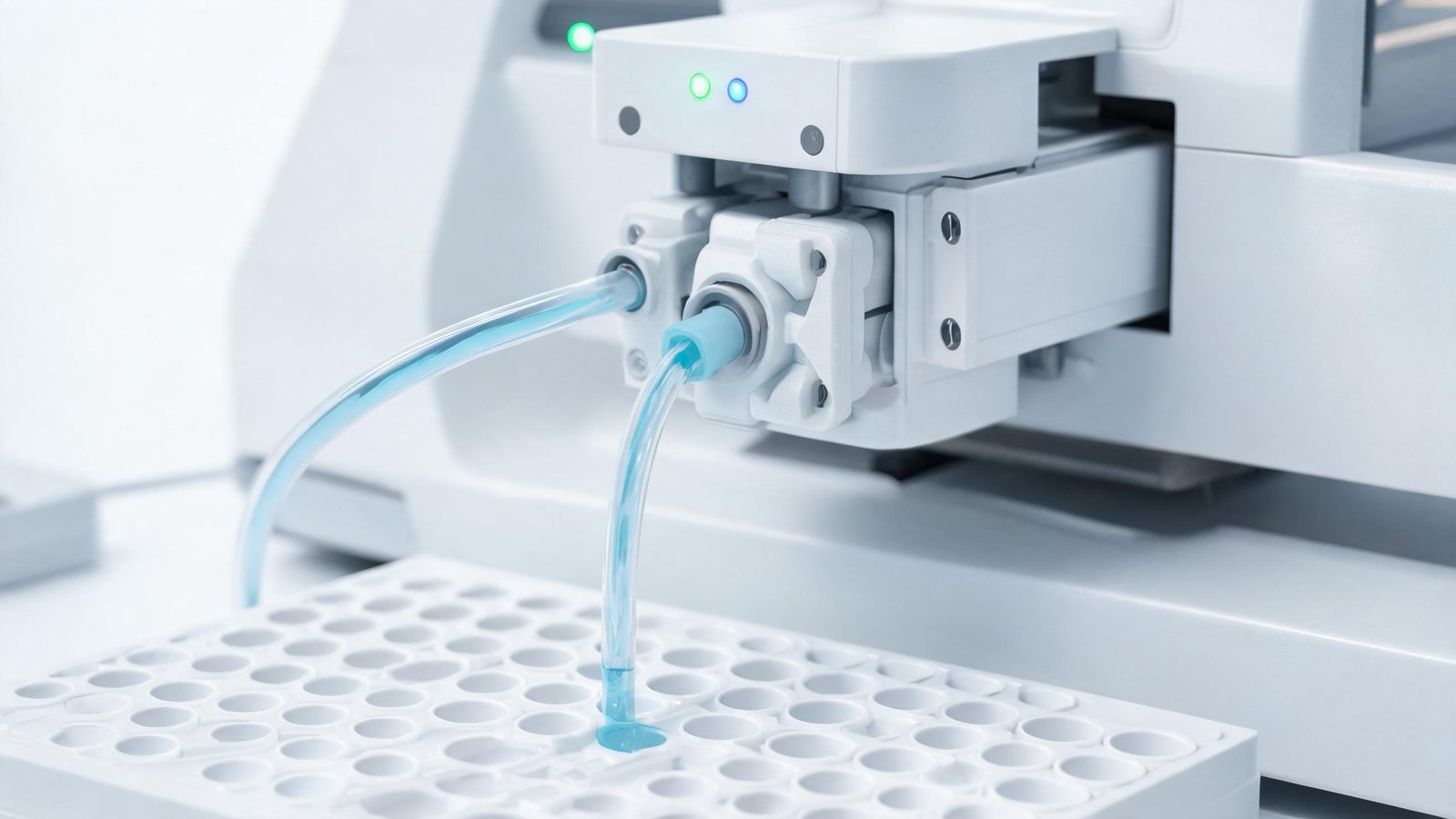
In-vitro diagnostic (IVD) equipment manufacturers face strict requirements for liquid handling accuracy, contamination control, and instrument reliability. Reagent dispensing directly affects test result precision, which means the pump technology selected for an analyzer must deliver consistent microliter-to-milliliter volumes across thousands of cycles without cross-contamination between samples. Peristaltic pumps are widely used in IVD instruments because the fluid contacts only the interior of a disposable tube, eliminating the need for cleaning validation between tests and reducing the risk of carryover. This application guide explains why peristaltic pumps fit IVD equipment, what specifications matter, and how instrument designers can avoid common integration problems.
Why Peristaltic Pumps Fit IVD Applications
IVD analyzers perform clinical chemistry, immunoassay, hematology, molecular diagnostics, and point-of-care testing. Each test type requires precise transfer of reagents, samples, wash buffers, and calibrators. The pump technology must satisfy several functional requirements:
- Fluid isolation: The pump mechanism must not contact the reagent or sample. Peristaltic pumps achieve this naturally because the fluid travels inside tubing that is compressed by external rollers.
- Accuracy and repeatability: IVD dispensing typically requires accuracy within 1% to 5% depending on the test type. Peristaltic pumps with stepper motor drives can achieve repeatability of ±0.5% to ±2% by controlling rotation angle rather than continuous speed.
- Low carryover: Replacing the tubing between tests or using multi-channel pump heads with dedicated tubes per reagent eliminates cross-contamination. This is critical for assays where residual reagent from a previous sample could produce a false positive.
- Compact footprint: Modern IVD instruments trend toward benchtop or portable formats. Micro peristaltic pumps with integrated drivers occupy minimal space inside crowded instrument chassis.
- Quiet operation: Clinical laboratories and point-of-care settings require low noise levels. Small peristaltic pumps running below 300 RPM generate minimal acoustic disturbance compared to piston or diaphragm alternatives.
These characteristics make peristaltic pumps suitable for reagent dispensing, sample dilution, wash solution delivery, and waste collection across a broad range of IVD platforms.
Main Fluid-Handling Requirements
IVD liquid handling involves several distinct fluid types, each with different physical properties:
| Fluid Type | Typical Volume | Key Property | Pumping Consideration |
|---|---|---|---|
| Reagents | 10 to 500 μL | Variable viscosity, surfactants | Accurate dispensing, minimal pulsation |
| Samples (blood, urine, serum) | 5 to 100 μL | Protein content, cellular material | Gentle handling, no shear damage |
| Wash buffers | 100 μL to 2 mL | Aqueous, low viscosity | Fast transfer, complete evacuation |
| Calibrators and controls | 20 to 200 μL | High value, limited volume | Precise low-volume accuracy |
| Waste fluids | Accumulated total | Mixture of reagents and samples | Reliable continuous transfer |
The pump system must handle these fluids without calibration drift over the instrument’s service interval. Temperature fluctuations in the laboratory environment can affect tubing elasticity and therefore dispensing volume. Instrument designers should specify pumps with temperature compensation or schedule periodic recalibration.
Pump Selection Considerations
Selecting a peristaltic pump for an IVD instrument requires matching the pump’s capabilities to the assay protocol:
Dispensing volume range: The pump must reliably dispense the minimum volume required by the assay. For volumes below 50 μL, a micro peristaltic pump with fine-pitch tubing and stepper motor control is typically necessary. The small peristaltic pump product range covers flow rates from milliliters per minute to several liters per minute, allowing designers to match the pump size to the application.
Tubing material: Reagent compatibility determines tubing life and assay reliability. Common IVD tubing materials include:
- Silicone: general purpose, economical, suitable for aqueous reagents and wash solutions
- PharMed BPT: improved chemical resistance for aggressive reagents and extended life
- Fluoropolymer (PTFE, PFA, FEP): maximum chemical resistance for solvents and acids
- Thermoplastic elastomer: flexibility at low temperatures, good for cold reagent storage
Tubing inner diameter directly affects the volume dispensed per rotation. Smaller diameters provide finer resolution but lower maximum flow. Designers should select the smallest diameter that meets the maximum flow requirement to optimize dispensing precision.
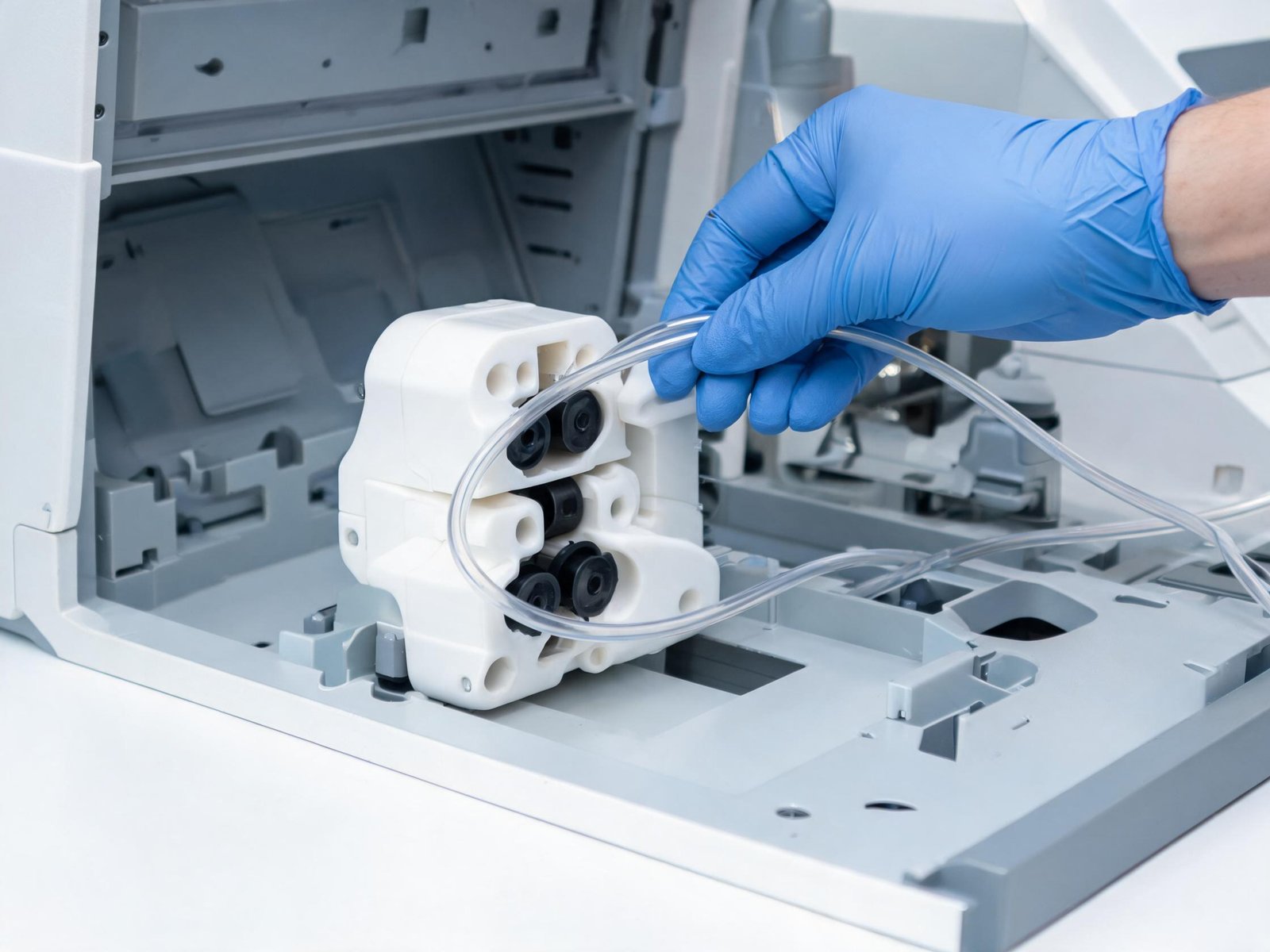
Pump head configuration: Multi-channel pump heads allow simultaneous dispensing of multiple reagents from a single drive motor. The YZ15 easy-load peristaltic pump head supports quick tube loading and replacement, which simplifies maintenance in service environments. Instrument designers should evaluate whether a single multi-channel head or multiple independent pump heads provide better reliability for their architecture.
Common Design Problems
IVD instrument designers encounter several recurring problems when integrating peristaltic pumps:
Bubble entrainment: Air bubbles in reagent lines cause volume errors and assay failure. Bubbles enter when tubing connections are loose, when reagent bottles run low, or when the pump cavitates due to excessive suction lift. Solutions include proper tube clamping at fittings, minimum liquid level sensors in reagent reservoirs, and limiting suction lift to 0.5 meters or less.
Dispensing accuracy drift: Over time, tubing compression set reduces the effective inner diameter, causing the volume per rotation to decrease. This drift is predictable and can be managed by scheduling tube replacement based on cycle count rather than calendar time. A pump that has run 500,000 cycles with protein-containing reagents will show more drift than one running aqueous buffers.
Reagent foaming: Surfactant-containing reagents foam when subjected to rapid flow changes. Using a pump with more rollers reduces pulsation and minimizes foam generation. Alternatively, programming a gentle acceleration profile rather than instant start/stop reduces shear at the dispensing tip.
Temperature sensitivity: Tubing elasticity varies with temperature. If the instrument operates in an environment where temperature fluctuates by more than 5°C, dispensing accuracy may drift. Calibrating the pump at the expected operating temperature and using tubing with low temperature coefficients addresses this issue.
Integration Into Equipment
Successful integration of a peristaltic pump into an IVD instrument extends beyond mechanical mounting:
Electronic control: The pump must interface with the instrument’s main controller. Stepper motor pumps accept step-and-direction signals, while pumps with integrated drivers accept analog voltage, RS-485, or TTL-level commands. The control protocol should support absolute positioning so the instrument firmware can command specific dispense volumes without managing speed profiles.
Fluid routing: The tubing path from reagent bottle to pump to dispensing tip should minimize dead volume. Dead volume wastes reagent and increases wash requirements. Manifolds with pinch valves located close to the pump head reduce the wetted volume between reagents.
Regulatory documentation: IVD instruments sold in the United States require FDA clearance or approval under the FDA in-vitro diagnostics program. The pump supplier should provide material certifications, biocompatibility data (ISO 10993), and manufacturing quality documentation. Instruments marketed in the European Union must comply with the In Vitro Diagnostic Regulation (IVDR). ISO 15189 specifies quality requirements for medical laboratories and indirectly affects instrument performance specifications.
Serviceability: Field service engineers replace tubing during preventive maintenance. The pump head should be accessible without removing other instrument modules. Tool-less tube loading mechanisms reduce service time and prevent improper installation.
Practical Recommendations
For IVD instrument designers evaluating peristaltic pumps, the following practical steps improve outcomes:
- Define the complete dispensing protocol including minimum volume, maximum volume, flow rate, and acceptable accuracy before contacting pump suppliers
- Test candidate tubing materials with actual reagents under operating temperature conditions; do not rely solely on generic compatibility charts
- Measure the total system backpressure including tubing length, fittings, and dispensing tip resistance
- Specify multi-channel pump heads only when reagent scheduling permits simultaneous dispensing; independent pumps provide more flexibility for complex protocols
- Include a bubble detector or air-in-line sensor for critical reagent lines
- Document the expected tubing replacement interval and verify it with accelerated life testing
- Request pump head drawings and 3D models early in the mechanical design phase to avoid space conflicts
- Plan control interface testing to confirm command response time meets assay timing requirements
If you are developing laboratory or diagnostic equipment, you can contact YOORAIN to discuss the fluid-handling requirements of your system.