
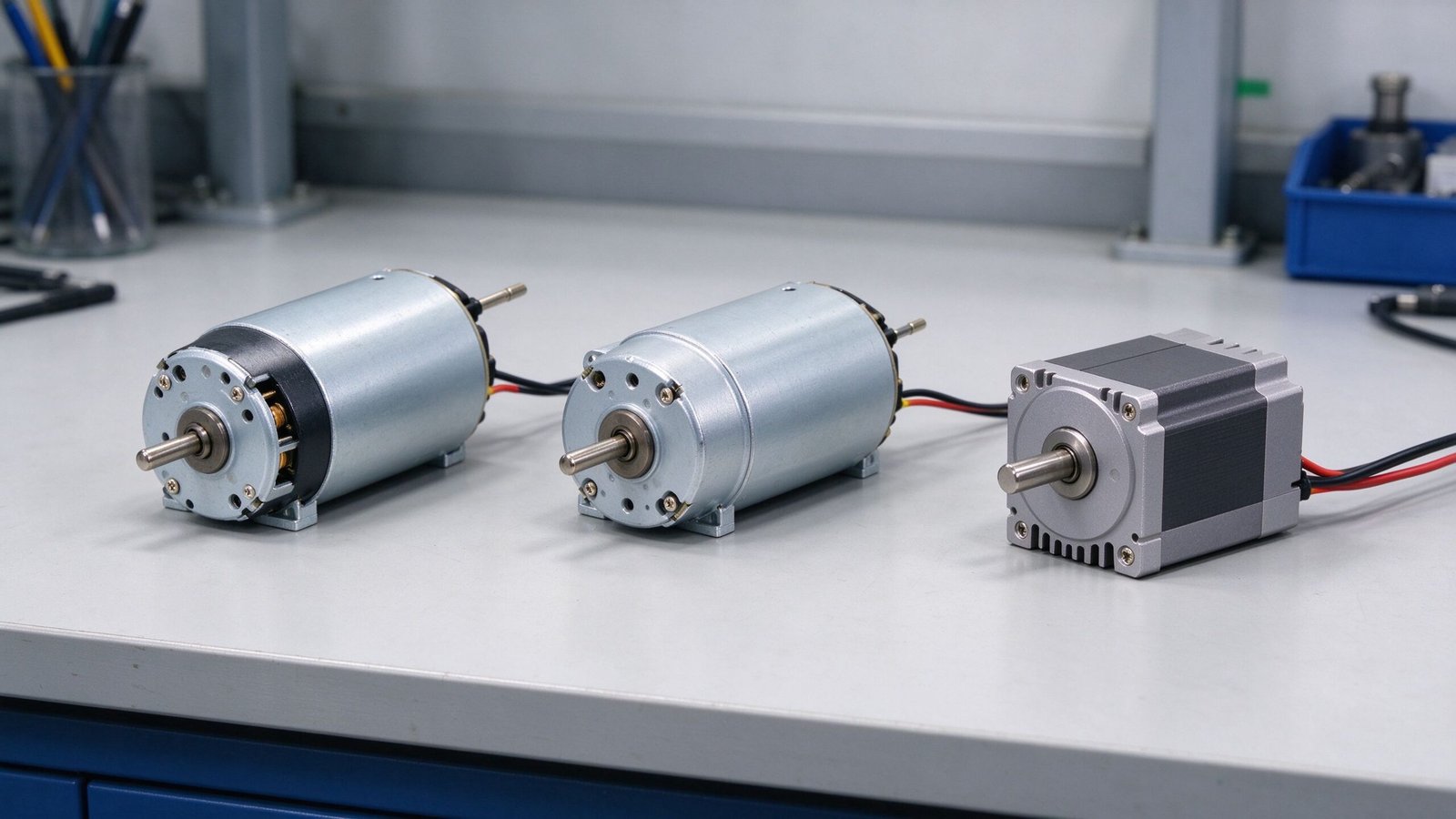
The motor is half of a peristaltic pump, and many OEM problems trace back to a motor that was chosen for price rather than for the job. A peristaltic pump is a constant-speed or variable-speed load, but it starts against a sealed tube, runs continuously or intermittently, and may need to be quiet, efficient, or controlled by a PLC. Brush DC, brushless DC (BLDC), and stepper motors each handle that load differently. This reference explains how each motor drives a peristaltic head, where each one fits, and what to ask a supplier when you specify one.
What the Pump Actually Asks of the Motor
A peristaltic head is a low-speed, medium-torque load. The rollers squeeze a flexible tube against a bed, and the motor must turn the roller shaft steadily without jerking. Three demands dominate the motor choice:
- Starting torque. At startup, the tube is cold and stiff, and the motor must break the static compression. A motor that starts weakly stalls or oscillates until the tube warms up.
- Steady low-speed torque. Once running, the head needs a smooth torque at the chosen RPM, often under a few hundred RPM. Motor types that cog or ripple at low speed deliver pulsing flow.
- Control and duty. The instrument may need speed adjustment, direction, and enable signals, and it may run for minutes, hours, or 24 hours a day.
The gear reduction between motor and head matters as much as the motor itself. Most small pumps use a gearbox to bring a fast motor down to the slow roller speed, so the motor is not judged on raw RPM but on torque after the gearbox. Measurement of the actual delivered flow should follow the gravimetric practice described by NIST’s Physical Measurement Laboratory: weigh the output under real load rather than reading the nameplate RPM.
Brush DC Motors
A brushed DC motor uses mechanical brushes and a commutator to switch the winding current. It is simple, low cost, and easy to control with a voltage or PWM drive. It develops good starting torque and runs smoothly through a gearbox, which is why it has been the default for small pumps for years.
The trade-off is the brushes. They wear, they generate dust, and they limit motor life and minimum maintenance. Brushed motors also produce electrical noise at the commutator, which matters in sensitive instrumentation. A brushed motor is the right choice for cost-sensitive, intermittent-duty devices where brush replacement is not a concern and a simple speed wire is enough. The 12V DC peristaltic pump line is the typical brushed or simple-motor package used in portable and low-duty equipment.
| Trait | Brush DC | Brushless DC (BLDC) | Stepper |
|---|---|---|---|
| Cost | Low | Medium | Medium |
| Life / maintenance | Brush wear | Longer, no brushes | Longer, no brushes |
| Starting torque | Good | Good | High, at low speed |
| Low-speed smoothness | Smooth with gearbox | Smooth with drive | Can resonate unless driven well |
| Electrical noise | Higher (commutation) | Low, with filtered drive | Drive-dependent |
| Control | Simple PWM/voltage | Drive + signals | Step/direction pulses |
| Best duty | Intermittent | Continuous | Positioned / repeatable dosing |
Brushless DC (BLDC) Motors
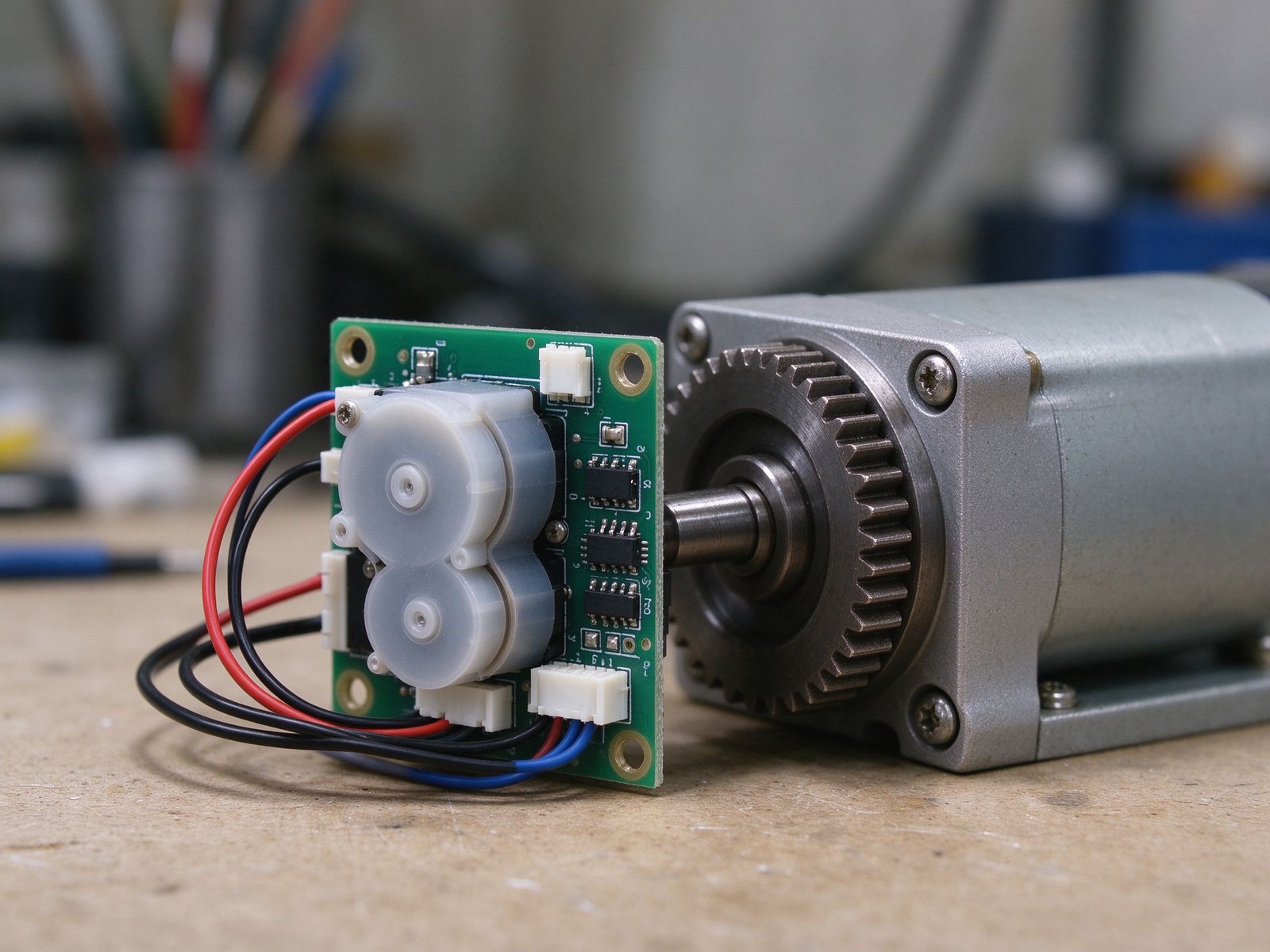
A BLDC motor switches the winding current electronically, through Hall sensors and a drive board, instead of through brushes. Remove the brushes and you remove the wear point: BLDC motors last longer, run cleaner, and produce less commutation noise. They also run more efficiently, which means less heat and longer battery life in portable gear.
The price is a drive board and slightly higher cost. A BLDC pump cannot be speed-controlled with a bare voltage; it needs a controller that accepts the speed signal and drives the phases. Common peristaltic drivers take an analog voltage or a PWM input and convert it into BLDC commutation, as described in typical motor-driver operating manuals. For continuous-duty equipment, analytical instruments, and anything that must run quietly or for long hours, the extra drive cost pays back in life and reliability. A 24V dosing pump built on a BLDC drive is the usual choice for sustained metering.
Stepper Motors
A stepper motor moves in defined angular steps. It holds position and delivers high torque at low speed, which makes it attractive for dosing where the instrument wants to dispense a set volume by counting steps rather than running open-loop at a speed. A stepper-based peristaltic pump can dose a precise number of roller revolutions, then stop, which suits analyzers and batch dispensing.
The downsides are heat and resonance. A stepper draws current to hold torque even when little is happening, and it can buzz or resonate at certain speeds unless the drive microsteps and damps properly. A stepper is not the best choice for a quiet, long-running continuous pump, but it excels when dosing accuracy by count is the priority. Stepper drivers that accept a defined analog speed-control input let a PLC command the same head either by speed or by step count.
Torque, Speed, and the Role of the Gearbox
It helps to separate two numbers: the motor’s rated speed and the pump’s required roller speed. A small DC motor spins at several thousand RPM, but a peristaltic head typically needs a few hundred RPM or less to deliver a useful flow. A gearbox sits between them, trading speed for torque. The motor chosen for a pump is therefore chosen after the gearbox ratio is known, because the gearbox is what converts a fast, low-torque motor into a slow, high-torque roller drive.
Undersizing the motor for the gearbox ratio is a common error. A motor that has enough torque at high speed may stall at the lower geared speed against a stiff tube. The practical check is to look at the torque delivered at the head shaft under the worst case: a cold, stiff tube against the highest back-pressure the system will ever see. If the motor starts and holds that load smoothly, it is sized correctly; if it stalls or groans, the ratio or the motor is too small.
| Question | Why it matters |
|---|---|
| Required head RPM and flow | Sets the gearbox ratio |
| Starting torque at the shaft | Overcomes the cold tube seal |
| Continuous torque at operating speed | Holds the load without overheating |
| Back-pressure the system will see | Raises the required torque |
| Mounting envelope | Fits motor and gearbox in the device |
Electrical Noise and EMC
Brush DC motors are the noisiest of the three electrically. The brushes switching the commutator generate radio-frequency interference that can disturb nearby sensors, analog circuits, or sensitive measurement electronics. In an instrument with a precision sensor next to the pump, this interference can show up as noise on the reading. The remedy is filtering, shielding, and a distance between pump and sensor, but those add cost.
BLDC and stepper drives are quieter electrically because the switching is controlled in a drive board, not arcing at brushes. They still generate switching noise, but a well-designed drive with filtering contains it. For medical, analytical, or any electronics-adjacent device, the lower EMI of a BLDC motor is often the deciding factor, and it is worth asking the supplier about the drive’s filtering and the device’s own EMC testing.
Life Expectancy and Maintenance
The brush life of a DC brushed motor is bounded by the brush material wearing down. In intermittent use that may be years, but in a 24-hour pump it is the limiting component. BLDC and stepper motors have no brushes, so their life is bounded by the bearings and the gearbox instead. That is why continuous-duty and long-life equipment converges on BLDC.
The gearbox also ages. Plastic gears are quiet and cheap but wear faster; metal gears last longer and cost more. Lubrication in the gearbox dries out over years, and a gearbox that whines or stiffens is usually near the end of its service life. When you specify a pump for a long-life device, ask whether the gearbox and motor are field-replaceable as a unit, so a worn gearbox does not scrap the whole head.
Heat and Duty Cycle
The gearbox changes the picture. A small motor at high RPM through a plastic or metal gearbox becomes a slow, torquey pump. Gear material and backlash affect noise and life, and a badly matched gearbox can add more noise than the motor itself. For a quiet clinical device, ask the supplier about the gearbox material and measured noise at the operating speed rather than the motor type alone.
Heat follows the same logic. A motor sized too small for the duty cycle runs hot, and a stepper held at current runs warm even at idle. The fix is to size the motor for the actual hours of operation and the real load, then confirm the surface temperature after a warm-up run. A driver with current and thermal protection, common on BLDC and stepper boards, should be enabled rather than bypassed.
How the Choice Maps to an Application
| Application | Typical motor choice | Reason |
|---|---|---|
| Portable, battery, intermittent | Brushed DC, 12V | Low cost, simple control |
| Continuous metering, 24/7 | BLDC, 24V | Long life, low heat, efficient |
| Precision batch dosing by count | Stepper | Repeatable step-based volume |
| Quiet analytical instrument | BLDC, low-noise gearbox | No brushes, controlled noise |
| Cost-sensitive disposable device | Brushed DC | BOM cost priority |
A small head like the micro peristaltic pump pairs naturally with a small brushed or BLDC motor, while a large-flow pump needs the torque of a larger geared motor and often a 24V BLDC drive to handle continuous duty. The matching peristaltic pump driver should be specified at the same time as the motor, because the drive board and motor are a matched pair, not separate parts.
What to Ask the Supplier Before You Commit
- Which motor type is fitted, and what is the rated duty cycle (intermittent vs continuous)?
- What is the starting torque and the torque at the actual operating RPM after the gearbox?
- What control signals does the driver accept (analog voltage, PWM, step/direction, UART)?
- What is the measured noise at the operating speed, and the surface temperature after warm-up?
- What is the expected motor life, and are brushes or gearboxes field-replaceable?
- Can a sample be tested on the real fluid and the real duty cycle before volume purchase?
A sample test on the actual fluid, over the actual duty cycle, settles every question at once. Noise, heat, flow drift, and starting behavior are all visible in a few hours of running. Compare that measured performance against the nameplate, because the nameplate is a starting point, not a guarantee in your application.
A Worked Example of Choosing a Motor
Take an OEM dosing panel that must run 24 hours a day, deliver a steady flow from a reservoir, and be quiet in a cabinet. The load is continuous and the electronics nearby are sensitive. A brushed motor would run hot and noisy over that duty cycle, and a stepper would buzz and hold idle current. The rational choice is a BLDC motor with a 24V supply, a low-noise gearbox, and a filtered driver accepting an analog speed signal. The slightly higher unit cost is paid back in fan-free cooling, lower EMI, and years of unattended running.
Now take a portable battery analyzer that doses a small sample for a few seconds every minute. The duty is light, the battery is 12V, and cost matters. A small brushed or BLDC 12V geared motor with a timed run is the right fit, because the intermittent duty keeps brush wear low and the simple control matches the battery-powered design. The point is that there is no universal winner: the right motor is the one matched to duty, noise, control, and power source.
Testing the Motor Before Production
The nameplate tells you the motor type and the rated supply, but only a bench test tells you how it behaves in your device. Run the sample on the real fluid, at the real duty cycle, and measure three things: the delivered volume against time, the surface temperature after warm-up, and the audible noise at the mounting position. If the pump must be controlled by your PLC, test the actual control signal end to end, because a signal that works on the bench can misbehave with long cables and nearby switching loads.
Keep the sample test short but realistic: a few hours of cycling reveals starting behavior, warm-up drift, and heat buildup. Document the results, because that baseline is what you compare the production units against. A supplier that will not provide a sample for this test is a risk, because the motor choice is being made on trust rather than on measurement.
Cost Structure at OEM Volumes
The unit cost difference between a brushed and a BLDC motor is real, but it is only one line on the BOM. The larger cost drivers are the added drive board for BLDC and stepper, and the avoided cost of field failures. A cheap brushed motor that needs brush service inside an enclosed instrument creates a service call that costs far more than the motor. When you build the business case, count the expected service rate and the warranty exposure, not just the purchase price.
At volume, the picture also changes. A supplier that builds pumps in volume can offer the motor, gearbox, and driver as a matched, pre-tested assembly, which removes your in-house integration work. Ask for the price breakpoints, the minimum order for customization, and the lead time for samples versus production. A pump that costs a little more but arrives tested and documented can be cheaper to integrate than a cheaper pump that your engineering team has to debug.
Thermal Protection and Safety
Whichever motor you choose, thermal protection is worth enabling. A motor that stalls against an over-tightened head or a blocked tube will keep drawing current and heat up until it damages itself. A driver with over-current and over-temperature shutdown stops the pump before the motor burns, and it protects the tube and the equipment too. For unattended equipment, this protection is not optional; it is the difference between a logged fault and a melted pump.
Pair the electrical protection with the mechanical protection: a correctly set occlusion, a clean intake, and a discharge path that is not restricted. The motor should never have to work harder than the design assumes. When the mechanical load is right, the motor runs cool and the protection rarely trips; when the load is wrong, the protection catches it before a failure.
Common Questions
Is BLDC always better than brushed? For long life, low heat, and low noise, yes. For cost-sensitive intermittent devices, a brushed motor is often the rational choice.
Can I drive a BLDC pump with a simple speed wire? No. It needs its controller; the speed wire goes into the controller, which drives the motor phases.
Is a stepper the most accurate option? It is the best for volume-by-step dosing, but a geared BLDC with a good driver can be smoother for continuous flow.
If you are choosing between brushed, BLDC, and stepper for an OEM peristaltic pump, contact YOORAIN with the required flow, duty cycle, control signal, and noise target. That lets us recommend the motor type, gearbox, and driver as a matched package, and to send a sample for testing on your fluid before production.