
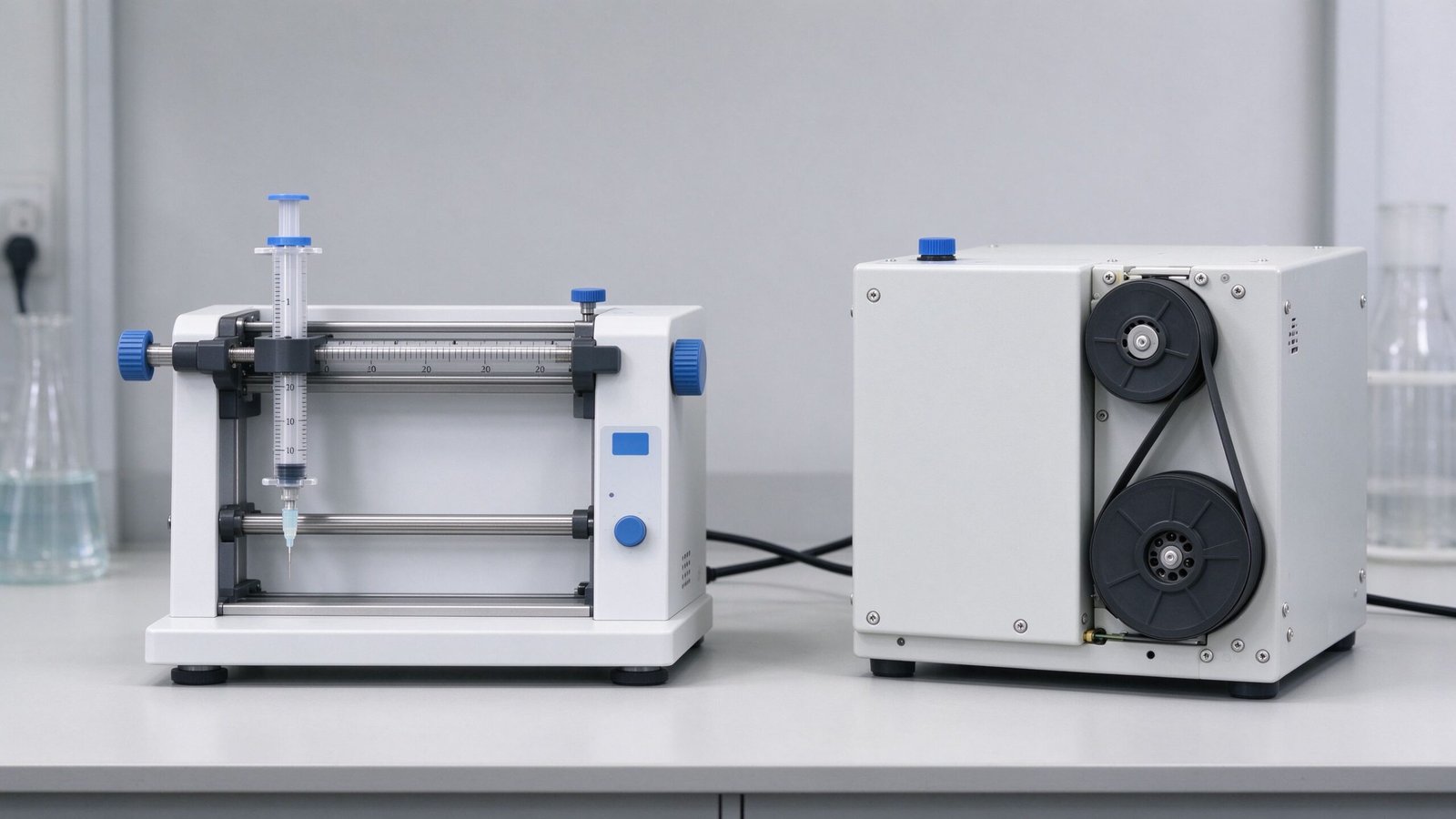
For precision fluid dispensing, the choice often comes down to a peristaltic pump or a syringe pump. Both deliver small, controlled volumes, but they work very differently, and the difference decides which one fits a given instrument. This comparison explains how the two pumps differ in how they move fluid, where each is strongest, and how to choose between them for an analytical, dosing, or dispensing design. Neither is universally better; the right one depends on whether the job is a single exact dose or a continuous metering task.
How Each Pump Moves Fluid
A syringe pump pushes a plunger into a syringe barrel, displacing a fixed volume of fluid at a controlled rate. The fluid is in a sealed, disposable syringe, and the pump only moves the plunger. A peristaltic pump compresses a flexible tube with rollers, pushing a bolus of fluid ahead. The fluid stays in the tube, and the pump never touches it.
The first difference is the reservoir. A syringe pump holds a finite, fixed volume in the syringe barrel. Once the plunger reaches the end, the syringe must be refilled or replaced. A peristaltic pump draws continuously from an external reservoir, so it can run indefinitely as long as the reservoir is fed. That single difference drives most of the application choice.
| Factor | Peristaltic pump | Syringe pump |
|---|---|---|
| Reservoir | External, continuous draw | Finite volume in the syringe |
| Wetted parts | The tube only | Syringe barrel, plunger, tip |
| Continuous operation | Yes, while reservoir lasts | Limited by syringe size |
| Small-volume precision | Good with stepper control | Excellent, by barrel displacement |
| Fluid change / cleaning | Replace or flush the tube | Replace the syringe |
| Shear on fluid | Low, gentle bolus | Very low, smooth plunger motion |
Precision and Volume Range
A syringe pump can be extremely precise for small, fixed volumes, because the displacement is set by the syringe cross-section and the plunger travel. It excels at repeating a small exact dose. Its limitation is volume: the largest syringe holds a finite amount, and for larger or continuous flow a syringe pump becomes impractical because it must be refilled. Viscosity also affects it: a very thick fluid resists the plunger, and the syringe must be sized and driven accordingly.
The wetted parts are another dividing line. A syringe pump’s fluid path is the sterile or single-use barrel and plunger, which is ideal when the fluid must not be reused or cross-contaminated. A peristaltic pump’s fluid path is the tube, which can be a cleanable or disposable line. For biotech and cell-handling work, the very low shear of both pump types is a reason either can be considered, but the single-use advantage usually points to the syringe, while the continuous-reservoir advantage points to the peristaltic.
A peristaltic pump’s repeatability is good for dosing, and with a stepper-driven head it can deliver small controlled volumes, but its absolute displacement drifts as the tube wears and depends on tube recovery. Its strength is continuous or larger-volume flow from an external reservoir, not the ultimate in microliter precision for a one-shot dose. Measurement practice for confirming either pump’s output follows the gravimetric principles that NIST’s Physical Measurement Laboratory describes: weigh the delivered volume under real conditions rather than trusting the nameplate.
Fluid Path and Cleaning
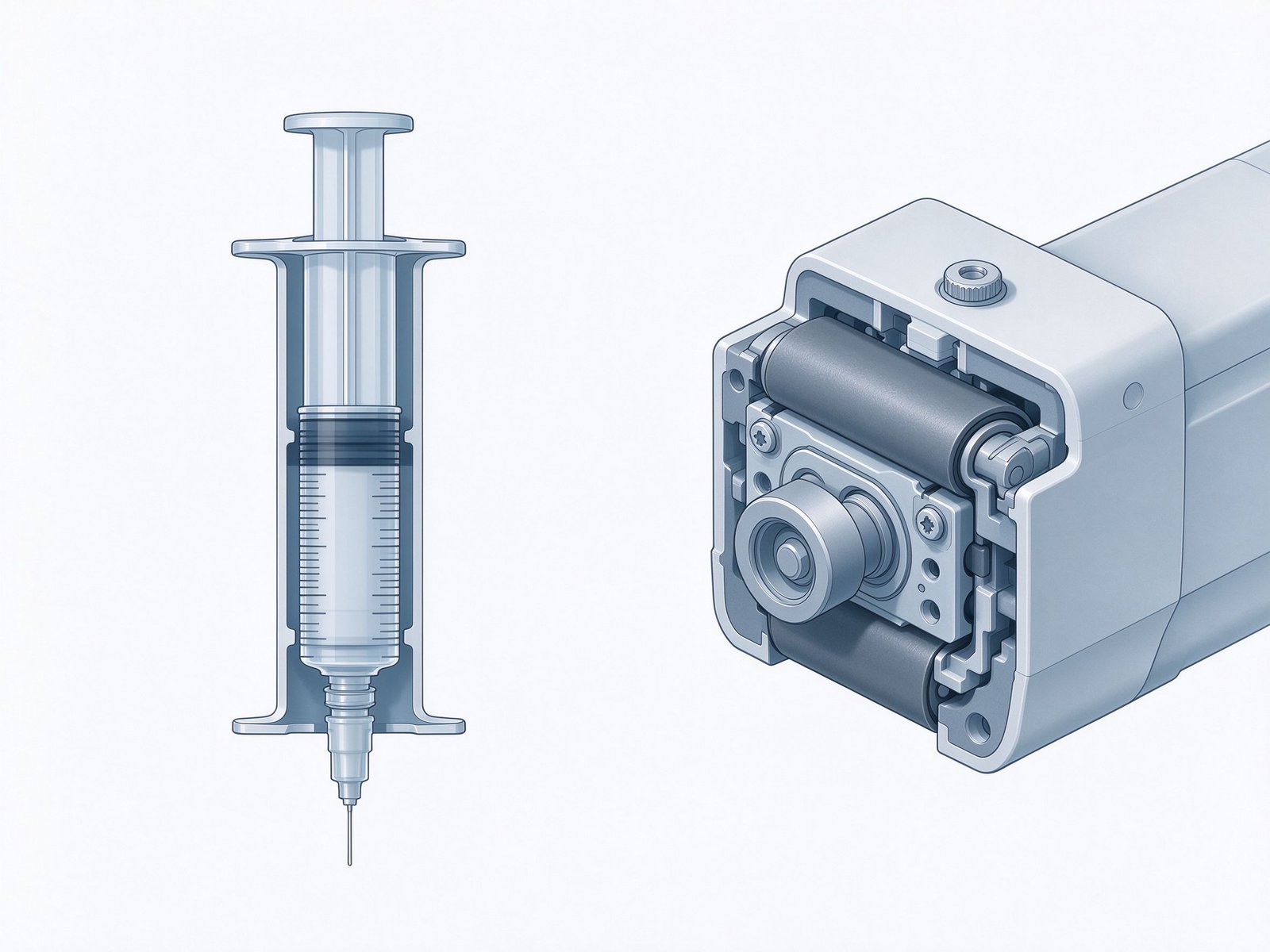
A syringe pump’s wetted parts are the disposable syringe itself, which is convenient for sterile or single-use fluids, because a new syringe means a new fluid path. For applications that use one fluid for a long run, the syringe is swapped for a reservoir and the peristaltic pump becomes the more practical choice. The peristaltic pump isolates the fluid in a replaceable tube, so cleaning between fluids means changing or flushing the tube rather than disassembling a wetted pump body.
For an OEM instrument, this shapes the consumable story. A mini peristaltic pump pairs with a reservoir and tubing, while a syringe pump pairs with a supply of syringes. The choice depends on whether the instrument refills continuously or replaces a cartridge, and on how often the fluid changes. Drivers for peristaltic heads commonly accept analog or pulse inputs, as described in motor-driver operating manuals, and stepper-based control can hold a set speed on a defined analog input, matching the controlled motion a syringe pump also provides.
Refill Interruption and Continuous Operation
This is the practical divider. A syringe pump must stop and be refilled or reloaded when the plunger reaches the end of travel. For a single-dose analyzer that is fine, because the whole process is one shot. For a process that meters fluid for hours, the refill interruption is a production gap, and refills mean human or automated handling that can introduce error or air. A peristaltic pump draws continuously from an external reservoir, so the only limit on run time is the reservoir volume.
Where the application needs unattended long runs, the peristaltic design wins by default. Where it needs a precise one-shot volume and no reservoir plumbing, the syringe pump is simpler to integrate. Many instruments actually use both: a syringe pump for the exact small dose, and a peristaltic pump to feed or drain a larger reservoir. They are not always competitors.
Cost, Consumables, and Maintenance
A syringe pump’s consumable is the disposable syringe, which is inexpensive but used repeatedly in high-volume operation. A peristaltic pump’s consumable is the tube, also a low-cost part, changed on a schedule. Over time the cost structure is similar, but the maintenance event differs: a syringe change is a manual reload, while a tube change is a planned service step. For equipment that must run with minimal operator attention, the peristaltic reservoir-and-tube approach avoids the repeated reload step.
Noise and heat also differ. A syringe pump with a leadscrew and gearbox can be audible, while a peristaltic pump head runs quietly, which matters in a clinical or laboratory environment where a quiet instrument is expected. Neither is inherently better; the choice follows the environment and the workflow.
Which Fits the Application?
Choose a syringe pump when the job is a small, exact, single-shot dose and the fluid path is single-use or sterile. It is the classic choice for precise micro-volume dispensing where a refillable reservoir is not needed. Choose a peristaltic pump when the application needs continuous flow, draws from an external reservoir, handles larger volumes, or isolates the fluid in a replaceable tube. A compact dosing pump such as a dosing pump is the usual building block for continuous metering, while the peristaltic pump tube defines the wetted path.
| Situation | Better choice |
|---|---|
| Small exact single-shot micro-dose | Syringe pump |
| Sterile / single-use fluid path | Syringe pump |
| Continuous flow from a reservoir | Peristaltic |
| Larger-volume metering | Peristaltic |
| Fluid isolation and easy tube change | Peristaltic |
| Long unattended runs | Peristaltic |
Selection Guide
- Define the required dose volume and whether it is one-shot or continuous.
- Decide whether the fluid path must be single-use or can be a flushed tube.
- Consider how the instrument is refilled: a syringe supply or a reservoir.
- Use a syringe pump for micro-volume precision; use a peristaltic pump for continuous metering.
- Confirm the choice with a gravimetric test on the real fluid.
Pressure and viscosity are the last practical checks. Syringe pumps can build pressure for pushing through filters or narrow lines, while peristaltic pressure is bounded by tube occlusion. For a free-flowing reservoir-fed process, that pressure difference rarely matters; for pushing through a restriction, it may tip the choice. In most instrument fluid handling, however, the refill model and the fluid-path single-use requirement are the deciding factors, not raw pressure.
If you are choosing between a peristaltic and a syringe pump for an analytical or dispensing instrument, contact YOORAIN with the target volume, whether the run is continuous or single-shot, and the fluid. That information helps recommend the pump type and the head and tube configuration that fits the refill and precision requirements of the instrument.