
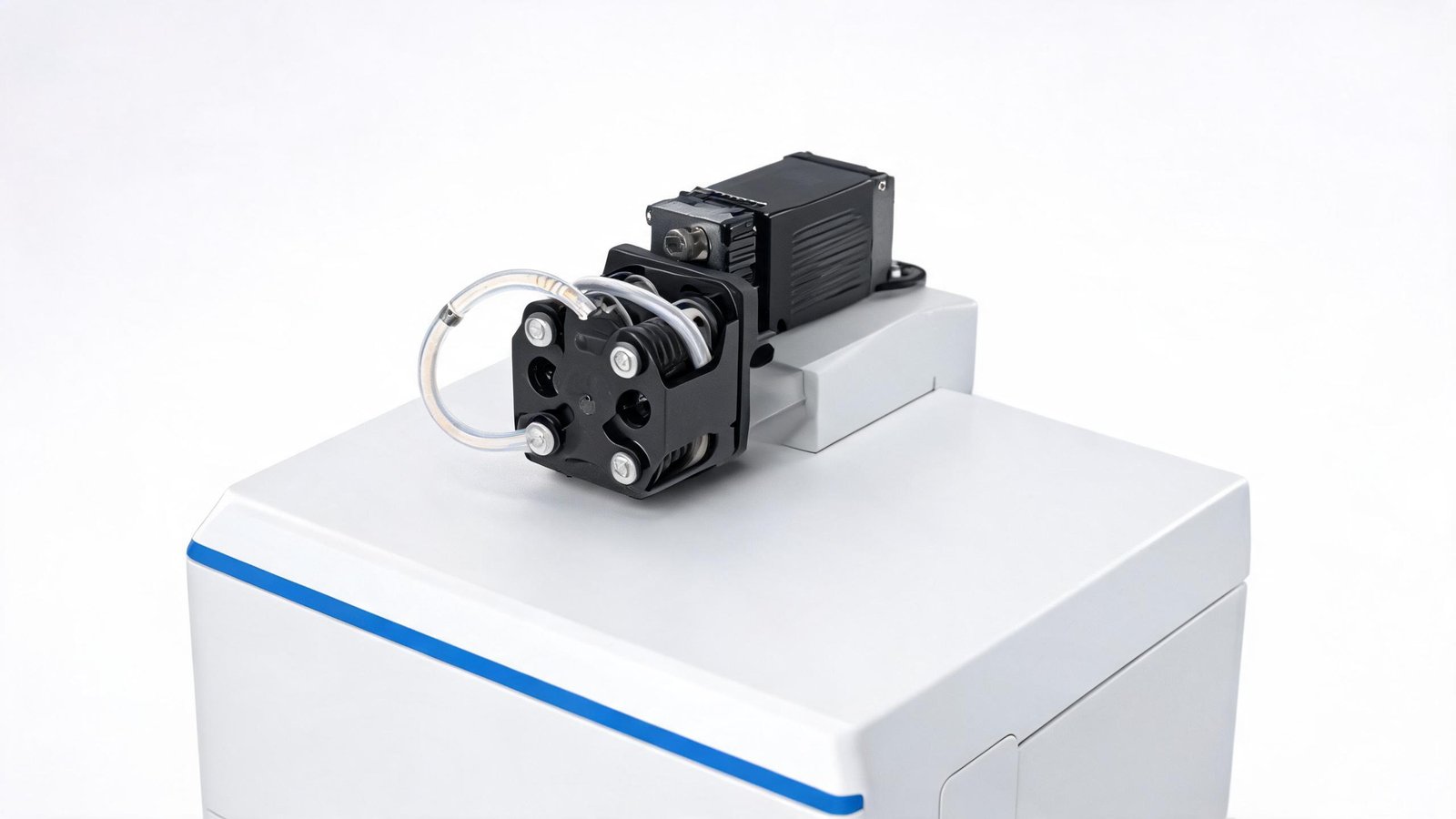
Pumps handling fluids above 1,000 centipoise behave differently from those moving water-like liquids. Tubing compression becomes harder, motor torque requirements increase, and flow accuracy depends on factors that do not matter at lower viscosities—suction lift, tube rebound time, and shear rate. For OEM equipment manufacturers building instruments that dispense glycerol, syrup, resin, lotion, or other viscous materials, selecting the right peristaltic pump at the procurement stage prevents costly redesigns and field failures.
This procurement guide outlines what buying teams and design engineers should define before approaching suppliers, how to evaluate peristaltic pump manufacturers for viscous fluid applications, and what testing protocols to run before committing to volume orders. The focus is on practical sourcing decisions for OEM integration, particularly for precision equipment destined for markets that value compact design and consistent quality—such as Japan.
What Procurement Teams Should Define
Before requesting quotes, the procurement team needs a complete fluid specification. This is not just “pump this liquid”—it is a detailed characterization that directly determines pump sizing, tubing selection, and motor requirements.
| Parameter | Why It Matters for Viscous Fluids | What to Specify |
|---|---|---|
| Viscosity range | Determines motor torque and tube size | Value in cP at operating temperature, including temperature variation |
| Shear behavior | Newtonian vs. non-Newtonian affects flow prediction | Shear-thinning, shear-thickening, or Newtonian characterization |
| Required flow rate | High viscosity reduces achievable flow at given pump speed | Target mL/min or mL/rev at operating viscosity |
| Dosing accuracy | Viscous fluids have slower tube rebound, affecting precision | Acceptable variation as percentage of target volume |
| Duty cycle | Continuous viscous dosing generates more heat in tubing | Minutes per cycle, cycles per hour, hours per day |
| Fluid compatibility | Viscous fluids may contain solvents or oils that degrade tubing | Full chemical composition or at minimum chemical family |
Without these parameters, suppliers cannot make informed recommendations. A pump that works well for 500 cP glycerol at 25 degrees C may fail completely for the same fluid at 15 degrees C where viscosity doubles. The NIST Fluid Metrology Group provides reference data and measurement standards that can help establish accurate fluid characterization.
Technical Requirements
Once the fluid is characterized, translate it into pump-level technical requirements. Viscous fluid dosing demands attention to three areas that are less critical for low-viscosity applications:
Motor torque: Higher viscosity means more force is needed to compress the tubing. A pump that works at low speed with water may stall or overheat when dosing a thick fluid. Stepper motors provide good low-speed torque and are common in OEM dosing pumps. DC motors with gear reduction are another option. The KFS DC brush motor peristaltic pump and the peristaltic pump driver line offer different motor options for varying torque requirements.
Tubing size and material: Larger bore tubing reduces the pressure needed to move viscous fluid but requires more torque to compress. The trade-off is between flow capacity and motor loading. Tubing material also affects rebound time—softer materials like silicone rebound more slowly under viscous load, which can reduce flow accuracy at higher speeds. Firmer materials like PharMed maintain occlusion better but require more motor torque.
Pump speed range: Viscous fluids often require lower pump speeds to allow tubing to fully rebound between roller passes. Running too fast causes incomplete occlusion, where the tube does not seal behind the roller and fluid slips backward. This reduces flow rate and accuracy. Specify the required speed range and confirm the pump can deliver adequate torque across that range.
Supplier Evaluation
Evaluating a peristaltic pump supplier for viscous fluid applications goes beyond comparing spec sheets. Key evaluation criteria include:
| Criterion | What to Assess | Why It Matters |
|---|---|---|
| Application experience | Has the supplier provided pumps for similar viscosity ranges? | Experience reduces the risk of misapplication |
| Tubing expertise | Can the supplier recommend tubing materials for specific fluids? | Tubing is the wearing part; expertise prevents premature failure |
| Customization capability | Can the supplier modify pump head, motor, or mounting for OEM integration? | OEM projects often require mechanical or electrical customization |
| Quality system | Is the supplier’s quality management system certified to ISO 9001? | Documented quality processes reduce variation in volume orders |
| Technical support | Does the supplier provide engineering support during integration? | Viscous fluid applications often require tuning after installation |
| Lead time and MOQ | What is the minimum order quantity and delivery lead time? | Affects project timeline and inventory planning |
For OEM projects targeting the Japanese market, where compact design and production consistency are prioritized, evaluate the supplier’s ability to hold tight tolerances across production batches. Request data on flow rate variation between units in a production lot.
Sample Testing
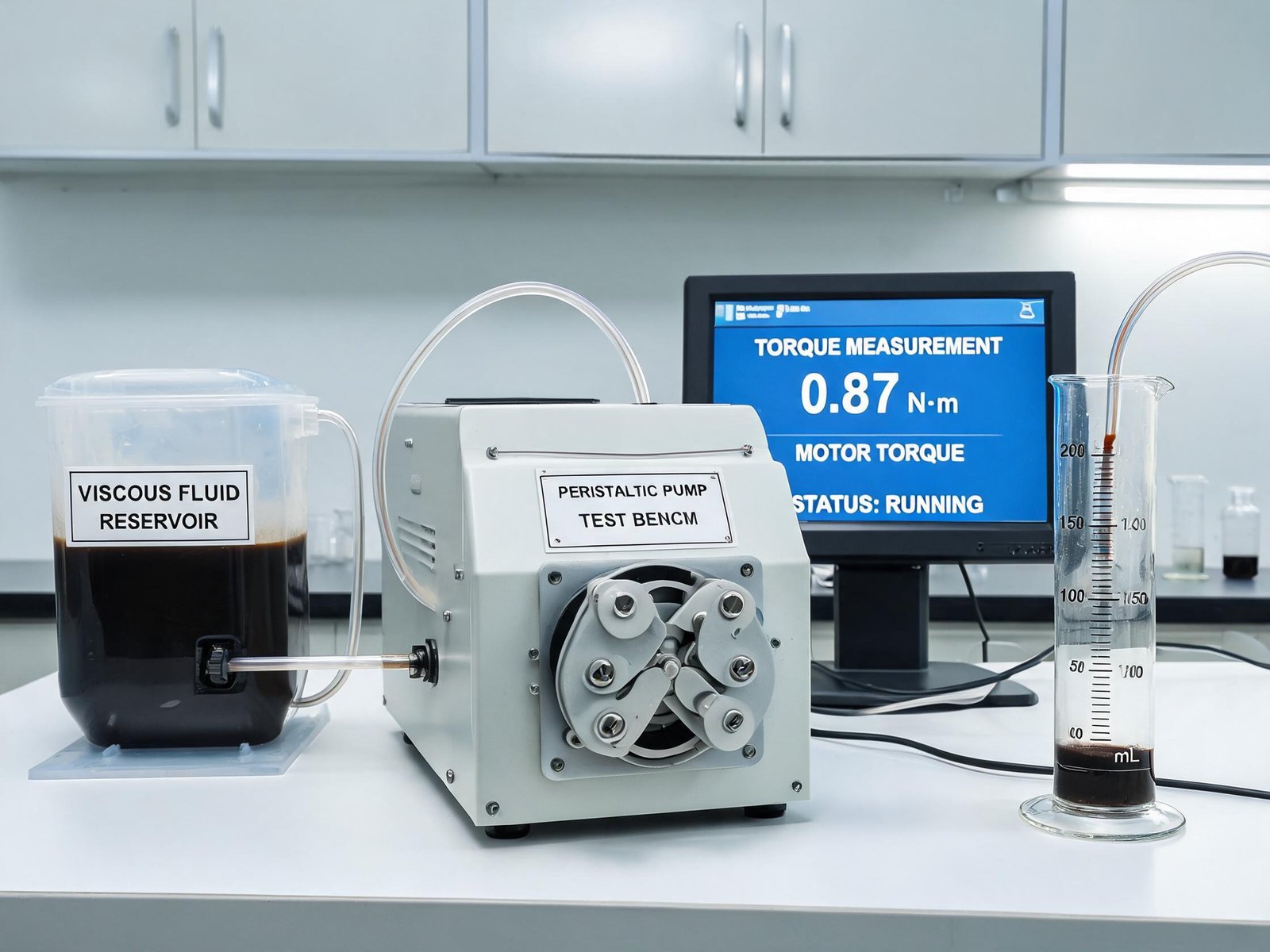
Never commit to a volume order without testing samples with the actual fluid at operating conditions. A structured sample testing protocol should include:
Flow accuracy test: Run the pump at the target speed with the actual fluid and measure dispensed volume over a defined number of revolutions. Repeat 10 times and calculate the coefficient of variation. For viscous fluids, accept no more than 3 percent variation unless the application specifically allows more.
Tubing life test: Run the pump continuously with the actual fluid and record flow rate over time. Note when flow rate drops below an acceptable threshold (typically 10 percent below initial). This establishes the tubing replacement interval for the application.
Temperature rise test: Measure motor and pump head temperature during continuous operation. Viscous fluids increase motor loading and heat generation. Verify temperatures stay within motor specifications and do not affect tubing material properties.
Start-stop accuracy test: For dosing applications, measure the volume dispensed per start-stop cycle. Viscous fluids may continue flowing briefly after the motor stops due to suction and pressure equilibration. The K15 micro peristaltic pump and K4024 mini peristaltic pump are designed for precision dispensing where start-stop accuracy is critical.
Quality Control
For OEM volume orders, establish quality control checkpoints with the supplier before production begins:
- Define acceptable flow rate variation between units (typically plus or minus 5 percent at a reference speed)
- Request 100 percent functional testing or AQL sampling on each production batch
- Specify documentation requirements: test reports, material certificates for tubing, motor specifications
- Establish a first article inspection process for the initial production run
- Define rework or replacement criteria for units failing acceptance testing
- Request traceability marking on each pump for warranty and field service tracking
Consistent quality across production batches is particularly important for OEM equipment manufacturers. A pump that performs differently in unit 100 compared to unit 1 creates field service problems and warranty costs that exceed any savings from a lower unit price.
Ordering Considerations
When finalizing the order, address these practical points:
- Safety stock: Viscous fluid applications may have shorter tubing life, requiring more frequent replacement. Stock spare tubing and pump heads.
- Lead time: Custom configurations (specific motor, mounting, or tubing) may have longer lead times than standard catalog products. Plan reorder points accordingly.
- Packaging: For OEM shipments, specify packaging that protects pump heads and tubing fittings during transit.
- Documentation: Request dimensional drawings, electrical specifications, and material declarations for compliance documentation.
- Warranty terms: Clarify what the warranty covers—motor, pump head, tubing—and the claim process for field failures.
Practical Recommendations
- Characterize the fluid completely before approaching suppliers—viscosity at operating temperature is the single most important parameter.
- Test samples with the actual fluid at the actual operating speed and duty cycle; do not rely on catalog flow rate data measured with water.
- Specify tubing material explicitly and verify chemical compatibility with the fluid, not just the viscosity.
- For high-viscosity applications, favor pumps with stepper or geared DC motors that maintain torque at low speeds.
- Build a tubing replacement schedule based on test data, not guesswork, and stock spares accordingly.
- Choose a supplier who can provide engineering support during integration and customization for OEM-specific requirements.
- For Japanese OEM customers, confirm that the supplier can meet batch-to-batch consistency requirements and provide documented test data.
If you are developing equipment that handles viscous fluids, you can contact YOORAIN to discuss the dosing requirements of your system, including viscosity range, flow targets, and integration constraints.