
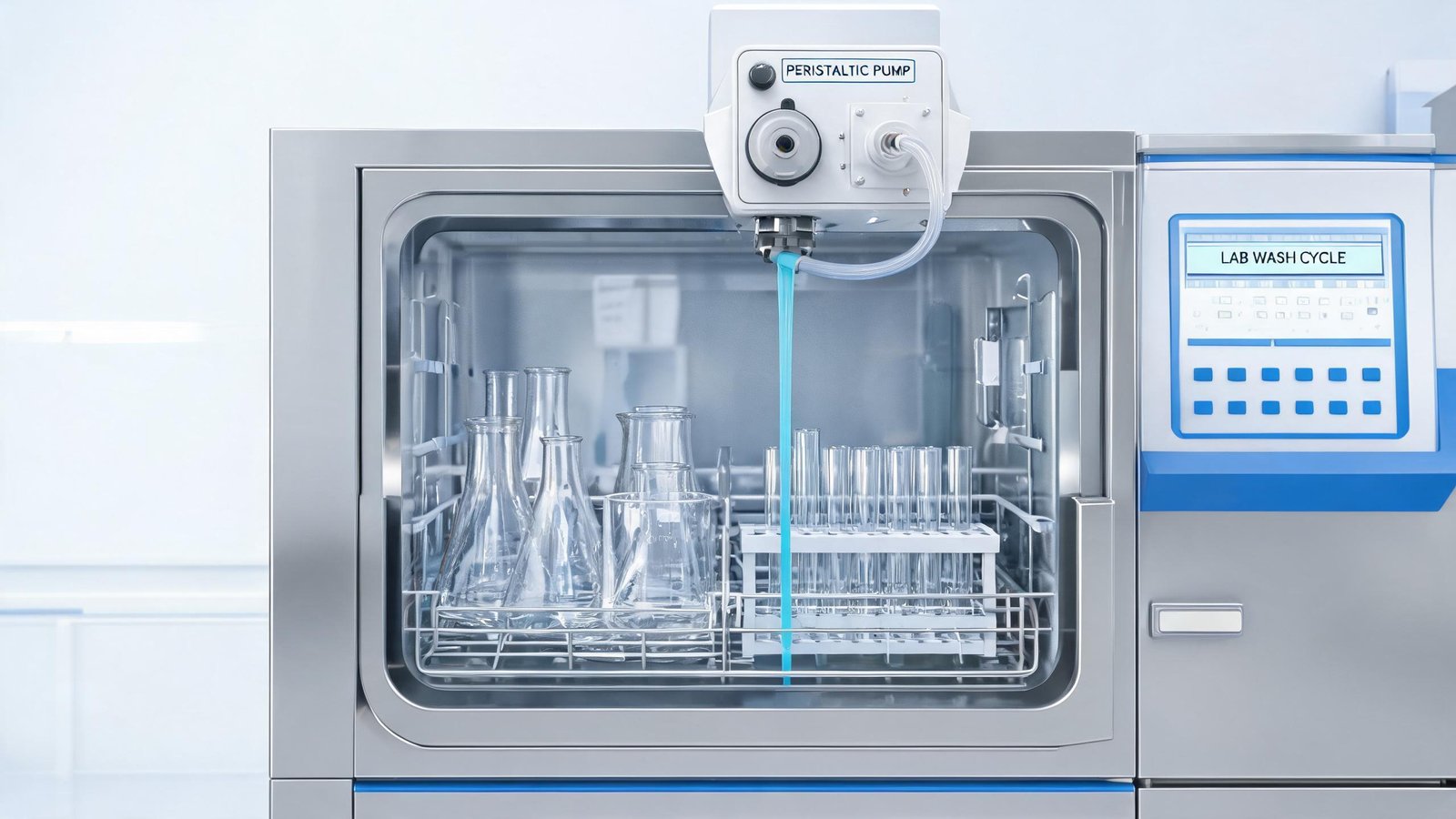
Laboratory glassware washers rely on precise chemical dispensing to clean and neutralize contamination on beakers, flasks, and pipettes. The pump that delivers detergent and neutralizer determines whether each wash cycle meets reproducibility requirements. For OEM engineers designing glassware washing equipment, selecting the right peristaltic pump involves balancing dosing accuracy, chemical compatibility, tubing longevity, and mechanical integration within a constrained enclosure.
What the Application Requires
Glassware washers typically run two independent dosing channels: one for alkaline detergent and one for acid neutralizer. Each channel needs a dedicated pump because mixing these chemicals inline causes precipitation that clogs fluid paths. The peristaltic pump is well-suited here because the fluid contacts only the tubing interior, keeping the pump mechanism isolated from corrosive cleaning agents.
The wash cycle depends on consistent detergent volume per run. If dosing drifts, glassware may carry chemical residue into subsequent experiments. NIST documentation on cleaning precision glassware notes that phosphate residues from detergents can interfere with meniscus readings and leave deposits that are difficult to remove. This makes dosing repeatability a functional requirement, not just a convenience.
Key application parameters for glassware washer pumps include:
| Parameter | Typical Requirement | Why It Matters |
|---|---|---|
| Detergent volume per cycle | 5–50 mL depending on chamber size | Determines cleaning effectiveness and chemical cost |
| Neutralizer volume per cycle | 5–30 mL | Neutralizes alkaline carryover before rinse |
| Dosing accuracy | ±2% or better | Prevents under-dosing or chemical waste |
| Tubing life | 500–2000 hours of operation | Reduces maintenance frequency in lab environments |
| Noise level | Below 55 dBA | Laboratories often operate near washers |
Key Pump Selection Factors
When selecting a K15 micro peristaltic pump or similar compact unit for glassware washer integration, engineers should evaluate several factors that directly affect wash performance.
First, consider the flow rate range. Glassware washers do not need high flow; they need controlled, repeatable dispensing. A pump delivering 0.5 to 50 mL/min covers most washer configurations. The peristaltic pump flow rate should match the programmed cycle volume and dispensing time window. If the pump runs too fast, the chemical splashes and may not distribute evenly. If too slow, the cycle time extends beyond the acceptable window.
Second, evaluate the motor type. Stepper motors provide precise speed control and hold position when stopped, preventing siphoning between cycles. DC motors are simpler and cost less but offer less speed resolution. For a dual-channel washer where each pump dispenses different chemicals at different times, independent motor control is necessary.
Third, assess the physical envelope. Glassware washers have limited internal space. The pump must fit alongside heaters, spray arms, circulation pumps, and electronic controls. A housed peristaltic pump design protects the mechanism from moisture and simplifies mounting.
Flow and Pressure Considerations
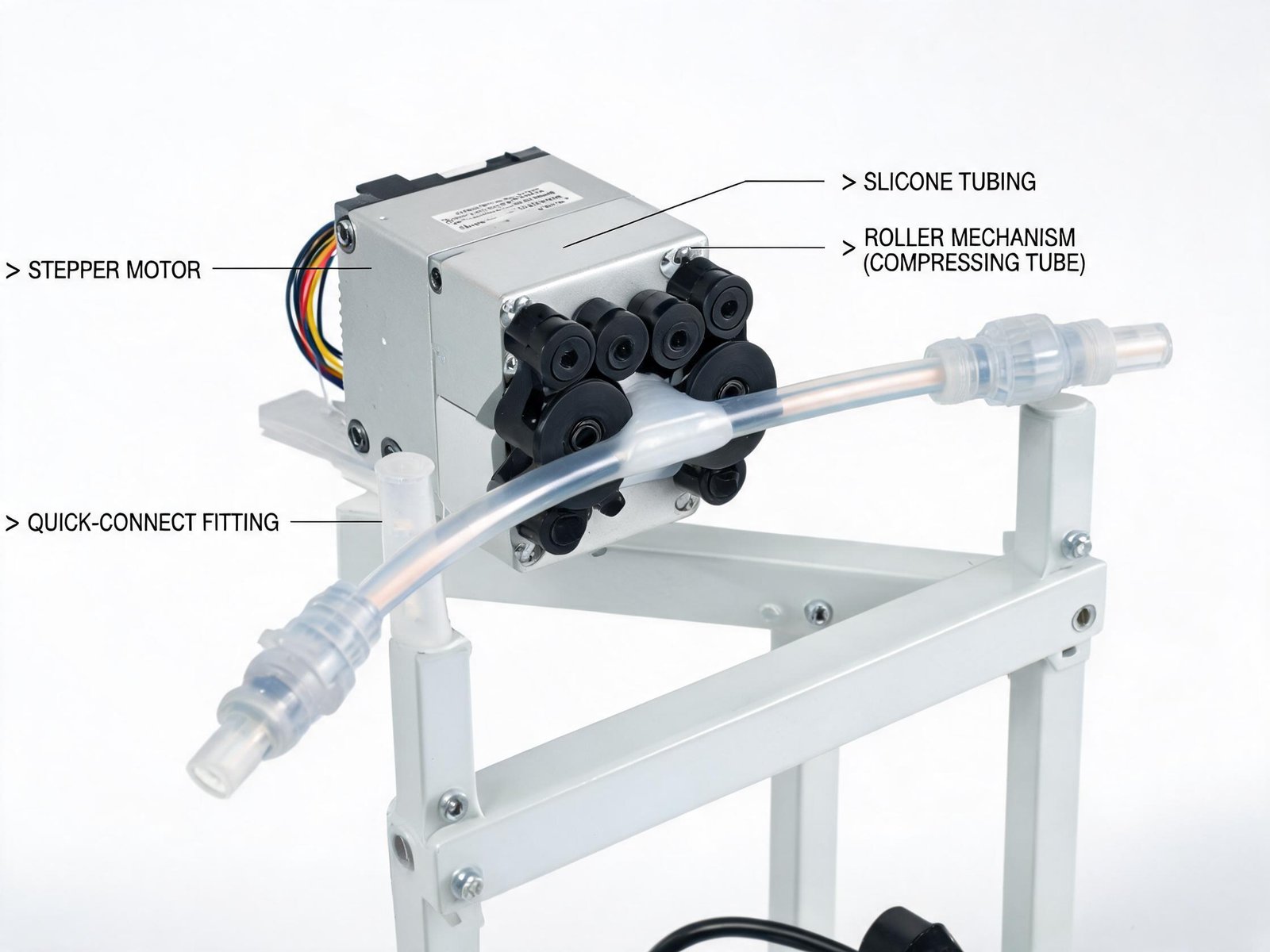
Peristaltic pumps generate flow by compressing tubing between rollers and a track. The flow rate depends on tube inner diameter, number of rollers, roller diameter, and rotational speed. For glassware washer applications, the system pressure is low — typically under 1 bar — because the dispensing path empties into the wash chamber through a nozzle or spray arm.
Low system pressure means standard-wall silicone tubing is usually sufficient. However, if the dispensing path includes a check valve or filter, the additional backpressure affects flow accuracy. Engineers should verify flow at the actual discharge point, not at the pump outlet, because tubing length and fittings introduce losses.
The following table compares tubing sizes and their impact on dispensing performance:
| Tubing ID | Flow per Revolution | Suitable Cycle Volume | Pressure Capacity |
|---|---|---|---|
| 1.6 mm | ~0.05 mL | 1–10 mL | Up to 3 bar |
| 2.4 mm | ~0.15 mL | 5–30 mL | Up to 3 bar |
| 3.1 mm | ~0.30 mL | 10–50 mL | Up to 2 bar |
| 4.8 mm | ~0.80 mL | 20–100 mL | Up to 2 bar |
Flow calibration at installation is necessary because actual dispensed volume varies with tubing material, temperature, and mechanical tolerance. Gravimetric calibration — weighing dispensed water over a set number of revolutions — provides a baseline. OSHA standards for occupational exposure to hazardous chemicals in laboratories require that chemical handling equipment function as intended, making calibration verification part of compliance documentation.
Tubing and Fluid Compatibility
Tubing selection for glassware washers depends on the chemicals being dispensed. Alkaline detergents used in lab washers typically have pH 11–13. Acid neutralizers are often citric or phosphoric acid solutions at pH 2–4. Silicone tubing handles both ranges adequately but has different wear characteristics depending on the surfactant package.
For applications requiring longer tubing life, chemical-resistant pump tubing in materials like Viton or PharMed handles aggressive detergents better than standard silicone. The trade-off is higher tubing cost and reduced flexibility, which can affect roller compression and flow consistency.
Tubing replacement intervals should be documented in the washer maintenance schedule. As tubing wears, the wall thickness decreases at the compression points, reducing flow per revolution. If the washer controller does not compensate for this drift, dosing accuracy degrades over time. The NIST Good Measurement Practice for cleaning precision glassware emphasizes that glassware cleanliness depends on consistent cleaning agent delivery, which in turn depends on maintained dispensing equipment.
Integration Considerations
Integrating a peristaltic pump into a glassware washer involves mechanical, electrical, and control system decisions.
Mechanical: The pump should mount on a vibration-damped bracket to minimize noise transmission through the washer chassis. The K25 compact peristaltic pump and similar small-frame units fit within standard washer enclosures. Quick-connect tubing fittings reduce service time when replacing tubing.
Electrical: The pump motor requires a dedicated drive circuit. For stepper-driven pumps, the washer controller sends step pulses to control volume. For DC-driven pumps, a PWM signal controls speed. Power supply sizing should account for stall torque — the pump must start reliably even when tubing is cold and stiff.
Control: The washer controller should track pump revolutions to calculate dispensed volume, rather than relying on time-based dispensing. Revolution counting compensates for speed variation caused by voltage fluctuations or mechanical resistance changes. A priming cycle at the start of each wash program ensures the tubing is filled and air pockets are expelled before the dosing count begins.
Safety: The washer should include a leak sensor beneath the pump area. If tubing fails, leaked chemical can damage electronics or create a safety hazard. The CDC laboratory safety resources provide guidance on chemical handling protocols that apply to equipment design. The pump drive should also include a stall detection feature that halts the motor if the roller mechanism jams, preventing motor burnout.
Engineering Checklist
Before finalizing a pump specification for a glassware washer, confirm the following:
- Flow range: Does the pump deliver the required volume within the programmed dispensing time?
- Accuracy: Has gravimetric calibration confirmed ±2% or better repeatability at the discharge point?
- Tubing compatibility: Is the tubing material rated for continuous contact with both detergent and neutralizer at operating temperatures?
- Tubing life: What is the expected replacement interval, and does the controller track cumulative run hours?
- Motor type: Does the motor provide sufficient speed resolution for the smallest required dose volume?
- Mounting: Does the pump fit within the washer enclosure with adequate clearance for tubing replacement?
- Drive interface: Is the control signal compatible with the washer controller (step pulses, PWM, analog voltage)?
- Leak protection: Is a leak sensor installed beneath the pump area with an alarm interlock?
- Noise: Has the assembled pump been measured at the target duty cycle to confirm it meets the laboratory noise target?
- Flow verification: Is there a procedure to verify dispensed volume after tubing replacement?
If you are developing laboratory glassware washing equipment and need a compact dosing pump, contact YOORAIN with your required flow range, tubing specifications, and integration constraints. The team can provide pump configurations matched to your washer architecture, including options for dual-channel dispensing and stepper motor control.