
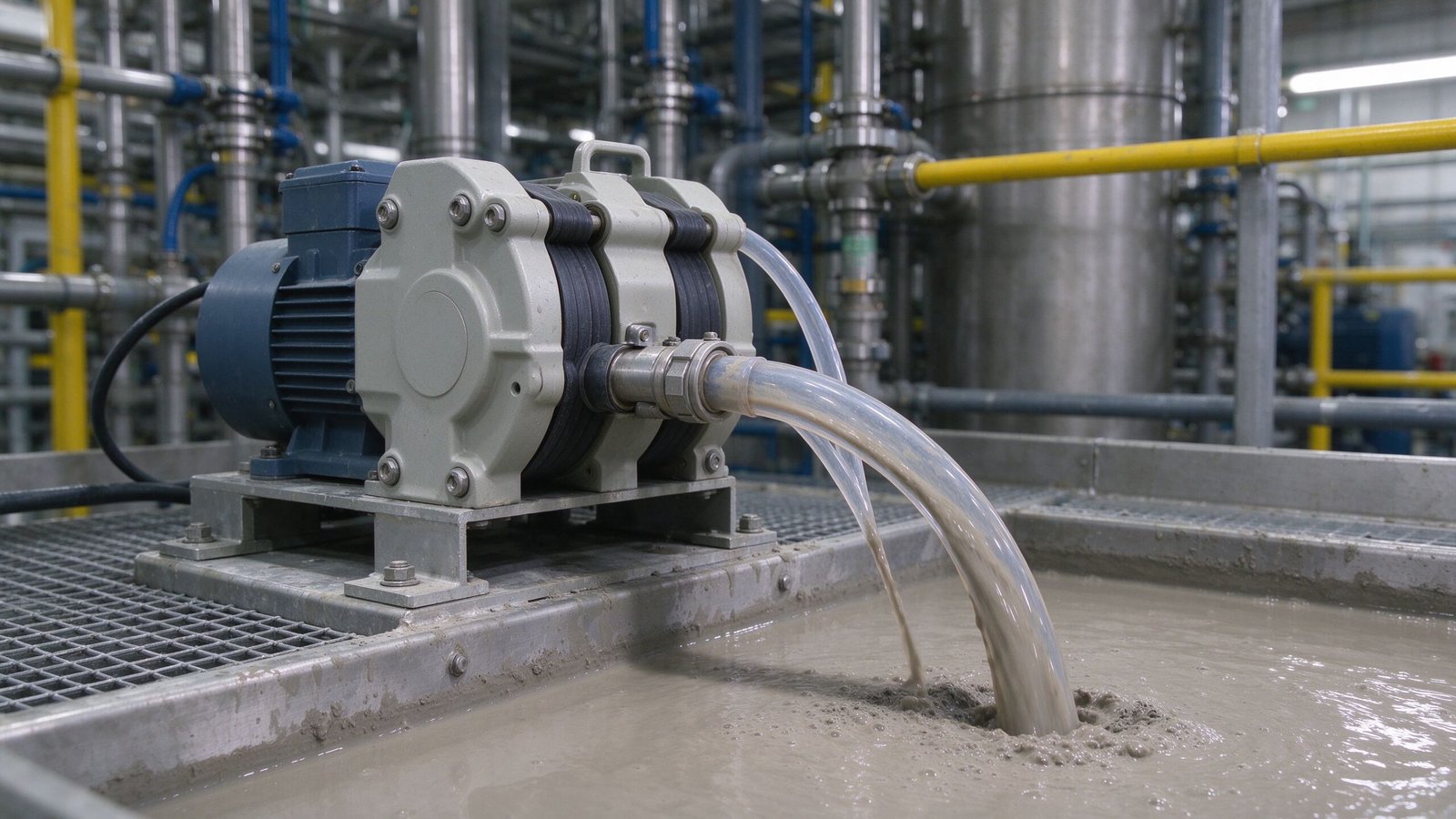
Pumping an abrasive slurry is where peristaltic pumps prove themselves, and where they fail fastest. A pump that moves clean water without complaint can chew through its tubing in days when the fluid carries ceramic powder, mining tailings, pigment, or grinding grit. The reason is not the motor or the head; it is the tube being flexed while solid particles are crushed between the roller and the bed. This engineering reference explains how slurries wear peristaltic tubing, how speed and bore change that wear, and how to size a pump that survives abrasive service rather than one that merely moves the fluid on a datasheet.
Why Slurries Wear Peristaltic Tubing Faster
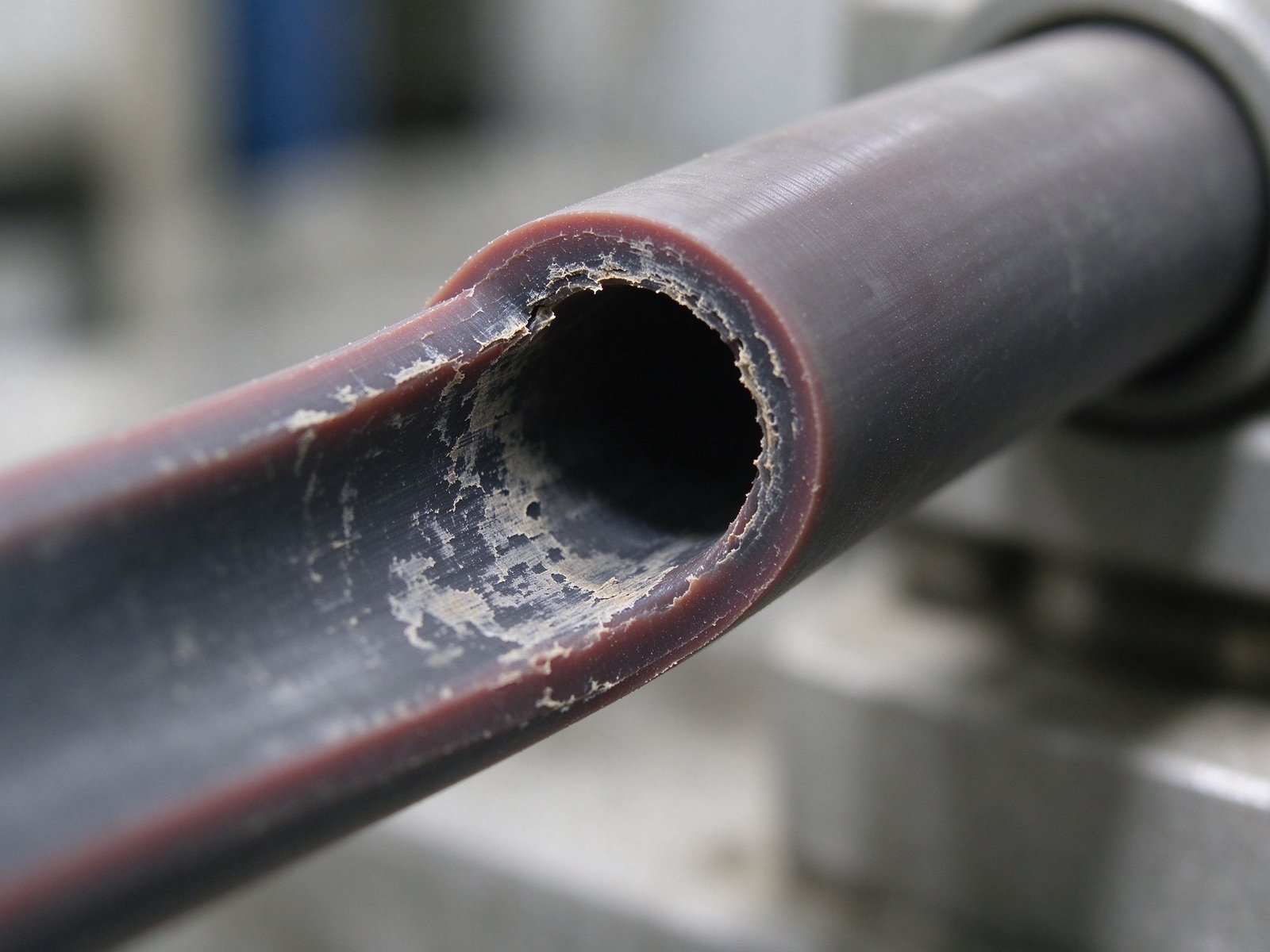
In a clean fluid, the tube flexes and returns; the wall sees bending fatigue, and that is the wear mechanism. In a slurry, the tube also contains solid particles. Every time a roller passes, it squeezes the tube flat, and the particles inside are momentarily crushed against the wall. That abrasion cuts the tube life far below what a clean-fluid duty would give. The wear is not uniform: the tube thins on the pressure side where the roller pinches it, and once a thin spot develops, it ruptures.
This changes the sizing logic. A clean-fluid pump is sized by flow and speed; a slurry pump must be sized to keep the particle impact mild. Larger bore, slower speed, and softer-running rollers are the levers. A large-flow peristaltic pump on a wide tube, turning slowly, outlasts a small pump spinning fast even when both deliver the same milliliters per minute.
| Wear mechanism | Clean fluid | Abrasive slurry |
|---|---|---|
| Main wear | Bending fatigue | Particle abrasion at the pinch point |
| Where it fails | Uniform wall thinning | Localized thin spot, then rupture |
| Effect of high speed | Modest | Sharp, disproportionate increase in wear |
| Effect of small bore | Fine | Higher velocity, more particle impact |
| Typical tube life | Long, predictable | Short, must be planned |
Particle Size and Concentration Matter
Not all slurries are equal. A fine 5-micron pigment is a milder duty than a 100-micron grinding grit at 30 percent solids. The larger the particles and the higher the concentration, the harder the tube works. A slurry that settles also creates problems on the suction side: the pick-up draws concentrated solids at the bottom of the tank, and the pump sees a more abrasive slug than the average fluid would suggest.
The sizing implication is that you choose the tube for the worst-case concentration, not the average. If the tank is poorly mixed, the pump should be expected to handle a concentrated slug. A wide-bore tube lowers the fluid velocity, which both reduces particle impact and helps the solids stay suspended. The peristaltic pump tube should be chosen with the abrasive duty in mind, and the tube wall should be on the thicker side of the approved range rather than the thinnest.
Speed Is the Biggest Lever
If one rule governs slurry service, it is slow down. Every roller pass is a compression event, and in a slurry each pass also crushes particles. Halving the speed does not halve the wear; it cuts it more than proportionally, because the tube also runs cooler and the particles have more time to move out of the pinch point. A pump that would last weeks on clean water at 100 RPM may last hours on slurry at the same speed, but it can last weeks at 30 RPM on the same fluid.
This is why oversizing the head is the standard slurry move. Pick a head whose displacement at 20 to 40 RPM matches the required flow, rather than one that reaches the flow at 100 RPM. The drive then has margin, the tube runs cool, and the wear drops. A peristaltic pump driver that holds a steady low speed is essential; a cheap controller that hunts at low RPM turns a slurry pump into a pulsing, uneven metering device. The speed-setting and control approach described in the motor-driver operating manual is what makes that low-speed operation repeatable rather than just slow.
| Operating choice | Effect on slurry wear | Recommendation |
|---|---|---|
| Small bore, high RPM | Severe | Avoid for abrasive duty |
| Large bore, low RPM | Mild | Preferred default |
| Thin-wall tube | Faster rupture | Use thicker approved wall |
| Fixed occlusion, tight | More crush, more wear | Set to just seal, not over-tight |
| Long, narrow suction line | Starves, draws concentrated solids | Short, wide suction |
Occlusion: Seal Tight Enough, Not Too Tight
The occlusion on a slurry pump is a compromise. Too loose, and the pump slips and loses flow, especially as the tube wears. Too tight, and every roller pass grinds particles harder into the wall, accelerating wear. The correct setting is the minimum compression that still seals and delivers the rated flow on the actual slurry, confirmed by a weighed-volume check. On a clean-fluid pump you can over-set the occlusion for safety; on a slurry pump over-setting shortens the tube life sharply.
This is an adjustment that should be checked after the first few hours of operation, because a new tube compresses and beds in. A tube that was set correctly on day one may slip by day three, and a tube that was set tight on day one may wear out by day three. Re-check the occlusion and the delivered flow after the break-in period, and set the maintenance schedule around that observation. This gravimetric, point-of-use verification is the approach described by NIST’s Physical Measurement Laboratory, and it is the only reliable way to confirm the pump is doing what the spec sheet claims under real slurry conditions.
Tubing Materials for Abrasive Service
The tube material for slurry is chosen for abrasion resistance and chemical compatibility, not for flexibility alone. A soft, flexible tube is easy to occlude but wears fast against grit; a harder, more abrasion-resistant tube lasts longer but needs a higher seal pressure. The material should be matched to both the slurry chemistry and the particle hardness. A tube that swells in the chemical also becomes soft and wears faster, so chemical compatibility is the first filter, and abrasion resistance is the second.
For an abrasive slurry that is also chemically aggressive, the combination is hard to satisfy in one material, and the answer is often a shorter tube-replacement interval rather than a perfect tube. A quick-change head makes that interval bearable, because swapping the tube takes minutes rather than tools. The material-compatibility and fluid-handling verification approach described by the U.S. National Science Foundation’s engineering research is to confirm the material against the actual slurry under real conditions, not against a generic chart.
Tubing Pump vs Hose Pump for Slurries
At high flow or very abrasive duty, the choice shifts from a tubing pump to an industrial hose pump. A tubing pump uses a short flexible tube pinched between rollers; a hose pump uses a full-radius hose through which rollers run, and the hose is the pressure-containing part. The hose pump handles larger particles and higher flow, but it is a different animal: it needs shoe lubrication, it costs more, and it is not the right answer for a bench-scale dosing duty. A tubing pump on a wide bore is correct for a few hundred milliliters to a few liters per minute; a hose pump is correct for tens or hundreds of liters per minute of coarse slurry.
| Duty | Tubing pump | Hose pump |
|---|---|---|
| Flow range | mL/min to a few L/min | Tens to hundreds of L/min |
| Particle size | Fine to moderate | Coarse, large solids |
| Maintenance | Quick tube swap | Hose replacement, lubrication |
| Cost | Lower | Higher |
| Best for | Dosing, metering, skids | High-volume coarse slurry transfer |
Calibration Drift on Slurry Duty
A slurry pump drifts. As the tube wears, the delivered flow changes, and the drift accelerates as the thin spot develops. A pump that was calibrated on day one will under-dose by day five, and by day ten it may be dosing half what it was. This is not a defect; it is the wear mechanism showing up in the flow. The maintenance plan must account for it: either re-calibrate on a schedule, or monitor the delivered volume and change the tube when the drift crosses a threshold.
For a process where the dose matters, a fixed-interval tube change is safer than a drift-watch, because the last stretch of tube life is when rupture risk is highest. The actual interval is found by running the pump on the real slurry and logging the delivered volume against time; that number is specific to your fluid, speed, and tube, and it cannot be taken from a catalog. A controlled-speed driver, as described in a peristaltic pump driver reference, makes that calibration data reproducible, because the speed is the same from one run to the next.
Suction and Discharge on Slurry Duty
The plumbing matters more on a slurry pump than on a clean-fluid pump. A long, narrow suction line lets the pump draw air or let the solids settle, and a sharp bend at the barb becomes a wear point where the slurry erodes the fitting. The suction should be short, wide, and routed straight to the head, with pick-up positioned so it does not sit in the settled solids layer but draws well-mixed fluid. The discharge should avoid a high, restricted lift that pushes against the tube’s pressure limit.
A flooded suction — mounting the tank above the head — removes the suction problem entirely and lets the pump work the way it was designed. For a slurry that settles, keeping the tank agitated also prevents the pump from seeing a concentrated slug. A small peristaltic pump on a bench skid, with a short wide suction and a level tank, runs far more reliably than the same pump on a tall, narrow lift.
Temperature and Its Effect on Slurry Wear
Heat accelerates every failure mode in a slurry pump. A tube running warm softens, and a soft tube wears faster against grit. The friction of the rollers, the compression of the fluid, and the ambient plant temperature all add up. A pump that runs cool on a clean fluid at the same speed can run warm on a slurry, because the particles dissipate extra energy as they are crushed. That warmth is an early warning: if the head is too hot to hold after an hour of slurry duty, the speed is too high or the occlusion is too tight, and the tube will fail long before its expected interval.
The conservative move is to size the head so it runs at a speed that keeps the body near ambient. A larger head at a slower speed not only compresses the tube less often; it also runs cooler, which protects the tube material from thermal softening. In a warm plant or near a process heater, add margin rather than running at the design edge. The material-fatigue principle described by the U.S. National Science Foundation’s engineering research applies here: fatigue life drops as temperature rises, so a slurry pump in a warm room needs more margin than the same pump in a cool lab.
Roller and Bed Materials
The parts that touch the tube matter in slurry service. A hard roller and a smooth bed pinch the tube cleanly; a worn or scored bed does not, and the tube slips and wears unevenly. In slurry duty, the rollers see the same abrasive environment as the tube, because particles can work their way into the roller path. A roller that picks up a grain of grit starts to score the tube every revolution, and the wear accelerates until the tube fails.
This is why keeping the head clean and the rollers free of grit is part of slurry maintenance. Wiping the head after a run, keeping the cover closed, and not letting slurry dry on the rollers all extend the life of both the rollers and the tube. A head with a simple, accessible roller design makes this cleaning quick; a sealed head traps grit and hides the wear. When specifying a slurry pump, ask how the rollers are removed and cleaned, and whether the bed can be inspected without tools.
Electrical and Control Considerations
A slurry pump needs a drive that holds a steady low speed and that does not stall when the tube momentarily resists compression. A cheap DC motor that slows down under load changes the delivered volume and makes the dose unpredictable. A controlled drive with current feedback holds the speed regardless of the tube’s resistance, which is what keeps the flow repeatable across the tube’s life. For a process that ramps up and down, a soft-start also helps, because a sudden start slams the rollers into a stationary column of slurry and shocks the tube.
For a dosing skid, the control should also be able to count shots or track run time, so the maintenance interval is based on cycles rather than the calendar. A peristaltic pump driver with a known speed and run time makes the cycle count easy to track, and the speed-setting approach in the motor-driver operating manual describes how to set that speed and read the load.
| Control feature | Why it matters in slurry |
|---|---|
| Steady low RPM | Repeatable dose despite tube resistance |
| Current feedback | Detects a stalled or blocked head |
| Soft start | Reduces shock on the new tube |
| Cycle or time tracking | Sets tube changes by duty, not calendar |
| Adjustable occlusion access | Re-seal after the tube beds in |
Worked Sizing Example
Say the duty is dosing 500 mL/min of a 20 percent ceramic slurry into a lapping process, running eight hours a day. A small head on a 2 mm tube might reach 500 mL/min at 90 RPM, and the tube would wear out in a day or two. A mid-size head on a 6 mm tube reaches 500 mL/min at 25 RPM, and the tube lasts weeks. The larger head costs a little more and takes more space, but the avoided tube changes and the avoided process downtime pay it back fast.
The check after choosing is: the head runs cool after an hour, the weighed delivery is within tolerance, and a fresh tube and a tube at 80 percent of life deliver the same volume. If the head is hot or the delivery has already drifted at the break-in check, the sizing or the occlusion is wrong and should be corrected before the pump goes into regular service.
Procurement Checklist for Slurry Duty
When buying a peristaltic pump for abrasive service, the catalog flow number is the least useful datum. The useful numbers are the displacement at the low RPM you will actually run, the tube materials approved for your slurry chemistry, the roller and bed materials, and the expected tube life on a similar duty. Ask the supplier for the displacement per revolution on the tube you plan to use, not the maximum flow on the thinnest tube at the highest speed. Maximum flow numbers are marketing; displacement at operating speed is the engineering number.
Also ask for a sample head and a length of the recommended tube, and run your own slurry through it for a shift. The wear you see on your own fluid is the only number that matters, because particle shape, concentration, and chemistry vary too much to predict from a catalog. The point-of-use verification approach, as described by NIST’s Physical Measurement Laboratory, is the same principle: measure on the actual fluid, not on a bench with water. A mini peristaltic pump as a sample unit lets you do that bench test cheaply before committing to a production quantity.
Common Questions
Can a peristaltic pump handle any slurry? It handles fine to moderate slurries well. Very coarse, high-concentration, or high-flow slurries move to a hose pump. Match the pump class to the particle size and the flow.
How often should I change the tube? Find the interval by running the pump on the real slurry and tracking the delivered volume. Change the tube on a fixed schedule before drift or rupture becomes a problem, not after.
Does a harder tube last longer? Abrasion-resistant tubing lasts longer, but it needs a tighter occlusion and may be harder on the rollers. Balance abrasion resistance against the seal pressure the head can deliver.
Why does my new tube already under-dose? The occlusion may be too loose after the tube bedded in, or the suction is drawing settled solids. Re-check the occlusion and the suction routing.
What to Ask the Supplier
- Which tube materials do you recommend for this slurry chemistry and particle size?
- What is the displacement per revolution at the low RPM I plan to run?
- How is the occlusion adjusted, and how do I confirm it on my fluid?
- What tube life have customers seen on a similar abrasive duty?
- Can the head be bench-tested on my slurry so the wear and flow are confirmed before production?
If you are sizing a peristaltic pump for an abrasive slurry and want the bore, speed, tube material, and head matched to your fluid, contact YOORAIN with the slurry chemistry, particle size and concentration, the required flow, and the duty cycle. We can recommend a pump head, tube, and driver combination and bench-test it on your slurry so the tube-replacement interval and the dosing accuracy are confirmed before you commit to production.