
Chromatography systems, whether high-performance liquid chromatography (HPLC) or preparative-scale separations, rely on precise solvent delivery to maintain resolution and reproducibility. The pump must deliver mobile phase at a constant flow rate, often against significant backpressure from the analytical column. While many laboratories use piston or syringe pumps for this task, peristaltic pumps offer advantages in specific chromatographic workflows, particularly where solvent compatibility, disposable fluid paths, or gentle flow profiles matter. Understanding when a peristaltic pump suits chromatography—and when it does not—helps OEM manufacturers and laboratory equipment designers make informed integration decisions.
This article compares peristaltic pumps with conventional piston and syringe pumps for chromatography solvent delivery, discusses flow control and pressure limitations, and outlines the tubing and maintenance factors that affect long-term performance.
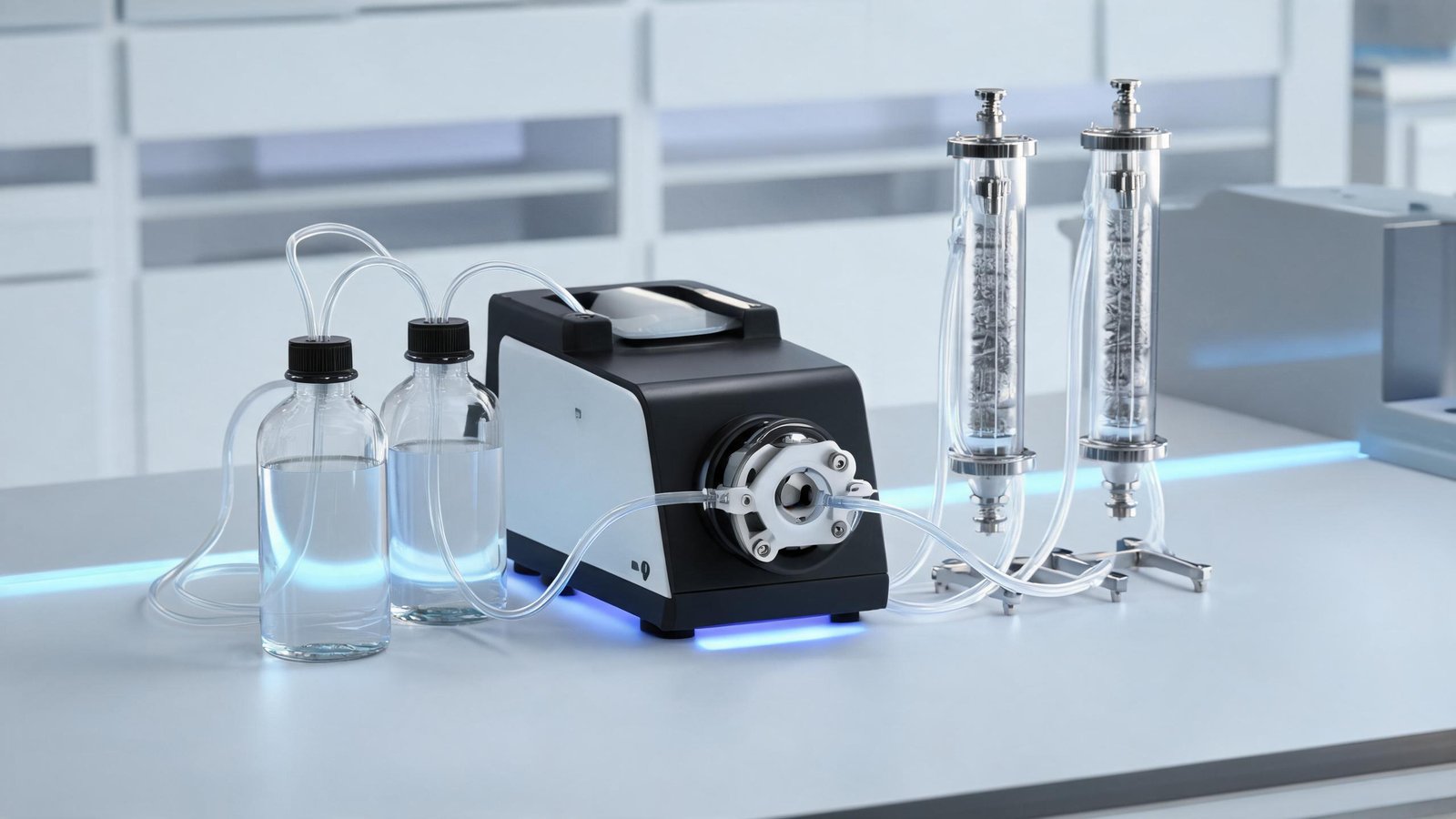
What Makes the Options Different
Piston pumps, syringe pumps, and peristaltic pumps each generate fluid flow through different mechanical principles. Piston pumps use reciprocating pistons with check valves to produce high-pressure, pulse-damped flow. Syringe pumps drive fluid from a sealed barrel using a motorized plunger, offering excellent flow stability but limited solvent capacity. Peristaltic pumps compress flexible tubing with rotating rollers, creating positive displacement without valves or seals.
For analytical HPLC, piston pumps dominate because they sustain the high pressures—often 4,000 to 6,000 psi—required to push mobile phase through tightly packed columns. Syringe pumps serve niche applications such as microfluidic chromatography or capillary electrophoresis, where flow stability at microliter-per-minute rates outweighs the inconvenience of limited solvent volume. Peristaltic pumps fill a different niche: low-to-moderate pressure applications where the solvent is corrosive, where disposable fluid paths prevent cross-contamination between sample batches, or where the chromatographic system operates at pressures below 100 psi.
Examples include ion chromatography with alkaline eluents, preparative liquid chromatography at larger scale, and certain flash chromatography systems where the column packing is relatively coarse and backpressure remains modest. USP General Chapter <621> on chromatography defines system suitability criteria that any pump must satisfy, regardless of mechanism, including flow rate accuracy and precision.
Flow Control
Flow control in chromatography directly affects retention time reproducibility. A pump that drifts by even a few percent can shift peak positions enough to fail system suitability tests. Piston pumps achieve precise flow control through electronic feedback and pulse dampeners, typically holding flow within ±1 percent of setpoint. Syringe pumps maintain similarly tight control because the plunger displacement is linear and measurable.
Peristaltic pumps control flow by adjusting roller speed and selecting tubing diameter. The relationship between speed and flow rate is approximately linear within the tubing’s elastic range, making calibration straightforward. However, flow pulsation is inherent in peristaltic pumping because fluid is delivered in discrete boluses as each roller compresses and releases the tubing. For chromatography, this pulsation can produce baseline noise in UV or conductivity detectors if the pump head does not contain enough rollers to smooth the output.
| Pump Type | Typical Flow Range | Flow Stability | Best Application |
|---|---|---|---|
| Piston pump | 0.01–10 mL/min | Excellent with dampening | Analytical HPLC |
| Syringe pump | 0.001–1 mL/min | Excellent | Microfluidics, capillary LC |
| Peristaltic pump | 0.1–100 mL/min | Good with multi-roller head | Preparative LC, ion chromatography, flash chromatography |
A micro peristaltic pump with a 10-roller head can reduce pulsation amplitude significantly compared to a 3-roller design, approaching the flow stability needed for low-pressure chromatography. For OEM instrument designers, the choice between pump types depends on whether the target application requires analytical precision or preparative throughput.
Pressure Requirements
Pressure capability is the primary limitation of peristaltic pumps in chromatography. Standard peristaltic pumps with silicone or PharMed tubing typically operate at pressures below 30 psi. High-pressure peristaltic pumps with reinforced tubing can reach 100–150 psi, but this remains far below the thousands of psi that analytical HPLC columns demand.
Consequently, peristaltic pumps are not substitutes for piston pumps in conventional analytical HPLC. Instead, they serve applications where the column is short, the particle size is large, or the mobile phase viscosity is low enough to keep backpressure within the pump’s operating envelope. Preparative chromatography, where columns are wider and particle sizes larger, often operates at 50–200 psi, making peristaltic pumps viable for loading crude extract onto the column or for step-gradient elution.
When specifying a peristaltic pump for chromatography, engineers should measure the system backpressure at the intended flow rate using the actual column and mobile phase. If the pressure exceeds the tubing’s rated limit, the tubing can collapse, causing flow starvation and potential damage to the column bed. ISO/IEC 17025:2017 requires laboratories to validate equipment performance under actual operating conditions, which includes pressure verification.
Tubing Considerations
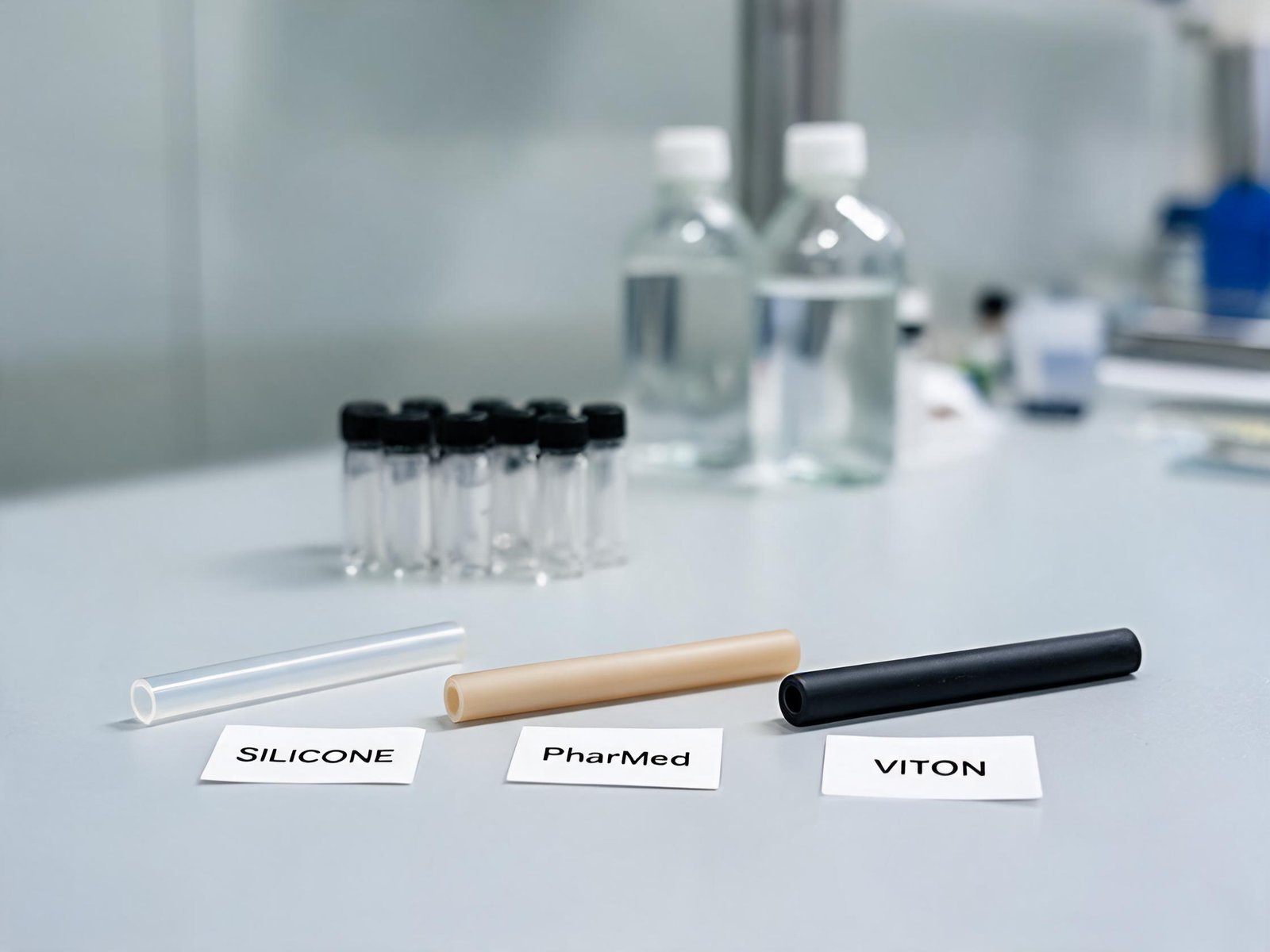
Tubing selection affects chemical compatibility, flow rate, pressure tolerance, and long-term stability. In chromatography, the mobile phase may contain organic solvents, acids, bases, or buffer salts that degrade incompatible tubing materials. Silicone tubing offers broad aqueous compatibility but swells in nonpolar organic solvents. Viton tubing resists many organic solvents but is less elastic and may exhibit shorter compression life. PharMed tubing balances chemical resistance with elasticity, making it suitable for a wide range of chromatographic eluents.
Tubing inner diameter determines the flow rate at a given pump speed. Smaller diameters provide finer flow control at low rates but require higher roller speeds to achieve larger flows, increasing tubing wear. Larger diameters handle higher flows with lower speeds but sacrifice low-flow resolution. For chromatography applications, engineers should select tubing that positions the desired flow rate near the middle of the pump’s speed range, optimizing both control resolution and tubing life.
Peristaltic pump tubing with consistent wall thickness and bore diameter is essential for reproducible retention times. Tubing lot-to-lot variation can shift flow calibration by several percent, so instrument manufacturers should specify tight dimensional tolerances and request certificate of conformance data from the tubing supplier.
| Tubing Material | Chemical Compatibility | Pressure Rating | Typical Chromatography Use |
|---|---|---|---|
| Silicone | Aqueous buffers, weak acids | Low | Ion chromatography with alkaline eluents |
| PharMed | Wide range, including oxidizing agents | Moderate | General preparative chromatography |
| Viton | Organic solvents, hydrocarbons | Moderate | Reverse-phase with high organic content |
| Reinforced | Depends on liner material | High (up to 150 psi) | High-pressure preparative systems |
Maintenance
Maintenance requirements differ substantially between pump types. Piston pumps need periodic seal replacement, check valve cleaning, and purge valve inspection. These tasks require trained service personnel and can take the chromatography system offline for hours. Syringe pumps need barrel and plunger replacement when wear causes leakage, which again involves disassembly and recalibration.
Peristaltic pumps simplify maintenance because the only wear component is the tubing. Operators can replace tubing in minutes without tools, returning the system to service quickly. This advantage is particularly valuable in preparative laboratories running multiple sample batches per day, where downtime directly reduces throughput. The trade-off is that tubing replacement is more frequent than piston seal replacement, so laboratories must factor tubing cost and inventory into the total cost of ownership.
Predictive maintenance based on tubing compression count can help laboratories schedule replacements before failure. Some pump heads with easy-load designs allow operators to change tubing without disassembling the head from the drive motor, further reducing maintenance time.
Which Option Fits the Application?
The decision between pump types should begin with pressure requirements. If the chromatographic method demands more than 150 psi, a peristaltic pump is unlikely to suffice, and a piston pump becomes necessary. For methods operating below 100 psi, the choice depends on other factors: the need for disposable fluid paths, tolerance for pulsation, maintenance accessibility, and cost constraints.
Peristaltic pumps are well suited to:
- Preparative and flash chromatography at low to moderate pressure
- Ion chromatography with corrosive alkaline eluents
- Applications requiring frequent solvent changes with minimal cross-contamination
- Laboratories prioritizing simple user-serviceable maintenance
Piston pumps remain the default for:
- Analytical HPLC with small-particle columns
- Methods requiring flow rates below 0.1 mL/min with high precision
- Systems where pulsation must be minimized for sensitive detection
Engineering Checklist
Before integrating a peristaltic pump into a chromatography system, verify the following:
- Maximum system backpressure at operating flow rate is below the pump’s pressure rating.
- Required flow rate range falls within the pump’s linear operating region.
- Tubing material is chemically compatible with all mobile phase components.
- Pulsation amplitude is acceptable for the detector sensitivity and integration method.
- Tubing replacement procedure fits the laboratory’s maintenance schedule.
- Flow calibration protocol meets the laboratory’s quality system requirements.
- Physical dimensions allow integration without obstructing column access.
Need help selecting a pump for an OEM chromatography instrument? Contact YOORAIN with your target flow range, tubing requirements, and application conditions.