
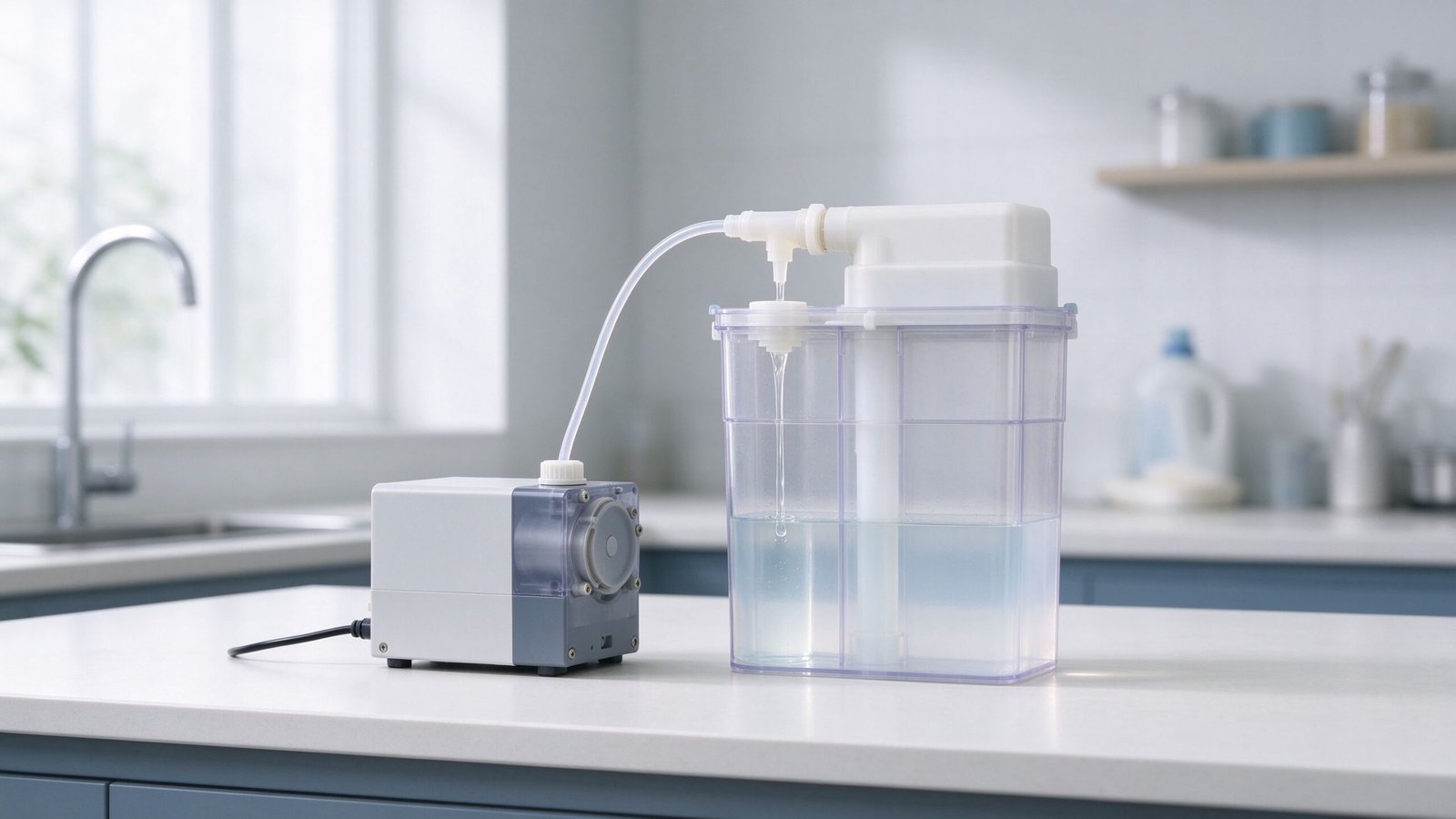
Automatic dishwashers, laundry machines, commercial dispensers, and car-wash systems all need to inject a measured shot of detergent, rinse aid, or fabric softener. A peristaltic pump is a natural fit for this job: the chemical stays sealed inside the tube, the shot volume is set by the run time, and the wetted path is cheap to replace. This application guide covers how peristaltic dosing works for detergent and softener, what to watch for on viscous and foamy fluids, and how to size the pump for an appliance or dispenser build.
Why Peristaltic Dosing Fits Detergent Dispensing
Detergent dosing is a small, repeatable shot, not a continuous transfer. A peristaltic pump dispenses a known volume by running for a set time at a known speed, and because the fluid never leaves the tube, the corrosive or foamy detergent cannot corrode a pump body or contaminate a motor. That sealed path is the main reason appliance designers choose it over a solenoid or a gear pump, which would see the chemical directly.
The same sealed path protects the user. A detergent leak stays inside the tube and the barb connections rather than weeping from a shaft seal. For a consumer appliance, that reliability matters; for a commercial dispenser, it means the service interval is a cheap tube change, not a pump replacement. A compact micro peristaltic pump is sized for exactly this kind of small, intermittent shot inside an enclosure.
| Need | Peristaltic dosing | Why it fits |
|---|---|---|
| Small measured shot | Set run time at fixed speed | Repeatable milliliter doses |
| Corrosive detergent | Fluid sealed in tube | No wetted metal or seal to corrode |
| Low maintenance | Tube is the consumable | Cheap swap, no pump rebuild |
| Mounted inside an appliance | Small, 12V/24V drive | Fits a panel or enclosure |
Working With Viscous and Concentrated Detergents
Detergents range from thin rinse aid to thick concentrated gel and fabric softener, and the pump behaves differently on each. A thin fluid doses easily but can slip past an under-compressed roller; a thick softener needs more suction and a wider bore tube, and it moves slowly through a narrow line. The sizing mistake is to use the same small head for a gel that was proven on a thin rinse aid and then wonder why the shot is short.
The fix is to choose the tube bore for the thickest fluid the appliance will see, and to let the pump run a little longer rather than forcing a fast shot through a narrow tube. A 12V drive that holds a slow, steady speed is more repeatable than one that jerks on and off. The 24V dosing pump and the 12V DC peristaltic pump are built for exactly this kind of intermittent metering, where the duty cycle is short and the accuracy of each shot matters more than continuous flow.
Foam and Suction
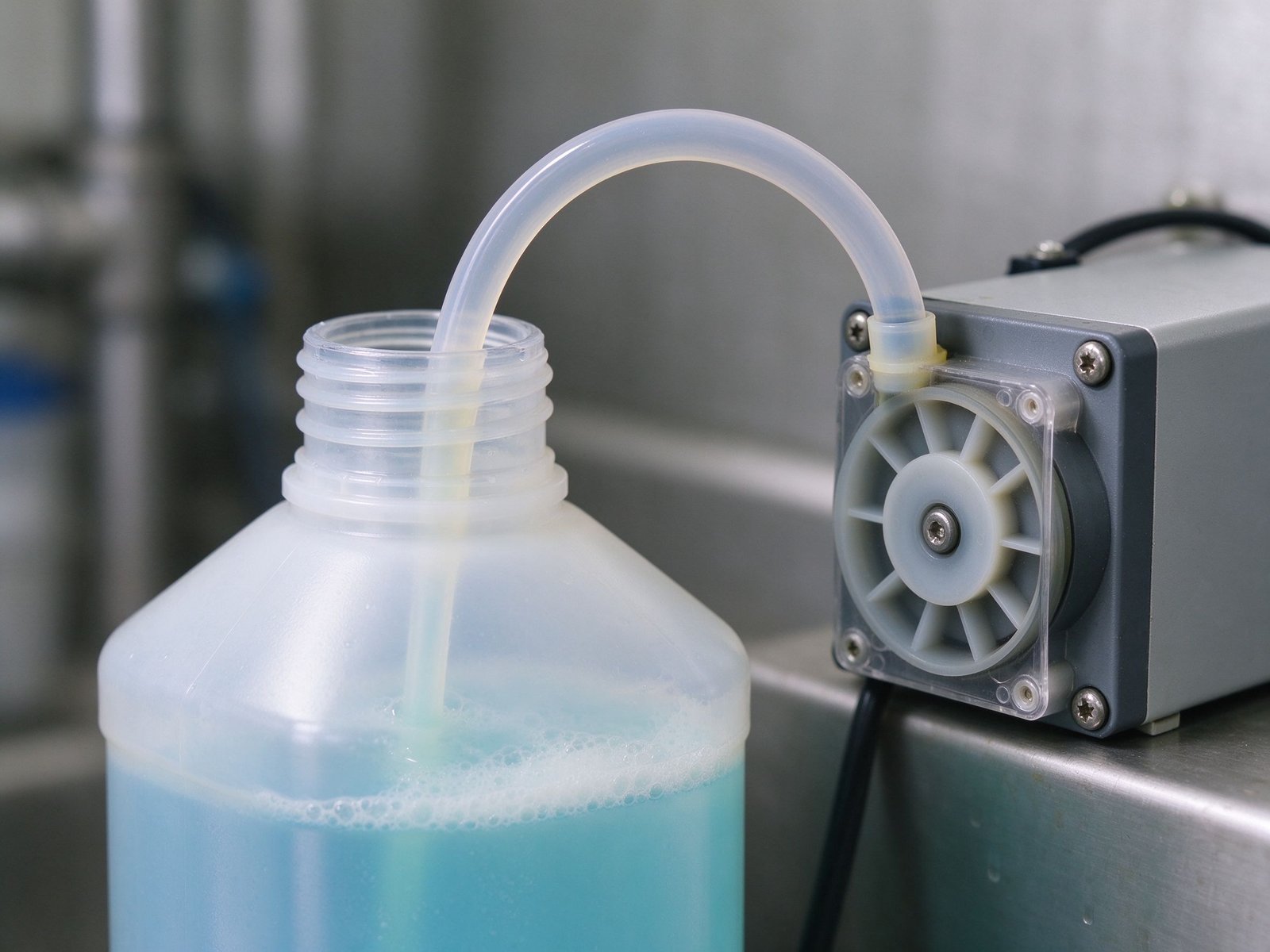
Foamy detergents complicate dosing because foam compresses and changes the apparent volume. If the pick-up sits in the foam layer rather than the liquid, the pump draws air-rich foam and the shot comes out short. The pick-up should reach the bottom of the bottle, and the intake line should be kept short and airtight so the pump draws liquid, not foam. A slow priming run also helps, because a fast start whips the detergent into foam.
This is the same suction-side discipline that prevents an airlock on any peristaltic pump: tight barbs, a submerged pick-up, and a line that does not leak. If the dispenser repeatedly under-doses on a nearly empty bottle, the cause is almost always the pick-up drawing foam or air rather than the pump itself. The peristaltic pump tube on the suction side should be rated for the detergent chemistry, because a tube that softens in the chemical can flex and admit air over time.
| Symptom | Usual cause | Fix |
|---|---|---|
| Short or uneven shots | Foam or air in the pick-up | Submerge pick-up, shorten intake |
| Slow on thick softener | Bore too small for viscosity | Wider tube bore, longer run time |
| Under-doses near empty | Pick-up sits in foam | Extend pick-up to bottle bottom |
| Tube softens or cracks | Wrong tube chemistry | Tube rated for the detergent |
| Pump hums but does not move | Airlock or worn tube | Re-prime, inspect tube |
Tube Chemistry for Detergents
Detergents are alkaline and often contain surfactants, enzymes, or bleach additives, and not every tube survives them. A general-purpose tube may swell or embrittle in a concentrated detergent, which both ruins the seal and contaminates the bottle. The tube material should be matched to the actual chemical, not assumed from “it’s just soap.” For a product sold in volume, the tube chemistry is a compliance and service-life decision, and it should be bench-tested with the real detergent rather than guessed from a generic compatibility chart.
This kind of material-and-fluid verification is the same point-of-use approach described by the U.S. National Science Foundation’s engineering research on fluid handling: confirm the material against the actual fluid under real conditions, not against a label. A controlled-speed driver, as in the motor-driver operating manual, then makes the shot repeatable across the tube’s life.
Duty Cycle and Reliability in an Appliance
A detergent dispenser runs in short bursts between long idle periods, which is gentle on the pump but hard on assumptions. The pump sits with chemical sitting in the tube for hours or days between shots, and that standing contact ages the tube faster than intermittent use. The tube must be chosen for that standing exposure, and the service interval should account for it. For a commercial dispenser that runs many cycles a day, the pump’s duty cycle and the tube life are the two numbers that decide the maintenance schedule.
Because the pump is hidden inside an appliance, it should be quiet and reliable. A correctly occluded head on the right tube is quiet; an over-compressed or wrong-size tube is noisy and wears fast. A mini peristaltic pump set to the correct occlusion runs quietly enough for a consumer product, which is worth verifying on a sample before production.
Shot Repeatability: What Actually Governs It
The dose a user cares about is repeatability, not just average flow. A pump that dispenses the right amount over ten cycles but varies cycle to cycle makes the appliance under- or over-dose. Repeatability is set by three things: a steady speed, a primed and air-free intake, and a tube that is not fatiguing. A controlled drive that holds the same RPM shot after shot, a pick-up that never draws foam, and a fresh tube are what keep each milliliter consistent.
This is why bench-testing the shot on the real detergent matters. Run the pump ten cycles, collect and weigh each shot, and look at the spread. A small spread across cycles is a good pump; a wide spread points to air in the line, a slipping tube, or a drive that cannot hold the speed. That kind of gravimetric, point-of-use measurement is the approach described by NIST’s Physical Measurement Laboratory, and it catches dosing variation that a flow rating on paper would never reveal.
For a commercial dispenser that runs thousands of cycles, the tube replacement interval is the other half of repeatability. As the tube fatigues, the shot drifts, and the service schedule should be set so the tube is changed before that drift becomes visible in the field. A 24V dosing pump on a predictable duty cycle makes that interval easy to plan, because the cycles are regular rather than random.
If you are designing detergent, rinse-aid, or softener dosing into an appliance or dispenser, contact YOORAIN with the detergent (or its chemistry), the shot volume, the bottle mounting, and the 12V or 24V supply you have. We can recommend a pump head, tube material, and driver combination and bench-test the shot volume on your fluid so the dosing is consistent across the tube’s service life.