
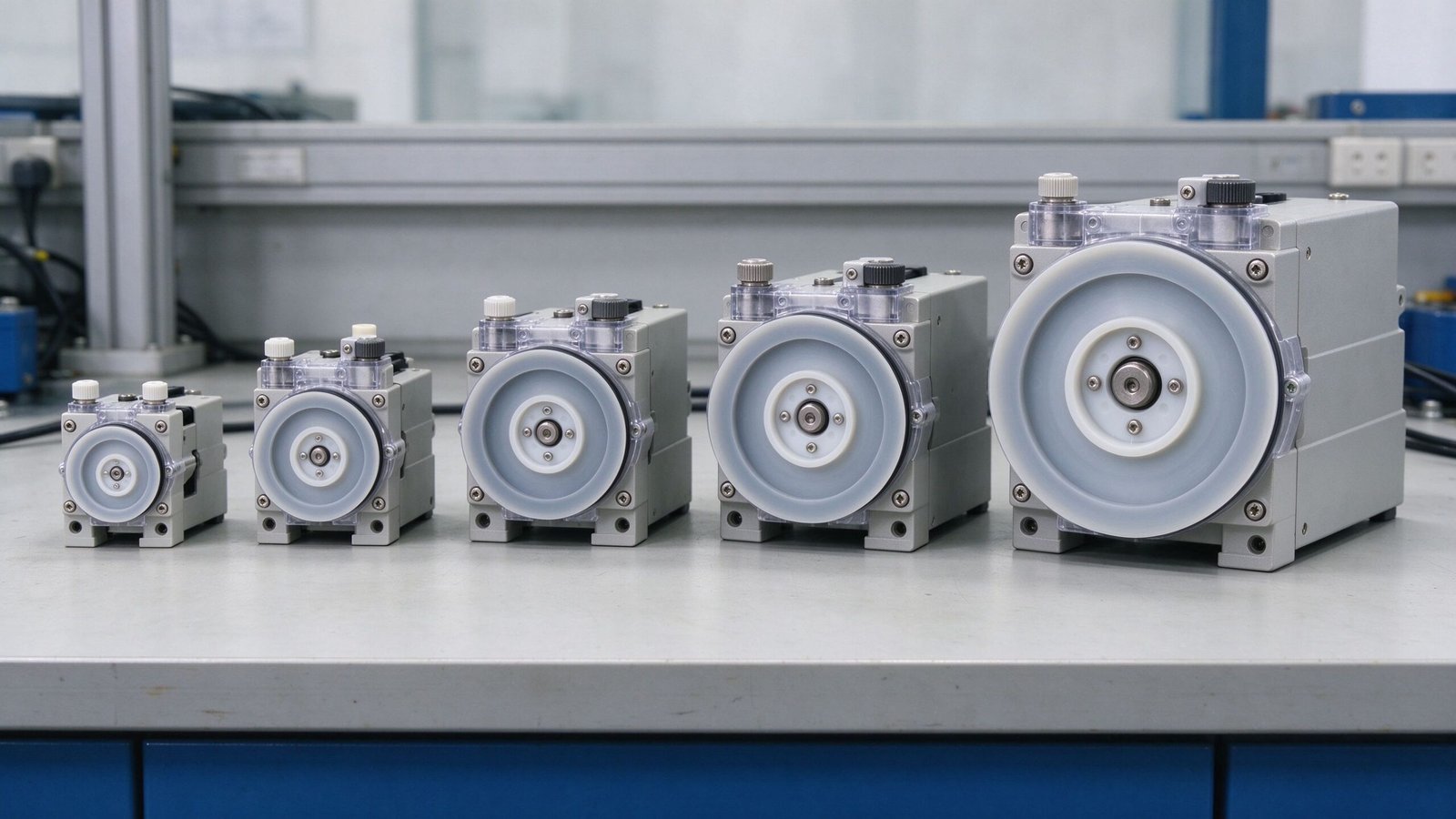
Selecting a peristaltic pump head is where most peristaltic projects go wrong. Engineers pick a head that moves the required flow, then discover it wears tubes fast, runs hot, pulses badly, or cannot hold suction on their fluid. The head is not a free add-on to the motor; it is the component that sets the displacement, the tube size, the roller frequency, the pressure limit, and the service interval. This guide walks through how head bore, roller count, tubing range, and drive speed trade against each other, and how to choose a head that lasts the duty cycle rather than one that merely meets the number on a datasheet.
The Head Sets the Displacement per Revolution
A peristaltic pump moves a fixed volume per revolution, and that volume is set by the tube inside the head, not by the motor. A head with a larger tube bore displaces more fluid per roller pass than a head with a small tube. So the first sizing step is to match the head’s displacement range to the required flow, given the RPM range the drive can hold steadily. A head that is too small forces the drive to spin fast to reach the flow; a head that is too large turns slowly and may not build enough roller frequency for smooth delivery.
This is why a “large pump” and a “small pump” can deliver the same flow at very different speeds. The right answer is usually the larger head turning slowly, because slow turns mean fewer compression cycles on the tube per hour and lower heat. The paired peristaltic pump driver is what lets the head run at a controlled, low RPM instead of a noisy open-loop speed.
| Sizing choice | Head too small | Head correctly sized | Head too large |
|---|---|---|---|
| Drive speed at target flow | High, fast wear | Moderate, controlled | Very slow, may pulse |
| Compression cycles per hour | Many | Fewer | Few |
| Tube life | Short | Expected range | Long but uneven |
| Flow smoothness | Pulsing at high speed | Smooth | Coarse pulses |
| Heat at the head | Warm | Neutral | Cool |
Tube Bore and the Flow It Delivers
The head is built around a tube range, and that range defines both the flow and the minimum and maximum RPM. A micro head accepts fine-bore tube and delivers milliliters per minute; a large head accepts a wide-bore tube and delivers liters per minute. The tube is the wetted displacement element, so changing the tube bore inside an approved range changes the flow without touching the motor. That flexibility is useful, but it also means the head must be chosen for the tube you actually plan to run.
Matching the bore to the fluid matters as much as matching it to the flow. A viscous fluid through a fine-bore tube requires more suction and pressure than the same fluid through a wider bore, and it slows the head’s effective output. A clean, low-viscosity chemical can run fine on a fine bore. The peristaltic pump tube range lists the bores each head accepts, and the bore should be chosen with the fluid in mind rather than only with the target number.
Roller Count: Pulse Versus Tube Life
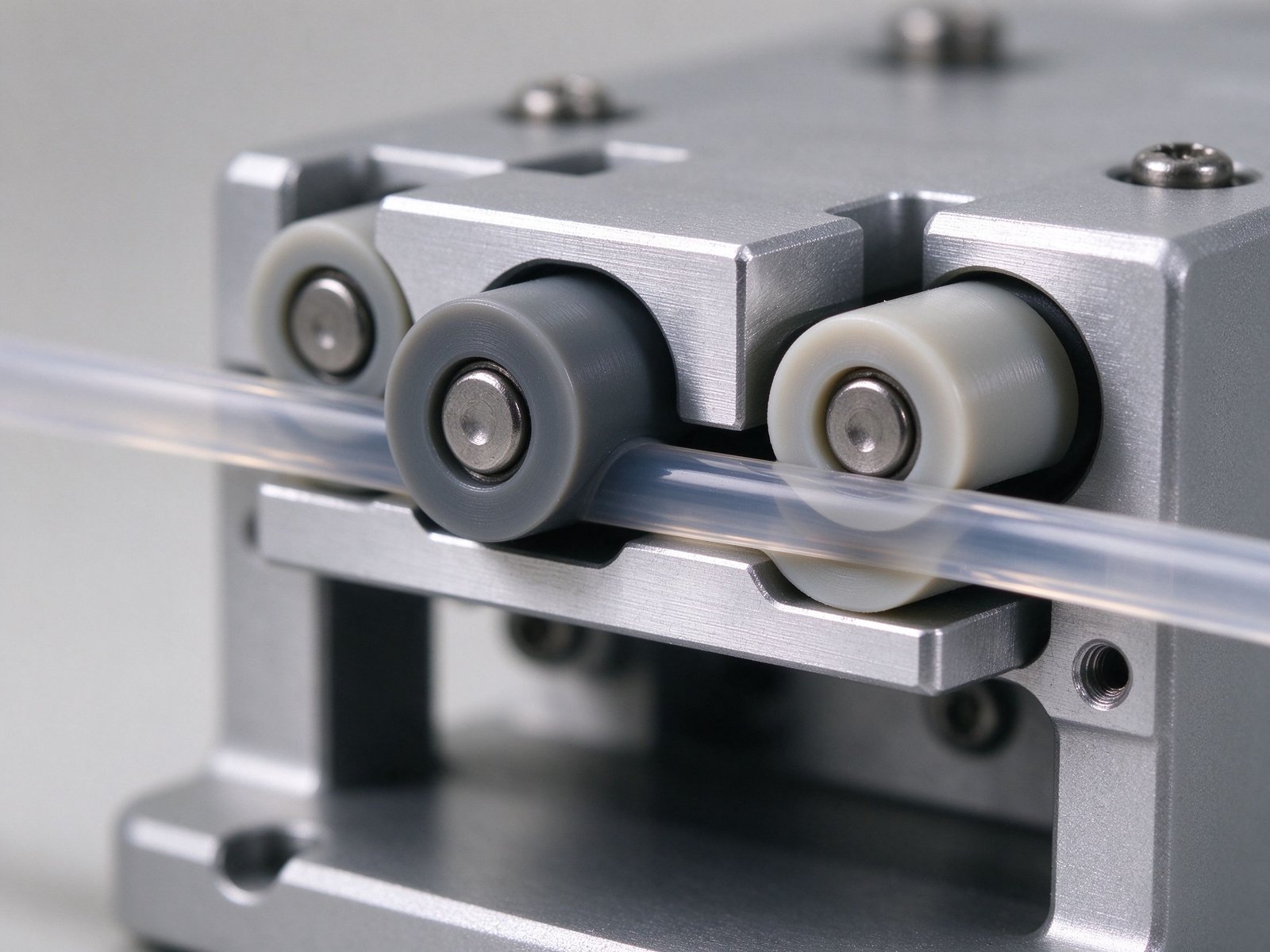
The number of rollers is the second major head choice, and it is a direct trade-off. More rollers mean more compression passes per revolution, which smooths the flow and reduces pulse. Fewer rollers mean larger individual pulses but fewer flex cycles on the tube per revolution. A two-roller head is smoother per pass but compresses the tube less often; a multi-roller head pulses less but fatigues the tube faster because every roller bends the tube once per turn.
This is the trade-off that trips up spec sheets. A head chosen for low pulse may wear tubes quickly, and that is expected. If your application can tolerate a little pulse, a two-roller head on the right tube will last longer and cost less. If smooth delivery matters — for dosing into a sensitive process or into a line where pulse must be damped — the multi-roller head is the answer, and the tube replacement interval should be budgeted accordingly. A small peristaltic pump head and a large-flow peristaltic pump head use different roller counts for their flow bands, and that difference is deliberate.
| Roller count | Pulse | Flex cycles per revolution | Best when |
|---|---|---|---|
| Two rollers | Higher, larger pulses | Two | Long tube life, cost-sensitive, tolerant flow |
| Three to four rollers | Lower | Three to four | Balanced flow, general dosing |
| Five and above | Low, smooth | Five or more | Sensitive delivery, accept shorter tube life |
Occlusion Bed and Adjustable Compression
Not all heads let you set the compression. Some heads are fixed-bed and factory-set for a specific tube range; others have an adjustable occlusion that lets you set the seal for different tube materials. The occlusion — how far the roller flattens the tube against the bed — is what makes the pump hold suction and deliver the rated flow. A head without adjustment is simpler and cheaper, but it is locked to the tube it was set for. A head with adjustment gives you room to switch tube materials for chemical compatibility, at the cost of needing to re-set the seal when the tube changes.
For an OEM that will run one tube for the life of the product, a fixed-bed head is fine and reduces assembly steps. For a lab or a pilot line that swaps tubing for different fluids, the adjustable head saves time and protects tube life. The bench method for confirming the setting — weighing a fixed volume of delivered fluid at a known RPM — is the point-of-use measurement approach described by NIST’s Physical Measurement Laboratory, and it is more reliable than trusting the head to be right out of the box.
Head Material: Plastic, Aluminum, Stainless
The head body material is a separate choice from the roller count, and it follows the environment. Plastic heads are light, cheap, and chemically resistant enough for clean and lab fluids. Aluminum heads are rigid and compact for general OEM use. Stainless heads are the choice for wash-down, corrosive, or hygienic environments where the head must stand up to regular cleaning. The material does not change the displacement, but it changes what the head can survive and how easy it is to clean.
For a process that gets hosed down or that must meet hygienic cleanability, the stainless head earns its cost. For an instrument sitting inside a dry enclosure, a plastic or aluminum head is lighter and cheaper. The mini peristaltic pump heads are the kind of compact OEM unit where material choice is about enclosure and weight, while a floor process head would more often be stainless.
Speed Range and the Low-End Problem
Once the head is chosen, the drive must hold a steady speed across the range the application needs. Peristaltic pumps dose accurately at low RPM, but a cheap controller that cannot hold low speed turns the pump into a pulsing, uneven meter. The lowest useful speed is where the roller passes are still regular and the tube has time to recover between compressions. At very high speed the tube heats and fatigues fast, and at very low speed the flow can become lumpy.
The right head-and-drive combination gives a usable range centered on the design point, not one that lives at the edge. A controlled drive, as in the motor-driver operating manual, holds that low speed steadily, which is what makes a dosing pump repeatable rather than just directional. If your application needs a slow, metered shot, check that the drive’s minimum speed is well below the operating point rather than at it.
| Condition | Symptom | Head or drive fix |
|---|---|---|
| Fast, hot head, short tube life | Warm head, tube splits | Step up to a larger head, run slower |
| Coarse pulsing delivery | Visible pulses in the line | More rollers, or add a pulse damper |
| Won’t hold low speed | Uneven small shots | Better speed-controlled drive |
| Won’t hold suction on viscous fluid | Loss of prime | Wider bore tube, check occlusion |
| Head won’t stand up to cleaning | Corrosion on the body | Stainless or wash-down head |
Pressure Limit and Back-Pressure
A peristaltic head is bounded by the pressure the tube can hold sealed. Push against a tall discharge, a filter, or a restricted line, and the tube either bulges, slips, or fatigues. The head’s pressure rating is set by the tube and the bed, not by how hard the motor pushes. If your duty has real back-pressure, the head must be rated for it; oversizing the motor does not help, because the tube is the limit. Confirm the pressure margin by measuring the delivered flow under real back-pressure, the way a controlled peristaltic pump driver reference describes for consistent test conditions, rather than assuming the nameplate applies to your installation.
How to Size a Head, Step by Step
- Start with the required flow and the fluid: clean or viscous, low or high back-pressure.
- Pick a head displacement range that puts the design RPM in the middle of the drive’s usable range, not at the edge.
- Choose the tube bore for the fluid, not only for the flow number.
- Choose the roller count for how much pulse the process can accept, and budget tube life accordingly.
- Choose the head material for the environment: plastic, aluminum, or stainless.
- Confirm the occlusion seals on the actual tube and fluid with a weighed-volume bench test.
- Size the drive to hold the low-end speed the dosing duty needs.
Temperature and Speed: How They Age the Tube
Two effects drive tube life more than any spec sheet: how fast the head turns, and how warm it runs. Every compression is a flex cycle, and flex cycles add up. A head that turns twice as fast does not wear the tube twice as fast — it wears it out of proportion, because the tube also heats and the material fatigues faster when warm. This is the core reason “larger head, slower speed” is the right default: it cuts both the cycle count and the heat at once.
Ambient temperature compounds it. A pump in a warm enclosure, near a heater, or in a summer plant runs hotter than the same pump in a cool lab, and the tube inside fatigues faster. If the installation is warm, the conservative move is a larger head with more margin and a lower RPM, rather than running the smallest head at its limit. The National Science Foundation’s engineering work on material fatigue supports the same point: fatigue life drops sharply as temperature rises, so the head and tube should be sized for the hottest expected day, not the average one.
| Operating condition | Effect on tube life | Sizing response |
|---|---|---|
| Low speed, cool ambient | Longest | Standard sizing |
| Moderate speed, room temperature | Expected range | Standard sizing |
| High speed | Steeper decline | Larger head, slower speed |
| Warm enclosure or plant | Faster fatigue | More margin, lower RPM |
| Continuous 24/7 duty | Highest cycle count | Oversize head, plan tube changes |
A Worked Sizing Example
Say the duty is a dosing skid that must deliver 500 mL per minute of a mildly viscous cleaning fluid, running several hours a day. A micro head on a fine tube might need to spin fast to reach 500 mL/min, which means many flex cycles and a warm head. A mid-size head on a wider tube reaches the same flow at a comfortable, controlled RPM, with the drive sitting in the middle of its range. The mid-size head costs a little more and takes a little more space, but the tube lasts far longer and the head stays cool.
The check after choosing is simple: at the design RPM, the drive should be nowhere near its minimum or maximum, the head should be cool to the touch after a run, and a weighed volume over a fixed time should match the expected displacement. If the head is hot or the measured volume is off, the sizing or the occlusion is wrong and should be corrected before production. This is the same bench discipline a controlled peristaltic pump driver reference expects: run it, measure it, and adjust rather than trusting the math on paper.
Mounting, Intake, and Discharge Design
The head choice interacts with how it is plumbed. A long, narrow intake starves a head that looked fine on the bench, and a tall or restricted discharge adds back-pressure the tube was not sized for. The head should be mounted with a short, wide intake and a discharge that does not fight the pump. For a difficult fluid, a flooded suction — mounting the reservoir above the head — removes the suction problem entirely and lets the head work the way it was designed.
Vibration and mounting matter too. A head running at speed shakes a little, and bolting it solidly to a thin panel can turn that shake into a rattle. A mounted head on a rigid bracket, with the intake and discharge lines supported rather than dangling, keeps the stress off the barbs and the tube. A small peristaltic pump on a skid, with lines supported and the head bolted down, runs far quieter and lasts longer than the same head flopping in an enclosure.
Common Questions
Is a bigger head always better? Only up to the point where the drive turns slowly and smoothly. A head that is too large turns so slowly that each roller pass becomes a coarse pulse, and the flow loses smoothness. Size for the middle of the speed range.
Can I run a different tube in a head? Only within the head’s approved tube range. Outside that range the occlusion no longer seals correctly, and the pump either slips or over-compresses the tube.
Why does my tube wear out fast even on a new pump? Usually because the head is too small and spins fast, or because the occlusion is over-tight. A larger head at a slower speed is the usual fix.
Do more rollers always last longer? No — more rollers flex the tube more times per revolution, which shortens tube life for smoother flow. It is a deliberate trade-off, not a free upgrade.
What to Ask the Supplier
- What tube bores and materials does this head accept, and what displacement per revolution does each give?
- What roller counts are available, and what is the expected tube life at my flow and speed?
- Is the occlusion fixed or adjustable, and how is it set for my tube?
- What is the pressure limit, and how does it change with back-pressure?
- Can the head be bench-tested on my fluid so the displacement and occlusion are confirmed before production?
If you are selecting a peristaltic pump head and want the bore, roller count, material, and drive matched to your flow and fluid, contact YOORAIN with the required flow, the fluid and its viscosity, the back-pressure, and the environment the head will run in. We can recommend a head, tube, and driver combination and bench-test it on your fluid so the sizing is confirmed before you commit to production.