
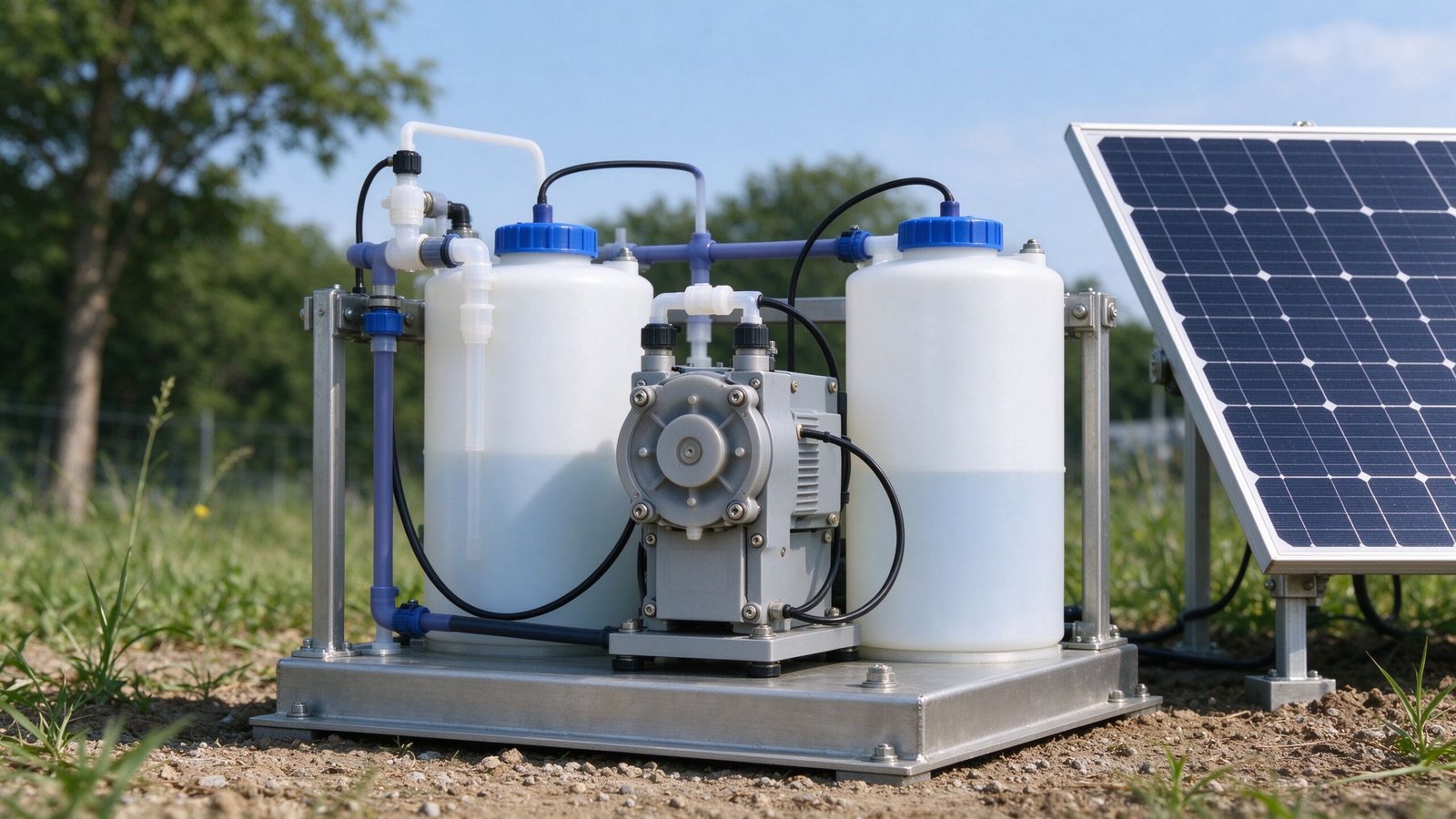
Remote chemical feed stations — well chlorinators, livestock water treatment, off-grid irrigation dosing, and remote pipeline injection — sit where there is no mains power. The pump has to run from a battery charged by a solar panel, survive the weather, dose accurately, and call for service as rarely as possible. A peristaltic pump is a strong fit for these stations, but only if you size the power, the pump, and the enclosure correctly. This buyer guide walks through what to look for when buying a peristaltic pump for a solar or off-grid installation.
Why Peristaltic for Off-Grid
A remote chlorinator or livestock water station doses a small, corrosive chemical into a line or a tank. The pump has no operator nearby, it cannot leak, and it cannot need weekly service. A peristaltic pump has no shaft seal in contact with the chemical, which eliminates the most common off-grid failure point — a weeping seal on a remote tank. It also tolerates run-dry, which matters when the chemical drum runs out and no one notices for a week. The tube is the only wetted part, and a tube swap is simple enough for a quarterly site visit.
A 12V DC peristaltic pump is the natural choice, because it runs directly from a battery. A 24V dosing pump works on a larger solar array. Either way, the pump is a low-current intermittent load, which is exactly what a small solar-battery system handles.
| Off-grid need | Why peristaltic fits |
|---|---|
| No seal weep at remote site | Sealed tube, no shaft seal |
| Runs dry when drum empty | No seal damage |
| Low power from battery | 12V/24V DC, intermittent duty |
| Low-skill maintenance | Tube swap on quarterly visit |
| Small accurate dose | Positive displacement per revolution |
Power Budget: The Part People Get Wrong
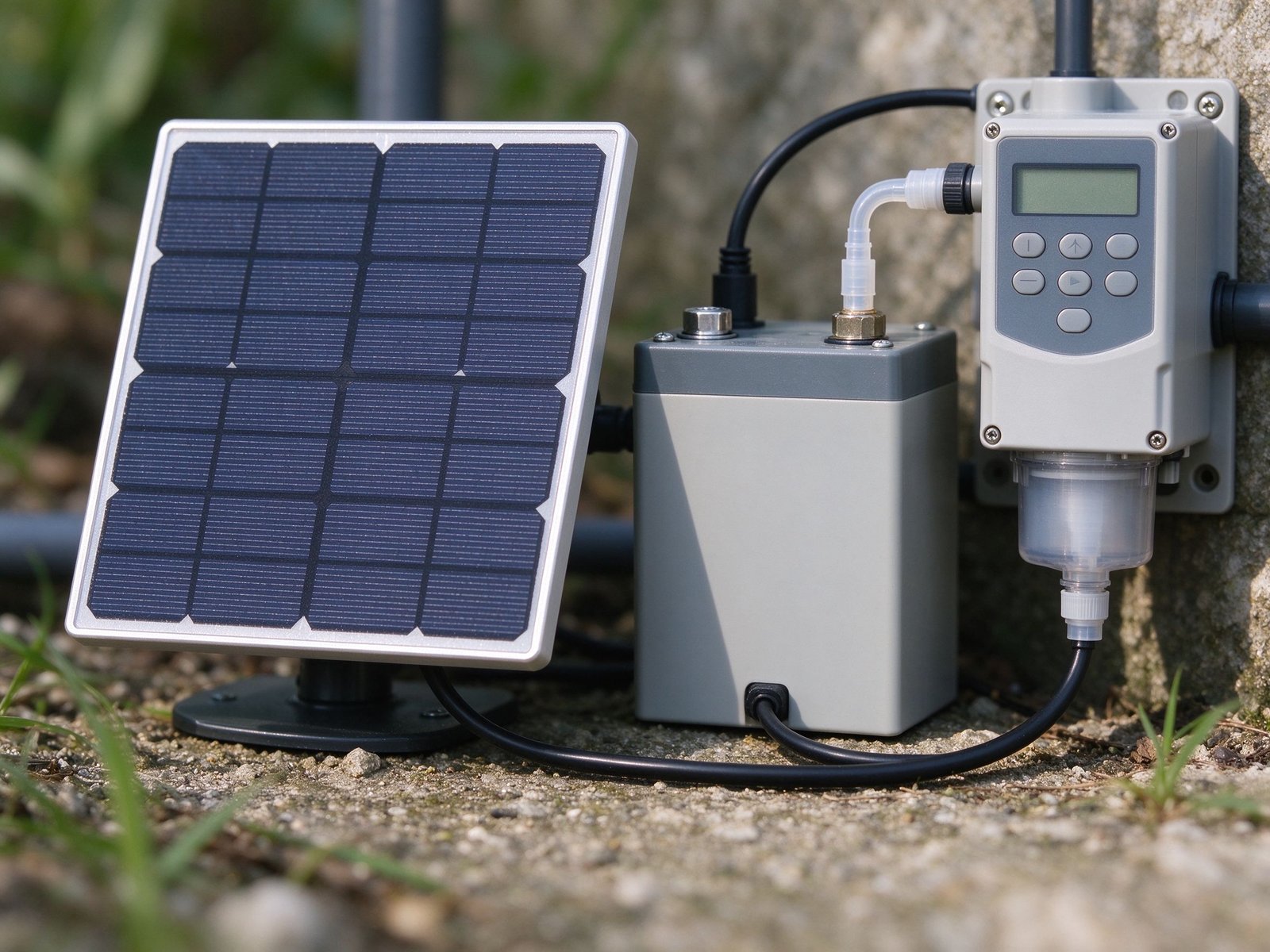
The pump is not the only load. The controller, the sensor (pH, chlorine, flow switch), and the telemetry radio all draw power continuously, while the pump draws power only when it doses. Size the solar panel and the battery for the continuous loads first, then add the pump’s duty. A pump that doses for 30 seconds an hour is a tiny energy load; a pump that runs continuously on a remote station is not, and the panel has to be sized for that. The speed and run-time setup on the peristaltic pump driver is what lets you keep the duty short and the energy use low, as described in the motor-driver operating manual.
For a remote station that doses a few short shots per day, a small 12V battery and a 50–100 W panel are usually enough. For a station with continuous telemetry and a continuous pump, size the array for the worst winter month, not the average summer day. The NIST measurement practice point applies: measure the actual current draw of the pump on your duty rather than relying on the nameplate, because startup current is higher than running current.
| Load | Current profile |
|---|---|
| Controller + sensor + radio | Continuous, small |
| Pump, intermittent shots | Short bursts, higher current |
| Pump, continuous | Steady current, size panel accordingly |
| Winter short days | Oversize panel and battery |
Weather and Enclosure
A remote station sits in the weather. The pump and the driver need a ventilated, weather-sealed enclosure. A sealed box in the sun gets hot, and a hot driver fails early. The tube also suffers in extreme heat or cold: summer heat softens it, winter cold stiffens it. Mount the enclosure in shade if you can, size the vent, and pick a tube material rated for the local temperature range. A small peristaltic pump on a well head in a cold climate needs a tube that stays flexible at the winter low, not one that hardens and slips.
The chemical drum also weathers. In cold climates, a drum of liquid chlorine or acid can freeze and split; insulate or heat-track it. In hot climates, the chemical degrades faster, so the drum needs shading. The fluid-handling and materials guidance described by NSF’s engineering research on remote water systems treats enclosure and temperature as part of the design, not afterthoughts.
Telemetry and Alarms
On a remote station, the pump has to report what it is doing. A low-level alarm on the chemical drum, a flow alarm on the line, and a low-battery alarm are the three basics. Without them, the station doses nothing for weeks until someone drives out and finds an empty drum. A driver with a contact output or a small telemetry module that sends a status message is worth the cost on any off-grid installation. The point of running solar is to save site visits; an unmonitored station forces exactly the visits you were trying to avoid.
| Alarm | What it catches |
|---|---|
| Low chemical level | Empty drum, no dose |
| No-flow / dose alarm | Tube failed or blocked |
| Low battery | Panel or battery problem |
| High current | Tube hardening or blocked head |
Mounting and Access on a Remote Station
A remote station is usually mounted on a pole, a wall, or a small skid, and the person who services it stands on a ladder. Mount the pump and the driver where they can be reached without removing the enclosure. The chemical drum should sit below the pump so the pump has a flooded suction rather than a lift; on a remote station, a priming problem is a service call. Keep the drum accessible, the vent clear, and the suction hose short. The foot valve should sit a few centimeters off the drum bottom so it does not suck sludge. The same suction-side sizing that applies to any peristaltic install — wider suction than the head tube, airtight fittings, a sealing foot valve — applies here, and on a remote station a small suction mistake becomes a drive to the site.
Label every fitting on the outside of the enclosure. When a technician arrives at a remote station after months away, they should not have to guess which tube is the acid line and which is the nutrient line. Weather-resistant labels and a simple diagram on the inside of the door save time on every visit.
Cost of Ownership on a Remote Station
The cheapest pump on a remote station is not the one with the lowest purchase price. It is the one that does not fail between visits. A cheap driver that dies in a year forces a service truck; a sealed tube that weeps on a remote well head forces a cleanup visit. The higher purchase price of a low-current, weather-sealed driver and a quality tube is paid back in fewer site calls. When you compare quotes, ask how many service visits per year each design implies, and price that in. The NIST measurement practice of confirming the dose on a sample before deployment saves a return trip, because the first time you catch a wrong dose should be on the bench, not at the well head.
| Cost factor | Why it matters off-grid |
|---|---|
| Purchase price | Only a small part of the total |
| Power draw | Smaller solar array and battery |
| Service interval | Fewer truck rolls |
| Telemetry | Catches failures before a visit |
| Spare availability | Avoids waiting weeks for a part |
What to Ask the Supplier
When you buy a peristaltic pump for a solar station, tell the supplier the supply voltage (12V or 24V), the duty cycle (how many seconds per hour), the chemical and its temperature range, and whether you need a contact closure or a low-level input. Ask whether the driver has a built-in low-power sleep mode, because that is what makes a 12V battery last through the night. Ask for the expected tube life on the chemical, and order a spare tube and a spare fuse in the same shipment, because a site visit to replace a one-dollar part is expensive.
If you are specifying a solar-powered remote chemical feed and need a 12V or 24V peristaltic pump that doses accurately from a battery, contact YOORAIN with the chemical, the shot volume, the duty cycle, and the local temperature range. We can recommend a head, tube, and low-power driver that runs for months between site visits.