
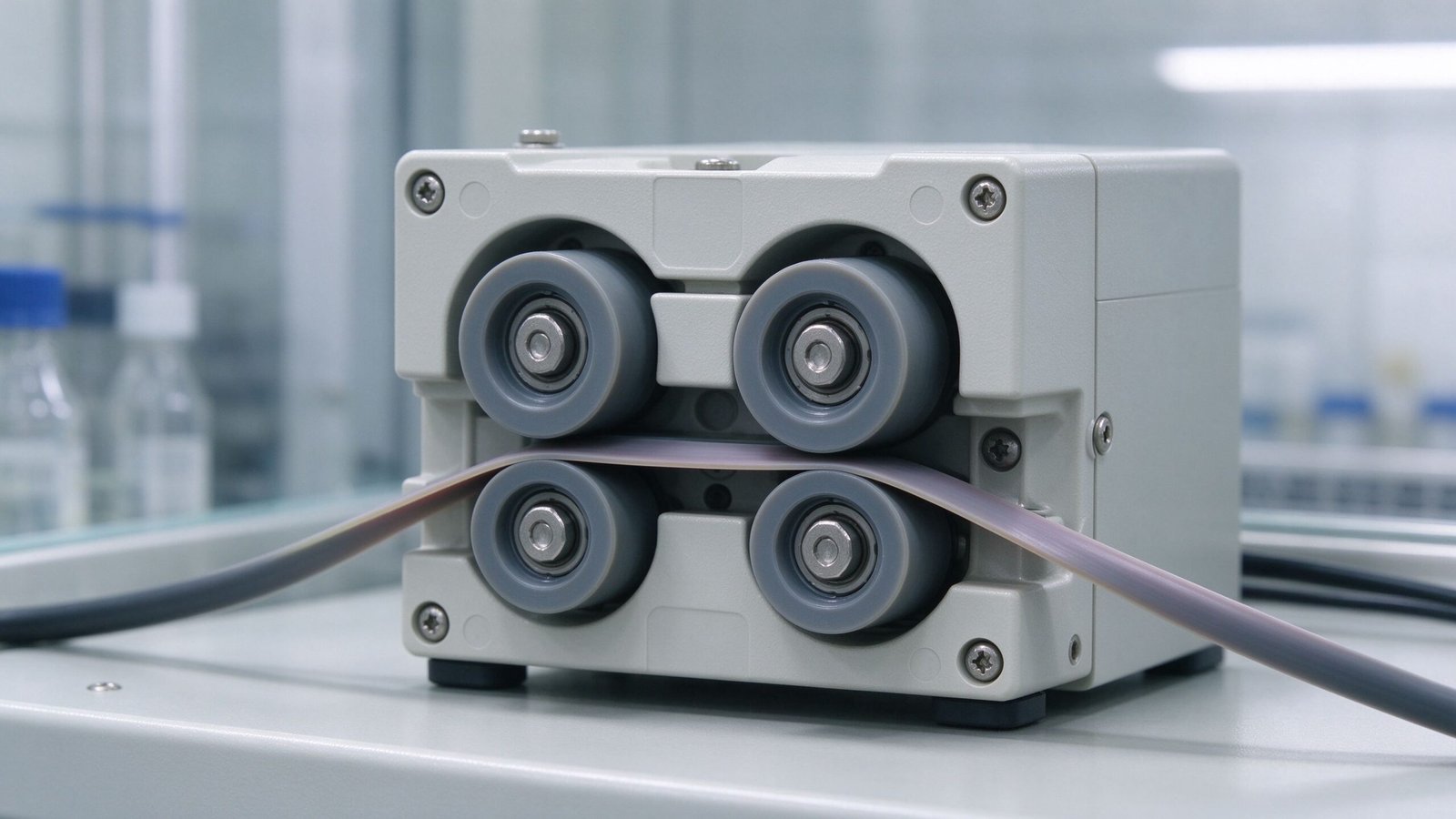
If you have ever watched liquid jump out of a small dispensing bottle on a peristaltic line, or seen a pressure gauge needle swing between two values on every revolution, you have seen peristaltic pump pulsation. It is normal, it comes with how the pump works, and it is not always a problem — but on a dosing, filling, or sensitive process line it can overfill bottles, hammer the pipe, stir a slurry, or shake a delicate sensor. This troubleshooting guide walks through where pulsation comes from, how to measure it, what reduces it, and when you should actually not worry about it.
Why a Peristaltic Pump Pulses at All
A peristaltic pump moves the tube forward by squeezing it between rollers. While a roller is in contact, that section of tube is closed and the downstream fluid is pushed forward. Between two rollers, the tube opens back up and the downstream flow momentarily drops, then rises as the next roller closes. That on-off-on delivery is the pulsation. It is not a defect in the pump; it is the displacement principle. A gear pump delivers a steadier stream because the gears mesh continuously; a peristaltic delivers a series of small slugs. The fewer the rollers, the fewer the slugs per revolution, and the bigger each slug is.
The peristaltic pump tube is the flexible part that creates the slug. When a roller passes, the tube wall flexes; when it relaxes, it recovers. A stiff or worn tube recovers more slowly, which changes the pulsation shape. The driver controls how often slugs arrive per minute, and the head determines how big each slug is.
| Factor | Effect on pulsation |
|---|---|
| Fewer rollers per revolution | Fewer, larger slugs — more pulsing |
| Higher pump speed | More slugs per minute, but faster |
| Soft / thin tube | Recovers quickly, gentler slugs |
| Longer discharge line | Smooths out pulsation (hydraulic capacitance) |
| High back-pressure | Amplifies pressure swings |
When Pulsation Matters — and When It Does Not
Not every pulsation needs fixing. If you are transferring water from one tank to another at a steady flow, a little pulsation is invisible and harmless. The flow average is what matters, and the line and tank smooth it out. Pulsation becomes a problem when it causes one of four specific issues: bottle over- or under-fill on a timed dispense, pipe hammer or vibration on a long discharge line, shear or damage to a delicate fluid (live cells, shear-sensitive polymers), or a pressure or flow sensor that reads noise instead of trend. If none of those is happening on your line, leave it alone.
A small peristaltic pump on a wash-down or transfer duty rarely needs a dampener. The same head on a precise bottle-filler does. The NSF engineering guidance on fluid handling treats pulsation as a line design parameter: match the dampening to the process tolerance, not to the pump datasheet.
First Triage: Is It Really Pulsation?
Before buying a dampener, rule out other causes that look like pulsation but are not. Air in the suction line causes surges and loss of prime; check the suction foot valve and fitting tightness. A worn tube that has flattened permanently delivers uneven slugs; pinch it and check for hard spots. A loose roller or a worn bed makes a beat that is not the regular peristaltic pulse. A kinked discharge line causes back-pressure swings that look like pressure pulsation on the gauge. The diagnostic approach, as described by NIST’s Physical Measurement Laboratory, is to isolate one variable at a time and observe the average, not just the peak.
| Symptom | Likely cause |
|---|---|
| Regular pulse per revolution | Normal peristaltic pulsation |
| Irregular surges, weak pulses | Air leak on suction |
| Pulse gets worse over weeks | Tube hardening / wear |
| Clanking noise with pulse | Worn roller or bed |
| Gauge swings only at high pressure | Back-pressure amplification |
Reduce Pulsation Without Buying Parts
The cheapest fixes are free. Slow the pump down and use a smaller head: fewer slugs per minute on a smaller slug is smoother than fast slugs on a big slug. Add length to the discharge line: a longer, flexible hose acts as a capacitance and averages the slugs. Drop the back-pressure: open the line, use a bigger discharge tube, shorten the discharge run. Use a softer tube that recovers quickly. On a peristaltic pump driver with adjustable speed, set the slowest speed that still hits the required average flow; the average is unchanged, but the per-rev pulse is the same and the perception of pulsation drops because the process has time between slugs.
On a two-head or multi-channel setup, run the two heads out of phase so one slug is delivered while the other head is between rollers. That halves the peak-to-peak pulse without any extra hardware. The speed and phasing on a multi-channel skid is tuned in the driver setup, as described in the motor-driver operating manual.
| Free fix | What it does |
|---|---|
| Slow speed, smaller head | Smaller slugs, smoother average |
| Longer discharge hose | Hydraulic capacitance averages slugs |
| Lower back-pressure | Smaller pressure swing |
| Softer / fresher tube | Faster recovery per stroke |
| Two heads out of phase | Staggered slugs halve the pulse |
Pulsation Dampeners and Accumulators
When free fixes are not enough, add hardware. A pulsation dampener is a small chamber on the discharge line with a flexible bladder or a gas volume; the slug compresses the gas slightly and the downstream flow evens out. For water-based low-pressure duty, a simple chamber with an elastomer bladder works. For higher pressure, a gas-charged accumulator with a pre-charge pressure set to about half the line pressure is the standard. For viscous or shear-sensitive fluids, a snubber with a fine restriction reduces the pulse without trapping product. Pick the dampener size by the slug volume per revolution, not by the pump flow rating; an undersized dampener does almost nothing.
A large-flow peristaltic pump on a filling line usually needs a properly sized dampener, because the slug per revolution is large. A micro peristaltic pump on a lab duty almost never does, because the slug is tiny. The sizing principle is the same: dampener volume should be several times the slug volume per revolution.
Shear-Sensitive and Delicate Fluids
On a bioreactor, a cell-culture line, or a shear-sensitive polymer, the pulsation matters because the repeated acceleration and deceleration adds shear. In these cases, run the slowest speed possible, use a long flexible discharge, and add a dampener sized for low pressure. Do not use a sharp restriction as a snubber; it adds shear at exactly the spot you are trying to protect. The 24V dosing pump on a shear-sensitive duty is usually run in short pulses rather than continuous, because a short pulse lets the downstream line absorb the energy before the next slug.
Measuring the Actual Pulsation
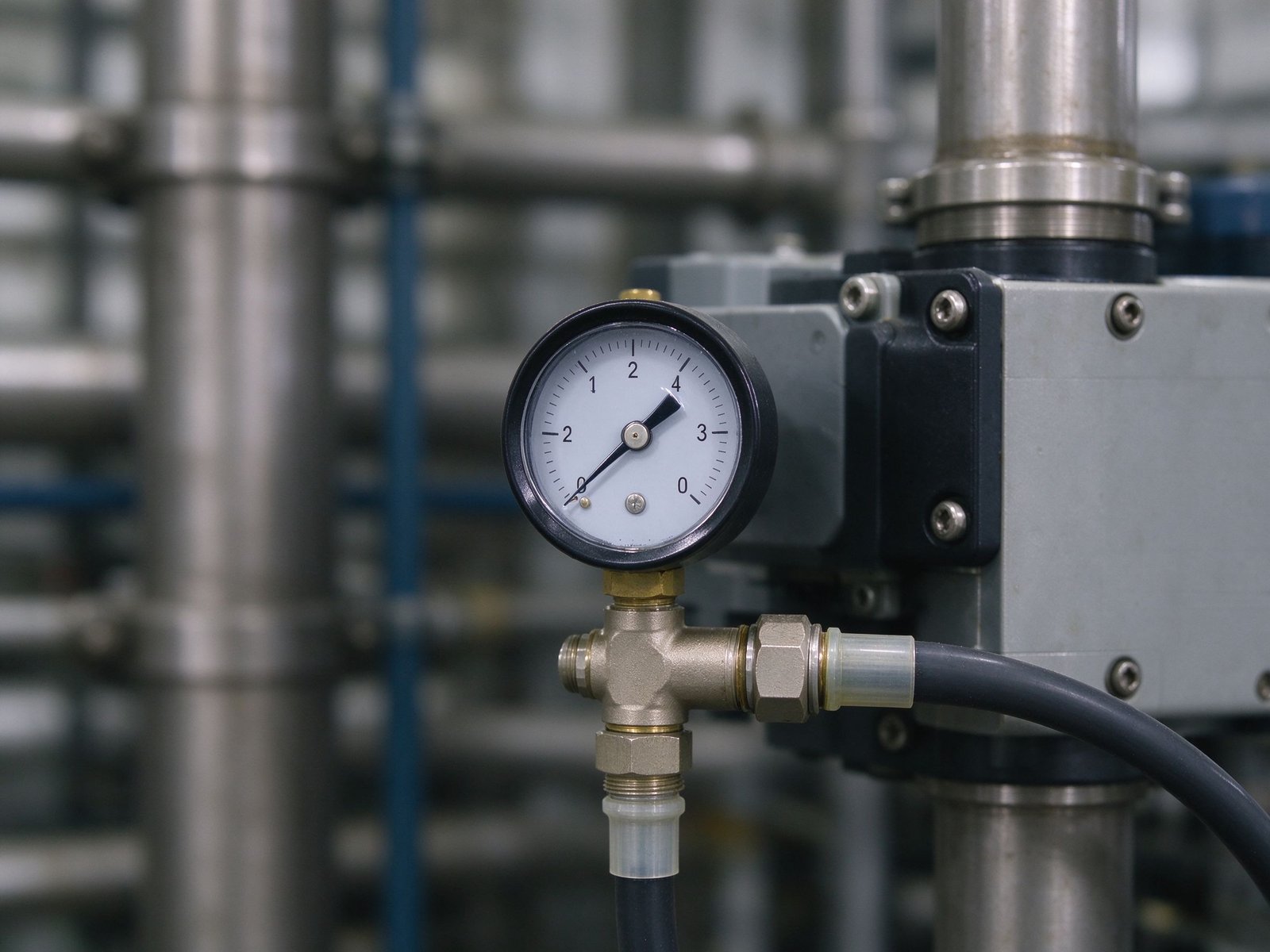
If you are deciding whether to add a dampener, measure it. Temporarily tee a pressure gauge or a low-cost pressure sensor into the discharge and watch the needle or the trace. Compare the peak-to-peak swing to the line pressure. If the swing is under about ten percent of line pressure, the process usually tolerates it. If it is twenty percent or more, plan a dampener. For a filling process, weigh ten timed fills in a row and look at the spread between the lightest and heaviest fill; that spread is what pulsation is actually costing you. The gravimetric method, as recommended by NIST measurement practice, is more honest than reading the gauge.
| Process | Typical tolerance | Action |
|---|---|---|
| Transfer between tanks | Wide | Do nothing |
| Timed chemical dosing | Moderate | Slow speed, re-calibrate |
| Bottle filling | Tight | Dampener + smaller head |
| Shear-sensitive fluid | Very tight | Slow speed, bladder dampener |
| Pressure-controlled loop | Tight | Accumulator pre-charged |
Roller Count and Head Geometry
The number of rollers on the head is the single biggest lever on pulsation, after the flow itself. A two-roller head delivers two slugs per revolution; a ten-roller head delivers ten smaller slugs. The average flow is the same, but the peak-to-peak pressure swing is much smaller on the multi-roller head. The trade-off is that more rollers mean more occlusion points, which means more motor torque, more heat on the tube, and shorter tube life. A two-roller head on a low-speed, intermittent duty lasts a long time; the same head on a high-speed continuous duty does not. Match the roller count to the process tolerance and the run time, not to the datasheet’s flow number.
The gap between the roller and the bed — the occlusion — also affects the pulse. A tight occlusion seals well but adds torque and shortens tube life; a light occlusion reduces torque but lets a little slip, which softens the pulse at the cost of accuracy. On a clean water duty, a light occlusion is fine and the pulse is naturally gentler. On a high-pressure duty, the occlusion has to be tight to seal, and the pulse comes back up. Set the occlusion to the minimum that still delivers the rated pressure, and the pulsation and the tube life both improve.
| Head geometry | Pulsation | Tube life | Motor torque |
|---|---|---|---|
| 2 rollers, low speed | Larger slugs | Longer (low speed) | Lower |
| Many rollers | Smaller slugs | Shorter (more flex) | Higher |
| Light occlusion | Softer pulse, slight slip | Longer | Lower |
| Tight occlusion | Firmer delivery | Shorter | Higher |
Pipework Effects on Pulsation
The discharge pipe is not just a path to the point of use; it is part of the pulsation behavior. A long, flexible hose on the discharge acts as a spring, absorbing the slug and smoothing the downstream flow. A short, rigid pipe transmits the slug directly, and the pulse shows up at the sensor. A sharp elbow, a sudden diameter change, or a closed valve right after the pump creates a pressure reflection that amplifies the pulse. If the line vibrates, look at the pipework before you blame the pump: add a few feet of flexible hose right after the discharge, and route it with gentle bends.
Elevation matters too. A lift on the discharge adds static head, which raises the average pressure and the relative swing. A flooded discharge into an open tank is the gentlest possible setup; a long vertical riser to a high tank is the harshest. The suction side matters less for pulsation, but a long or kinked suction causes air ingestion, which looks like random surges rather than a regular pulse. Keep the suction short, wide, and airtight.
Dampener Types in Detail
Three common dampener types cover most small-pump duties. The bladder type is a small chamber with an elastomer bag on a gas side; the liquid never touches the gas, so it works on most fluids. The dead-volume type is a plain T-shaped chamber with no moving part; it is cheap and it helps a little, but it traps a small amount of product between batches, which matters on multi-product lines. The spring-loaded type uses a spring-loaded piston instead of gas; it is more consistent across temperature but has a moving part that can wear.
Size the chamber to several times the slug volume per revolution, not to the pump’s liters-per-hour. A dampener that is too small barely moves; one that is too large adds a settling delay after startup. Pre-charge a gas dampener to roughly half the average line pressure; if the pre-charge is too high, the bladder does not move; if it is too low, the gas absorbs the whole stroke and the downstream flow slows.
| Dampener type | Best for | Watch out for |
|---|---|---|
| Bladder / gas-charged | General, water-based | Pre-charge pressure |
| Dead-volume chamber | Low cost, single product | Traps product |
| Spring piston | Temperature swings | Moving part wears |
Multi-Channel Phasing
On a skid that runs two or more peristaltic heads from one drive, the biggest free pulsation reduction is to set the heads out of phase. If head A delivers a slug when head B is between rollers, the two streams average out. On a four-head skid, phase the four heads by a quarter revolution each, and the combined pulse drops to a small fraction of the single-head pulse. This is done by timing the rollers on the shaft or, on independent channel drivers, by setting a phase offset in the controller. It is a free upgrade once the hardware supports it, and it is more effective than adding a dampener on most small dosing skids.
When to Leave Pulsation Alone
We said it earlier, but it is worth repeating. Pulsation is normal, and chasing it down on a line that does not care wastes money. A transfer pump, a recirculation loop, a tank-fill pump with a wide tolerance — these do not need a dampener. The cost of the dampener, the cost of the trapped product, and the maintenance of the bladder all add up, and they buy nothing the process needs. Measure the tolerance, compare it to the measured pulse, and only spend when the pulse is outside the tolerance. The NIST gravimetric measurement practice is the honest way to make that call, because it catches what the gauge does not.
Common Questions
Do more rollers mean less pulsation? Yes, up to a point. More rollers deliver smaller, more frequent slugs. But more rollers also mean more occlusion points, more motor torque, and shorter tube life. It is a trade, not a free win.
Will a pulsation dampener affect accuracy? It should not, if it is sized correctly. The average delivered volume stays the same; the peak-to-peak swing drops. Re-weigh after installing it, because a large dampener can add a small volume that takes time to settle.
Can a pulsation cause pipe failure? On a long, rigid discharge line with high pressure, repeated pulsation can fatigue fittings over months. If the line vibrates or rattles, fix it; if it is quiet, it is not a failure risk.
Does a flexible suction line help? Not really; pulsation is on the discharge side. A flexible discharge hose is what averages the slugs.
Procurement Notes
When you order a pump for a pulsation-sensitive duty, tell the supplier the required fill accuracy, the line pressure, and whether the fluid is shear-sensitive. Ask whether the head is available with more rollers, and whether a bladder dampener is stocked for that head size. Buy one dampener with the first pump and test it before scaling the line. A small peristaltic pump on a test rig is the cheapest place to tune the dampener size, before you commit it to production.
If your line is pulsing and you are not sure whether you need a dampener, send YOORAIN the pump head, the slug volume per revolution, the line pressure, and the fill tolerance. We can recommend a roller configuration, a speed setting, and a dampener size that smooths the line without over-spending on hardware.