
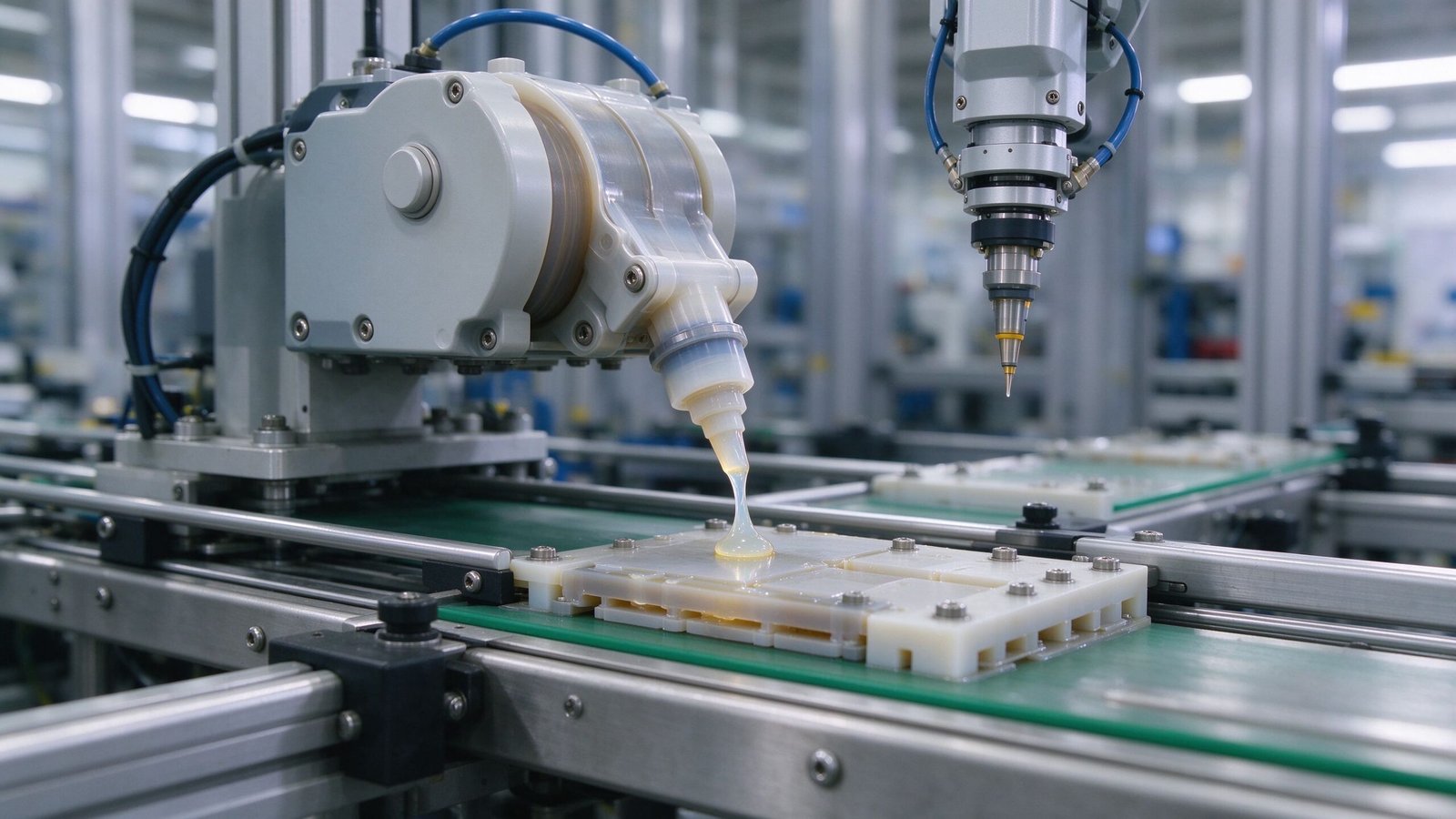
Adhesive dispensing is one of those fluid-handling jobs that looks simple and is not. The pump has to move a glue, a resin, or a sealant that may be viscous, may set fast, and must land in the right place in the right amount. Peristaltic pumps appear in adhesive dispensing because the adhesive touches only a replaceable tube, which simplifies cleaning between color or adhesive changes and keeps the adhesive out of the pump’s mechanical seals. This article explains when a peristaltic pump fits adhesive dispensing, what fluid-handling requirements drive the choice, and the design problems manufacturers should plan for.
Why Peristaltic Pumps Fit Adhesive Dispensing
Two properties make peristaltic pumps a natural fit for adhesives. First, the fluid path is the tube. If an adhesive is beginning to set, you replace the tube rather than flushing a pump body full of wetted components. Second, the pump seals by tube occlusion rather than by a mechanical valve, so there are no seals or check valves in the adhesive path to gum up. That matters for cyanoacrylate, UV-cure adhesives, and two-part materials that start reacting once mixed.
For an OEM dispensing machine, this means the maintenance procedure is a tube change, not a pump teardown. Production teams that run short jobs and change adhesives often prefer this, because the line can be reset between products without a long cleaning cycle.
Main Fluid-Handling Requirements
Adhesives differ from water-like fluids in ways that change the pump selection. Viscosity is the first: a thick adhesive resists being drawn through the tube, and the pump must generate enough suction to pull it from the reservoir. Pot life and cure speed are the second: an adhesive that cures quickly cannot sit in a long tube loop, so the fluid path should be as short as practical. The third is repeatable bead volume, because a dot of adhesive that varies by more than a small tolerance causes bonding defects downstream.
| Requirement | What it means for the pump |
|---|---|
| High viscosity | Pump must prime and pull adhesive from reservoir without air ingress. |
| Cure / pot life | Short fluid path, easy tube change between jobs. |
| Repeatable bead | Consistent per-dispense volume and stop/start response. |
| Solvent carriers | Tubing material must resist the adhesive and its solvents. |
| Cleaning between jobs | Wetted parts limited to the tube. |
Pump Selection Considerations
Selection starts with the adhesive’s viscosity and the dispense volume. A low-viscosity cyanoacrylate in small dots suits a compact, controllable pump. A thicker UV-cure resin in a broader bead may need a larger head and a slower, steadier speed. The control signal matters because dispensing machines start and stop the pump on every dot, so the pump must respond quickly and leave no drip after the signal stops.
The reservoir and feed arrangement also affects performance. If the adhesive is stored in a cartridge, the pump draws directly from the cartridge with a short tube. If it sits in a bulk tank, the pump must prime from a lower level and may need a gentle agitation to keep the adhesive uniform. Adhesives that are sensitive to light, moisture, or air should be fed from a sealed or pressurized reservoir, because letting air into the tube both dries the adhesive and introduces the bubbles that cause voids.
The tube material is critical. Adhesives and their solvents attack some elastomers, so the recommended tube should be compatible with the adhesive rather than chosen for generic chemical resistance. A compact small peristaltic pump is often used for moderate dispensing, while a dosing pump with controlled speed suits repeatable metering. The peristaltic pump tube should be specified against the adhesive’s chemistry, and the supplier should be asked which material holds up to the specific product.
| Adhesive type | Typical pump duty | Key consideration |
|---|---|---|
| Cyanoacrylate (fast-set) | Small dots, intermittent | Short path, easy tube change, no cure in line. |
| UV-cure resin | Beads of controlled width | Steady speed, light-blocked tubing. |
| Two-part epoxy | Metered mixed volumes | Metering accuracy; mixing handled downstream. |
| Hot-melt | Heated reservoir | Heated path; peristaltic less common. |
Common Design Problems
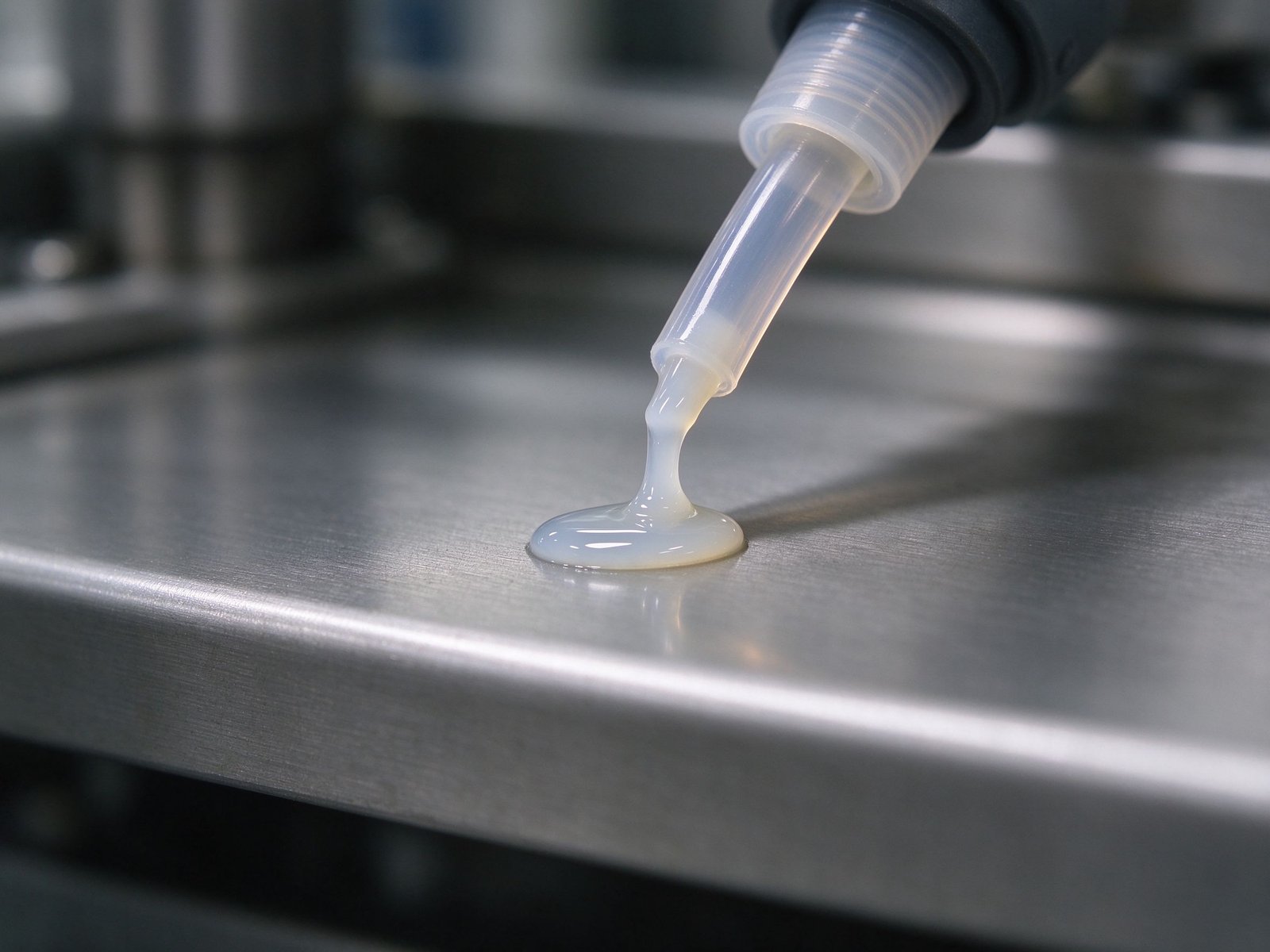
The recurring issues in adhesive dispensing are dripping, stringing, and air. Dripping happens when the tube keeps pushing fluid after the pump stops, which is solved by reversing the rollers slightly at the end of a dispense to pull the bead back. Stringing happens when a viscous adhesive draws a thin thread as the nozzle moves; the pump can help by cutting flow cleanly at stop. Air enters when the pump cannot pull the adhesive consistently, which causes intermittent dots and voids in the bond.
Blocked or swollen tubing is another failure. If the tube material is incompatible with the adhesive or its solvent, it swells, hardens, and changes flow. That is why the tube part number should be locked to the adhesive and changed on schedule rather than when it fails.
Two-part adhesives add a metering requirement. The pump usually meters one component against another, and the ratio between the two pumps must stay consistent over the life of the tubes. This is where repeatability matters more than absolute accuracy: if both pumps drift the same way, the ratio holds, but if one tube wears faster than the other, the ratio shifts and the adhesive cures incorrectly. Pairing pumps with matched tube life and a periodic ratio check protects the bond quality.
Integration Into Equipment
An OEM dispensing machine integrates the pump with the nozzle, the controller, and the reservoir. The pump should be mounted close to the nozzle to keep the fluid path short, and the controller should drive the pump for the exact duration of each dot, with a small reverse suck-back at the end. The control signal should match the machine’s PLC or motion controller; analog or pulse inputs let the dispensing program set flow per dot. Drivers that accept standard speed signals, as described in common OEM motor-driver operating manuals, simplify that integration.
Software-wise, the dispensing program should treat the pump as a metering device rather than a simple on/off pump. It records the dispense duration, the commanded speed, and the resulting volume, so that drift is visible in the data rather than discovered at the bonding station. Over time this data also tells maintenance teams when a tube is reaching the end of its life, and which adhesive formulations stress the pump most.
For quality control, every dot should be repeatable to a tolerance the bonding process can live with. Measuring dispensed mass on a balance confirms the pump is delivering the programmed volume, and a drift check flags a tube that has worn. Gravimetric measurement of this kind follows the metrology principles that NIST’s Physical Measurement Laboratory documents, where controlled setup and recorded conditions are what make the number trustworthy. Organizations such as NSF set standards for materials that contact fluids in processing and packaging, a useful reference when the adhesive or food-contact context calls for defined material safety.
Key Takeaways
- Peristaltic pumps fit adhesive dispensing because the adhesive touches only a replaceable tube, which eases cleaning and adhesive changes.
- Selection starts with adhesive viscosity, dispense volume, and the cure or pot life of the material.
- Tube material must be compatible with the adhesive and its solvents; swollen or hardened tubing causes flow drift.
- Drip and stringing are controlled with a short fluid path and a reverse suck-back at dispense stop.
- Repeatable dots are confirmed by gravimetric check, not assumed from the pump nameplate.
If you are building adhesive or coating dispensing equipment and want to discuss the fluid-handling requirements of your process, contact YOORAIN with the adhesive type, viscosity, and the dot or bead volume you need. Those details help narrow the pump head, tube material, and driver combination to a configuration that holds up in production rather than only in a demo. A short sample run with the real adhesive is the fastest way to confirm whether the chosen pump primes, doses repeatably, and cleans up between jobs.