
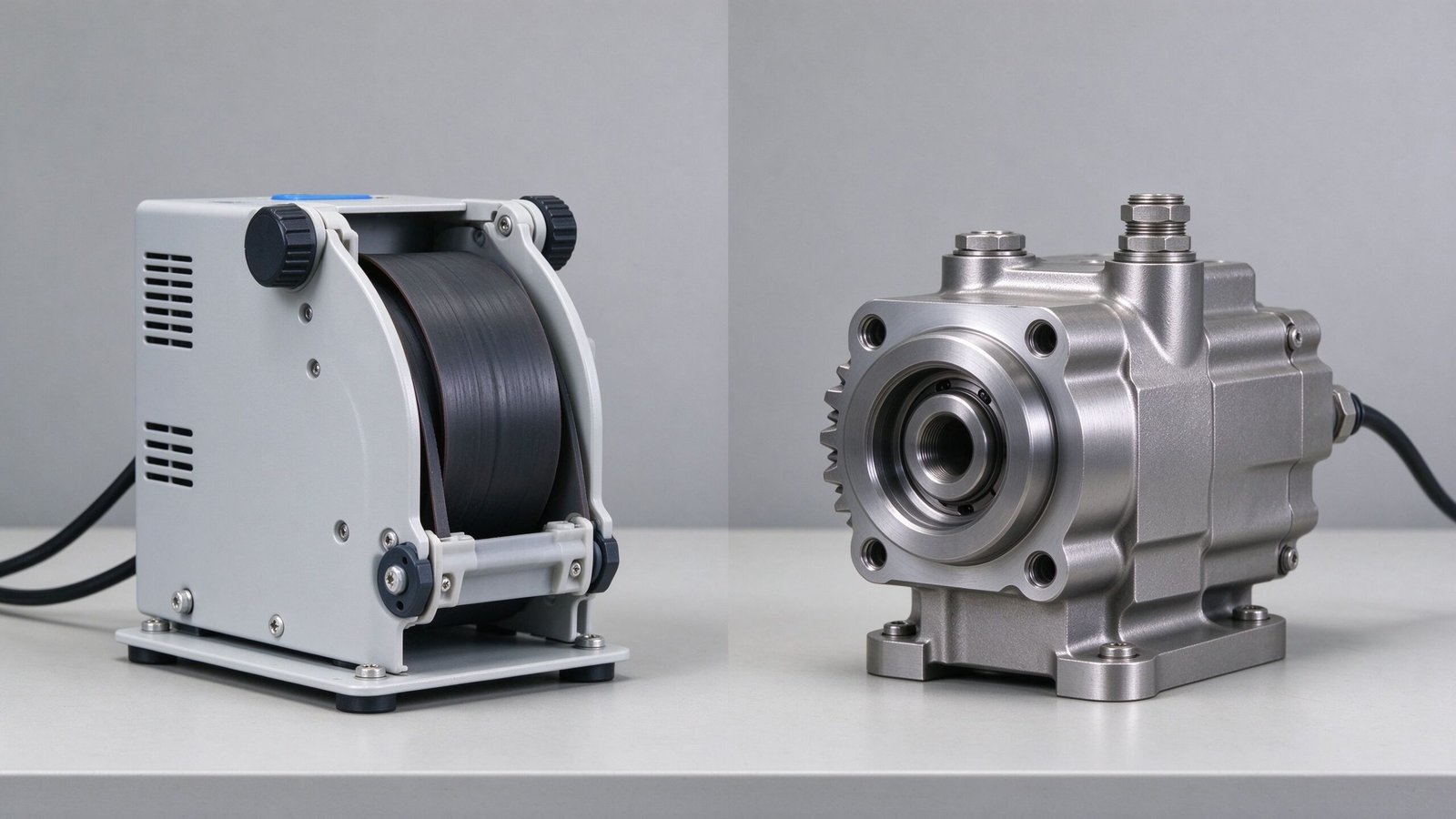
When an OEM designer needs to meter a liquid, the choice often comes down to a peristaltic pump or a gear pump. Both move fluid at a controlled rate, but they do it in fundamentally different ways, and the difference shows up in what they handle best, how they wear, and how cleanly they can be integrated into an instrument. This comparison explains the mechanical differences, where each pump type fits, and how to decide between them for a given fluid-handling job.
What Makes the Two Pumps Different
A gear pump moves fluid by meshing rotating gears that trap liquid in the gear teeth and carry it around the housing. A peristaltic pump moves fluid by rollers compressing a flexible tube, pushing a bolus ahead of the roller. The first difference is that in a gear pump the fluid contacts gears, bearings, and seals inside the housing. In a peristaltic pump the fluid contacts only the inside of the tube. That single distinction drives most of the selection logic.
| Factor | Peristaltic pump | Gear pump |
|---|---|---|
| Wetted parts | Only the tube | Gears, housing, bearings, seals |
| Self-priming | Yes, by tube compression | Often limited, may need priming |
| Fluid isolation | Fluid contained in tube | Fluid enters pump body |
| Wear item | Replaceable tube | Gears and seals in the housing |
| Shear on fluid | Low, gentle bolus | Higher, between meshing gears |
| Cleaning | Replace or flush the tube | Flush and disassemble housing |
Flow Control and Accuracy
Both pump types can be speed-controlled, but their accuracy behaves differently. A gear pump is a positive-displacement pump with tight tolerances, and per-revolution volume is fairly constant once the gears are worn in. It can deliver steady, repeatable flow, but its accuracy depends on gear clearance and on fluid viscosity, because leakage past the gears changes with viscosity and pressure.
A peristaltic pump’s per-revolution volume depends on tube recovery and occlusion, which vary with speed, tube condition, and fluid viscosity. Its repeatability is good for dosing applications but its absolute displacement changes as the tube wears, which is managed by calibration and tube replacement. Drivers for both types accept standard speed signals; peristaltic OEM drivers commonly take analog or pulse inputs as described in motor-driver operating manuals, and stepper-based control can hold a set speed on a defined analog input.
Pressure capability is a practical dividing line. Peristaltic pressure is bounded by how hard the tube can be occluded without failing, so very high-pressure discharge favors a gear pump. Where the application runs at low to moderate pressure, the peristaltic design loses little and gains the isolation and cleanability advantages that matter in instrument work.
Fluid Compatibility and Shear
This is where the two diverge most. A gear pump’s wetted gears and seals must be compatible with the fluid, and abrasive or shear-sensitive fluids can wear the gear clearance quickly. Fluids with particulates are hard on gear teeth. A peristaltic pump, by contrast, isolates the fluid in the tube, and the rollers ride outside the fluid path, so particulates and slurries do not abrade internal parts. Gentle fluids, shear-sensitive materials, and fluids with solids are handled more gently by the peristaltic approach.
The trade-off is that the tube material itself must be compatible with the fluid. The peristaltic pump tube is the wetted component, so choosing the right tube material is the compatibility step. For clean, low-viscosity oils and fuels, a gear pump can be the more compact and constant-displacement choice.
Maintenance and Wear
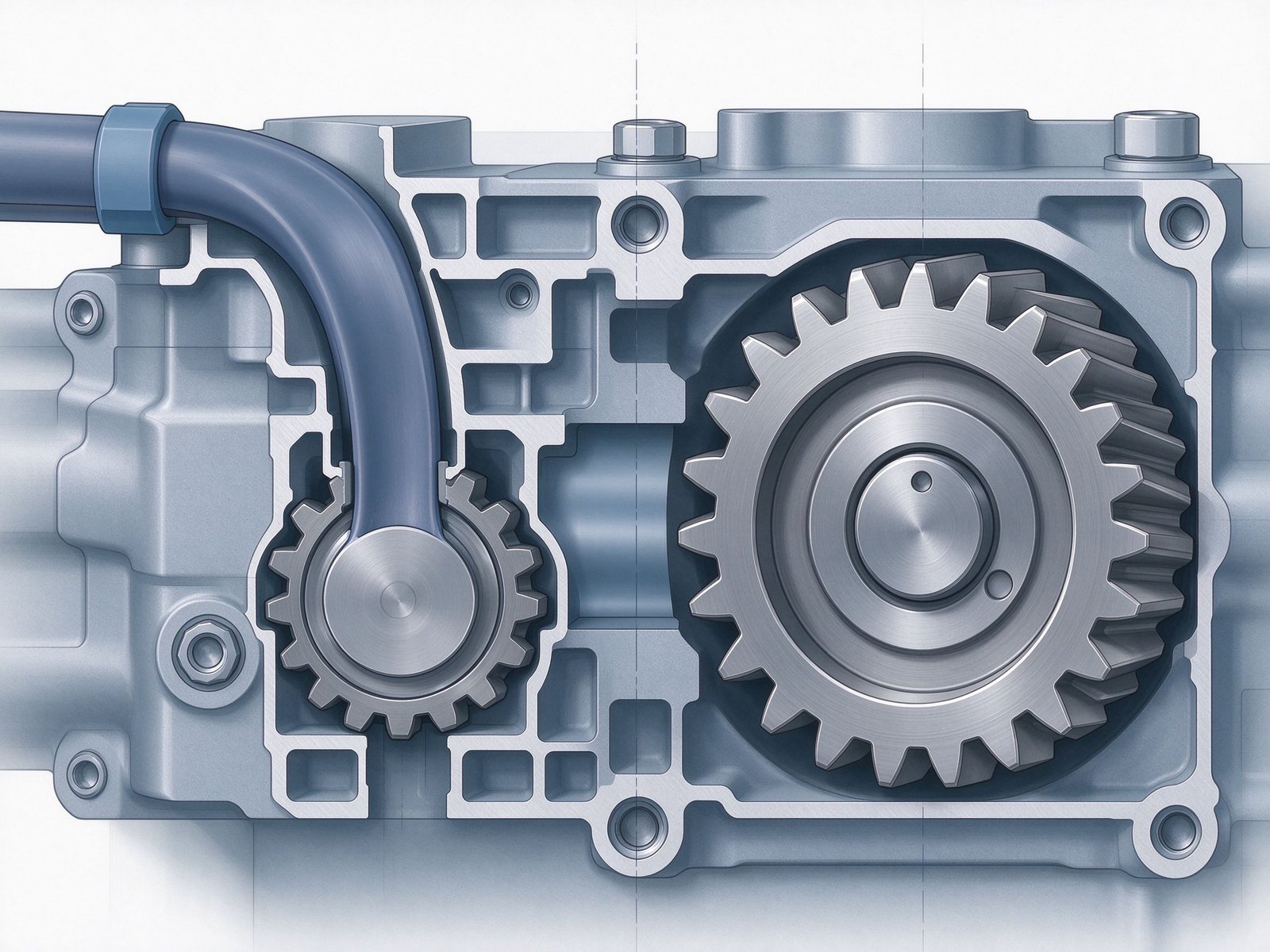
A gear pump wears internally: gear clearance and seal wear change performance over time, and fixing it means servicing the pump body. A peristaltic pump wears only the tube, which is designed to be replaced. For production environments where uptime matters, a tube change is a fast, predictable service step, whereas a gear pump overhaul is more involved. The peristaltic design also has no internal valves or seals in the fluid path to clog, which is an advantage when running fluids that could set or coat internal components.
Maintenance cost over the life of the machine often favors the peristaltic setup, even if the upfront pump price is similar. The consumable is a short length of tubing, swapped in minutes, while a gear pump’s worn gears and seals are a more involved repair. For an OEM product, this also means field service can be handled by the customer without returning the pump, because a trained operator can change a tube without special tools.
| Situation | Better choice |
|---|---|
| Fluid with particulates or slurries | Peristaltic |
| Shear-sensitive or gentle fluids | Peristaltic |
| Frequent fluid changes / cleaning | Peristaltic |
| High-pressure, clean oil metering | Gear pump |
| Compact constant-displacement oil transfer | Gear pump |
| Need fluid isolated from pump internals | Peristaltic |
For very high-pressure clean-oil applications, a gear pump often wins because peristaltic pressure is limited by tube occlusion and wall strength. But for instrument fluid handling, reagent transfer, and dosing where the fluid must stay clean and isolated, a peristaltic 12V DC peristaltic pump or a bench-top dosing unit is the more practical building block, and it integrates with the same control drivers used across the product line.
Cost and Total Ownership
The upfront price is only part of the decision. A gear pump can be compact and efficient for clean oils, but its internal wear parts and the need for compatible seals and gearing add to the cost of ownership over years of service. A peristaltic pump’s consumable is a low-cost tube, and service is a tube change rather than a pump overhaul. For an OEM product sold into the field, the peristaltic design also simplifies spare-parts inventory: the customer stocks tubing, not a rebuilt pump.
Energy efficiency is rarely the deciding factor at the small sizes these OEM pumps run at, but noise and heat can matter in a laboratory or clinical instrument. Peristaltic pump heads are quiet compared with meshing gears, and they run cooler because there is no tight gear clearance generating friction heat in the fluid path.
Which Fits the Application?
Choose a peristaltic pump when the fluid must be isolated, when it contains particulates, when it is shear-sensitive, or when cleaning and fluid changes are frequent. Choose a gear pump when the fluid is a clean lubricating liquid, when high pressure is required, and when a compact, constant-displacement oil transfer is the job. For analytical and diagnostic instruments, laboratory dosing, and process fluid handling where the fluid path must stay clean and simple, the peristaltic approach is usually the easier engineering fit; a compact mini peristaltic pump is a common building block for those instruments.
Measurement practice for confirming which pump delivers the volume the application expects follows the same metrology principles supported by NIST’s Physical Measurement Laboratory: gravimetric measurement at operating conditions, with the chosen fluid and tube, rather than relying on the nameplate displacement.
Final Selection Guide
- List the fluid: viscosity, solids, shear sensitivity, and chemical aggressiveness.
- Define the required flow range, pressure, and dispense repeatability.
- Consider how often the fluid changes and how often cleaning is needed.
- Choose peristaltic for isolation, cleanliness, and gentle handling; choose gear pump for high-pressure clean oils.
- Confirm the choice with a gravimetric test on the real fluid before production.
If you are choosing between a peristaltic and a gear pump for an instrument or process and want help deciding, contact YOORAIN with your fluid, flow range, and pressure requirement. That information helps identify which pump type and which pump head or tube configuration fits the application, rather than picking a pump on nameplate specs alone. A short sample test with the real fluid is the most reliable way to confirm the choice before committing to a production design.