
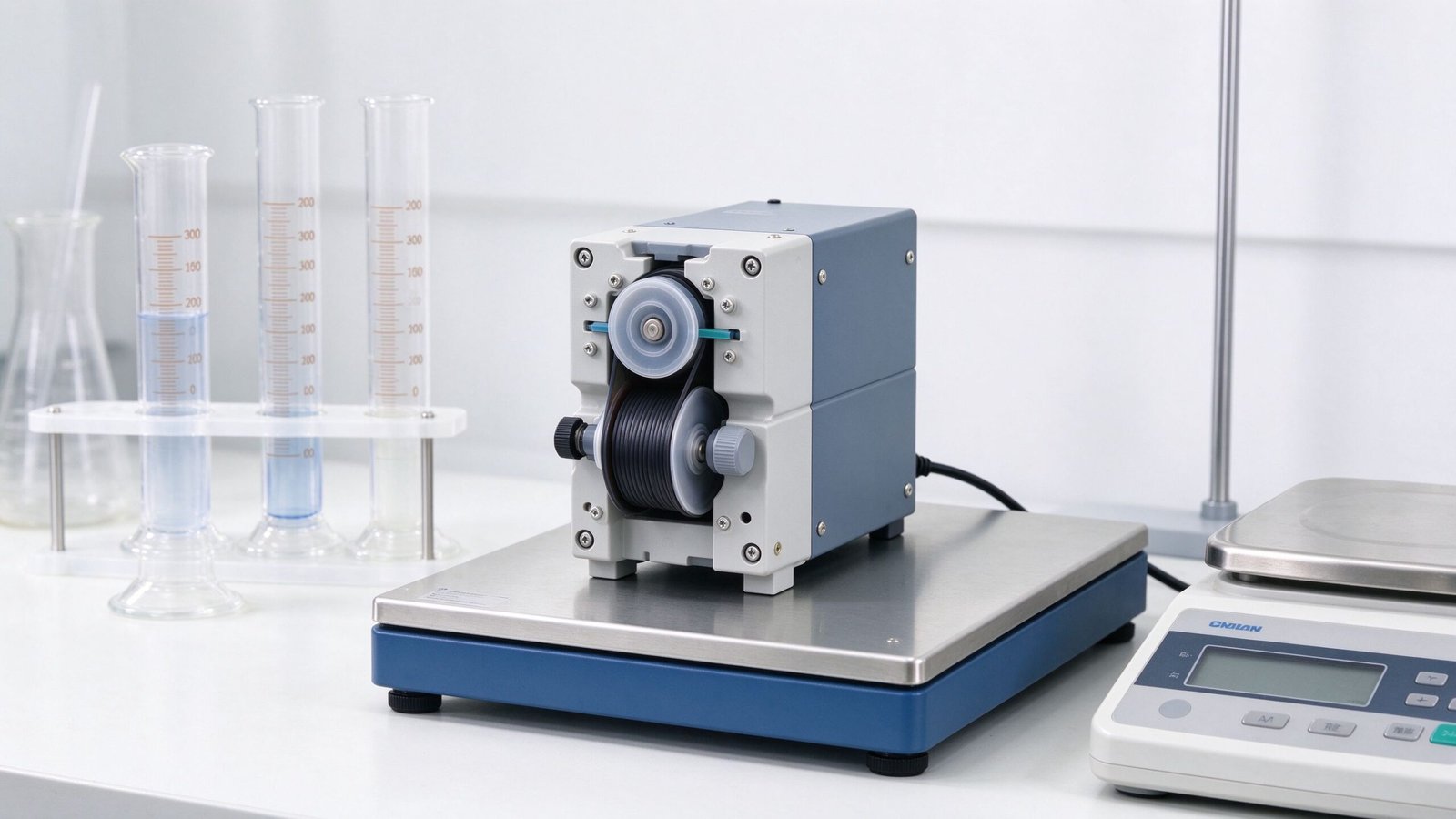
Flow accuracy is the number that decides whether a peristaltic pump earns its place inside an instrument. A pump that moves fluid is easy to source; a pump that delivers the same volume on the tenth day that it delivered on the first is an engineering problem. This reference explains what flow accuracy and repeatability actually mean for a peristaltic pump, where the error comes from, how it is measured, and what an OEM or procurement team can do to hold it over the life of the product.
What Accuracy and Repeatability Mean Here
Two terms get used interchangeably but measure different things. Accuracy is how close the delivered volume is to the target. Repeatability (precision) is how close repeated deliveries are to one another. A pump can repeat well but sit five percent off target, or it can be calibrated on target and drift between runs. For dosing instruments, repeatability usually matters more than absolute accuracy, because a known bias can be corrected in software, while run-to-run scatter cannot.
In peristaltic pumps, flow is generated by rollers compressing a flexible tube and pushing a bolus of fluid ahead. The theoretical displacement per revolution is the tube bore times the tube cross-section times the number of rollers, but the real delivered volume depends on how completely the tube recovers between compressions, how much the rollers actually occlude the tube, and how the fluid viscosity resists the bolus. That is why two pumps with the same nominal displacement can behave differently with the same fluid.
The Main Sources of Flow Error
To improve accuracy, the errors have to be separated. The dominant sources fall into a few groups.
Tube compression and occlusion. The roller must fully compress the tube to seal it, but not over-compress it. If the tube is under-occluded, fluid back-flows around the roller and reduces the delivered volume. If it is over-occluded, the tube fatigues faster and the compression force changes as the tube wears. The pump head’s occlusion adjustment is the single biggest mechanical lever on accuracy.
Tube recovery. After a roller passes, the tube must spring back to draw the next bolus. At low speeds the tube has time to recover; at high speeds it does not, and the per-revolution volume drops. This is the main reason peristaltic pumps are rated for a speed range rather than a fixed displacement.
Fluid viscosity and temperature. A thicker fluid resists being drawn through the tube and changes how the bolus forms. Temperature changes the viscosity and the tube’s stiffness, which is why a pump calibrated at 20 °C can read differently at 5 °C or 40 °C.
Voltage and load variation. On an open-loop drive, the motor slows under load or as supply voltage sags, and flow drops with it. Closed-loop speed control removes this particular error, which is why it is preferred for dosing instruments.
Wear and fatigue. As the tube fatigues, its compression characteristic changes and its walls thin. Flow drifts gradually over hours or weeks of operation. This is normal and is managed by tube replacement intervals, not by perfect design.
| Error source | Symptom | Typical fix |
|---|---|---|
| Under-occlusion | Low flow, back-flow, weak priming | Adjust head occlusion, check tube size |
| Tube recovery limit | Flow drops at high speed | Reduce speed, choose larger-bore softer tube |
| Viscosity / temperature | Flow varies with fluid or ambient temp | Calibrate at operating conditions, closed-loop control |
| Voltage / load | Flow sags during long runs | Closed-loop speed drive, regulated supply |
| Tube fatigue | Gradual drift over weeks | Define tube replacement interval |
How Flow Accuracy Is Measured
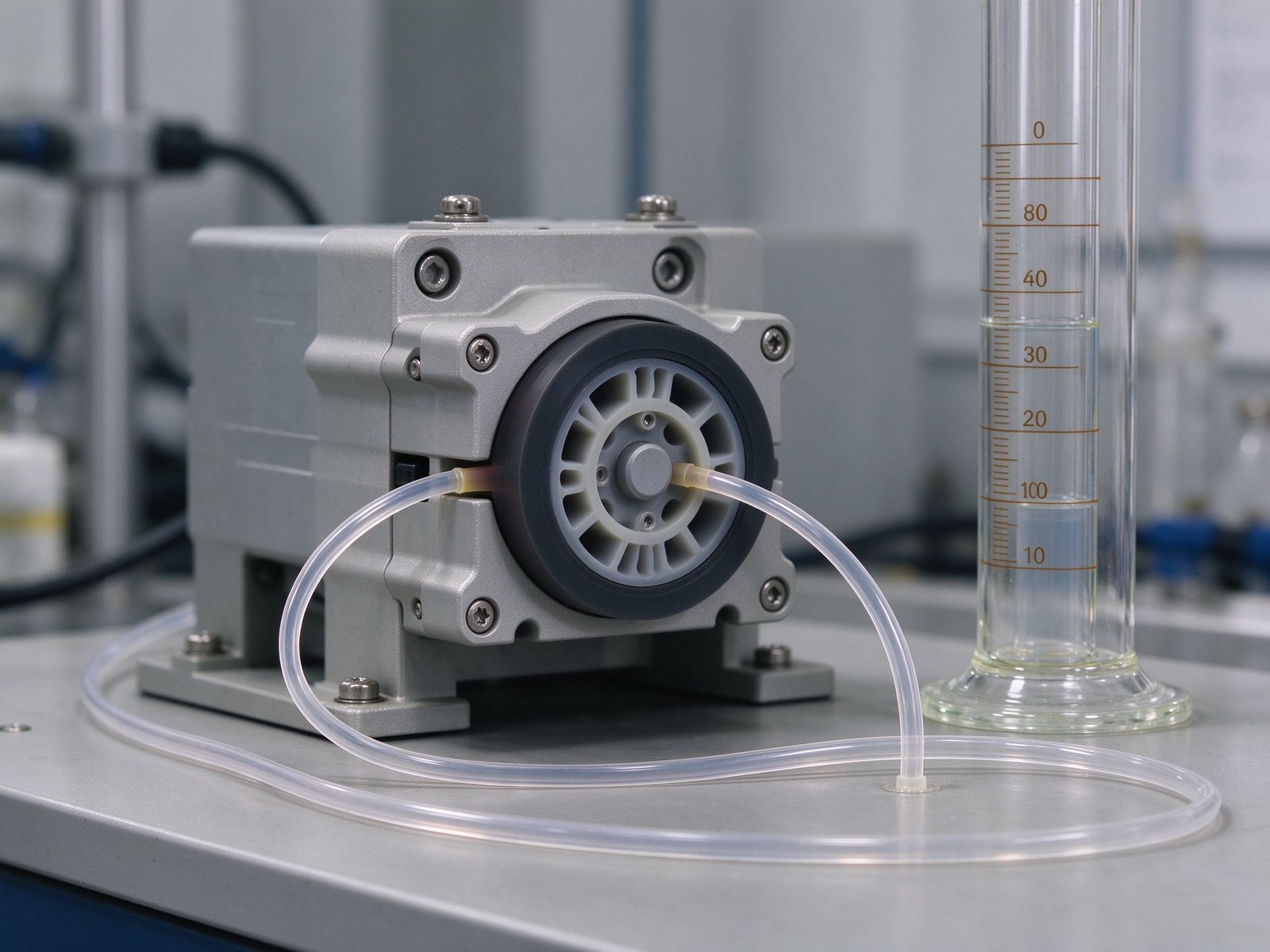
There are two practical methods, and a serious instrument uses both at different stages.
Gravimetric measurement. The pump dispenses into a tared vessel on a balance for a timed interval, and the mass is converted to volume using the fluid’s density. This is the reference method because it does not depend on a flow meter. Repeatability is measured by repeating the dispense several times and computing the spread. Measurement practice of this kind falls under the discipline of metrology that NIST’s Physical Measurement Laboratory supports, where careful setup, known density, and controlled temperature are the difference between a usable number and a misleading one.
Volumetric measurement. The fluid is drawn into a graduated cylinder or a calibrated syringe and the volume read directly. Faster than gravimetric but less precise, and sensitive to meniscus reading. It is useful on the production line but not as the calibration reference.
For both methods, run the pump for a warm-up period before measuring, because a cold tube delivers less than a warmed, cycled tube. Record the fluid, the temperature, the tube part number, the speed, and the supply voltage. Without those notes, the measurement cannot be reproduced.
Speed Control and Its Effect on Accuracy
The control scheme chosen for the pump directly sets how much of the error the instrument has to live with. An open-loop drive that applies a fixed voltage delivers whatever flow the motor and tube decide on that day. A closed-loop drive compares an encoder or Hall-sensor reading to the setpoint and corrects the motor, holding speed steady as load and voltage vary.
Compact OEM drivers commonly expose analog and pulse inputs so the instrument controller can command speed rather than voltage. Operating manuals for these drivers list selectable inputs such as 4–20 mA, 0–5 V, 0–10 V, and pulse frequency, with the mapping between signal and speed configurable over communication, as described in a motor-driver operating manual. Stepper-motor drivers can hold a commanded speed with a defined analog speed-control input, which removes the voltage-sag error that open-loop brush motors suffer.
| Control scheme | Holds speed under load? | Best when |
|---|---|---|
| Fixed voltage | No | Fixed setpoint, low accuracy need |
| Open-loop PWM / analog | Partly | Moderate accuracy, regulated supply |
| Closed-loop encoder / Hall | Yes | Dosing instruments, repeatable dispense |
| Stepper with position feedback | Yes, good at low speed | Small-volume, high-turndown dosing |
Tubing’s Role in Accuracy
The tube is the displacement element, so its properties dominate the flow characteristic. Bore sets the per-revolution volume; wall thickness sets the occlusion needed; material sets recovery, chemical compatibility, and fatigue life. A softer tube recovers faster and delivers more volume per revolution, but fatigues sooner. A harder tube lasts longer but needs a tighter occlusion and delivers less per revolution at speed.
The practical consequence is that accuracy numbers are only meaningful for a named tube part number under named conditions. Switching from one tube material to another without recalibrating moves the flow, which is why the peristaltic pump tube part should be treated as a calibrated component, not a consumable that can be swapped freely.
Common tube materials behave differently in accuracy terms. Silicone recovers quickly and is widely used, but its compression set and chemical limits vary by formulation. Fluoroelastomer and other high-performance elastomers resist aggressive chemicals but are stiffer, which changes occlusion and low-speed recovery. The table below is a general guide, not a substitute for testing with the actual fluid; always confirm compatibility and expected tube life with the supplier.
| Tube material class | Recovery / accuracy behavior | Typical use |
|---|---|---|
| Silicone | Good recovery, common baseline; varies by grade | Laboratory, water-like fluids |
| Pharma/chem-grade tubing | Consistent compression, longer life with care | Reagent and pharmaceutical transfer |
| Fluoroelastomer | Stiffer, needs correct occlusion; chemical resistant | Aggressive solvents |
| Heat-cured specialty tube | Stable wall, predictable fatigue | Dosing with known duty cycle |
Calibration Strategy
A calibration routine converts the pump’s commanded speed into a volume the instrument trusts. For OEM products, the usual approach is a two-point calibration: run a known low volume and a known high volume, fit the line between them, and store the slope and offset. This corrects the systematic bias while leaving repeatability as the residual error the hardware cannot remove.
Calibration should be done at the operating temperature and with the actual fluid, because a water calibration on a viscous reagent will not transfer. For production, a fixture that dispenses into a balance and reads the result over the serial line makes calibration a one-button step rather than a manual procedure. For field service, document a check calibration the customer can run on a known volume.
| Calibration step | What it establishes |
|---|---|
| Warm-up cycles | Tube at steady compression state |
| Low-volume gravimetric run | Offset at low flow |
| High-volume gravimetric run | Slope at high flow |
| Repeat check (3–5 runs) | Residual scatter |
| Document tube and fluid | Reproducibility |
How Wear Changes Accuracy Over Time
Peristaltic pumps wear the tube by design. Each compression cycle fatigues a small amount of the wall material, and after thousands of cycles the tube compresses more easily and delivers slightly less. This drift is gradual, not sudden, and it is why a maintenance interval exists rather than a run-to-failure policy.
A drift check on a known volume lets the system flag a tube that has reached the end of its useful life. For a dosing instrument, this is often implemented as a software warning when the measured dispense falls outside the accepted band. The motor itself is the long-lived part; the tube is the wear item. A compact micro peristaltic pump with easy tube access makes this service step quick, while a larger large-flow pump will show the same drift over a different cycle count.
Pulsation and Its Effect on Small Dispenses
Peristaltic flow is not smooth; each roller produces a pulse. In continuous transfer this is a minor ripple, but in small-volume dispensing it becomes the dominant source of error. When the commanded dispense is only a few roller-boluses long, the timing of the dispense relative to the roller position decides how much fluid actually leaves the nozzle. A dispense that starts between rollers delivers a different volume than one that starts just as a roller seals.
There are practical ways to tame this. A multi-roller head produces smaller, more frequent pulses, which averages out the ripple. A pulse damper or a small accumulator on the discharge side smooths the outlet. Slowing the pump for the dispense and using a smaller tube bore raises the number of boluses per dispense, which reduces the relative effect of any single pulse. For very small accurate dispenses, a stepper-driven head that counts steps rather than relying on continuous speed is the more controllable choice.
Back-Pressure and Suction Conditions
The pump does not deliver the same flow against every back-pressure. A long narrow discharge tube, a filter, a nozzle restriction, or a shut-off valve adds resistance, and that resistance changes the effective flow. On the suction side, a long intake line, a high lift, or a viscous fluid limits how fast the tube can refill, which throttles the pump at the low end.
For an accurate instrument, the discharge restriction should be defined and kept constant between units. A nozzle that clogs gradually raises back-pressure and silently reduces flow, which is why a pressure sensor or a periodic gravimetric check is the feedback that catches it. On the suction side, keeping the intake short, with few bends, and using a tube that does not collapse under vacuum, protects the pump from starving itself.
Motor Types and Accuracy
The motor behind the head sets what kind of speed control is realistic. A brushed DC motor is inexpensive and easy to drive, but it wears and its speed drifts with voltage and brush condition. A brushless DC motor lasts longer and runs quieter, and with a closed-loop controller it holds speed well. A stepper motor moves in defined steps and gives the best position and low-speed control, which is why small accurate dispensers often use stepper-driven heads.
| Motor type | Speed holding | Best fit |
|---|---|---|
| Brushed DC | Open-loop, drifts | Low-cost, fixed-setpoint transfer |
| Brushless DC | Good with closed loop | Long-life dosing, continuous duty |
| Stepper | Best at low speed, position control | Small-volume dispensing, repeatable dots |
The choice ties back to the control signal the instrument uses. A closed-loop brushless or stepper drive removes the speed error that an open-loop brush motor introduces, which is why accuracy-focused designs gravitate to them. The peristaltic pump driver selected should match the motor type and the feedback scheme, rather than being chosen after the motor is mounted.
Common Questions
Does a higher price mean better accuracy? Not by itself. Accuracy comes from the head, the tube, the motor control, and a defined calibration procedure. A modest pump with closed-loop control and a good tube can outperform a premium pump run open-loop.
How often should a tube be replaced? Replace it on a defined cycle based on hours or dispense count, not only when it visibly fails. A drift check on a known volume tells you when the tube has reached the end of its consistent life.
Can I switch tube brands without recalibrating? No. Different tube materials and wall thicknesses change the per-revolution volume. Treat the tube part number as part of the calibration.
Monitoring Accuracy Over the Product Life
A calibration set at installation is only a starting point. The question for a production instrument is how to know when the flow has drifted out of tolerance without stopping the line for a full recalibration. The practical answer is a lightweight in-process check: periodically dispense into a known vessel or weigh a batch, compare it to the expected volume, and flag the result when it crosses a threshold. This turns accuracy from a one-time event into a monitored parameter.
The threshold should be set from the measured repeatability. If the pump repeats to within one percent, a warning at three percent is reasonable; if it repeats to five percent, the warning band has to be wider or the control scheme improved. Setting a warning too tight causes false alarms; setting it too wide misses real drift. The band is derived from data, not from a guess.
There is also a difference between drift that the controller can compensate and drift that needs maintenance. A gradual slope change as the tube wears can be partly corrected by recalibrating the slope. A sudden jump in scatter, however, usually means a mechanical problem, an air leak, or a tube that is about to fail, and no amount of software correction fixes that. A good monitoring routine distinguishes the two: recalibrate for slow drift, stop and inspect for sudden scatter.
What to Specify When Ordering
When procuring a peristaltic pump for a dosing instrument, ask the supplier for the accuracy and repeatability numbers under defined conditions, not a single marketing figure. Specifically ask for the repeatability at the operating speed the instrument will use, with the intended tube and fluid, and ask how those numbers were measured. A supplier that can describe a gravimetric procedure is a supplier that has measured, not estimated.
- Define the minimum and maximum dispense volumes the instrument must deliver.
- Specify the repeatability target at the working speed, not at the head’s rated speed.
- Fix the tube part number and its replacement interval.
- Choose closed-loop speed control when run-to-run scatter matters.
- Plan a two-point calibration at operating temperature with the real fluid.
- Add a software drift check that flags tube wear.
If you are selecting a peristaltic pump for a dosing or analytical instrument and need help defining the accuracy and calibration approach, contact YOORAIN with your target dispense volumes, fluid, and operating speed. Those details let a supplier recommend a pump head, tube, and driver combination that can be calibrated and held over the product’s life, rather than a nominal flow figure that does not survive real use.