
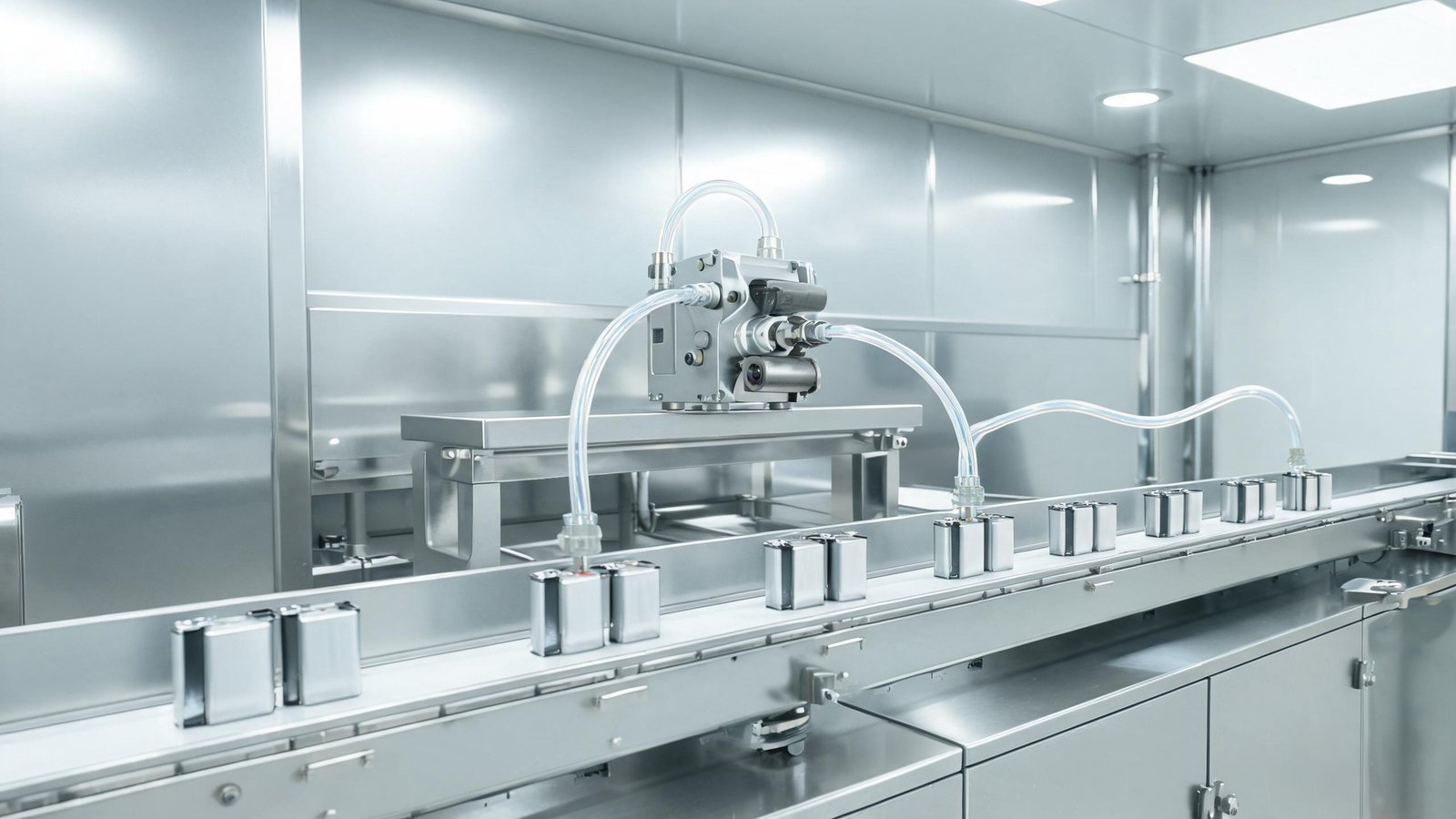
Battery manufacturers face a specific challenge during cell assembly: dispensing electrolyte into each cell with consistent volume accuracy while preventing contamination. The electrolyte — typically a lithium hexafluorophosphate (LiPF6) solution in organic carbonate solvents such as ethylene carbonate (EC), dimethyl carbonate (DMC), and ethyl methyl carbonate (EMC) — is sensitive to moisture and must not contact metal surfaces that could introduce trace ions. Peristaltic pumps offer a practical approach because the fluid path is confined to the tubing, isolating the electrolyte from pump internals.
This article covers the engineering factors that matter when selecting a peristaltic pump for battery electrolyte filling, including dosing accuracy, tubing compatibility with organic solvents, and integration into automated filling equipment. The U.S. Department of Energy has committed significant funding to expand domestic battery manufacturing capacity, making process equipment selection increasingly relevant for new production lines.
What the Application Requires
Lithium-ion battery manufacturing involves multiple fluid-handling steps, but electrolyte filling is among the most precision-critical. The process typically follows vacuum baking of the cell, followed by vacuum-assisted injection of a measured electrolyte volume. Fill quantity must be consistent cell-to-cell because underfilling reduces capacity and cycle life, while overfilling can create safety risks during formation and aging.
Several application requirements shape pump selection:
Contamination isolation. Electrolyte must not contact stainless steel, aluminum, or other metals that could dissolve and introduce trace metal ions into the cell. Even parts-per-billion levels of certain metal contaminants can accelerate degradation. Peristaltic pumps address this by confining the fluid to the tubing interior — the rotor, housing, and motor never touch the electrolyte.
Dosing precision. Commercial electrolyte injection systems typically specify fill accuracy in the range of ±0.5% of target volume. Reaching this level depends on pump speed stability, tubing condition, and calibration protocol. Safety standards such as IEC 60086-4:2025 for lithium battery safety define test criteria that are indirectly affected by fill consistency.
Moisture control. Electrolyte handling occurs in dry rooms or glove boxes with dew points below −40°C. Pump components must tolerate this environment without outgassing or mechanical issues.
Chemical compatibility. Organic carbonate solvents used in electrolyte formulations can swell, soften, or degrade tubing materials that are not specifically rated for these chemicals. Tubing selection is a primary engineering decision, not an afterthought.
Key Pump Selection Factors
Selecting a peristaltic pump for electrolyte filling requires evaluating several interdependent factors.
| Selection Factor | What to Evaluate | Why It Matters for Electrolyte Filling |
|---|---|---|
| Dosing accuracy | Stepper or encoded motor, speed stability | Determines fill volume consistency across cells |
| Tubing compatibility | Material rating for EC, DMC, EMC, DEC | Prevents swelling, leaching, and contamination |
| Flow rate range | Required fill volume per cell, cycle time | Sets throughput for the filling station |
| Tubing life | Expected replacement interval | Affects maintenance scheduling and operating cost |
| Motor control interface | Analog, PWM, RS485, or fieldbus | Determines integration with filling controller |
| Mounting envelope | Space inside filling equipment or glove box | Constrains pump size and configuration |
A K15 micro peristaltic pump or similarly compact unit may fit small-cell filling stations where space is limited, while a K25 small peristaltic pump provides additional flow capacity for larger prismatic or pouch cells. The key is matching the pump’s flow range to the cell format and required cycle time.
Motor type directly affects dosing precision. Stepper motors provide precise rotational control, allowing the controller to dispense a specific number of shaft revolutions — and therefore a specific volume — per fill cycle. Brush DC motors are simpler and less expensive but require external speed feedback for volumetric accuracy. For battery filling, where each cell receives a measured dose, stepper-driven pumps are generally the better match.
Flow and Pressure Considerations
Electrolyte fill volumes vary by cell format. Small cylindrical cells (e.g., 18650, 21700) may require 3–5 mL per cell, while large prismatic cells for energy storage can require several hundred milliliters. This range affects both pump sizing and tubing inner diameter selection.
For small-volume cells, the pump must deliver consistent micro-doses without drift. A flow rate selection guide can help engineers calculate the required RPM and tubing ID for a target fill volume and cycle time. Lower flow rates with smaller-ID tubing generally produce better dosing resolution, but extend cycle time.
Vacuum-assisted filling introduces a specific pressure consideration. The pump must overcome the vacuum differential to deliver electrolyte into the evacuated cell. While peristaltic pumps are not high-pressure devices, the modest pressure requirement of vacuum-assisted injection (typically a few psi above ambient) is well within their operating range. The more important consideration is suction lift — the pump must reliably draw electrolyte from a reservoir into the tubing without cavitation or air entrainment.
Flow consistency over time depends on tubing condition. As tubing wears from repeated compression, the effective flow rate per revolution can drift. Gravimetric calibration — weighing the dispensed volume on a precision balance — at regular intervals helps detect and correct this drift. The NIST Fluid Metrology Group maintains national standards for liquid flow measurement, providing a reference framework for calibration methodology.
Tubing and Fluid Compatibility
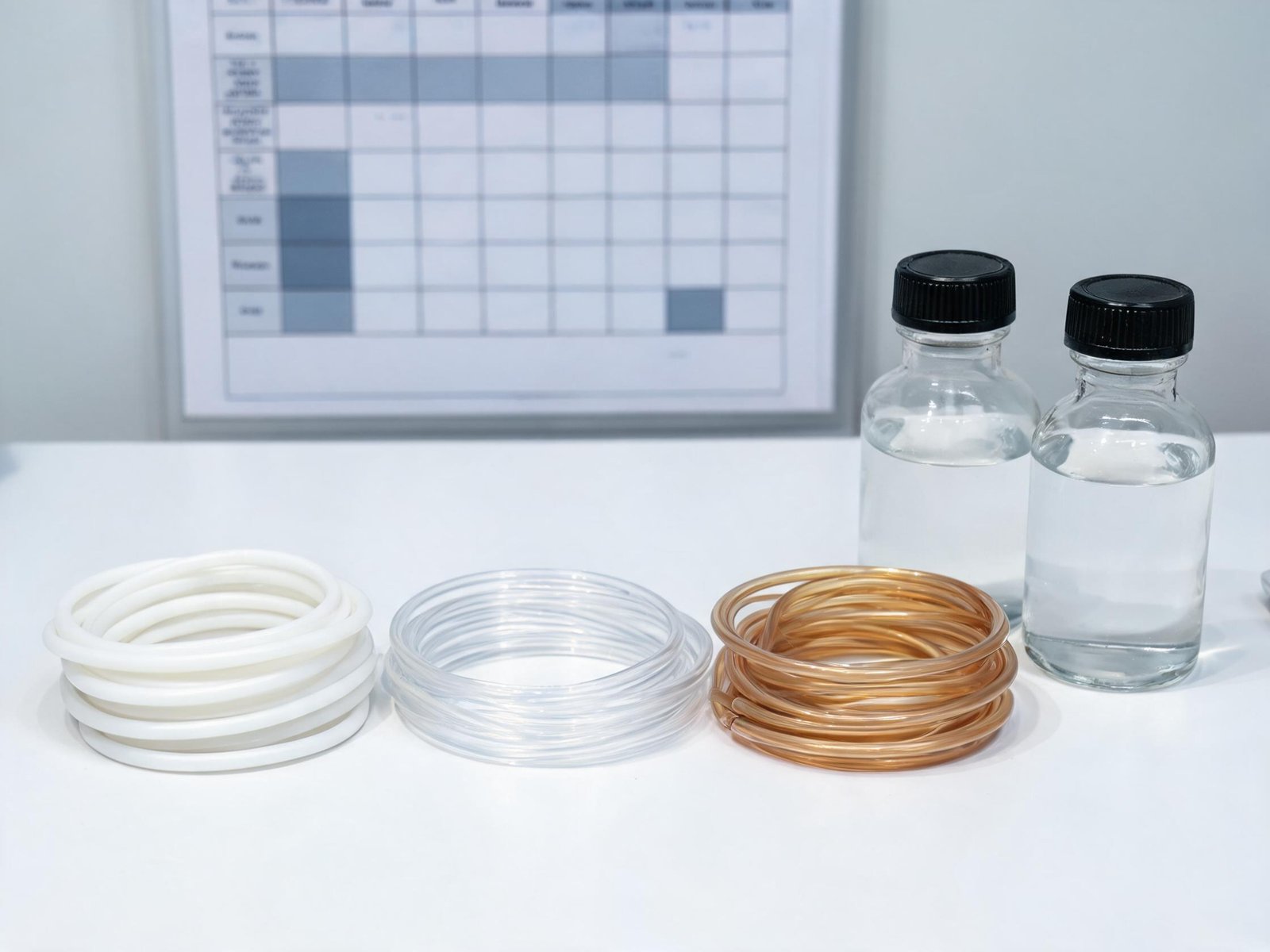
Tubing selection is arguably the most critical engineering decision for electrolyte filling applications. The tubing must maintain dimensional stability and mechanical integrity in contact with organic carbonate solvents.
| Tubing Material | Compatibility with Carbonate Solvents | Notes |
|---|---|---|
| Silicone | Moderate — may swell with prolonged exposure | Low cost, good elasticity, monitor for softening |
| Fluoropolymer (PTFE/FEP) | Good — broad chemical resistance | Stiffer, may require thicker wall for proper occlusion |
| PharMed / Viton | Good — designed for aggressive solvents | Higher cost, longer service life in solvent service |
| Norprene | Limited — not recommended for organic solvents | Better suited for aqueous fluids |
The specific electrolyte formulation, solvent ratio, and concentration of LiPF6 salt all affect tubing behavior. Engineers should request chemical compatibility data from the tubing manufacturer and validate with immersion testing under actual operating conditions.
YOORAIN offers peristaltic pump tubing in multiple materials, and selecting the appropriate formulation for electrolyte service is a decision that should involve both the pump supplier and the battery engineering team.
Tubing wall thickness also affects performance. Thicker-walled tubing (e.g., 2.4 mm or 3.2 mm wall) provides better occlusion and longer life but requires a pump head designed for that wall dimension. Thinner-walled tubing offers more flexibility but has a shorter service interval. The relationship between wall thickness, occlusion, and flow accuracy is covered in more detail in YOORAIN’s technical resources.
Integration Considerations
Integrating a peristaltic pump into an electrolyte filling system involves mechanical, electrical, and process considerations.
Mechanical mounting. The pump must be securely mounted within the filling station, typically inside or adjacent to a dry-room enclosure. A pump with integrated housing simplifies mounting and provides protection for the motor and drive electronics in the controlled-atmosphere environment.
Electrical interface. The filling controller must communicate with the pump motor driver. Common interfaces include:
- Step/direction signals for stepper-driven pumps
- Analog voltage (0–5V or 0–10V) for speed control
- RS485 with MODBUS protocol for digital command and status feedback
The control interface determines whether the pump can report fault conditions, accept volume-based dosing commands, and synchronize with the filling station’s vacuum and weighing systems. For energy storage applications, IEC 62933-5-2:2025 safety requirements for electrochemical energy storage systems define system-level safety provisions that may influence equipment integration requirements.
Tubing replacement access. Electrolyte service tubing requires periodic replacement. The pump should be mounted so that tubing can be changed without disassembling the filling station. Quick-release pump heads or front-loading designs reduce maintenance downtime.
Environmental compatibility. Dry-room operation at dew points below −40°C places thermal and material demands on pump components. Plastic parts, cable insulation, and lubricants must be rated for low-humidity, low-temperature service.
Buyer Checklist
Before ordering a peristaltic pump for battery electrolyte filling, confirm the following:
- Required fill volume per cell and acceptable tolerance
- Cell formats (cylindrical, prismatic, pouch) and their respective fill volumes
- Electrolyte solvent formulation (EC/DMC/EMC/DEC ratios)
- Tubing material compatibility data from the tubing manufacturer
- Required dosing accuracy (target ±0.5% or better)
- Flow rate range matching the smallest and largest cell volumes
- Motor type and control interface compatible with filling controller
- Physical envelope inside the filling station or dry room
- Tubing replacement interval and maintenance access
- Operating environment (dew point, temperature, atmospheric pressure)
- Calibration method and frequency (gravimetric recommended)
- Supplier’s experience with battery manufacturing applications
For OEM projects, providing the required fill range, electrolyte formulation, cycle time, and integration constraints can help suppliers recommend a suitable pump configuration. YOORAIN can discuss these requirements and provide tubing compatibility guidance for specific electrolyte formulations.